
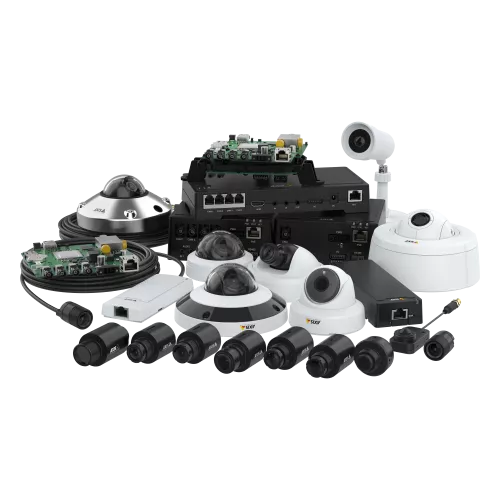
A Camera Architecture Built Around Placement Flexibility
Axis modular cameras are designed for projects where the viewing point and the processing hardware do not have to occupy the same physical location. The sensor contains the image sensor and lens, a compatible cable carries the connection, and the main unit handles image processing and network communication. That separation changes how a security designer can approach difficult spaces.
In a conventional fixed camera, the lens, electronics, housing, network interface, and often infrared components are integrated into one body. That is convenient for many standard installations, but it can become restrictive when the camera must sit behind a panel, inside an ATM, near a point-of-sale counter, inside a vehicle, within machinery, or at eye level without exposing a full camera enclosure. A modular design allows the sensor to remain small while the main unit is installed in another protected position.
The current Axis portfolio gives buyers several paths. AXIS F Modular Camera Series is the broadest high-performance family, with current main units and sensor choices for indoor, outdoor, onboard, and high-vibration use. Selected F combinations support image quality up to 4K, edge analytics using a deep learning processing unit, one- or four-channel main units, and sensor cables up to 30 metres depending on the selected components. AXIS FA Series focuses on discreet indoor surveillance and public-view monitoring, with single- and multi-channel main units, 1080p video, Forensic WDR, HDMI on relevant main units, configurable I/O, and the ability to monitor several closely located areas. AXIS P12 Mk II cameras are complete compact modular products for indoor use, providing 1080p video, detachable sensor cables, and support for advanced analytics.
For a UAE buyer, the key decision is not simply “which camera has the highest resolution?” The better question is which combination fits the scene, installation space, environmental exposure, desired field of view, analytics requirement, cable route, recording platform, and future maintenance plan. FourTeck can help translate those site requirements into a compatible component list and a practical quote rather than treating every modular camera as an interchangeable part.
Why Businesses Choose Modular Surveillance
The main advantage is design freedom: the system can prioritize the best camera viewpoint without forcing the full electronics package into the same visible space.
Put the lens where the evidence is strongest
A compact sensor can be mounted where a standard camera body would be visually intrusive or physically impractical. This matters at customer counters, teller areas, narrow corridors, kiosks, ticketing machines, vehicle interiors, production equipment, and premium interiors. The result is not merely a cleaner installation. Better lens placement can improve the usefulness of the recorded scene by positioning the sensor closer to the actual activity that matters.
Cover several nearby views efficiently
Selected multi-channel main units can connect several compatible sensors. For projects with multiple nearby viewpoints, this can reduce the number of network endpoints and switch ports compared with installing a separate full camera for every view. Licensing impact depends on the chosen video management platform, so buyers should confirm the VMS rules before finalizing the design.
Use processing close to the camera
Current F main units and P12 Mk II models support advanced edge analytics, while F-series deep learning processing can power functions such as AXIS Object Analytics and metadata generation. This can make video more actionable for alerting, search, counting, or operational review when the selected model and scene support the required analytic.
Choose hardware for the installation environment
The F family includes rugged sensor and main-unit options designed for more demanding placements such as vehicles, machinery, outdoor locations, or vibration-prone areas. Indoor-only products remain available when environmental protection is unnecessary. Matching the rating and connector type to the environment prevents a discreet design from becoming an unreliable one.
Replace or upgrade parts selectively
Because the architecture is component-based, a future project change may be addressed by reviewing a sensor, cable, mount, or main unit rather than replacing an entire installation. Compatibility must still be checked carefully, especially across product generations, but modularity can give maintenance teams more options than a fixed all-in-one design.
Plan storage, network, and software together
Resolution, frame rate, analytics, number of channels, retention time, compression, and recording rules all affect the wider surveillance design. FourTeck can review PoE switching, VMS or recorder compatibility, storage planning, mounting accessories, and network architecture so the camera components are selected as part of a complete system.
Three Families, Different Procurement Paths
The buyer should begin with deployment type, not with a part number. Axis uses the modular concept across families that solve different installation problems. The correct family determines the level of ruggedness, analytics, sensor choice, channel count, and whether the camera is purchased as separate components or as a complete modular unit.
AXIS F is the most flexible choice when the project needs advanced processing, several sensor styles, multi-channel main units, rugged options, high-vibration support, or current sensor choices up to 4K. AXIS FA is well suited to cost-conscious discreet indoor applications where 1080p video, Forensic WDR, HDMI or public-view monitoring, I/O, and several closely situated sensor points may be required. AXIS P12 Mk II is a straightforward path when the buyer wants a complete compact indoor modular camera with sensor, cable, and main unit designed as one product.
Axis Modular Camera Solution Specification Guide
Specifications are configuration dependent because this page covers the modular solution family. Final performance is determined by the selected main unit, sensor, cable, accessories, and software environment. The table summarizes verified family-level capabilities and highlights where a buyer must confirm the exact model.
| Area | Verified family guidance | Buyer note |
|---|---|---|
| Brand | Axis Communications | Confirm exact orderable part number |
| Product class | Modular network camera system | Sensor and main unit can be physically separated |
| Current families | AXIS F, AXIS FA, AXIS P12 | Choose family before individual parts |
| Architecture | Sensor unit, connecting cable, main unit | P12 products are sold as complete modular camera combinations |
| Video resolution | Up to 4K on selected F combinations; 1080p on current P12 and FA families | Sensor and main-unit pairing controls the final result |
| Channel options | Single and multi-channel main units available by family | Selected F main units support 1 or 4 channels; FA also offers single and multi-channel choices |
| Sensor formats | Standard, pinhole, dome, varifocal, fisheye, rugged, IR and thermal options across selected products | Not every sensor works with every main unit |
| Cable distance | Up to 30 m on selected F sensors; up to 15 m on P12 Mk II with suitable cable | Confirm exact cable type and supported length |
| Analytics | Advanced analytics supported on current families; selected F and P12 products include deep-learning capability and AXIS Object Analytics | Verify analytic compatibility for the exact scene and model |
| Image enhancement | WDR or Forensic WDR on relevant combinations | Low-light capability varies by sensor and main unit |
| Environment | Indoor, outdoor, onboard and high-vibration options depending on model | Check IP rating, impact rating, temperature and connector type |
| Power and network | Configuration dependent | Confirm PoE class, DC input needs and switch capacity for selected main unit |
| Recording platform | Compatible Axis and third-party VMS options vary by model and system design | Check licensing, stream count and retention requirements |
| Warranty | Based on selected model and applicable manufacturer terms | Ask FourTeck to confirm current warranty conditions |
| Availability | Contact FourTeck for current options | Component supply can differ by series, part number and quantity |
When comparing specifications, avoid selecting the sensor and main unit in isolation. The main unit may support a higher processing level than a particular sensor can provide, while a high-resolution sensor still depends on a compatible main unit to deliver its intended output. Cable type and distance can also be part of the compatibility chain. Buyers should therefore confirm the exact sensor part number, main-unit part number, cable, mount, power method, VMS, and environmental requirement together. For multi-channel projects, also check whether every planned view needs the same resolution or sensor style, and how the video management software licenses the channels. FourTeck can review these details before a quote is finalized.
How to Choose the Correct Modular Camera Configuration
Start with the scene and installation constraints, then select the camera family. The highest-risk mistake is buying a sensor because its size or resolution looks suitable and only later discovering that the main unit, cable, environment, or software requirement does not match.
What must the camera actually see?
Define whether the purpose is overview, face-level identification, counter monitoring, machine observation, fisheye coverage, discreet pinhole monitoring, or thermal measurement. The viewing distance, field of view, lighting, and expected detail should drive sensor choice.
Indoor, outdoor, vehicle, or machinery?
A compact indoor sensor should not be substituted for a rugged option in a high-vibration or exposed environment. Confirm operating temperature, protection rating, vibration needs, connector type, and mounting method before choosing the physical components.
One sensor or several nearby views?
For a single discreet point, a one-channel design or a complete P12 camera may be simplest. For several closely located views, a compatible multi-channel main unit can be more efficient, but network, recording, and VMS licensing should be checked before assuming a lower total cost.
How far is the sensor from the main unit?
Measure the real routed distance rather than the straight-line distance. Ceiling voids, service loops, cabinet placement, vehicle routing, and maintenance access can add length. Use the Axis cable type and length supported by the selected combination.
Which events must the system understand?
If the project needs object classification, counting, metadata, or advanced edge applications, choose a current main unit or complete camera with the required processing capability. Confirm that the selected analytic supports the scene, object type, camera angle, and operating conditions.
Prepare a useful quote request
Share the location type, number of sensor points, indoor or outdoor exposure, required resolution, mounting constraints, cable distance, analytics requirement, recording platform, desired retention, quantity, delivery location, and target project date. FourTeck can then review a suitable component combination.
Where Modular Cameras Solve Practical Surveillance Problems
Modular cameras are strongest when a normal camera body creates a placement problem. The use case should justify the extra component planning; otherwise, a conventional dome, bullet, or box camera may be simpler.
Retail counters, banking areas, receptions, and customer-facing zones
A small sensor can be positioned at a useful angle without placing a full-size housing in the customer’s immediate view. In retail, this can support close observation of checkout areas, service counters, self-service stations, or displays while preserving a clean interior. In banking or reception environments, a discreet lens can be placed at a height that helps capture a more useful facial perspective than a high ceiling camera alone. The final design should still respect privacy rules, local requirements, and the organization’s internal surveillance policy.
ATMs, kiosks, and self-service machines
Barebone or compact main units and very small sensors can be integrated into equipment where external camera space is limited. Buyers should confirm sensor opening dimensions, service access, cable routing, power, heat, and compatibility with the machine design before ordering.
Vehicle and onboard surveillance
Selected rugged F components are designed for onboard and high-vibration environments. This can suit buses, emergency vehicles, and specialized transport applications where the sensor must be compact and the main unit needs a protected mounting point. Vehicle power behavior and ignition-control requirements should be reviewed with the exact main unit.
Manufacturing and process observation
A separated sensor can be placed close to machinery or a process while the main unit remains somewhere more accessible. Selected F-series main units support high frame-rate modes and analytics, which can help when observing fast movement. Protection, vibration, contamination, heat, and lens-cleaning access remain key design questions.
Multi-view indoor areas
A four-channel configuration can be useful when several compact viewpoints are close enough to share one main unit, such as a group of counters, neighboring entrances, or a set of machine positions. The project should compare cable routing and VMS licensing against installing independent cameras.
Premium interiors and space-constrained offices
Some offices, hospitality spaces, showrooms, or high-design interiors require surveillance without a prominent camera body. Compact P12 or other suitable modular sensors can help maintain the visual design while still providing network video, as long as the project has a sensible place for the main unit and cable route.
Axis Modular Camera Solutions + Discreet Sensor Architecture
The divided-camera concept gives the installer freedom to separate the viewpoint from the processing hardware. This is the defining difference between a modular camera and a conventional all-in-one network camera.
The sensor can be very small because it does not need to contain the complete network and processing platform. Depending on the selected series, it may be a standard sensor, pinhole sensor, dome, varifocal unit, fisheye unit, rugged sensor, IR-equipped sensor, or another purpose-built format. The cable carries the connection back to the main unit, which can be installed in a more protected or serviceable location. This arrangement is especially useful when the lens must be placed at eye level, recessed into a panel, hidden in a machine, fitted inside a vehicle, or positioned where there is not enough room for a full camera body.
Buyer outcomes
- More flexibility to choose a useful viewing angle.
- Cleaner installations in customer-facing or design-sensitive spaces.
- Potential to place main electronics where service access is easier.
- Ability to choose sensor form factors for very different physical environments.
- Better fit for embedded use inside kiosks, ATMs, machines, and vehicle interiors.
Axis Modular Camera Solutions + Image Quality and Edge Intelligence
Current modular families are not limited to simple covert video. Selected F-series sensor and main-unit combinations support up to 4K, while current P12 Mk II cameras provide 1080p with deep-learning capability and AXIS Object Analytics. FA systems provide full-frame-rate 1080p, Forensic WDR, and support for analytics in a discreet indoor architecture.
The buying decision should connect image quality to the actual task. A 4K option can be valuable when the camera must preserve more detail across a wide scene, but it may also increase storage and bandwidth requirements. High-frame-rate modes can matter in fast-moving industrial processes, yet may not be necessary for a quiet office counter. Analytics can improve alerting and search, but only when the camera angle, object size, lighting, scene behavior, and selected application support the intended rule. FourTeck can help review these tradeoffs rather than treating every feature as mandatory.
Axis Modular Camera Solutions + Scalable Multi-Sensor Design
Multi-channel modular systems can simplify projects that need several nearby viewpoints, but the savings depend on the complete architecture. Selected Axis main units support up to four sensor channels, allowing several compact sensors to share one processing and network endpoint.
Axis notes that a four-channel F design can reduce network-switch port needs and, with some video management systems, may require one license rather than four. That can be valuable in retail counters, vehicle interiors, machinery lines, or clusters of closely situated indoor areas. However, licensing rules are set by the selected VMS, and cable routing can become more complex when sensors are far apart. A buyer should compare the total installed design, not only the camera hardware count.
Confirm whether all sensor points belong close enough to the same main-unit location and whether the cable paths are practical.
Do not assume one license always covers all channels. Verify the exact video management software and licensing model.
The main unit should remain accessible for network, storage, power, diagnostics, and future component replacement.
A modular design can make component-level changes easier, but new-generation parts still require a formal compatibility check before reuse.
What Buyers Should Check Before Purchase
The biggest purchase risk is treating “modular camera” as one standard specification. Sensor type, main-unit generation, cable, environmental rating, channel count, analytics, and mounting accessories can change the result significantly, so the quote should be based on a defined surveillance task.
Configuration Fit
Confirm the required number of views, resolution, field of view, frame rate, sensor form factor, lighting, and analytics. A high-performance main unit does not automatically make every connected sensor a high-resolution camera. Choose the combination as one engineered system.
Compatibility Check
Check the official compatibility between the selected sensor and main unit, then confirm cable type, maximum supported length, mount, PoE or DC requirement, network switch capacity, recording platform, and software version. For replacement projects, do not assume an older sensor works with a current main unit.
Availability and Warranty
Component availability can vary by part number and quantity, especially when a project needs several matching sensors, long cables, rugged accessories, or specific main units. Warranty terms should be confirmed for the selected Axis products rather than assumed from another model in the family.
Quote Preparation
Share the floor plan or installation concept, sensor count, scene purpose, environment, cable distance, required retention, VMS, network details, accessories, quantity, delivery location, and target deployment date. This gives FourTeck enough context to recommend a usable combination instead of quoting disconnected parts.
Common questions to answer before you request a quote
Is the camera for a counter, machine, vehicle, ceiling, wall panel, or outdoor position? Does the lens need to be almost invisible, or is a small dome acceptable? Is the goal a wide overview or detailed evidence at a known point? How many sensor locations are close enough to share a main unit? What is the longest routed cable distance? Will the project use AXIS Camera Station Pro or another VMS? Are object analytics required? How many days of video must be stored?
These questions also help reveal when a modular camera may not be the best choice. If the project has plenty of space, standard mounting, no need for a separated sensor, and each view is far from the next, a conventional network camera may be simpler. FourTeck can review both options and help the buyer avoid paying for modular flexibility that the site does not need.
Plan the Components, Then Confirm Current Supply
FourTeck supports Axis modular-camera inquiries across Dubai and the UAE with product selection, configuration review, quote preparation, delivery coordination, and warranty guidance. Availability can change by series, individual part number, sensor type, cable, mounting accessory, order quantity, and supplier position. For that reason, a project should be quoted as a complete component set rather than assuming that every item in a desired combination is immediately available.
Review F, FA, or P12 against the intended scene, sensor form factor, analytics, channel count, environmental conditions, and recording platform.
FourTeck can coordinate quotation and delivery planning after the required part numbers, quantity, and destination are confirmed.
Warranty treatment can depend on the exact Axis model and applicable manufacturer terms. Confirm the conditions for the quoted products before purchase.
Dubai, Abu Dhabi, Sharjah, and Ajman Project Support
Businesses in Dubai, Abu Dhabi, Sharjah, and Ajman can contact FourTeck for modular camera selection, compatible component planning, quotation support, and delivery coordination. A retail rollout may need several discreet counter sensors; a transport requirement may need rugged F-series hardware; an office or banking project may prioritize a small indoor sensor and a clean concealed cable path. The correct list can therefore differ significantly even when every project starts with the same broad request for an Axis modular camera.
For multi-site deployments, buyers should consider whether they want a standardized sensor and main-unit combination across locations or whether each site needs a different camera type. Standardization can simplify spares, configuration, training, and support, while site-specific selection can improve scene fit. FourTeck can help review those tradeoffs and create a cleaner bill of materials for procurement.
GCC and Africa Availability Planning
FourTeck also supports business technology inquiries across selected GCC and Africa markets through its regional platforms and project channels. Requirements may come from organizations in Saudi Arabia, Qatar, Oman, Kuwait, Bahrain, Kenya, Uganda, or other locations that need discreet IP surveillance, rugged vehicle cameras, embedded sensors, or multi-view modular systems. Product availability, delivery routing, warranty handling, documentation, and accessory supply can differ by country and by the specific Axis part numbers requested.
Regional projects benefit from a clear technical bill of materials before commercial discussions begin. The buyer should identify the exact sensor count, main units, cables, mounts, network equipment, recording software, storage needs, and expected deployment schedule. This reduces the risk of shipping the main camera components while leaving a project blocked by an overlooked cable or mount. For regional assistance, buyers can use the FourTeck UAE platform, Kenya project channel, Uganda project channel, or Africa solutions desk as relevant.
Other Surveillance Options Buyers May Consider
A modular design is one way to solve camera-placement challenges, not the only one. Buyers should compare the component-based approach with compact domes, conventional fixed cameras, and broader surveillance-system options when the installation does not require a separated sensor.
Explore Axis camera options on FourTeck
Use the Axis camera category when you want to compare modular designs with domes, bullet cameras, panoramic models, thermal cameras, or other Axis network video products for different scenes.
AXIS M3085-V
Consider a compact conventional mini dome when there is enough mounting space and the project does not need the sensor and processing unit to be separated.
Axis bullet camera options
A bullet form factor can be more appropriate for visible deterrence, straightforward aiming, outdoor perimeter views, gates, yards, or loading areas where discretion is not a requirement.
Axis Dubai product category
Useful when the project may also require access control, network audio, intercoms, software, or related Axis security components beyond cameras.
CCTV and access control systems
Choose a broader project review when cameras must be planned together with recording, PoE switching, storage, access control, cabling, user permissions, or monitoring workflows.
Why Buyers Contact FourTeck for Modular Camera Projects
Modular surveillance purchases need more pre-sales checking than a simple all-in-one camera order. The value of FourTeck support is the ability to review the technical requirement, help organize the correct component combination, and connect the camera decision to the wider network and recording environment.
Shortlist F, FA, P12, or a conventional Axis camera based on the site rather than forcing every requirement into one family.
Review sensor, main unit, cable, mount, environment, power, and recording compatibility before the order is prepared.
Build the quote around part numbers, quantities, installation locations, accessories, and project timing so commercial discussion follows a defined requirement.
Consider PoE switching, network load, video management, storage retention, user access, and integration instead of treating cameras as isolated devices.
Coordinate supply discussions after the complete bill of materials and destination are confirmed, with no assumption of stock before checking the actual items.
Clarify the applicable warranty terms for the selected Axis products and help buyers understand what support expectations should be confirmed before purchase.
Axis Modular Camera Buying Questions
What is an Axis modular camera used for?
An Axis modular camera is used when the sensor needs to be placed separately from the main processing and network unit. Typical applications include discreet retail and banking surveillance, ATMs, kiosks, customer counters, vehicles, machinery, and tight installation spaces. The design can also support several nearby sensor views through a compatible multi-channel main unit, depending on the selected family and model.
Which Axis modular family should I choose?
Choose AXIS F when you need the widest current range of sensor formats, rugged options, advanced edge processing, multi-channel main units, or selected combinations up to 4K. AXIS FA is aimed at discreet indoor monitoring with 1080p, Forensic WDR, and useful main-unit features. AXIS P12 Mk II is a good fit when you want a complete compact indoor modular camera rather than separate F or FA components.
Can one main unit support several sensors?
Yes, selected Axis modular main units support multiple sensor channels, including four-channel options in the current F family and multi-channel choices in the FA family. This can be useful when several camera viewpoints are located close enough to share one main unit. Buyers should still confirm sensor compatibility, cable distances, VMS licensing, network capacity, and recording requirements for the exact proposed configuration.
Do Axis modular cameras support 4K and analytics?
Selected current AXIS F sensor and main-unit combinations support video up to 4K and deep-learning-based edge analytics. Current P12 Mk II cameras provide 1080p and support advanced analytics with AXIS Object Analytics preinstalled. FA systems provide 1080p and analytics support. Exact image quality and analytic features depend on the selected sensor, main unit, software, scene, and product generation, so the configuration should be checked before purchase.
How long can the cable be between the sensor and main unit?
Cable distance varies by family and component. Axis states that selected current F sensor solutions can use cable lengths up to 30 metres, while P12 Mk II products support detachable cable options up to 15 metres. The actual supported cable and length must be verified for the exact sensor and main-unit combination. Measure the routed path, including service loops and cabinet placement, not only the straight-line distance.
Are modular cameras suitable for outdoor or vehicle use?
Some are. The AXIS F family includes sensor and main-unit options designed for indoor, outdoor, onboard, and high-vibration environments. Other modular products are intended only for indoor use. Always check the specific environmental rating, operating temperature, impact or vibration needs, connector type, and mounting accessory. A physically small sensor is not automatically suitable for an exposed or mobile installation.
How do I know which sensor works with which main unit?
Use the official Axis compatibility information for the exact product generation and part numbers. Do not assume that every F sensor works with every F main unit or that an older sensor will work with a newer platform. Compatibility should include the sensor, main unit, cable, mount, firmware support, and required feature set. FourTeck can help review the component list before a commercial quote is prepared.
Can FourTeck help with installation and system planning?
FourTeck can support product selection, component planning, quote preparation, delivery coordination, and surveillance-system discussions for UAE projects. Buyers can share the camera locations, intended field of view, cable routes, network and PoE environment, VMS, storage retention, analytics goals, and mounting conditions. This gives the team enough context to discuss a practical design instead of quoting camera parts without understanding the installation.
Where can I request Axis modular camera solutions in Dubai?
Contact FourTeck with the preferred Axis family if known, number of camera points, indoor or outdoor environment, required resolution, analytics needs, cable distance, recording platform, quantity, delivery location, and target date. FourTeck can then check the appropriate part numbers and current supply position. Final pricing and availability depend on the selected configuration and project quantity, so a quote should follow the technical review.
Need Help Choosing the Right Axis Modular Configuration?
FourTeck can review the intended scene, sensor count, installation environment, field of view, analytics, cable distance, main-unit choice, VMS, storage needs, quantity, delivery location, and warranty expectations before preparing a quote.
Share your floor plan or camera locations, required number of sensor points, indoor or outdoor conditions, preferred resolution, cable distance, recording platform, and project quantity.