
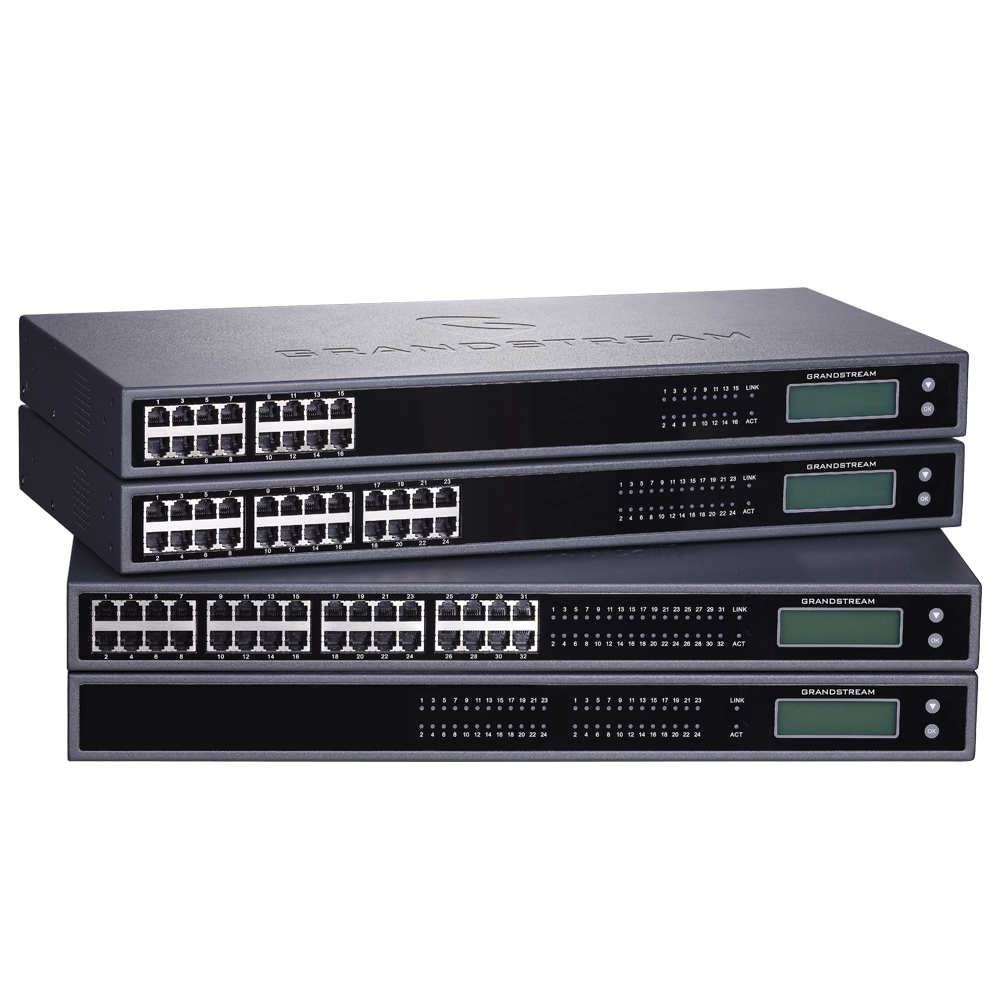
A practical bridge between analog endpoints and modern SIP calling
The Grandstream GXW4200 Series is designed for organizations that still depend on analog telephones, fax machines or other compatible analog voice endpoints but want call control, routing and management to operate through an IP-based communications platform. In simple terms, each FXS port behaves as the interface that an analog endpoint expects from a telephone system, while the gateway registers and communicates with a SIP server, IP-PBX, soft-switch or compatible hosted voice environment.
That role makes the family particularly useful during staged migrations. A hotel may already have hundreds of room phones wired through established copper pairs. A clinic may need to retain analog handsets at nurse stations, reception areas or service rooms. A school may have basic phones in classrooms and security points. A warehouse may have durable analog sets placed across loading, administration and guard areas. Replacing every endpoint can add cost, cabling work, user retraining and operational disruption. A high-density FXS gateway can reduce that pressure by allowing the existing endpoint layer to remain in service while the core calling platform moves to SIP.
Grandstream offers four density levels in the current GXW4200 v2 family: 16, 24, 32 and 48 FXS ports. The 16, 24 and 32-port models provide individual RJ11 interfaces and Telco connectors according to the selected model, while the 48-port unit uses two 50-pin Telco connectors for high-density wiring. All current models use a Gigabit Ethernet network interface and support independent SIP account assignment per telephone port. This structure gives administrators a clean way to map each analog extension to a specific SIP identity instead of treating the gateway as one undifferentiated trunk.
For UAE procurement teams, the central decision is not simply whether an analog gateway is needed. Buyers should confirm the exact number of endpoints, the physical wiring method, the IP-PBX or SIP service being used, fax requirements, network VLAN design, security policy, rack space and expected growth. FourTeck can review these details before quoting so the selected model fits the current deployment and leaves sensible room for expansion instead of forcing an early replacement.
Why high-density FXS matters in a real deployment
The value of this gateway family comes from keeping analog assets useful while placing them under a modern SIP communications architecture. The benefits below connect the technical design to the buying decisions that matter most.
Modernize the call platform without discarding every analog endpoint
Many organizations have working analog phones distributed through rooms, corridors, service areas or back-office spaces. A GXW4200 gateway lets those endpoints become extensions on a SIP system. This can make a phased migration easier to budget and easier to operationalize because the PBX layer can change before the endpoint estate changes. The result is a clearer path from legacy telephony toward VoIP without forcing every user, cable route and device to change on the same project date.
Consolidate many analog extensions into one managed gateway
A 16, 24, 32 or 48-port chassis can replace the need to deploy many small adapters. Centralizing analog conversion simplifies rack documentation, port labeling, troubleshooting and power planning. It also gives the IT team one place to review SIP registration and gateway status for a large group of endpoints.
Give each telephone port its own SIP identity
Independent SIP account support per telephone port helps administrators map analog devices to extensions in a structured way. A hotel room, clinic desk, warehouse point or service phone can be assigned separately, which supports clearer numbering plans, call routing policies and fault isolation.
Use security mechanisms that are appropriate for IP voice administration
The series supports secure signaling and management technologies including TLS, SIPS, SRTP and HTTPS, along with Secure Boot, per-device random administrator passwords and dual firmware images. Those features do not replace correct firewall policies, access control or patch management, but they give IT teams a stronger base than an unmanaged analog environment. For business use, the correct deployment approach is to combine device security features with restricted management access, firmware governance and segmented voice networking where appropriate.
Keep compatible fax workflows in a VoIP transition plan
T.38 Group 3 fax relay and G.711 pass-through options can help organizations migrate fax endpoints where the surrounding SIP service and network are configured to support the chosen method. Fax reliability depends on the complete path, so buyers should confirm provider support and test critical workflows before a large rollout.
Support repeatable provisioning for multi-device projects
Provisioning options such as HTTP, HTTPS, TFTP, FTP, FTPS and TR-069, together with Grandstream Device Management System support, can reduce repetitive configuration work. That becomes more important in branch rollouts, hospitality projects or service-provider environments where settings need to remain consistent across devices and sites.
The technical strengths that shape model selection
The family is built around a simple architectural idea: connect a significant number of analog devices to a SIP environment in one chassis, while still giving administrators per-port control and modern management choices. The most important buying facts are port density, physical connector layout, network interface, SIP profile design, supported codecs, fax behavior, management tools and security capabilities.
The 16, 24 and 32-port versions expose RJ11 interfaces for direct analog endpoint connection and also include high-density Telco connectors. The 48-port model is intended for dense wiring and uses two 50-pin Telco connectors. That difference is significant for installation planning: a buyer choosing GXW4248 V2 should confirm the cable harness, patching method and rack-room termination design before ordering rather than assuming it connects exactly like the smaller units.
GXW4200 v2 family specification guide
These are manufacturer-confirmed family specifications. Final connector layout, power requirement, physical depth and weight depend on the selected model, so the exact model should be stated on the purchase request.
| Specification | Confirmed details | Buyer relevance |
|---|---|---|
| Models | GXW4216 V2, GXW4224 V2, GXW4232 V2, GXW4248 V2 | Choose by endpoint count and wiring method. |
| Telephone interfaces | GXW4216/4224/4232: 16/24/32 RJ11 FXS ports plus 1/1/2 50-pin Telco connectors. GXW4248: 2 × 50-pin Telco connectors. | Confirm direct RJ11 use versus high-density Telco termination. |
| Network interface | 1 × 10/100/1000 Mbps auto-sensing RJ45 | Fits Gigabit LAN environments. |
| SIP architecture | SIP RFC 3261 over UDP/TCP/TLS; 4 distinct SIP server profiles; independent SIP account per telephone port | Supports structured extension mapping and multi-profile designs. |
| Voice codecs | G.711, G.723.1, G.726-32, G.729, G.722, iLBC, Opus | Match codec policy with PBX, provider and bandwidth requirements. |
| Fax over IP | T.38 Group 3 fax relay up to 14.4 kbps; G.711 fax pass-through; V.17, V.21, V.27ter and V.29 support for T.38 relay | Provider and end-to-end testing remain important for critical fax use. |
| QoS and VLAN | DiffServ, TOS, 802.1P/Q VLAN tagging | Useful for integrating voice into managed LAN designs. |
| Provisioning | TFTP, HTTP, HTTPS, FTP, FTPS, TR-069; GDMS support | Supports repeatable deployment workflows. |
| Security | SRTP, TLS/SIPS, HTTPS with AES-128 support, Secure Boot, random administrator passwords, dual firmware images | Use with network access controls and firmware management. |
| Management | Syslog, HTTPS, SSH, web browser, voice prompt, TR-069, GDMS | Supports local and centralized administration approaches. |
| Power | GXW4216/4224/4232: 12VDC, 5A, max 60W. GXW4248: 24VDC, 6.25A, max 150W. AC input 100–240V, 50–60Hz. | Confirm UPS sizing and rack power planning. |
| Environment | Operating 0°C to 40°C; storage -10°C to 60°C; 10%–90% non-condensing humidity | Install in a controlled telecom or equipment environment. |
| Physical format | 1U. GXW4248: 440 × 255 × 44 mm. GXW4216/4224/4232: 440 × 185 × 44 mm. | Check rack depth and cable bend space. |
| Mounting | Desktop and rack mount with front brackets | Supports telecom-room or office deployment. |
The port count should be treated as a design choice rather than a simple maximum. A site with 14 active analog devices could use a 16-port unit, but a buyer expecting additional rooms, departments or branch phones may prefer to leave more expansion headroom. Conversely, choosing a 48-port model for a small project can add unnecessary wiring complexity because the high-density Telco connector approach requires the correct harness and termination plan. The most efficient purchase usually matches current endpoint count, short-term growth and the physical patching method already present in the site.
Build the requirement before choosing the port count
The right gateway is the one that fits the endpoint inventory, wiring, SIP platform and operating environment. A model number alone does not confirm suitability, especially when analog lines, analog endpoints and PBX roles are being discussed in the same project.
Are you connecting analog devices or analog outside lines?
FXS is for analog endpoints such as phones and compatible fax devices. FXO is for analog PSTN line interfaces. Choosing the wrong side of that distinction is one of the most expensive avoidable mistakes in a gateway project. If the requirement is to bring telephone-company analog lines into an IP-PBX, review an FXO gateway such as the Grandstream HT881 instead.
How many analog endpoints will be active in the next 12–24 months?
Count active room phones, department handsets, service phones, fax devices and other supported endpoints. Add realistic growth, not an arbitrary percentage. Port density should follow the expansion plan and the practical way the site is wired.
Which SIP server or IP-PBX will register the ports?
Provide the PBX platform, software version, hosting model and SIP provider details where relevant. The family is designed for broad SIP interoperability, but real deployments should still be checked for registration method, codec policy, DTMF behavior, fax handling, security settings and network reachability.
Will you patch individual RJ11 leads or use a Telco harness?
This becomes especially important with higher-density installations. Existing patch panels, punch blocks and cable routes can influence the most practical model. Buyers should include rack photos or wiring diagrams when a large existing analog estate is being migrated.
Where will the gateway sit on the LAN and the power system?
Define the voice VLAN, IP addressing, DHCP or static addressing, firewall path to the SIP platform, monitoring approach and UPS requirement. The GXW4248 has a different power rating and deeper chassis than the lower-density models, so rack and UPS planning should use the exact selected model.
Send the details that affect both product selection and installation effort
A useful request includes quantity, preferred model if known, active analog endpoint count, PBX or SIP service, fax requirement, wiring type, delivery location, target date, installation scope and warranty expectations. These details help FourTeck quote a usable solution rather than only a gateway chassis.
Where the GXW4200 family makes the strongest practical case
This family is most useful where a business has many analog endpoints that still serve a purpose, yet wants centralized SIP call control and an IP-based voice architecture. The examples below focus on environments where high port density and staged migration create measurable operational value.
Hotels, serviced accommodation and room-phone estates
Hospitality properties often have large numbers of analog room phones already connected through structured copper cabling. Replacing every endpoint during a PBX upgrade can create unnecessary room access, procurement cost and guest disruption. A high-density FXS gateway lets the hotel keep familiar room handsets while moving extension registration and call routing into an IP-PBX or SIP environment.
The important design work is extension mapping, room-number documentation, Telco connector termination where used, emergency and service dialing rules, front-desk call behavior and any property-management integration handled by the PBX. The gateway solves the analog-to-SIP interface layer; the overall hotel voice design still depends on the PBX and operational workflow.
Offices and multi-floor commercial buildings
Businesses can retain analog phones in meeting rooms, reception points, service areas, security posts and low-use locations while staff-facing departments move to IP phones or soft clients. This mixed environment can be easier to finance and manage during phased modernization.
Clinics, education sites and campuses
Analog endpoints may remain useful in rooms, corridors, laboratories, classrooms, reception areas or administration spaces. A dense gateway can bring these points into a common SIP dial plan without forcing endpoint replacement across the entire facility in one phase.
Warehouses, logistics sites and industrial support areas
Rugged or simple analog sets can remain practical in loading areas, gatehouses, stores and service zones. The gateway lets those points participate in an IP-based company voice system while keeping existing field cabling where it is still serviceable.
Branch standardization projects
An organization with several branches can use a common SIP architecture while allowing different sites to retain analog endpoints temporarily. Standard templates, port documentation and centralized management practices can make branch migration more predictable, provided each site’s cabling and endpoint count are documented correctly.
Grandstream GXW4200 Series Port Density and Extension Mapping
The defining capability of the series is not merely the number of sockets on the chassis; it is the combination of dense analog access with independent SIP identity per telephone port. That architecture allows a business to preserve physical analog endpoints while making each one a separately managed extension on the SIP platform.
For a 24-room floor, for example, the administrator can map each room phone to a specific extension and still apply PBX-level call routing, dialing permissions and monitoring. In an office, reception, stores, accounts, warehouse and security phones can keep separate numbers even though they terminate through one gateway. The technical advantage becomes an operational advantage because troubleshooting can follow a clear chain: physical endpoint, gateway port, SIP registration and PBX extension.
Grandstream GXW4200 Series SIP, Voice and Fax Interoperability
A gateway migration succeeds only when the complete communication path is considered. The GXW4200 v2 family supports SIP over UDP, TCP and TLS, four SIP server profiles, independent accounts per port, common narrowband codecs and wideband codecs including G.722 and Opus. It also supports multiple DTMF transmission methods and T.38 fax relay. Those capabilities give integrators flexibility, but they do not remove the need to match the PBX, SIP provider, network and analog endpoint behavior.
Grandstream GXW4200 Series Security and Management
Moving analog endpoints onto an IP network changes the security model. The analog phone itself may be simple, but the gateway becomes an IP-managed device holding SIP credentials, configuration data and access to the voice platform. Grandstream therefore includes encrypted transport and management options, Secure Boot, random administrator passwords per device, dual firmware images and multiple provisioning methods.
For business deployments, those capabilities should sit inside a disciplined operating process. IT teams should restrict management interfaces, use HTTPS or SSH rather than insecure alternatives where possible, separate voice traffic according to network policy, keep firmware under change control, back up configuration, monitor registration status and remove unused accounts. GDMS and TR-069 can support centralized workflows, but management ownership and access rights still need to be defined internally.
Decision checklist
- Who owns the gateway administrator credentials?
- Which management interfaces are allowed from the production network?
- Will the device sit in a voice VLAN or another controlled segment?
- How will firmware updates be tested and scheduled?
- Where will the configuration backup and port map be stored?
- Who monitors SIP registration and call faults after handover?
What Buyers Should Check Before Purchase
The biggest purchase risk is choosing a gateway by port count alone. A correct order must also match FXS versus FXO requirements, connector style, PBX registration method, analog wiring, fax needs, network design, rack environment and the number of ports the business expects to use over the life of the project.
Configuration Fit
Start with endpoint count and growth, then choose 16, 24, 32 or 48 ports. The smaller three models give direct RJ11 access as well as Telco connectivity; the 48-port model relies on two 50-pin Telco connectors. If direct individual patch leads are part of the existing installation, confirm how the wiring will transition before selecting the highest-density unit. Also identify any fax devices and special service phones that need extra testing during migration.
Compatibility Check
Provide the SIP platform, software version and service-provider details. Confirm supported transports, codec choices, DTMF method, VLAN design, firewall path and any zero-touch provisioning requirement. The family is built for SIP environments, but compatibility is an end-to-end question involving the gateway, PBX, provider, network, analog endpoint and sometimes the cabling itself.
Availability and Warranty
Availability can vary between GXW4216 V2, GXW4224 V2, GXW4232 V2 and GXW4248 V2, especially when project quantities are involved. Buyers should ask for current model availability, estimated delivery planning and warranty terms at quotation stage. Warranty handling can depend on the source, model and supplier arrangement, so the applicable coverage should be confirmed in writing rather than assumed from a generic family description.
Quote Preparation
Send the selected or preferred model, quantity, number of analog endpoints, PBX platform, fax requirement, rack or desktop preference, wiring method, delivery location and target project date. For larger sites, include an extension list or port schedule. If installation help is needed, mention whether the scope includes physical rack placement, Telco breakout wiring, SIP registration, extension mapping, call testing or handover documentation.
Support from model selection through delivery coordination
FourTeck supports Grandstream gateway enquiries across Dubai and the wider UAE with a procurement process that starts from the requirement rather than from a model number. For an FXS gateway project, that means identifying how many analog endpoints must remain active, confirming the SIP or IP-PBX environment and understanding the physical cabling before selecting a chassis.
FourTeck can help compare the 16, 24, 32 and 48-port options, clarify FXS versus FXO and review whether the connector format matches the existing patching approach.
Current availability and lead time depend on the selected model, quantity and supplier status. Delivery planning can be discussed at quotation stage so the hardware schedule aligns with migration and installation work.
Warranty expectations should be confirmed for the quoted item and source. FourTeck can help buyers understand the applicable terms and the practical process for support or replacement requests.
Project enquiries across Dubai, Abu Dhabi, Sharjah and Ajman
Businesses in Dubai, Abu Dhabi, Sharjah and Ajman can contact FourTeck for gateway model guidance, quote preparation and delivery coordination. The most useful first step is to share the deployment type and analog endpoint count so the enquiry can be matched to the correct density rather than treated as a generic telephony purchase.
For multi-site UAE projects, procurement teams may also want to standardize port maps, firmware policy, rack layout and documentation across locations. That can simplify later support because each site follows the same naming and management approach even when the required port density differs. A smaller branch could use a 16-port model while a larger property uses 32 or 48 ports, yet both can remain part of one defined SIP and support standard.
GCC and Africa project support through FourTeck channels
FourTeck also handles business technology enquiries for selected GCC and Africa markets through regional inquiry channels. Projects in Saudi Arabia, Qatar, Oman, Kuwait and Bahrain may have similar analog-to-SIP migration needs in hotels, offices, education, healthcare or distributed business sites. Availability, commercial terms, delivery options and warranty handling can vary by country and should be confirmed for the specific order.
For Kenya, Uganda and other Africa-region requirements, the same planning principle applies: start with endpoint count, wiring format, SIP platform, project quantity and delivery location. Regional supply does not automatically mean the same configuration, lead time or support method in every market, so project details should be reviewed before a model is committed.
Other products buyers may consider for the same voice project
The right alternative depends on whether the project needs a different FXS density, analog outside-line integration or a PBX platform. These FourTeck pages can help buyers move from a broad requirement to a more specific design.
Grandstream GXW4224 V2
A useful choice for projects that need 24 analog endpoints and prefer direct RJ11 connectivity along with a high-density Telco connector. It can suit medium-density hotel, office, clinic or branch deployments where 16 ports would leave too little growth headroom.
Grandstream GXW4248
The 48-port model is aimed at large analog endpoint counts and uses two 50-pin Telco connectors. Consider it where rack density and centralized wiring are priorities, but confirm the correct breakout cabling and termination method before ordering.
Grandstream HT881 FXO Gateway
Choose this direction when the requirement is to connect analog PSTN lines into a VoIP system rather than analog phones out to SIP extensions. The FXS-versus-FXO distinction should be confirmed before purchasing.
Grandstream UCM6301 IP PBX
A PBX appliance addresses call control rather than analog conversion. Buyers building a complete Grandstream voice environment may need both the PBX layer and an FXS gateway, depending on analog endpoint count and required functionality.
Grandstream product range
Browse additional Grandstream phones, gateways, PBX and networking products when the gateway is one part of a broader communications refresh.
Buying assistance for projects where the details matter
An analog gateway can look straightforward until the deployment involves mixed cabling, multiple SIP accounts, fax lines, legacy room wiring and a live PBX migration. FourTeck’s role is to help customers turn those moving parts into a clear purchase requirement. The support is most valuable when it prevents a wrong port type, incorrect model density or missing installation component from reaching the project site.
Translate endpoint count, site type, wiring and PBX details into a model shortlist.
Review SIP registration, port mapping, VLAN, fax and management considerations before deployment.
Prepare the commercial request around the correct model, quantity and project scope.
Align hardware supply with the customer’s delivery location and project timing, subject to current availability.
Clarify applicable warranty information for the quoted product and sourcing arrangement.
Identify when the project also needs an IP-PBX, IP phones, FXO gateway or another Grandstream component.
Answers for Grandstream FXS gateway buyers
What is the GXW4200 Series used for?
It is used to connect groups of analog endpoints, such as telephones and compatible fax devices, to a SIP-based VoIP or IP-PBX environment. Each telephone port can have an independent SIP account, allowing analog devices to operate as managed extensions on a modern call-control platform while the organization continues using existing handsets and wiring where appropriate.
Which model should I choose: 16, 24, 32 or 48 ports?
Choose according to the number of active analog endpoints, expected growth and physical wiring method. The GXW4216, GXW4224 and GXW4232 provide 16, 24 and 32 RJ11 ports respectively, together with Telco connectors. The GXW4248 is a 48-port high-density option that uses two 50-pin Telco connectors, so cable termination should be planned before purchase.
Is this an FXS or FXO gateway?
The GXW4200 Series is an FXS gateway family. FXS ports are intended to provide analog telephone interfaces for endpoints such as analog handsets and compatible fax devices. If your requirement is to connect analog PSTN outside lines into a VoIP system, you need an FXO solution instead. FourTeck can help clarify this before quoting because FXS and FXO serve different sides of an analog telephony connection.
Can it work with an existing SIP-based IP-PBX?
The family is designed for broad interoperability with SIP-based platforms and supports SIP over UDP, TCP and TLS. Compatibility should still be reviewed against the exact PBX, firmware, authentication method, codec policy, DTMF settings and network path. For important deployments, test registration, inbound and outbound calling, caller ID and any fax workflows before moving all analog extensions.
Does the series support fax over IP?
Yes. The manufacturer lists T.38 Group 3 fax relay up to 14.4 kbps and G.711 pass-through options. Fax performance depends on the gateway, PBX or provider, network quality and the far-end fax environment. Businesses that rely on fax for critical workflows should verify provider support and perform real document tests before treating the migration as complete.
Can FourTeck help with configuration planning?
Yes. FourTeck can help review model density, endpoint count, FXS-versus-FXO requirements, PBX compatibility, cabling approach, SIP account mapping, VLAN and network readiness, fax needs and basic deployment scope. The exact assistance available should be agreed as part of the quotation so the customer knows whether the requirement is supply only, guided configuration or a wider installation project.
Is the gateway available in Dubai and the UAE?
FourTeck handles UAE enquiries for the GXW4200 family, but current availability can differ by model and quantity. Buyers should specify the preferred model or required port count and ask for a current quote. Project supply may need additional planning when multiple units, specific delivery dates or installation coordination are required.
What should I provide when requesting a quote?
Provide the endpoint count, preferred model if known, quantity, SIP or IP-PBX platform, fax requirement, connector or cabling preference, delivery location and target date. For larger sites, an extension list or room schedule is useful. Also state whether you need supply only, basic configuration guidance, rack installation, Telco breakout work or complete testing and handover support.
Can businesses request multiple gateways for a project rollout?
Yes, project quantities can be requested. For multi-unit or multi-site deployments, it is useful to standardize model choice, firmware level, configuration templates, extension naming and documentation. FourTeck can review quantities and delivery planning, while the customer or implementation team should provide a clear site-by-site port requirement so each location receives the appropriate gateway density.
Need Help Choosing the Right FXS Gateway Capacity?
FourTeck can review the intended use, number of analog endpoints, SIP platform, wiring method, model quantity, delivery location and support expectations before preparing a quote. This helps the project select the correct port density and avoids buying an FXS gateway when the requirement is actually for FXO lines or another PBX component.
Share the required port count, PBX platform, quantity, delivery location, target date and whether you need supply-only or deployment support.