
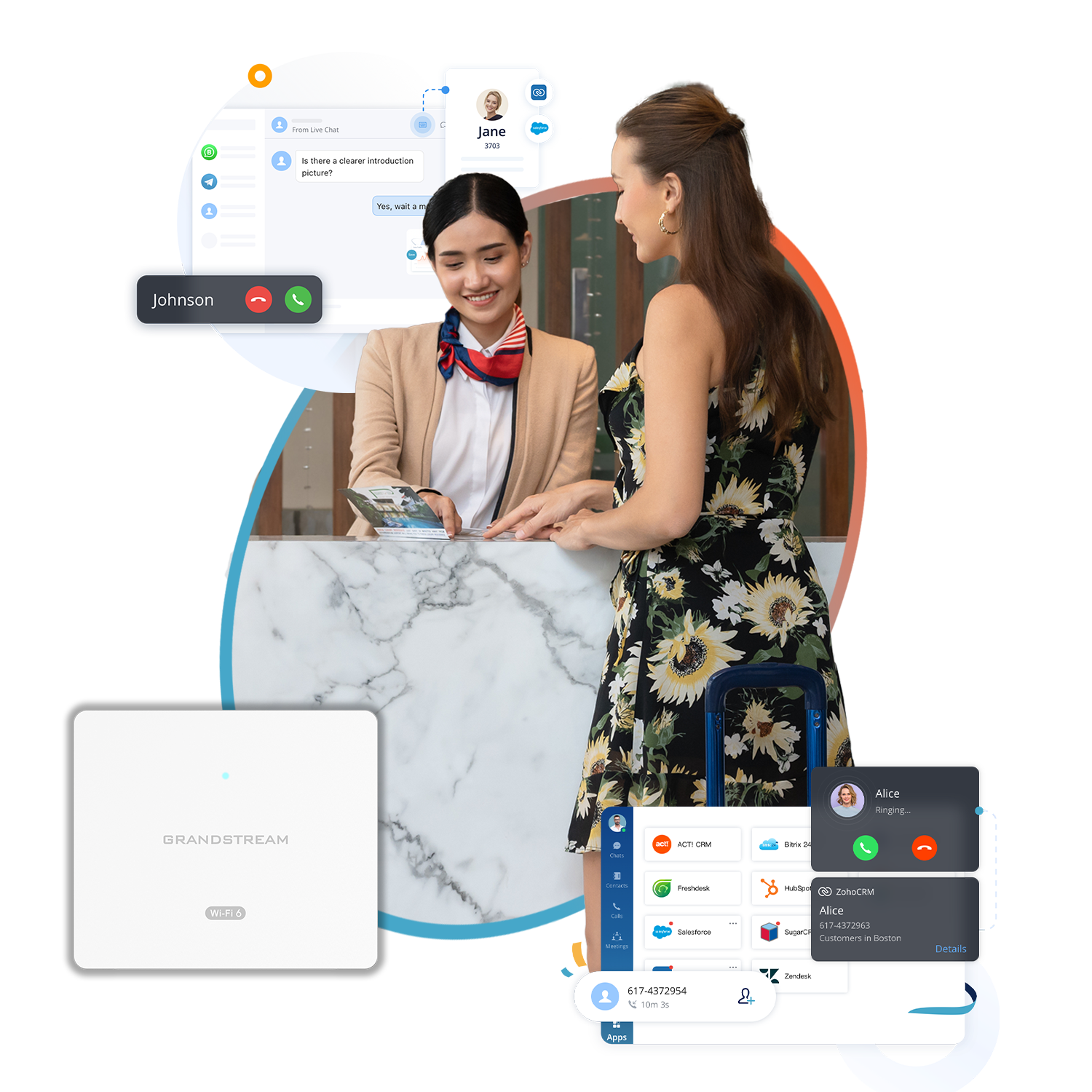
A Hotel Technology Stack Built Around the Property
Grandstream Hospitality Solutions are designed to connect several parts of hotel operations rather than solve only one communications task. A deployment can include UCM unified communications infrastructure for call control and collaboration, GHP guest-room IP phones, GWN Wi-Fi access points, managed network switches, Wi-Fi cordless phones for mobile staff, paging or intercom devices, and GDMS for centralized configuration and monitoring. The exact mix depends on the size and operational design of the property.
For a buyer, the practical value is architectural consistency. Guest rooms may need simple calling and reliable wireless access; reception requires efficient call handling; housekeeping and maintenance need mobility; meeting and event areas can require denser Wi-Fi; and back-office systems must remain separate from guest traffic. Grandstream’s current hotel solution guidance specifically addresses guest and staff wireless networks, network segmentation, unified communications, property-management system integration and centralized device administration. This lets the project be planned as one operational environment rather than as unrelated phones, access points and switches.
The solution is relevant to UAE hospitality because properties often combine high guest-device counts, round-the-clock operations, multilingual front-desk workflows, outdoor leisure areas and a strong dependence on Wi-Fi for both guest experience and staff productivity. A city hotel, beach resort and serviced apartment building will not need identical hardware. Indoor room coverage, pool or courtyard coverage, conference density, cabling routes, PoE power budgets and the required number of extensions all change the design.
FourTeck can help translate those site requirements into a bill of materials. The review can cover room count, floors, existing structured cabling, internet links, SIP trunks, expected concurrent calls, PMS platform, staff device count, guest Wi-Fi policy, VLAN design, outdoor coverage and future expansion. The goal is to quote a hospitality stack that matches the property instead of selecting equipment only because a model appears popular.
Key Business Benefits for Hotels and Resorts
The strongest reason to choose an integrated hospitality stack is not a longer feature list. It is the ability to align communications, guest connectivity, mobility and network control with the way the property actually operates.
Coordinate guest and staff technology
A hotel rarely has only one communications audience. Guests call reception, housekeeping moves between floors, engineering teams roam across service areas, managers may work from mobile devices, and events staff must stay reachable during functions. A Grandstream-based design can bring these endpoints onto a coordinated IP platform so call control, wireless access and device administration are planned together.
Separate guest and operational traffic
Managed GWN switching supports VLAN-based segmentation, while Quality of Service can prioritize important traffic such as voice. That matters in hospitality because guest internet access should not be treated as the same network domain as staff systems, IP phones or facilities devices.
Keep service teams reachable
Grandstream WP Wi-Fi cordless phones are designed for staff that move across a property. Combined with Wi-Fi roaming support, they can help housekeeping, room service, maintenance and event teams stay connected without being tied to a fixed desk extension.
Design connectivity room by room
In-wall access points can serve guest rooms while models intended for denser or outdoor environments can cover lobbies, conference areas, courtyards and leisure spaces. Captive portals and SSID policies can be planned separately for guests and employees.
Manage repeatable room deployments
GDMS supports centralized provisioning and batch configuration for Grandstream endpoints. That can reduce repetitive setup when a project includes dozens or hundreds of room phones, access points or other managed devices spread across floors or buildings.
Connect telephony to property operations
Grandstream documents PMS integration for UCM hospitality deployments. Depending on the selected platform and integration, workflows can include check-in or check-out events, wake-up calls, room status, do-not-disturb settings and call permissions. Integration should be confirmed before ordering.
What Makes the Hospitality Stack Different
Grandstream’s hotel architecture covers the communications core, guest-room endpoints, wireless access, managed switching and additional facility tools. That broad scope gives a hotel IT team or system integrator flexibility to standardize more of the environment while still selecting different models for different zones.
The design is particularly useful where a property wants repeatable provisioning. Current GHP hotel phones are supported by GDMS, and Grandstream’s hotel guidance describes batch configuration, staging templates and remote monitoring across large deployments. Guest-room phones are available in wired and Wi-Fi variants, while current color-screen GHP models add features such as two SIP accounts, PoE on wired models, GDMS management and USB Type-C charging. Exact model characteristics should be checked against the final room standard.
Grandstream Hospitality Solution Specifications
This is a multi-product architecture, so there is no single fixed port count, capacity or power specification. The table shows the verified solution families and the decisions that must be finalized for a project.
| Area | Verified solution direction | Buyer decision |
|---|---|---|
| Brand | Grandstream | Single-brand or mixed-infrastructure deployment |
| Solution type | Hospitality communications, networking and facility technology | Required project scope |
| Unified communications | UCM platforms with call control, IVR, queues, collaboration and integration capabilities | Users, extensions, SIP trunks and concurrent calls |
| Guest-room phones | GHP Series hotel IP phones; wired and Wi-Fi variants available by model | Room count, color, wired/Wi-Fi preference and key layout |
| Wireless | GWN indoor, in-wall, high-density and outdoor access-point options | Coverage survey, client density, room materials and outdoor zones |
| Switching | Managed GWN switching with VLAN, QoS and model-dependent PoE | Port count, uplinks, PoE budget and redundancy |
| Management | GDMS centralized provisioning, templates, monitoring and troubleshooting for supported devices | Sites, administrator roles and rollout method |
| PMS integration | UCM supports hospitality workflows through supported PMS integrations and open API options | Exact PMS, middleware and required workflow |
| Staff mobility | WP Wi-Fi cordless IP phones and Wave options | Roaming zones, device count and mobile workflow |
| Paging / facility | GSC speakers, intercoms and other compatible facility endpoints | Zones, paging priority, access and security requirements |
| Security controls | VLAN segmentation, ACLs, DHCP snooping, port security and secure device features by model | Policy design and existing security architecture |
| Warranty / availability | Based on selected models, supply source and project terms | Contact FourTeck for current options |
Choosing the correct configuration begins with the property map rather than the catalogue. A 90-room business hotel with compact floor plans may need a very different wireless layout from a 90-room resort with villas, pools, outdoor dining and event areas. The same applies to telephony: extension count is only one input. Concurrent calls, SIP trunk capacity, front-desk queues, guest-room calling policy, remote management and PMS workflows can change the UCM choice. The switching layer then has to supply enough ports and PoE power for access points, IP phones, paging and security endpoints. Buyers should therefore treat each specification as part of an interdependent design and confirm the final model list only after coverage, power and integration requirements are known.
Configuration and Buyer Guidance
The highest-risk mistake is buying room phones, access points and switches independently and discovering later that the power, coverage, management or PMS requirements do not line up. Confirm the operating model first, then select hardware.
How many rooms and users?
Separate guest rooms, staff extensions, reception positions, office users, mobile teams and common-area devices. This gives a more realistic endpoint count than room count alone.
Where must Wi-Fi work?
Map rooms, corridors, lobby, restaurants, pool deck, beach, ballroom, meeting rooms, offices and service areas. Wall materials and expected client density influence access-point placement.
What existing systems remain?
Check SIP trunks, existing phones, PMS platform, cabling, switches, firewall, surveillance and access systems. Migration may be staged rather than replacing everything at once.
Is the PoE budget sufficient?
PoE can simplify installation, but switch wattage, port allocation and device class must be planned. Add future devices and high-availability needs before finalizing switch sizes.
What happens during growth?
Consider additional rooms, new restaurants, conference capacity, new staff devices and future outdoor areas. Expansion headroom can reduce disruptive redesign later.
What support is expected?
Clarify configuration, installation, testing, handover, firmware policy, warranty expectations and who will administer the platform after deployment.
For a useful FourTeck quote, share the property type, number of rooms, floors or buildings, estimated staff extensions, concurrent-call requirement, internet and SIP-trunk details, PMS name, expected guest count, existing cabling, outdoor coverage zones, required quantity and delivery location. Site drawings or a basic floor plan can make the early design discussion more productive.
Ideal Business Use Cases
A Grandstream hospitality deployment can fit different property types, but each use case emphasizes different parts of the stack. The examples below explain where the architecture can be especially useful.
Full-service hotels with many departments
Properties with front desk, reservations, housekeeping, engineering, restaurants, events and administration need more than guest-room phones. The UCM layer can centralize call handling, while staff phones, Wave clients and Wi-Fi cordless endpoints provide different ways to communicate. Managed networking can separate guest, staff and facility traffic, and GDMS can make repeated endpoint configuration easier across floors. PMS integration should be assessed around the exact workflows the hotel wants to automate.
Resorts with outdoor guest areas
Pools, courtyards, beaches, gardens and golf areas can require outdoor-rated long-range wireless hardware rather than indoor access points placed near windows. A resort design should map roaming routes for staff as well as guest coverage and should include environmental conditions, mounting and backhaul.
Serviced apartments and extended-stay properties
Apartment-style rooms can benefit from compact guest telephony and in-room wireless designs, especially where occupants use multiple personal devices. The network should still separate resident or guest access from operational systems and consider wired ports for smart TVs, workstations or in-room devices where required.
Conference and event hotels
Ballrooms and meeting spaces can create temporary peaks in Wi-Fi client density and staff coordination. The design should account for capacity, roaming, traffic policy and temporary event requirements instead of using the same access-point assumptions as guest corridors.
Smaller inns and boutique properties
Smaller sites may prefer a reduced hardware footprint. Grandstream’s GCC convergence family can combine IP PBX, firewall, router and Layer 2 switching functions in one platform for selected smaller deployments, while the exact suitability still depends on user count, internet design and security expectations.
Multi-building hospitality campuses
A campus-style resort or hotel group can benefit from centralized templates and monitoring when similar devices are repeated across buildings. Network resilience, fiber uplinks, site boundaries and administrative responsibility become more important as the physical footprint expands.
Grandstream Hospitality Solutions – Guest and Staff Communications
The communications layer needs to serve two very different experiences. Guests usually want simple, predictable access to reception, housekeeping, reservations or emergency assistance. Staff need queues, transfers, internal extensions, mobile access and efficient ways to reach departments. Grandstream addresses that difference through UCM call control combined with purpose-built GHP hotel phones and staff endpoints.
UCM platforms can support IVR, call queues and integration with property systems, while GHP room phones are designed for hospitality deployments and can be managed through GDMS. Current GHP families include wired and Wi-Fi variants, which gives designers options where room cabling differs. For roaming teams, WP Wi-Fi phones can use the property’s wireless network so housekeeping, maintenance or events personnel are not tied to a reception desk. Wave can add desktop, mobile and web collaboration for supported UCM environments.
Grandstream Hospitality Solutions – Wi-Fi, Segmentation and Roaming
Hotel Wi-Fi is both a guest amenity and an operational network. A design that treats it as only a coverage problem can fail when hundreds of devices arrive, when staff move between floors, or when business systems compete with guest streaming traffic. Grandstream’s hospitality guidance emphasizes separate SSIDs, captive portals, client controls, VLAN segmentation and Quality of Service so the network can be tuned by audience.
In-room access points such as the GWN7661E and GWN7604 are designed for guest-room style deployments and can provide Ethernet connectivity in addition to wireless service. Other GWN models address higher-density indoor or longer-range outdoor zones. Managed switches can provide PoE to access points, IP phones and security devices while VLANs separate guest, staff, voice and facility traffic. Voice VLAN and QoS capabilities are especially useful where large numbers of IP phones share the same physical switching infrastructure.
Grandstream Hospitality Solutions – Centralized Management and PMS Workflows
Centralized administration becomes important as the number of endpoints grows. Configuring ten phones by hand is manageable; repeating the same work across hundreds of rooms, multiple access points and different buildings is not. GDMS is designed to provision, configure, monitor and troubleshoot supported Grandstream devices from a centralized platform, including batch operations by site, group or model.
Hospitality projects can also depend on the PMS. Grandstream documents UCM integration capabilities for functions such as guest check-in and check-out, wake-up-call scheduling, room status, do-not-disturb settings, call permissions and clearing guest call history on checkout. Supported integrations and available workflows can change by platform or middleware, so the PMS name and desired automation should be part of the technical review rather than an assumption made after hardware arrives.
Decision checklist
- Identify which device families must be centrally managed.
- Define administrator roles for hotel IT, integrator and support teams.
- Confirm whether templates will be staged before devices arrive on site.
- List the PMS platform, version and required telephony workflows.
- Decide how firmware changes and configuration backups will be controlled.
- Document handover responsibility so ongoing management does not depend on one installer account.
What Buyers Should Check Before Purchase
The most important purchase risk is treating a hotel solution as a list of independent devices. Compatibility, PoE capacity, PMS workflows, Wi-Fi coverage and operational ownership need to be confirmed as one design before the model list is finalized.
Configuration Fit
Start with room count, staff extensions, concurrent calls, guest density and service areas. Then decide which rooms need wired or Wi-Fi hotel phones, which zones need in-wall, ceiling or outdoor access points, and how many powered network ports are required. The UCM, switch and access-point models should be sized from these requirements, not selected independently.
Compatibility Check
Confirm SIP trunking, existing structured cabling, firewall rules, switching uplinks, PMS integration method, VLAN scheme and any third-party phones or facility devices that will remain. A phased migration can be practical, but only when the old and new environments have a clear interconnection plan.
Availability and Warranty
A hospitality bill of materials may contain several device families, and supply timing can differ by model, quantity and selected variant. Ask for current availability, delivery planning and warranty guidance against the final list. Do not assume that a Wi-Fi variant, color option, PoE switch or outdoor access point has the same lead time as another component.
Quote Preparation
Share the property type, room count, floors, guest capacity, staff users, expected call load, PMS platform, outdoor zones, existing network, quantity and target date. Mention whether installation, configuration, site survey, migration or handover support is needed. This gives FourTeck enough context to prepare a more useful commercial and technical response.
Also consider long-term operating cost. Power consumption, switch capacity, spare devices, replacement batteries for mobile phones, additional access points after renovation, support ownership and future room expansion can matter more over several years than the initial unit price of one phone or access point. Where two Grandstream models appear similar, choose based on the requirement that changes the deployment: Wi-Fi generation, wired ports, PoE behavior, device capacity, environmental rating, management need or user interface. FourTeck can help review those differences before the purchase order is prepared.
UAE Availability and Service Support
FourTeck supports Grandstream hospitality inquiries in Dubai and across the UAE with solution selection, configuration review, quote preparation, delivery coordination and warranty guidance. Because the page represents a configurable hotel architecture rather than one boxed item, availability should be confirmed against the final bill of materials. A project can include different UCM, GHP, GWN, WP and facility devices, and each may have its own supplier status or lead time.
For projects that already use Grandstream, FourTeck can also help buyers identify whether the requirement is an expansion, refresh or new deployment. Existing model numbers, firmware information, network diagrams and current PMS details are useful when preserving part of the installed environment. Contact FourTeck for current hospitality solution options.
Dubai, Abu Dhabi, Sharjah and Ajman Project Coverage
Businesses and hospitality groups in Dubai, Abu Dhabi, Sharjah and Ajman can contact FourTeck for Grandstream solution availability, configuration guidance and quotation support. The same buying method applies across the UAE: define the property size, guest and staff requirements, voice design, Wi-Fi coverage, switching, cabling, PMS integration and delivery location before confirming the equipment list. Large resorts may need staged delivery by building or floor, while a smaller boutique property may prefer one consolidated shipment. Project scheduling, installation scope and support expectations should be stated during the quote process so the proposal matches how the site will actually be deployed. FourTeck can also help identify suitable alternatives when a selected model does not fit the required capacity, interface or current supply position.
GCC and Africa Availability
FourTeck also receives business technology inquiries for selected GCC and Africa markets. Hotels, resorts, serviced apartments and system integrators in Saudi Arabia, Qatar, Oman, Kuwait, Bahrain, Kenya, Uganda and other locations can use FourTeck’s regional inquiry channels to discuss Grandstream communications and networking requirements. Product availability, delivery routes, warranty handling, import terms and configuration support may vary by country, project size and supplier status, so regional requests should be reviewed individually.
For a cross-border hotel group, it is useful to standardize the design intent before standardizing every part number. The same guest-room phone or access point may not be the best choice in every property because building materials, local cabling, internet services and room layouts differ. A group can still define common requirements for SIP calling, guest network policy, staff mobility, management templates and security segmentation while allowing site-specific hardware adjustments.
Regional inquiry options include FourTeck Kenya, FourTeck Uganda, FourTeck Africa and FourTeck Kuwait. Share the destination country, quantity, required model families and project scope so the team can review the appropriate route.
Other Options Buyers May Consider
A hospitality project often starts with one requirement and expands into adjacent infrastructure. The links below help buyers review Grandstream platforms and FourTeck guidance that may form part of the same deployment.
Grandstream UCM6300 Series
Consider the UCM6300 family when the project needs on-premises unified communications, call routing, collaboration, Grandstream endpoint provisioning and integration options. Final model choice depends on users and concurrent calls.
Grandstream Wi-Fi for Hotels
Useful when the primary project challenge is guest-room, lobby, event or outdoor wireless coverage and the buyer needs to compare access-point roles.
Grandstream GWN Access Points
Compare the GWN wireless family for different indoor, density and long-range deployment requirements.
Grandstream RemoteConnect
Relevant when a UCM6300 deployment needs cloud-assisted remote endpoint connectivity and easier NAT traversal for off-site users.
Grandstream Products at FourTeck
Browse additional Grandstream IP phones, PBX platforms, gateways and networking products that may be relevant to the wider property design.
Why Buyers Choose FourTeck
Hospitality technology buying is easier when the supplier understands the dependencies between products. FourTeck can support the procurement discussion at the level of the complete requirement rather than reducing it to individual part numbers. That matters when a switch choice affects PoE capacity, an access-point choice affects room ports, a UCM choice affects call capacity, or a PMS integration affects the telephony workflow.
Translate room count, user roles, wireless zones, call load and project constraints into product decisions.
Help compare variants where Wi-Fi, PoE, ports, capacity or management characteristics change the deployment.
Prepare the commercial request around the selected bill of materials, quantities and delivery location.
Coordinate shipment expectations around supplier status, project schedule and component quantities.
Clarify applicable warranty handling and support expectations against the actual products supplied.
Suggest a suitable model direction when the first choice does not fit the capacity, environment, interfaces or project timing.
FourTeck can support SMB properties, larger enterprise hospitality buyers and system integrators. The level of assistance depends on the project: some buyers need only supply and delivery, while others need help checking compatibility before committing to a large quantity. Clear requirements at the beginning reduce rework later and make it easier to distinguish between a simple product quote and a complete hospitality infrastructure request.
Grandstream Hospitality Solutions FAQ
What is a Grandstream hospitality solution used for?
It is used to build a coordinated communications and networking environment for hotels and similar properties. Depending on the design, it can include guest-room phones, IP PBX call control, staff mobility, wired and wireless networking, paging, facility endpoints and centralized management. The exact combination is configuration dependent because a small inn and a multi-building resort have different room counts, coverage areas and operational requirements.
Can Grandstream integrate with a hotel PMS?
Grandstream documents PMS integration capabilities for UCM hospitality deployments, including workflows such as check-in and check-out, wake-up calls, room status, do-not-disturb settings and call permissions. Supported PMS platforms and integration methods should be confirmed for the exact project. Buyers should provide the PMS name, version and required workflow so compatibility can be checked before the equipment is ordered.
Which Grandstream phones are suitable for guest rooms?
Grandstream’s GHP Series is designed for hotel-room and similar deployments. Current families include wired and Wi-Fi variants, and model features differ in display, programmable keys, network interface and wireless support. Buyers should choose the room-phone standard based on the guest experience, cabling, PoE availability, branding or faceplate requirements and how the phone will be managed across the property.
Can one access point model be used everywhere in a hotel?
Usually it is better to design by area. Guest rooms may benefit from in-wall models, open lobbies and meeting spaces may have different density needs, and pools or outdoor leisure zones can require weatherproof long-range hardware. A Wi-Fi survey or detailed floor-plan review helps determine placement. Client density, walls, interference, roaming and Ethernet port needs all affect model choice.
How should guest and staff networks be separated?
Grandstream managed networking supports tools such as VLAN segmentation and Quality of Service. A hotel can use separate logical networks for guests, staff, voice and facility systems, while applying different access and bandwidth policies. The exact design should be agreed with the site’s security and network team. Segmentation is especially important where guest internet access shares the same physical switching infrastructure as business systems.
Can FourTeck help size the UCM platform?
Yes. Sizing should consider more than the number of rooms. Share the total extensions, staff users, expected concurrent calls, SIP trunks, IVR and queue requirements, remote users, conferencing needs and PMS integration. FourTeck can use those inputs to guide model selection and identify where capacity headroom is appropriate. Final specifications depend on the selected UCM model and deployment design.
Is Grandstream hospitality equipment available in the UAE?
FourTeck can assist with current UAE availability and quotation requests, but a complete hospitality project can include multiple device families and variants. Supply therefore depends on the selected models, quantities and supplier status at the time of the request. Send the required bill of materials or property requirement so FourTeck can confirm current options instead of assuming that every component has the same availability.
What information should I send for a hotel solution quote?
Provide the property type, room count, floors or buildings, staff extensions, guest capacity, expected call volume, PMS platform, internet and SIP trunk details, existing network equipment, outdoor coverage areas, quantity, delivery location and target date. If you need installation, configuration, migration or handover support, include that too. Floor plans, rack details and current network diagrams are helpful for more complex projects.
Can a hotel expand the deployment later?
Yes, expansion can be planned, but the original design should reserve suitable capacity. Consider spare switch ports and PoE budget, UCM user and call headroom, wireless controller or management limits, available rack space and future coverage zones. Expansion is easier when IP addressing, VLANs, naming, templates and cabling are documented from the start. Model compatibility should still be checked when new hardware is added later.
Does FourTeck support bulk or multi-site requests?
FourTeck can review bulk and multi-site business inquiries. For large quantities, provide the site count, model standard, quantity per site, delivery schedule and whether configurations need to remain identical across properties. If sites have different room layouts or internet environments, it may be better to standardize the operating requirements while allowing selected hardware to vary. Current availability and commercial terms should be confirmed for the final quantities.
Need Help Planning the Right Hotel Configuration?
FourTeck can review the property layout, room and staff count, telephony requirement, guest Wi-Fi zones, existing network, PMS integration, PoE needs, delivery location and support expectations before preparing a quote.
Share the room count, floors, user count, call load, PMS name, wireless areas, quantity and target delivery date.