
Grandstream HT812 v2 Analog Telephone Adapter in Dubai, UAE
A compact two-line bridge for keeping analog phones and fax devices useful while moving business calling to SIP-based VoIP.
The HT812 v2 gives a small office or branch two RJ11 FXS ports, two Gigabit Ethernet ports, integrated NAT routing, secure provisioning options and practical telephony features in one appliance. It is a particularly balanced choice when a buyer needs two analog endpoints but also wants stronger network flexibility than a basic two-port adapter.
Dual Gigabit Ethernet
T.38 Fax Support
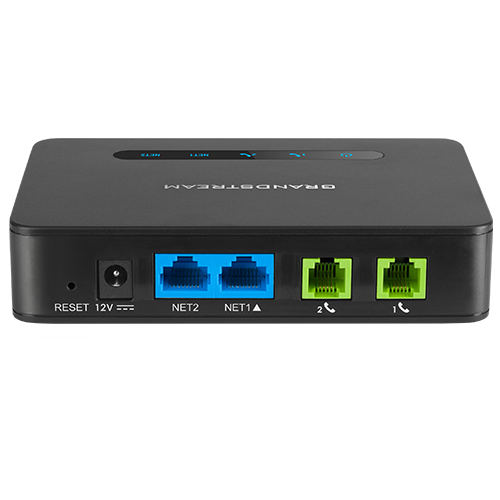
A practical way to keep analog phones during a VoIP migration
The Grandstream HT812 v2 is an analog telephone adapter, often shortened to ATA, that sits between traditional analog telephone equipment and an IP-based voice system. An analog handset cannot normally register directly to a SIP account or IP PBX. The adapter provides the FXS interfaces that the analog device expects, then translates the calling functions into SIP traffic for the network. This makes the unit useful when the telephone itself is still fit for purpose but the organisation is replacing older lines, moving to hosted VoIP, introducing a modern IP PBX, or standardising branch communication over an IP network.
For many businesses, two ports are the sweet spot. A reception area may have a desk phone and a cordless base. A clinic may need one analog voice handset and one fax machine. A warehouse might retain a basic administration phone and a security-desk phone. In each of these cases, a single-port adapter creates an immediate capacity limit, while a four-port or eight-port gateway may be more equipment than the site needs. The HT812 v2 provides two RJ11 FXS interfaces and two SIP profiles, so a buyer can plan two analog endpoints without moving to a larger gateway class.
Its network design is another reason it stands out inside Grandstream’s current HT family. The model has two 10/100/1000Mbps RJ45 interfaces and an integrated NAT router, allowing it to fit more flexibly into office network layouts than a very simple one-port or two-port ATA. The device also supports TLS and SRTP for protected signalling and media when the wider SIP environment is configured accordingly, automated provisioning through technologies such as TR-069, failover SIP server behaviour, T.38 fax relay, and a broad collection of familiar analog calling features.
For UAE buyers, the important question is not only whether the adapter has two phone sockets. The SIP provider, PBX platform, analog device type, fax requirement, network addressing, VLAN design, codec policy, power placement and future line count can all affect whether the final setup works smoothly. FourTeck can help review those details before a quotation is prepared, so the purchase is based on the working environment rather than the model name alone.
Why this ATA makes sense for two-line analog requirements
Its value is not simply converting analog to IP. The stronger benefit is allowing a business to modernise the voice platform without replacing every working endpoint at the same time.
Extend the useful life of analog equipment
A phased voice migration is often easier to manage than replacing every handset, cordless base or fax unit in one project. The two FXS ports let a business keep selected analog devices while the backend moves to SIP. This can reduce disruption at reception, administration desks, service counters or branch locations where users already understand the existing phones and where a full endpoint refresh offers little operational benefit.
Flexible office connectivity
Dual Gigabit Ethernet ports give installers more freedom when positioning the ATA in an office or branch network. The integrated NAT capability can also support selected deployment patterns. Network design still matters, particularly for VLANs, firewall policies and SIP traffic, but the hardware provides more connectivity options than a basic single-interface adapter.
Business-grade calling features
Call waiting, caller ID, blind or attended transfer, forwarding, hold, do-not-disturb and three-way conferencing are supported. These familiar features help analog users participate in a modern call environment without requiring an IP phone at every desk.
Provisioning for repeat deployments
TR-069, configuration-file methods and remote administration options are useful when an IT team or voice provider is managing more than one adapter. Standardised configuration can reduce setup inconsistency across branches and simplify later changes to SIP details or operational policy.
Secondary SIP server support
The adapter can switch to a secondary SIP server when the primary server becomes unavailable, provided the service is configured for that behaviour. This feature can support a more resilient voice design, although true service continuity still depends on the PBX, network, internet connection and power environment around the ATA.
Keep selected fax workflows
T.38 Group 3 fax relay and automatic G.711 pass-through fallback can support fax-over-IP scenarios. Fax reliability is still influenced by the SIP provider, codec settings, network quality and remote endpoint, so buyers with critical fax requirements should include this detail in the pre-sales discussion.
A balanced two-port design, not simply a basic phone converter
The strongest reason to choose the HT812 v2 is the way its features fit together for small business voice requirements. Two FXS ports cover the common case of two analog endpoints, while the two Gigabit interfaces make the network side more capable than Grandstream’s simpler HT802 v2. Buyers who need only one analog device may be better served by a single-port option, while sites with four or eight analog devices should examine higher-port gateways before ordering.
The adapter also supports several voice codecs including G.711, G.722, G.723.1, G.729A/B, G.726-32, iLBC and OPUS. Dynamic jitter buffering and line echo cancellation help the platform handle real-world voice conditions. On the analog side, it supports multiple caller ID methods and both DTMF and pulse dialling. On the IP side, it supports SIP over TCP/TLS, SRTP media protection, quality-of-service mechanisms and a range of common network services. These are technical capabilities, but the buyer benefit is straightforward: the adapter can fit into a properly designed business network without forcing the organisation into a minimal home-user feature set.
Grandstream HT812 v2 specifications that affect buying decisions
The table below keeps the key verified details in one place. Final deployment settings depend on the SIP service, PBX, network design and selected analog devices.
| Specification | Verified detail | Buyer relevance |
|---|---|---|
| Brand / Model | Grandstream HT812 v2 | Current v2 two-port ATA family model |
| Telephone interfaces | Two RJ11 FXS ports | Connects two analog endpoints |
| SIP profiles | 2 SIP profiles | Useful when planning two analog lines or account groups |
| Network interfaces | Two 10/100/1000Mbps RJ45 ports | Better fit for Gigabit office networks |
| Routing | Integrated NAT router | Supports selected network placement designs |
| Voice codecs | G.711, G.722, G.723.1, G.729A/B, G.726-32, iLBC, OPUS | Confirm compatibility with PBX and carrier policy |
| Fax over IP | T.38 Group 3 relay up to 14.4kbps; G.711 pass-through fallback | Important for fax-dependent departments |
| Telephony features | Caller ID, call waiting, transfer, forward, hold, DND, 3-way conference | Keeps familiar business calling functions on analog devices |
| Security | TLS/SIPS/HTTPS control options, SRTP media, AES-secured provisioning capabilities | Useful for controlled SIP deployments |
| Provisioning | HTTP/HTTPS, TFTP, TR-069, SSH and automated methods | Supports repeatable branch or provider rollouts |
| UCM integration | Grandstream UCM Zero Config support | Simplifies selected Grandstream PBX deployments |
| Power | 100–240VAC input power supply; 12V/0.5A output | Plan a nearby protected power source |
| Operating environment | 0°C to 50°C; 10–90% non-condensing humidity | Install in a suitable indoor equipment environment |
| Dimensions / weight | 28.5 × 130 × 90mm; 353.33g | Compact desktop or communications-cabinet placement |
Choosing the correct configuration begins with the endpoints, not the Ethernet ports. Count how many analog devices must remain active and confirm whether each device needs its own independent SIP identity. If there is only one analog phone, a one-port adapter may be enough. If there are exactly two endpoints, this model offers useful headroom and networking flexibility. If the requirement is likely to expand beyond two analog devices, a four-port HT814 v2 or eight-port HT818 v2 can reduce the need to deploy multiple small adapters. Fax users should additionally confirm T.38 support and codec behaviour with the chosen service provider. Network administrators should decide whether the ATA belongs on the voice VLAN, whether the integrated router will be used, and which firewall rules or quality-of-service policies are required. FourTeck can use these details to recommend the right model before the order is placed.
What configuration do you need for two analog phones?
For most two-device installations, the hardware choice is simple; the real work is confirming the SIP, network and endpoint details that determine whether the phones behave as expected.
Count independent analog endpoints
Confirm whether you need one or two independent phone or fax connections. Two physical devices do not always mean two separate SIP accounts, so document the required extension and calling behaviour for each port.
Check the PBX or provider
Identify the SIP platform, hosted voice provider or Grandstream UCM model. Confirm registration method, codec requirements, transport security and any provisioning expectations before deployment.
Decide network placement
Determine where the ATA will connect, which VLAN it should use, whether the NAT function is required, and how the device will reach the SIP service. A stable wired connection and suitable quality-of-service policy are preferable for business voice.
Treat fax as a special case
If one port is for fax, tell the supplier and SIP provider in advance. T.38 support is present, but end-to-end fax success depends on the service and network as well as the ATA itself.
Plan power and continuity
An analog handset connected through an ATA depends on the adapter, network switch, router and IP voice service. If calling must continue during brief power interruptions, include suitable UPS protection for the complete voice path.
For a useful quote, send FourTeck the required quantity, number of analog phones or fax devices per site, PBX or SIP provider, delivery location, target deployment date, and whether you want configuration or installation support. These details are more useful than asking for the adapter by model number alone.
Where a two-port ATA fits naturally
The model is most useful where two analog devices need dependable access to a modern SIP environment without justifying a larger gateway.
Small office analog-to-VoIP migration
A small office may want to move its call control to SIP while keeping a reception phone and one back-office analog handset. This is exactly the type of requirement where two FXS ports make sense. The company gains access to modern SIP services without forcing users to change familiar endpoint hardware immediately. The Gigabit interfaces also make the adapter easier to integrate into a contemporary wired office network.
Clinic or administration fax
One port can be used for an analog phone and the second for a fax machine where the SIP provider supports the required fax workflow. This arrangement can suit clinics, accounts teams and administrative offices that still exchange documents by fax.
Retail counter plus back office
A shop can retain a simple counter phone for customer calls and a second analog endpoint in the office. SIP calling can then be managed centrally without placing an IP handset in every area.
Warehouse and security desks
Basic analog phones are often practical in operational spaces where advanced screen features are unnecessary. Two ports can cover an administration point and guard station, provided cabling and ring-load requirements are properly planned.
Branch office standardisation
A business with several small branches can standardise on a two-port ATA where each site has the same analog endpoint pattern. Central provisioning methods can make repeat deployment cleaner and reduce manual setup differences across locations.
Grandstream HT812 v2 Two FXS Ports and Analog Device Fit
The two FXS ports are the key reason to select this model. FXS is the interface that provides the analog phone-side connection expected by a traditional handset or compatible fax device. A business can therefore preserve two analog endpoints while registering them into an IP voice environment.
The practical decision is whether two ports match the real site requirement over the expected life of the deployment. If the current project has two devices but a third analog line is likely to be added soon, buying a larger gateway may be more efficient than adding another adapter later. On the other hand, a small branch with exactly two fixed endpoints can benefit from the compact footprint and simpler port mapping of the HT812 v2.
Grandstream HT812 v2 Gigabit Networking and Secure SIP Control
Two 10/100/1000Mbps RJ45 ports distinguish this model from Grandstream’s simpler HT802 v2, which uses a single 10/100Mbps Ethernet interface. For a business buyer, this does not mean the ATA itself generates heavy traffic; voice traffic is normally modest. The advantage is deployment flexibility inside networks that have standardised on Gigabit switching and where the installer may want two physical network interfaces and integrated routing capability.
Security capabilities include SIP over TLS, SRTP for media protection, HTTPS, SSH and secure provisioning features. These technologies can help reduce exposure of SIP credentials and voice traffic, but they only provide value when the PBX, service provider, certificates, firewall and device configuration are aligned. A secure-capable ATA installed with weak passwords or an exposed management interface is not automatically secure.
Network planning should therefore include IP addressing, VLAN placement, DNS, NTP, firewall traversal, QoS and remote management policy. The device supports Layer 2 and Layer 3 quality-of-service mechanisms, including 802.1Q VLAN and DiffServ-related controls. FourTeck can discuss these considerations with the buyer, especially when the ATA is part of a larger PBX or multi-branch deployment rather than a standalone line conversion.
Grandstream HT812 v2 Provisioning, UCM Integration and Operational Management
A small ATA can become an operational burden when dozens of units are deployed without a consistent configuration method. The HT812 v2 addresses this with remote management and automated provisioning options that can support service-provider and multi-site deployment patterns. Grandstream also lists Zero Config provisioning when the adapter is used with compatible UCM IP PBX systems.
Standardise configuration
Provisioning methods can help keep SIP server details, dial plans, security settings and management parameters consistent across units. This is especially important when multiple branches use the same voice design.
Reduce repetitive manual work
A documented deployment process is easier to repeat and troubleshoot than configuring each adapter from memory. Teams can also maintain records of firmware versions, port assignments and SIP registrations for support.
Plan failover deliberately
Secondary SIP server capability can help when the primary server is unreachable, but failover should be tested as part of the full voice system. DNS, internet access, PBX behaviour and routing all influence the final result.
For buyers already using Grandstream UCM, this model can be a logical endpoint bridge because the vendor’s Zero Config workflow is designed to reduce manual setup. For hosted PBX or third-party SIP environments, configuration remains service-dependent. FourTeck can help the buyer identify what information is required from the voice provider before installation begins.
What Buyers Should Check Before Purchase
The most common purchasing mistake is treating an ATA as a universal analog adapter. The correct choice depends on port count, SIP compatibility, fax behaviour, physical wiring and the wider network design. Confirm those points before choosing only by price or by the number of sockets.
Configuration Fit
Confirm how many analog devices must work now and how many may be added later. If the site will remain at two endpoints, the HT812 v2 is well matched. If four or eight analog ports are likely, compare larger HT gateways before committing to multiple small adapters.
Compatibility Check
Identify the PBX or hosted SIP platform, expected codecs, DTMF method, security transport, VLAN requirements and provisioning method. For fax, confirm whether the provider supports T.38 and how it handles G.711 pass-through. Analog devices with unusual electrical or signalling requirements should be checked separately.
Availability and Warranty
Availability, delivery timing and warranty handling can vary by supplier status, quantity and project timing. Ask FourTeck to confirm the current commercial options for the exact v2 model rather than assuming that a listing for the older HT812 represents the same hardware revision.
Quote Preparation
Provide model, quantity, delivery location, analog device count, PBX or SIP provider, fax requirement, expected deployment date and whether configuration assistance is required. For multi-site projects, add the number of branches and planned adapters per branch so the quotation can reflect the rollout scope.
Buyers comparing the HT802 v2 and HT812 v2 should focus on network requirements rather than simply seeing two FXS ports on both models. The HT802 v2 provides one 10/100Mbps Ethernet port, while the HT812 v2 provides two Gigabit interfaces and integrated NAT routing. That difference matters when the network design requires the extra interfaces or a more flexible placement model. Conversely, if the requirement is only two analog lines and a simple Ethernet connection, the smaller HT802 v2 may be sufficient. FourTeck can help review that distinction before purchase.
Buying support for Dubai and UAE business voice projects
FourTeck supports inquiries for the Grandstream HT812 v2 in Dubai and across the UAE with product-selection guidance, configuration review, quote preparation, delivery coordination and warranty guidance. Availability is not presented as fixed because supplier status, order quantity and project timing can change. A buyer should request a current check for the exact v2 revision and required quantity.
For a straightforward two-phone deployment, FourTeck can help verify that the model fits the intended port count and network. For a more complex project, the discussion can include SIP provider details, PBX compatibility, analog device type, fax needs, VLAN planning, cable placement, power protection and whether the business wants deployment assistance. These checks are useful because the ATA sits in the middle of several dependencies: analog hardware on one side and IP voice infrastructure on the other.
Dubai, Abu Dhabi, Sharjah and Ajman coverage
Businesses in Dubai, Abu Dhabi, Sharjah and Ajman can contact FourTeck for current product availability, model clarification, quotation support and delivery coordination. A small office may need one or two units, while a multi-branch project can require a repeatable adapter standard across several locations. FourTeck can review the requirement by branch, endpoint count and SIP platform so the same purchasing decision is not applied blindly to sites with different line counts. Delivery and support arrangements depend on project scope, supplier status and the exact commercial requirement.
GCC and Africa project availability
FourTeck also supports business technology inquiries connected with selected GCC and Africa markets. Organisations in Saudi Arabia, Qatar, Oman, Kuwait and Bahrain may use analog telephone adapters during PBX modernisation, branch standardisation, hospitality voice upgrades or transitions from legacy lines to SIP services. The right hardware choice still depends on the number of analog endpoints, service-provider compatibility and local deployment conditions.
For Kenya, Uganda and wider Africa-region projects, buyers should provide the destination country, quantity, PBX or hosted voice platform, target date and support expectation. Availability, delivery options, warranty handling, import arrangements and configuration support can vary by country and supplier status, so these points should be confirmed before the order is finalised.
Regional buyers can use FourTeck Kenya, FourTeck Uganda, FourTeck Africa and FourTeck Kuwait inquiry channels where relevant. These links are intended to help buyers start a regional discussion rather than imply local stock at every location.
Other Grandstream choices for analog and SIP requirements
The best model depends on how many analog ports are required and whether the network needs the extra interfaces and routing capabilities of the HT812 v2.
Grandstream ATA Adapter Solutions
Use this guide when you are still deciding between one-port, two-port, four-port and eight-port Grandstream analog adapters rather than starting with a specific model.
Grandstream HT812
Review the existing HT812 page when comparing the earlier model with the newer v2 hardware revision and current project requirements.
Grandstream HT818
Consider an eight-port gateway when a single site must connect several analog phones or fax devices and two ports would create immediate expansion pressure.
Grandstream UCM6301
A compact Grandstream IP PBX option for organisations that need local call control as part of a wider Grandstream voice deployment.
Grandstream product range
Browse related Grandstream IP phones, PBX systems, gateways, Wi-Fi and business communication products for a complete deployment.
Buying help that covers the complete voice path
An ATA is inexpensive compared with a complete PBX project, but a poor model choice can still cause wasted time. The adapter must match the analog endpoint, the SIP platform, the network and the business calling requirement. FourTeck approaches the product as part of that complete path rather than as an isolated black box.
Buyers can request help comparing port counts, reviewing the difference between Grandstream HT-series models, identifying whether the deployment needs a Grandstream UCM or a hosted SIP service, and preparing a quotation that reflects real quantities and delivery locations. Where installation or configuration support is required, the scope can be discussed before purchase so expectations are clear.
Clarify the exact model revision and quantity before ordering.
Review SIP accounts, port assignment, network placement and fax needs.
Prepare the commercial request around quantity, destination and project scope.
Coordinate delivery details after current product availability is confirmed.
Confirm applicable warranty expectations for the offered product.
For broader voice planning, buyers can also review Grandstream IP PBX solutions to see how analog adapters can fit into a wider communications environment.
Common questions about the HT812 v2
These answers cover the practical questions buyers usually need resolved before connecting analog devices to SIP.
What is the HT812 v2 used for?
It is used to connect traditional analog telephones, fax machines and similar FXS endpoints to a SIP-based voice environment. The adapter provides two analog phone interfaces and converts their call traffic for an IP PBX or compatible SIP service. It is a strong fit when a business wants to keep two working analog devices while modernising the underlying voice platform.
Can it connect two analog phones?
Yes. Grandstream specifies two RJ11 FXS ports and two SIP profiles. Each port can be assigned according to the intended SIP configuration. Before ordering, confirm whether the two phones need independent extensions, shared call behaviour or separate provider accounts, because the service configuration determines how the ports will operate in practice.
Is HT812 v2 better than HT802 v2?
It is better for buyers who specifically need dual Gigabit Ethernet interfaces and the integrated NAT router. Both are two-port ATAs, but the HT802 v2 uses a single 10/100Mbps Ethernet interface. If a simple two-phone adapter is all you need, the HT802 v2 may be sufficient; if network flexibility matters, the HT812 v2 is the stronger fit.
Does it support fax over IP?
Yes. The model supports T.38 Group 3 fax relay up to 14.4kbps and can automatically switch to G.711 for fax pass-through. Successful faxing still depends on the SIP provider, network quality and the remote fax path. If fax is business-critical, tell FourTeck and your voice provider before deployment so the configuration can be reviewed specifically for fax.
Can it work with a Grandstream UCM IP PBX?
Yes. Grandstream lists support for using the HT812 v2 with its UCM series and Zero Configuration provisioning. This can simplify selected deployments because the PBX and ATA are part of the same vendor ecosystem. The exact workflow depends on the UCM model, firmware and network setup, so installation planning should still include those details.
Does the ATA include security features?
The device supports protected SIP and management technologies including TLS/SIPS, HTTPS, SRTP media protection and AES-secured provisioning capabilities. These features help when the complete system is configured correctly. Buyers should still use strong credentials, limit management exposure, keep firmware under control and align firewall settings with the PBX or provider’s security requirements.
Is the product available in Dubai and the UAE?
FourTeck can assist with current availability checks and quotations for Dubai and other UAE locations. Availability can change with supplier status, project quantity and timing, so it should be confirmed for the exact v2 model before purchase. Send the required quantity, delivery location and target date to receive a more useful commercial response.
What information should I send for a quote?
Provide the HT812 v2 model name, quantity, delivery location, number and type of analog devices, PBX or SIP provider, fax requirement and target deployment date. If you need configuration, installation or multi-site rollout support, include that scope as well. These details help FourTeck determine whether the two-port model is suitable before preparing the quotation.
When should I choose a four-port or eight-port gateway instead?
Choose a larger gateway when more than two analog endpoints are required at one location or when future expansion is highly likely. Grandstream offers four-port and eight-port models in the same broader family. A higher-port gateway can simplify power, cabling and management compared with installing several two-port adapters, but the exact choice should follow the final line count and network design.
Need help choosing the right Grandstream ATA?
FourTeck can review the number of analog devices, SIP or PBX platform, network layout, fax requirements, quantity, delivery location and support expectations before preparing a quote. This helps confirm whether a two-port adapter is the right fit or whether a different Grandstream gateway would be more practical.
Share the model, required quantity, analog endpoint count, PBX or SIP provider, fax needs, destination and target date.