
Grandstream Reception IP Phones in Dubai, UAE
A Grandstream reception phone is a SIP-based business desk phone selected for fast answering, transfer, extension monitoring and high-volume front-desk call handling.
The best model is determined by the receptionist’s real workflow: number of active lines, SIP identities, visible BLF keys, headset use, PBX platform, PoE availability and whether an extension module is required. FourTeck helps buyers match those requirements to suitable Grandstream GRP professional phones instead of treating every desk phone as interchangeable.
PBX Compatibility Review
UAE Quote Assistance
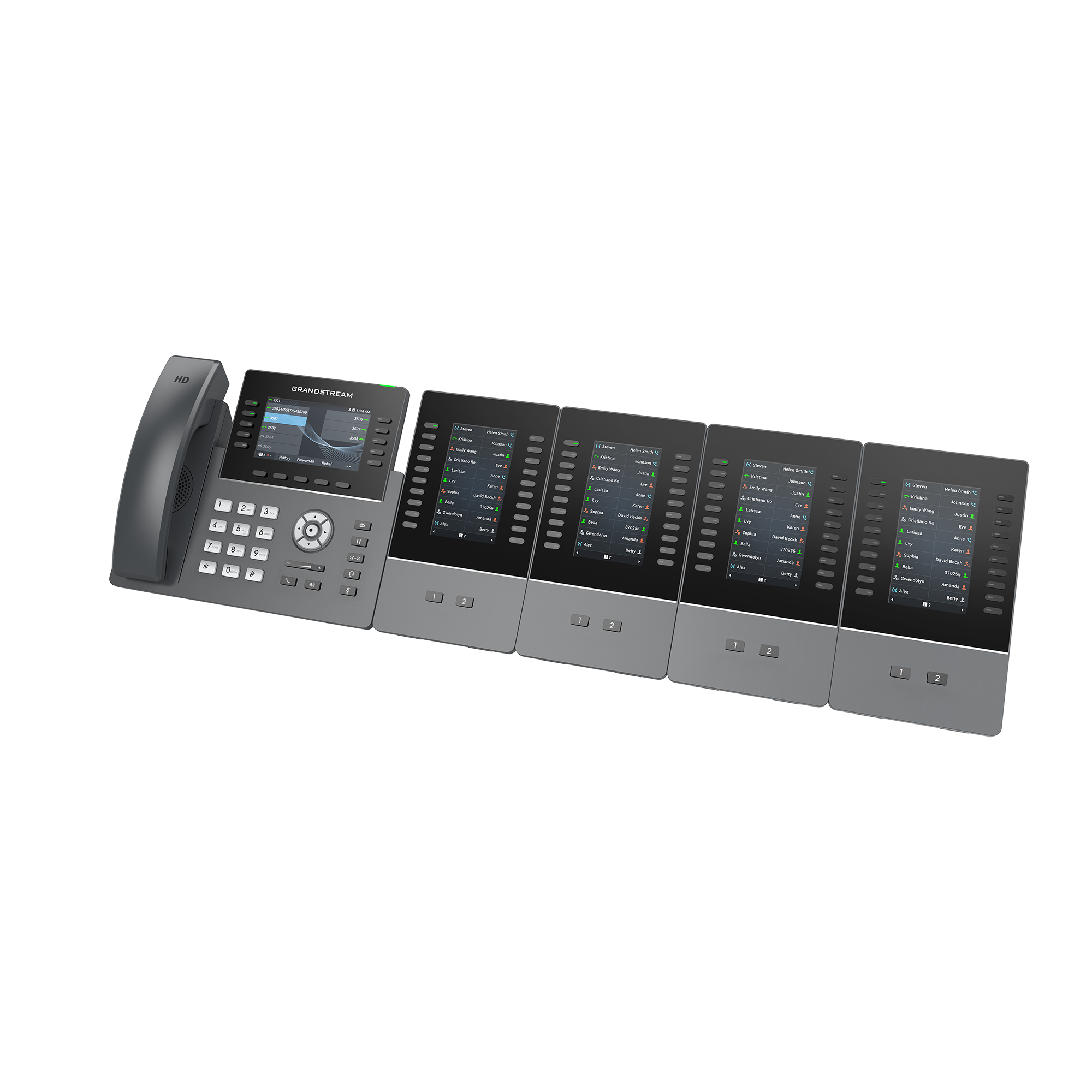
Representative reception-oriented setup: a compatible Grandstream professional phone can be expanded with GBX20 modules when the selected model and workflow require more visible contacts and call-control keys.
What Makes an IP Phone Suitable for a Reception Desk?
A reception phone must make frequent call actions visible and quick. A basic SIP handset may be perfectly adequate for an occasional caller, but a receptionist often needs to monitor colleagues, answer several call paths, park and retrieve calls, transfer callers without delay, use a headset comfortably and reach frequently contacted extensions with minimal menu navigation.
Grandstream’s professional GRP family provides several phones that can be selected for this role. The range is designed for managed business deployment and includes models with different line capacities, displays, programmable keys, network interfaces and wireless features. Grandstream Device Management System support on the GRP family gives administrators a centralized way to provision and manage endpoints, which is valuable when a business has one receptionist today but expects to standardize phones across departments or branches later.
For a smaller front desk, a model such as the GRP2614 can provide a compact professional layout with dual displays and digital BLF visibility. A busier operator may require the additional built-in key capacity of the GRP2615, while the GRP2670 brings a large touch interface and can also work with the GBX20 extension module. The correct choice is not simply the model with the largest screen. It is the phone that places the required call functions in front of the user without creating unnecessary complexity.
The surrounding telephone system is equally important. An IP phone must register to a compatible IP PBX, hosted PBX or SIP platform. Network addressing, voice VLANs, Power over Ethernet (PoE), firewall rules, quality-of-service settings and SIP account details may all affect deployment. A phone can have excellent hardware and still be a poor purchase if the business platform does not support the intended provisioning method or if the front desk needs features that have not been configured in the PBX.
FourTeck helps UAE buyers approach the purchase as a workflow decision. Share the current PBX or hosted service, approximate daily call pattern, required number of monitored extensions, headset preference, network switch type, user quantity and delivery location. Those details make it easier to recommend a suitable Grandstream reception IP phone, identify whether a GBX20 side module is useful, and avoid paying for capabilities the operator will not use.
Why Reception Teams Benefit from the Right Phone Level
The business value comes from faster, more predictable call handling rather than from buying the phone with the longest specification list. A well-matched endpoint reduces the number of steps between answering a caller and connecting that person with the right colleague.
Fewer steps during busy call periods
Reception work becomes inefficient when every transfer requires searching a directory or moving through several menus. Professional GRP models offer more visible keys, line information and programmable actions than basic phones. Where a compatible model is used, the GBX20 can extend that visibility further. The result is a desk layout that can be mapped to departments, managers, call park positions or frequently contacted users. The exact programming depends on the PBX and business call plan, but the goal is consistent: make repeated actions easier to reach.
Better extension awareness
Busy Lamp Field (BLF) functions can show the status of configured extensions when supported and correctly provisioned. A receptionist who can see whether a colleague is busy or available can make better transfer decisions and reduce unnecessary call bouncing.
Professional daily calling
HD audio support on professional GRP models helps create a clearer handset and speakerphone experience. For a reception user who may spend much of the day speaking with customers, suppliers and internal teams, consistent voice quality is a practical productivity requirement rather than a cosmetic feature.
More comfortable long-call workflows
Bluetooth is integrated on several professional GRP models, while headset support varies by model and accessory. A suitable headset can let a front-desk operator type, check visitor details or consult an internal system while continuing a conversation. Compatibility should be confirmed before ordering the phone and headset together.
Cleaner desk deployment with PoE
Selected professional models provide Gigabit Ethernet and integrated PoE. When the network switch supplies compatible PoE, the phone can receive network connectivity and power through the structured cabling plan. This can reduce separate adapters at a busy counter and makes UPS-backed voice continuity easier to plan from the network cabinet.
A reception phone that can fit a wider rollout
Grandstream’s GRP family is supported by GDMS for centralized provisioning, management and monitoring. That matters when the reception desk is one part of a larger deployment. IT teams can standardize settings, prepare devices for branches and maintain a more consistent endpoint estate instead of configuring every phone independently. The practical benefit is reduced operational friction when phones are added, moved or replaced across a growing organization.
Reception Capability Is About the Complete Desk Setup
A professional reception endpoint combines call visibility, fast access to functions, good audio, manageable provisioning and the right expansion path. Grandstream offers several ways to build that combination, which is why model selection should begin with the operator’s workload rather than a fixed specification.
The GRP2614 provides a professional four-line format with dual displays, digital BLF keys, Gigabit PoE, Wi-Fi, Bluetooth and GDMS support. It is useful when the front desk needs stronger control than an essential handset but does not require an external extension module. The GRP2615 increases the call-control ceiling with ten line keys, support for up to sixteen SIP accounts and forty built-in digital BLF keys. It is also compatible with the GBX20, making it a particularly practical choice when a receptionist must monitor many extensions.
For users who prefer a larger touch interface, the GRP2670 provides twelve lines, sixteen SIP accounts, forty-eight virtual multi-purpose keys and a seven-inch capacitive touchscreen. It also supports the GBX20. On compatible hardware versions, Grandstream lists integrated dual-band Wi-Fi 6, alongside Bluetooth and Gigabit PoE networking. This combination can suit executive reception, customer-service coordination or central front-office positions where screen space and visible actions matter.
The GBX20 is not a universal add-on for every Grandstream phone. It is designed for selected GRP and GXV models. Each module offers two pages of twenty keys, supporting up to forty contacts or extensions, and up to four modules can be daisy-chained on supported phones for as many as 160 contacts or extensions. Buyers should confirm the exact host phone before purchasing any extension module.
Grandstream Reception Phone Specifications to Compare
Because “reception IP phone” describes a business role rather than one fixed model, the technical specification is configuration dependent. The table below shows verified characteristics of representative professional GRP options and the GBX20 expansion path so buyers can identify which details affect the purchase decision.
| Decision Field | Reception Buying Guidance |
|---|---|
| Brand | Grandstream |
| Product class | Professional SIP / VoIP desk phones selected for reception and high-call-volume roles |
| Representative models | GRP2614, GRP2615, GRP2616 and GRP2670; final choice depends on required workflow |
| Lines / SIP accounts | GRP2614: 4 line keys, up to 12 SIP accounts; GRP2615: 10 line keys, up to 16 SIP accounts; GRP2616: 6 line keys, up to 16 SIP accounts; GRP2670: 12 lines, 16 SIP accounts |
| Display | Model dependent. GRP2614 and GRP2616 use dual-display layouts; GRP2670 uses a 7-inch 1024×600 capacitive touchscreen |
| Programmable / BLF capacity | Model dependent. GRP2615 includes 40 built-in digital BLF keys; GRP2670 provides 48 virtual multi-purpose keys |
| Extension-module support | GBX20 supported on selected models including GRP2615 and GRP2670; not universal across the GRP range |
| GBX20 capacity | Up to 40 contacts/extensions per module; up to four compatible modules can provide 160 contacts/extensions |
| Network | Named professional models provide dual auto-sensing Gigabit Ethernet ports with integrated PoE |
| Wireless | Integrated Wi-Fi and Bluetooth are available on the professional examples above; Wi-Fi generation can depend on model and hardware revision |
| Audio | HD audio capabilities are available on the named professional models; conference and noise-control features vary by model |
| Management | Grandstream Device Management System (GDMS) support on GRP professional models |
| Security | Professional examples include secure boot, dual firmware images and encrypted data storage |
| PBX / SIP compatibility | Configuration dependent; confirm the target IP PBX, hosted platform or SIP provider before purchase |
| Power planning | PoE is available on named models; switch PoE budget and any required power adapter should be checked for the selected deployment |
| Warranty / supply terms | Based on selected model, supplier channel and current quotation; contact FourTeck for current options |
When choosing between these models, count the actions the receptionist needs to see at one time. A business with a few departments may be comfortable with a compact phone and digital BLF pages. A central operator monitoring dozens of users may benefit from a model that supports the GBX20. If a large touch interface matters more than physical side keys, the GRP2670 may deserve consideration. If the priority is dense extension visibility with a more traditional desk layout, the GRP2615 can be a practical candidate. FourTeck can help translate the call-flow requirement into a shortlist before a quotation is prepared.
How to Choose the Right Grandstream Reception Configuration
Start with the reception workflow, then match the phone. The highest-risk mistake is choosing by screen size or visible price before confirming how many extensions, call paths and repeated functions the operator must manage.
How many extensions must be visible?
List the people, departments and park positions the receptionist needs to reach quickly. If the number exceeds the practical built-in key layout, consider an expansion-compatible model rather than assuming a sidecar can be added later to any phone.
Which PBX or hosted platform will register the phone?
Provide the PBX brand and model, hosted service name or SIP-provider details. This helps identify provisioning requirements, supported call features and whether specific firmware or templates are needed.
Will the desk use PoE, Wi-Fi or both?
Wired Ethernet with PoE is common for fixed reception desks because it can simplify power and network management. Wi-Fi may be useful where structured cabling is difficult, but the final design should consider coverage, reliability and voice-network policy.
What headset will the receptionist use?
Headset compatibility can depend on connector type, Bluetooth support, electronic hook-switch requirements and the exact phone model. Include the headset requirement in the quote rather than treating it as an accessory decision after installation.
How will calls be routed and parked?
The handset alone does not define the reception experience. Ring groups, queues, transfer rules, BLF subscriptions, call park positions, hunt behavior and after-hours routing live in the broader phone system and must be designed with the user interface in mind.
Will the business add users or branches?
If the reception desk is part of a wider rollout, standardization and centralized device management become more important. Selecting a GRP model that fits the organization’s longer-term endpoint plan can reduce future rework.
For a useful quote, send FourTeck the preferred model if known, required quantity, current PBX or hosted platform, approximate number of monitored extensions, headset preference, whether PoE is available, delivery location and any installation or configuration requirement. If you do not know the model, send the workflow instead. That often leads to a better recommendation.
Where Reception-Focused Grandstream Phones Fit Best
These phones suit environments where one desk acts as a communication junction. The same hardware can serve different industries, but the call flow, extension map and accessory choices should reflect the actual workplace.
Corporate Reception and Main Switchboard
A main office reception desk may answer a public number, transfer callers to several departments, monitor key staff and retrieve parked calls. This is the strongest use case for evaluating visible BLF capacity and expansion support. A compatible GRP phone with GBX20 modules can create a clear map of extensions when the organization has more users than the built-in key layout comfortably displays. The PBX call plan should be designed at the same time so keys and call behavior match.
Clinic or Medical Front Desk
Clinics often route calls among reception, appointments, nursing stations, billing and administration. A professional desk phone can help the front-desk user keep frequent destinations visible while a headset leaves both hands free for appointment systems. Any integration with specific clinical software is separate and should not be assumed from the phone alone.
Hotel, Serviced Office or Hospitality Desk
Hospitality reception can involve transfers to departments, managers, guest services and back-office teams. A phone with strong line visibility and quick access to programmed destinations can reduce the time spent navigating directories. The hotel PBX design, room-phone environment and any property-management integration should be reviewed separately.
School or Campus Administration
A school office may need rapid contact with leadership, security, nurse stations, maintenance and departments. BLF and speed-dial layouts can turn the reception phone into a practical internal communications panel. The wider network should also consider paging, emergency procedures and power continuity where those functions are required.
Logistics, Warehouse and Service Counter
Front counters in logistics and industrial environments often coordinate with stores, loading areas, finance, drivers and management. A fixed IP phone gives the counter a stable extension while programmable keys reduce repeat dialing. Network quality, cable protection and any need for cordless mobility should be evaluated as part of the site design.
Shared Customer-Service Coordination
A small support team may use one senior desk as the point for escalations, transfer control and departmental visibility. In this case, the receptionist-style phone can complement agent phones rather than replace a dedicated contact-center platform. Queue reporting, recording and supervisor features depend on the PBX or service platform.
Grandstream Reception IP Phones + BLF and Programmable Call Control
BLF and programmable keys matter because receptionists repeat the same call actions many times each day. When the PBX supports the required subscriptions and the keys are configured correctly, BLF can provide at-a-glance extension status while programmable actions can be assigned to speed dial, call park, pickup and other functions.
The practical decision is how many destinations need immediate visibility. A GRP2615 provides forty built-in digital BLF keys, while a GRP2670 provides forty-eight virtual multi-purpose keys. If the user needs a larger extension map, compatible phones can use the GBX20. Each GBX20 offers twenty keys on each of two pages for up to forty contacts or extensions per module, and Grandstream supports up to four modules on compatible host phones.
More keys are not automatically better. A poorly planned 100-key layout can be harder to operate than a well-organized 30-key layout. Grouping staff by department, placing urgent destinations in consistent positions and limiting the screen to functions the operator actually uses can make the desk easier to learn. FourTeck can help buyers determine whether they need a compact digital-key workflow or a physical extension-panel approach before the hardware is ordered.
Grandstream Reception IP Phones + Centralized Device Management
A reception phone should be easy for the user, but it also needs to be manageable for IT. Grandstream’s GRP series works with GDMS, the manufacturer’s centralized platform for provisioning, configuration, monitoring, firmware management and broader endpoint administration.
For procurement teams, this matters because phone selection affects the cost of ongoing administration. A model that fits the organization’s management approach may be more valuable than one that saves a small amount on the initial handset price but requires a different provisioning process. It also helps when replacement phones are needed: a standardized model family can make configuration and user training more predictable.
Centralized management does not remove the need for network and PBX planning. SIP credentials, firewall policy, voice VLANs, DNS, time settings and call permissions still need to be designed correctly. FourTeck can help buyers identify the endpoint side of the requirement and coordinate the discussion around PBX compatibility, while final deployment settings should reflect the customer’s chosen platform and security policy.
Grandstream Reception IP Phones + Network, Headset and Power Planning
The best reception handset still depends on the network around it. For a fixed front desk, Gigabit Ethernet and PoE can simplify installation, while integrated Wi-Fi and Bluetooth on selected professional GRP models add placement and headset flexibility. The right combination depends on how the site is wired and how critical the reception position is.
Decision checklist
- Confirm the switch has available PoE capacity.
- Check whether the desk requires a separate PC passthrough connection.
- Review voice VLAN and QoS requirements.
- Confirm headset interface and preferred wearing style.
- Decide whether Wi-Fi is a fallback, a requirement or unnecessary.
- Protect the PBX and PoE switching path with suitable power continuity where uptime matters.
Power planning is especially important at reception because a phone powered from a PoE switch can remain part of a centrally backed-up communication path when the switch and PBX are connected to an appropriate UPS. If every phone uses an individual wall adapter that is not protected, a power interruption can remove the desk phone even when the network core remains available. The final continuity plan depends on the customer’s infrastructure and should be designed as a system.
Headsets deserve the same early attention. A receptionist may answer hundreds of calls and spend long periods using both a PC and phone. Bluetooth support on selected models can provide wireless convenience, but a buyer should still confirm the exact headset, call-control method and any required accessory. Buying the headset after the phones arrive can create avoidable compatibility delays.
Finally, do not use Wi-Fi simply because it is available. A fixed wired connection is often easier to control for a critical desk, while Wi-Fi can be useful when cabling is impractical or when the desk location may change. FourTeck can help buyers identify the network questions that should be answered before the order is finalized.
What Buyers Should Check Before Purchase
The main purchase risk is choosing a phone that looks suitable but does not match the PBX, key-count requirement or accessory plan. Before requesting a quote, define the receptionist’s daily call actions and the surrounding telephone infrastructure so the selected model can be configured for the role.
Configuration Fit
Count the SIP identities, visible extensions, call park positions and repeated functions required at the desk. Decide whether a compact dual-display phone is enough or whether the user needs the larger built-in key capacity and expansion path of a model such as the GRP2615 or GRP2670. Also decide whether the receptionist prefers touch navigation, physical side keys or a mix of both.
Compatibility Check
Confirm the IP PBX or hosted SIP platform, provisioning method, network addressing, VLAN policy, PoE switch capability and headset type. If a GBX20 is required, verify the exact host phone because expansion-module support is model specific. For existing phone systems, include the current firmware and platform details when requesting compatibility advice.
Availability and Warranty
Current availability can vary by model, quantity, supplier channel and hardware revision. Warranty terms can also depend on the supplied product and quotation. Ask for the exact model code, included accessories, warranty handling and expected delivery arrangement rather than assuming that every listing represents the same package.
Quote Preparation
Provide quantity, delivery location, target date, current phone system, number of extensions the receptionist must monitor, headset preference, PoE availability, desired extension-module capacity and whether installation or configuration support is required. If the project includes many phones, separate reception, manager and standard-user requirements so each role can receive an appropriate model.
Buyers should also consider long-term operating cost. An oversized phone can waste budget at a simple desk, while an underspecified handset can create daily friction for a high-volume receptionist. Standardizing on a manageable family can reduce training and administration effort. FourTeck can review comparable Grandstream models and suitable alternatives when the original request is unavailable or when another model better matches the number of keys, display preference or expansion requirement.
Grandstream Reception Phone Availability and Service Support
FourTeck supports Grandstream phone inquiries across Dubai and the UAE with product-selection, quotation and deployment guidance. Availability is not presented as fixed because it can change by exact model, quantity, supplier status, hardware revision and requested accessories.
For project purchases, FourTeck can also help organize reception phones separately from standard staff phones. This avoids a common procurement problem where every user receives the same handset despite very different calling roles. A front desk may need larger key capacity or an expansion module, while many office users need only a simpler endpoint. Role-based selection can improve usability without turning the whole deployment into a premium-phone project.
Dubai, Abu Dhabi, Sharjah and Ajman Business Coverage
Businesses in Dubai, Abu Dhabi, Sharjah and Ajman can contact FourTeck for Grandstream reception-phone selection, current availability checks, quote assistance and delivery coordination. The most useful inquiry includes the exact phone model if already specified, or the reception workflow if the model is still undecided. That allows the sales and technical discussion to focus on the number of extensions, PBX environment, key requirements and accessories rather than only the handset name.
For multi-site UAE projects, it is also helpful to state whether every branch uses the same PBX or hosted platform. A standardized configuration may simplify deployment, but different sites can have different cabling, PoE, internet and reception requirements. FourTeck can help buyers structure those differences before the final product list is prepared.
GCC and Africa Availability Guidance
FourTeck also supports business technology inquiries through selected regional channels for customers in markets such as Saudi Arabia, Qatar, Oman, Kuwait, Bahrain, Kenya, Uganda and the wider Africa region. Product availability, delivery options, warranty handling, import requirements and configuration support can differ by country, so regional requests should be treated as project-specific rather than as an extension of UAE stock assumptions.
For a reception-phone project outside the UAE, share the destination country, quantity, required phone models or user roles, PBX platform and any need for GBX20 modules. Power accessories, shipping arrangements and warranty processes should be confirmed for the destination before ordering. This is especially important when a project includes multiple branches or a mixture of professional and standard user phones.
Regional inquiry paths include FourTeck Kenya, FourTeck Uganda, FourTeck Africa and FourTeck Kuwait. Buyers can use the relevant regional channel to discuss local delivery and support expectations.
Other Grandstream Products Buyers May Consider
The closest alternative depends on whether the buyer needs more key capacity, a larger screen, a simpler professional phone or the PBX behind the reception desk. These FourTeck pages can help narrow the surrounding solution without treating every model as equally suitable.
Grandstream GRP2615
A strong reception candidate when the buyer wants ten line keys, up to sixteen SIP accounts, forty built-in digital BLF keys and compatibility with the GBX20 expansion module.
Grandstream GRP2670
Consider this model when a seven-inch touch display, twelve lines, sixteen SIP accounts, forty-eight virtual multi-purpose keys and GBX20 compatibility align with the user’s workflow.
Grandstream GRP2614
A compact professional option with four line keys, dual displays and digital BLF capability for reception desks that do not need a separate expansion module.
Grandstream GRP2616
Useful for professional users who want six line keys, up to sixteen SIP accounts and a dual-display layout without an external expansion module.
Grandstream GBX20
The extension module to review when a compatible receptionist phone needs additional BLF, speed-dial and call-control visibility.
Grandstream UCM6301
A related IP PBX option for businesses building the call-control platform behind Grandstream endpoints, subject to user, trunk and call-capacity requirements.
Why Business Buyers Contact FourTeck
Reception-phone procurement is easier when product selection, compatibility and accessories are reviewed together. FourTeck supports the buying process by helping customers organize the requirement before a model is finalized.
This approach is useful for both small offices and larger deployments. A five-user office may need one capable reception phone and four simple endpoints. A multi-floor organization may need a central receptionist with expansion keys, several department coordinators and a standardized fleet of professional phones. By separating user roles before ordering, the buyer can create a cleaner bill of materials and avoid forcing one handset type onto every desk.
Grandstream Reception Phone FAQs
Which Grandstream phone is suitable for a reception desk?
The right model depends on call volume, required SIP accounts, visible extension keys, display preference and whether an expansion module is needed. GRP2614, GRP2615, GRP2616 and GRP2670 are professional options with different layouts. For a high-volume receptionist who needs many monitored extensions, a GBX20-compatible model such as the GRP2615 or GRP2670 may be particularly useful.
Can a Grandstream reception phone monitor staff extensions?
Professional Grandstream phones can provide BLF and programmable-key functions when the feature is supported and configured through the phone system. BLF can help a receptionist see extension status and make quicker transfer decisions. The exact behavior depends on the IP PBX or hosted platform, extension permissions and provisioning, so the handset and PBX configuration should be planned together.
Do I need a GBX20 extension module for reception?
Not always. A receptionist who monitors a moderate number of users may be comfortable with the phone’s built-in digital keys. The GBX20 becomes valuable when the desk needs more visible contacts, speed-dial destinations or call-control positions. It is compatible only with selected Grandstream phones, so the host model should be confirmed before ordering the module.
Will these phones work with my existing IP PBX?
Compatibility is configuration dependent. Grandstream professional phones are SIP-based, but buyers should confirm the target PBX or hosted service, provisioning method, firmware requirements and supported call features. Share the PBX brand and model or the hosted service name with FourTeck so the compatibility discussion can happen before the phone is purchased.
Can the receptionist use a wireless headset?
Several professional GRP models include Bluetooth, which can support compatible wireless-headset workflows. Headset support still depends on the exact phone and headset, and some users may prefer wired or electronic-hook-switch options. Include the headset model or desired headset type in the purchase request so compatibility and any required accessory can be checked.
Do Grandstream reception phones support PoE?
The professional examples covered here, including GRP2614, GRP2615, GRP2616 and GRP2670, provide Gigabit Ethernet ports with integrated PoE. The network switch must supply compatible PoE and have enough available power budget. Buyers should also check whether power continuity is required for the reception desk and protect the related switch and PBX appropriately.
Is a large touchscreen always better for reception?
No. A large touch display can make navigation and information easier to view, but some receptionists prefer physical or dedicated programmable keys for repeated actions. The GRP2670 offers a large seven-inch touch interface, while other GRP models use more traditional layouts. The operator’s workflow, training and number of visible extensions should drive the decision.
Can FourTeck supply phones for a complete office deployment?
Businesses can request a project quotation that separates reception users, managers and standard desk users. This helps avoid purchasing premium reception-level phones for employees who only need basic calling. Share the user count by role, PBX platform, required accessories, branch locations and delivery schedule so FourTeck can help structure a more practical product list.
How do I request a UAE quote for a reception phone?
Send the preferred Grandstream model if known, required quantity, delivery location, current PBX or hosted service, approximate number of extensions the receptionist must monitor, headset preference, PoE availability and any installation requirement. If you are unsure about the model, describe the call-handling workflow and FourTeck can help narrow suitable options before the quotation is prepared.
Does price and availability depend on the selected model?
Yes. Grandstream reception-oriented phones cover several professional models with different screens, key capacity and expansion options, so pricing and availability can vary materially. Quantity, supplier status, hardware revision, included accessories and warranty terms can also affect the quotation. Ask FourTeck for the exact model and current commercial terms rather than relying on one generic price for every reception setup.
Need Help Choosing the Right Reception Phone?
FourTeck can review the receptionist’s call volume, number of monitored extensions, PBX platform, headset requirement, PoE environment, expansion-module need, quantity, delivery location and warranty expectations before preparing a quote. A short description of the workflow is often enough to determine whether the business needs a compact professional handset or a more expandable front-desk setup.
Share these details: preferred model or user role, quantity, PBX or hosted platform, number of extensions to monitor, headset preference, PoE availability, delivery city and required support scope.