
Grandstream VoIP Gateways in Dubai, UAE
A flexible gateway family for connecting analog phones, PSTN lines, legacy PBX equipment, fax devices, and digital carrier trunks with SIP-based voice networks.
The correct gateway is determined first by interface direction and port density: FXO models connect outside analog lines to an IP environment, FXS models provide analog station ports for phones and fax machines, while the GXW4500 family addresses E1/T1/J1 digital trunk integration. FourTeck can review these choices before quotation so the selected model matches the existing PBX, carrier circuits, user count, cabling, and migration plan.
SIP / PBX Compatibility Review
UAE Quote Assistance
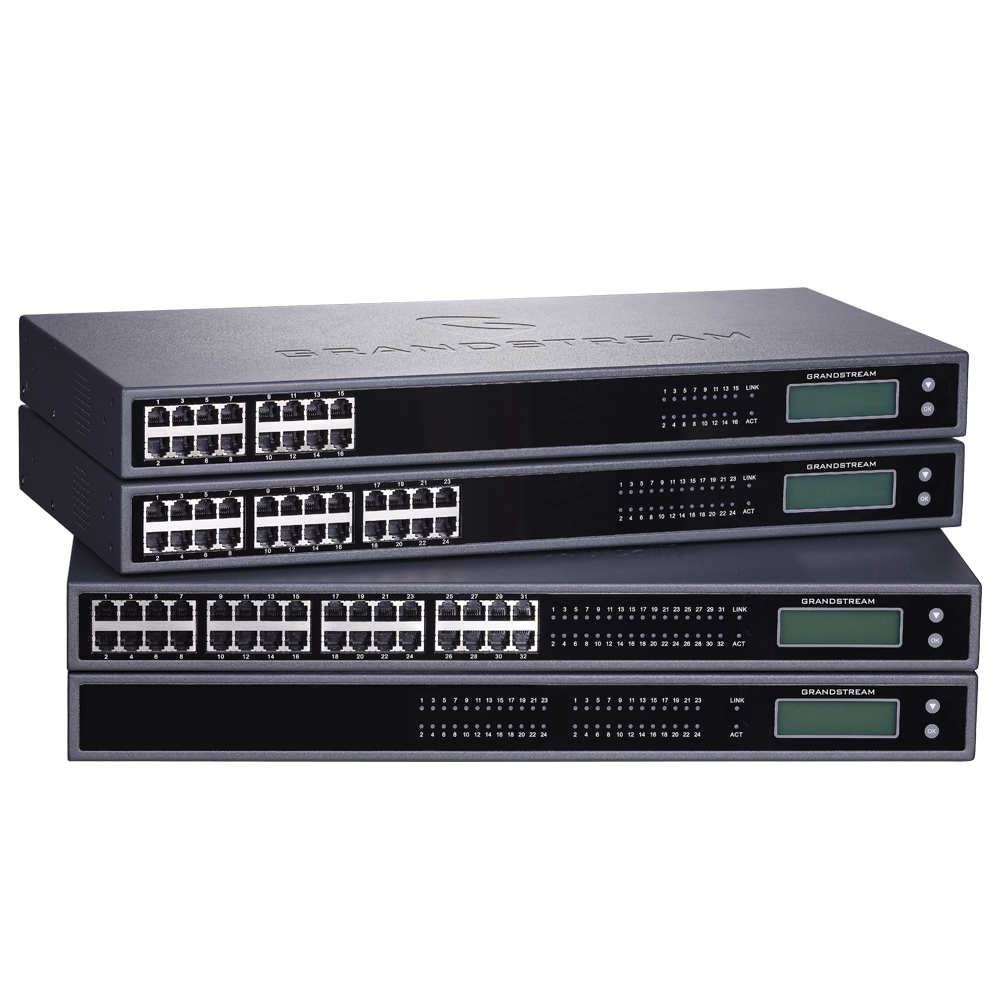
Official Grandstream GXW4200 Series product imagery shown as a representative high-density FXS gateway family. Physical design, port layout, and interfaces vary by selected model.
Choose the Gateway by Telephony Interface First
The most important first decision is not the number of ports; it is whether the project needs FXO, FXS, or a digital trunk gateway. Once that direction is clear, port count and management requirements can be matched to the appropriate Grandstream family.
What Grandstream VoIP Gateways Do in a Business Network
In simple terms, a voice gateway translates between traditional telephone interfaces and an IP-based calling environment. That translation lets a business modernize its communications platform while keeping useful analog phones, fax machines, PBX extensions, PSTN lines, or digital carrier trunks where they remain operationally necessary.
Grandstream approaches this requirement through several gateway families rather than one universal appliance. The GXW4104 and GXW4108 are FXO gateways with four or eight FXO ports. FXO ports face the public switched telephone network side of an analog deployment, so these models are commonly evaluated when an IP PBX must receive or place calls over existing analog PSTN lines. Grandstream specifies two 10/100 Mbps network ports, broad codec support, flexible dial plans, SRTP security protection, interoperability with SIP-based platforms, and PSTN failover on power failure for the GXW410x family.
The GXW4200 v2 family addresses a different requirement: high-density FXS connectivity. FXS ports provide station-side analog interfaces for endpoints such as conventional telephones and fax devices. Grandstream positions this family for hybrid IP and analog deployments and lists GXW4216 v2, GXW4224 v2, GXW4232 v2, and GXW4248 v2 configurations. Official specifications include a Gigabit network port, a backlit 132 x 48 graphic display, four SIP server profiles per system, independent SIP accounts per port, SRTP/TLS/HTTPS protection, wideband codec support including Opus and G.722, and security measures such as secure boot, unique certificates, random default passwords, and dual firmware images.
For organizations working with digital PSTN or ISDN trunks, the GXW4500 series moves beyond analog station and line interfaces. It supports software-configurable E1/T1/J1 connections and protocols including PRI, SS7, and MFC R2. Grandstream also lists dual Gigabit Ethernet, TLS and SRTP, automated provisioning through HTTP/TFTP with XML configuration files, multiple voice codecs, and T.38 Fax-over-IP support.
For UAE buyers, this portfolio approach is useful because migration projects rarely look identical. A small branch may need only a few analog PSTN lines integrated with an IP PBX, while a hotel or campus may need dozens of analog room phones kept in service during a phased migration. A larger enterprise may have an E1 circuit that must interoperate with a SIP platform. FourTeck can help identify the interface type, port count, PBX compatibility, expected call load, network requirements, and deployment constraints before the order is finalized.
Key Business Benefits of a Planned Gateway Deployment
The value of a gateway is highest when it solves a specific migration or interoperability problem. Instead of replacing every telephone device or carrier interface at the same time, the business can introduce SIP-based communications in a controlled way and preserve equipment that still has practical value.
Modernize Telephony Without a Forced Rip-and-Replace
A gateway can preserve analog endpoints or trunks while the call-control platform moves to SIP. This is particularly useful in hotels, warehouses, clinics, schools, apartment management environments, and older offices where analog devices are numerous, embedded in operations, or expensive to replace all at once. The project can focus first on PBX modernization and call routing, then replace endpoints later when there is a business reason to do so.
Match Port Density to the Site
Grandstream offers low-density FXO and higher-density FXS families, which helps avoid buying an appliance that is either undersized or unnecessarily large. Port planning should include currently connected lines or devices, near-term expansion, spare capacity, and the physical termination method required by the chosen model.
Bridge Existing PBX and SIP Environments
The gateway becomes an interoperability boundary between the analog or digital side and the IP side. That allows organizations to retain existing call paths while moving extensions, trunks, or locations toward modern IP telephony. Compatibility must still be reviewed against the actual PBX, softswitch, SIP provider, codec plan, and dialing rules.
Centralized Provisioning and Ongoing Administration
Grandstream documents centralized management through its Grandstream Device Management System (GDMS) for supported Grandstream products, with functions such as provisioning, configuration, firmware management, monitoring, alarms, and batch administration. For multi-site projects, centralized tools can reduce repetitive setup work and make ongoing configuration changes easier to coordinate. Buyers should confirm support for the exact gateway model and firmware before making management architecture a purchase requirement.
Use Protected SIP Signaling and Media Where Supported
Security capabilities vary by family. Grandstream lists SRTP on GXW410x and SRTP/TLS/HTTPS on GXW4200 v2, while GXW4500 also supports TLS and SRTP. These capabilities matter when the deployment policy requires encrypted signaling or media, but they must be aligned with the PBX, provider, certificates, network firewall, and security configuration.
Plan for Telephony Continuity
Continuity needs differ sharply between sites. The GXW410x family includes PSTN failover during power failure, while newer HT841/HT881 alternatives include a lifeline relay from FXS to FXO. Buyers should map which calls must remain possible during power, WAN, SIP, or PBX outages and then confirm whether the chosen design meets that requirement.
A Portfolio Built Around Different Telephony Boundaries
Grandstream VoIP Gateways are best understood as three main deployment directions. The GXW410x line converts analog PSTN interfaces toward the IP PBX side; the GXW4200 v2 family delivers many FXS station ports for analog endpoints; and the GXW4500 series connects digital E1/T1/J1 trunks to VoIP. This distinction is more important than comparing model names alone because each family sits at a different point in the telephony architecture.
Across the portfolio, Grandstream emphasizes SIP interoperability, codec support, deployment controls, and security functions. The higher-density GXW4200 v2 models add Gigabit networking, a front-panel graphic display, four SIP server profiles, per-port SIP accounts, wideband audio support, and security measures intended for larger deployments. The GXW4500 family focuses on digital trunk protocols and automated provisioning, while the GXW410x family retains a simpler FXO-oriented architecture for analog line integration.
Grandstream Gateway Family Specification Guide
Specifications vary substantially by gateway family. Use this table to identify the correct architecture, then confirm the exact model datasheet before procurement. Port counts, connectors, network interfaces, protocols, security features, and physical deployment details are based on the selected model.
| Specification | GXW4104 / GXW4108 | GXW4200 v2 Series | GXW4500 Series |
|---|---|---|---|
| Gateway role | Analog FXO gateway | High-density analog FXS gateway | Digital E1/T1/J1 VoIP gateway |
| Primary interface | 4 or 8 FXO ports | 16, 24, 32 or 48 FXS family options; connector style depends on model | Software-configurable E1/T1/J1 |
| Network | 2 x 10/100 Mbps ports | 1 x Gigabit network port | Dual Gigabit auto-sensing RJ45 ports with integrated NAT router |
| SIP / telephony | SIP-based interoperability, flexible dial plans, caller ID and codec support | 4 SIP server profiles per system; independent SIP account per port | Supports PRI, SS7 and MFC R2 on digital trunk side |
| Voice codecs | Comprehensive codec support; exact codecs based on model documentation | Wideband support includes Opus and G.722 | Includes Opus, G.722, G.729, iLBC and additional codecs |
| Security | SRTP | SRTP, TLS, HTTPS; secure boot, unique certificate, random default password, dual firmware images | TLS and SRTP |
| Fax support | Configuration dependent; confirm exact model requirements | Configuration dependent; confirm selected model and fax workflow | T.38 Fax-over-IP supported |
| Display | Based on selected model | 132 x 48 backlit graphic display | Based on selected model |
| Provisioning / management | Model documentation and supported management tools should be confirmed | Grandstream management and provisioning options; confirm exact model/firmware support | HTTP/TFTP with XML configuration files |
| Continuity feature | PSTN failover on power failure | Deployment dependent; design continuity at PBX, network and power layers | Deployment dependent |
| Best suited for | Existing analog PSTN lines into hosted or on-premise IP PBX | Many analog phones/fax devices integrated with SIP | Digital PSTN/ISDN trunks integrated with VoIP networks |
| Warranty / availability | Contact FourTeck for current options | Contact FourTeck for current options | Contact FourTeck for current options |
A buyer should treat the interface row as the gating decision. If the requirement is to connect analog telephone lines from the carrier to an IP PBX, evaluate FXO gateways. If the requirement is to keep analog handsets, fax machines, modems, or PBX station devices while moving call control to SIP, evaluate FXS. If the carrier presents E1/T1/J1 rather than individual analog lines, the GXW4500 digital family is the relevant starting point. After interface type, confirm port quantity, cabling and connectors, codec expectations, fax behavior, call routing rules, security policy, provisioning method, rack or equipment-room conditions, and the exact PBX or SIP provider. This order of decisions prevents the common mistake of selecting a gateway based only on port count.
Configuration and Buyer Guidance
The highest-risk purchase decision is confusing FXO and FXS. They are not interchangeable labels. Confirm what the gateway must connect on each side before discussing price, port count, or delivery.
Are you connecting carrier lines, analog devices, or a digital trunk?
Carrier analog lines generally point toward an FXO gateway. Analog phones and fax devices need FXS station ports. E1/T1/J1 carrier circuits call for a digital gateway. Write down what physically connects to the gateway today, not only the PBX brand or the number of users.
How many ports are needed now and later?
Count active analog devices or trunks, then include reasonable spare capacity. A 16-port gateway can be efficient for a modest block of analog extensions, while hospitality, education, and campus sites may justify 24, 32, or 48-port planning.
Which PBX or SIP platform will register the gateway?
Provide the PBX model, software version, SIP provider if used, network topology, and whether registration is per port or through a shared trunk design. Interoperability is broad, but project success still depends on matching authentication, codecs, DTMF, dialing rules, NAT, firewall, and security settings.
How will analog pairs terminate at the gateway?
Connector layout varies. Some high-density models use many individual ports while the GXW4248 family includes 50-pin Telco connectors. Confirm patching, punch-down blocks, rack placement, cable lengths, labeling, and who will perform the physical migration before the equipment arrives.
Do fax, caller ID, alarms, or special analog devices matter?
Not every analog workload behaves like a standard voice handset. Faxing, door phones, legacy modems, elevator or emergency systems, analog paging interfaces, and alarm lines may have special electrical, codec, or carrier requirements. Validate these use cases individually rather than assuming voice compatibility guarantees every legacy device will work.
What must still work during a failure?
Identify required behavior during power failure, internet outage, SIP-provider loss, PBX failure, and local network disruption. Then design UPS capacity, failover routing, secondary SIP servers, PSTN lifelines, and operational procedures around the actual business risk.
For a useful quote, send FourTeck the gateway role (FXO, FXS, or digital), required port count, exact PBX or SIP service, quantity, delivery location, target date, cabling or rack requirements, fax needs, security expectations, and any critical legacy devices. Those details allow the sales and pre-sales team to focus on configuration fit rather than quoting a model that may not suit the deployment.
Ideal Business Use Cases
A gateway fits best where the business has a clear reason to preserve traditional telephony while adopting SIP. The strongest use cases are usually migration, trunk integration, analog endpoint density, or continuity requirements rather than greenfield sites where every endpoint can be IP-native from day one.
Phased Migration from Legacy PBX or Analog Extensions
Organizations often modernize call control before they replace every field device. A high-density FXS gateway can keep analog handsets or fax machines connected while an IP PBX takes over extension management and routing. This is especially practical in buildings where recabling is disruptive, where analog phones are built into rooms or public areas, or where the installed endpoint base is too large to replace in one budget cycle. The gateway creates a controlled bridge: existing analog pairs stay in service while the central platform adopts SIP.
Hotels and Hospitality Properties
Guest rooms, service areas, lifts, back offices, and operational spaces may still rely on analog telephones. High-density FXS gateways can help preserve those endpoints during PBX modernization. The design should verify room count, extension mapping, caller ID, voicemail integration, front-desk workflows, emergency calling, cabling, and any hospitality middleware requirements.
Branch Offices with Analog PSTN Lines
A branch may retain local analog lines for inbound numbers, local calling, or fallback while its PBX becomes IP-based. GXW4104 or GXW4108 can be evaluated where four or eight FXO ports fit the line count. Dial plans, number presentation, failover routing, and the relationship between the gateway and central PBX should be defined before installation.
Healthcare and Education Campuses
Large sites may have many analog phones spread across rooms, corridors, reception points, classrooms, laboratories, or staff areas. A high-density gateway can reduce the pressure to replace all devices immediately. Buyers should still separate ordinary voice endpoints from emergency, life-safety, lift, alarm, paging, or specialized devices that may require dedicated validation.
Enterprises with E1/T1/J1 Trunks
Where the carrier handoff is digital rather than analog, the GXW4500 family can bridge E1/T1/J1 trunks into a VoIP network. This is relevant during PBX replacement, carrier transition, or coexistence projects. Confirm line framing, signaling type, protocol requirements, channel usage, clocking, number plans, and carrier settings as part of the project design.
Fax and Legacy Analog Device Retention
Some departments still depend on fax or specialized analog equipment. Gateway-based migration can keep those workflows attached to a SIP environment, but each device type should be tested. Fax performance depends on T.38 support, codec settings, provider behavior, network quality, and the exact gateway model. Legacy modems and non-voice devices may need separate engineering review.
Grandstream VoIP Gateways + Interface Flexibility
The portfolio separates line-side, station-side, and digital-trunk requirements instead of forcing one gateway architecture into every project. That gives buyers a cleaner way to map the device to the physical and signaling boundary already present in the business.
FXO and FXS are often confused because both relate to analog telephony. An FXO port is the interface used to receive service from an analog telephone line; an FXS port provides the line-side electrical service expected by an analog telephone. In practical procurement terms, GXW4104/GXW4108 are evaluated when analog PSTN lines need to enter an IP PBX. GXW4200 v2 is evaluated when many analog endpoints need ports from an IP-based call-control environment. The GXW4500 family is separate again, because E1/T1/J1 is a digital trunk interface rather than an analog station or line port.
Grandstream Gateway Security and SIP Interoperability
Gateway security must be designed together with the PBX, SIP provider, LAN, firewall, and certificate policy. Grandstream provides security capabilities across the gateway families, but supported methods differ by model and should not be treated as identical.
SRTP Protection
Grandstream lists SRTP security protection for the GXW4104/GXW4108 family. Deployment should verify that the connected PBX or service provider is configured to use compatible media-security settings.
Layered Security Features
Grandstream lists SRTP, TLS, HTTPS, secure boot, a unique certificate, a random default password per device, and dual firmware images. These features are useful in high-density deployments where many analog endpoints depend on one gateway.
TLS and SRTP
The digital gateway family supports TLS and SRTP for protecting SIP accounts and calls. Automated provisioning using HTTP/TFTP and XML configuration files also supports repeatable deployment processes when appropriately secured.
Interoperability is also broader than simply registering a SIP account. Buyers should confirm codec selection, DTMF method, caller ID presentation, SIP headers, NAT traversal, firewall rules, registration timers, number normalization, failover behavior, and fax handling. When the gateway links two generations of telephony, both sides must be understood: the legacy interface must behave correctly and the SIP side must be accepted by the PBX or service provider.
Grandstream Gateway Port Density and Migration Planning
High port density reduces the number of devices required, but it also concentrates more users and analog circuits behind one gateway. That means a larger model should be selected with equal attention to cabling, power protection, network resilience, labeling, spare capacity, and maintenance access.
The GXW4200 v2 family is designed for dense FXS deployment. Grandstream lists 16, 24, 32, and 48-port family options, with the GXW4248 using two 50-pin Telco connectors. This variety lets a designer consolidate many analog endpoints into a smaller number of networked gateways, but the correct density depends on building layout. One central 48-port unit may be efficient in a telecom room with existing multi-pair cabling; several smaller units may be easier where analog lines terminate in different floors or buildings.
Future expansion should be planned deliberately. Leaving a small number of unused ports can make adds and changes easier, but buying significantly more capacity than the site will use may not be economical. Consider the migration roadmap: if the organization expects to replace analog handsets with IP phones over time, the analog port count may shrink. If the analog base will remain for many years, spare capacity and replacement planning become more important.
What Buyers Should Check Before Purchase
The model name should be the last major choice, not the first. Begin with the real telephony boundary, connected devices, PBX platform, port quantity, cabling, and business continuity needs. That sequence reduces the chance of purchasing a gateway with the wrong interface or an unsuitable density.
Configuration Fit
Confirm FXO, FXS, or digital trunk interface, then count ports. For high-density FXS, decide whether 16, 24, 32, or 48-port planning fits the site. For analog PSTN integration, confirm whether four or eight FXO ports are enough. For E1/T1/J1 projects, document the digital signaling type and channel requirements.
Compatibility Check
Provide the PBX or softswitch model, software version, SIP provider, codec policy, DTMF method, VLAN and addressing plan, firewall or NAT arrangement, and expected fax behavior. For analog devices, identify any non-standard endpoints such as door phones, paging interfaces, elevator phones, alarms, or modems that need separate validation.
Availability and Warranty
Availability can differ by model, generation, quantity, and supplier status. Warranty terms can also depend on sourcing channel and current product lifecycle. Ask FourTeck to confirm the exact model, current supply option, applicable warranty guidance, and any replacement or alternative model before issuing a purchase order.
Quote Preparation
Send the required interface, port count, quantity, PBX or SIP environment, delivery location, target date, rack or cabling needs, security requirements, critical failover expectations, and any installation support requested. A precise requirement makes it easier to quote the right gateway rather than an approximate model selected from port count alone.
Common questions that change the purchase decision
Is this gateway for analog lines coming from the carrier or analog phones inside the building? Can the existing PBX register SIP trunks or per-port SIP accounts? Does the network team require TLS or SRTP? Will fax devices be retained? Is a 50-pin Telco connector compatible with the existing cross-connect? Does the organization need a spare gateway for a critical site? Will the unit be installed in a rack, telecom room, branch cabinet, or distributed floor location?
These questions matter because the long-term cost of a gateway deployment includes more than hardware. Cabling, patching, PBX licenses, carrier changes, network configuration, UPS capacity, installation labor, testing, documentation, and support can all influence the project. For businesses modernizing a large analog estate, a phased migration plan may produce a cleaner result than selecting a single large gateway only because it has the highest port count.
UAE Availability, Selection Support, and Delivery Coordination
FourTeck supports Grandstream gateway inquiries across the UAE with model-selection and procurement assistance rather than assuming one model fits every site. Availability can vary by gateway family, exact model, product lifecycle, supplier status, order quantity, and the timing of the project.
Share whether the project needs FXO, FXS, or digital trunk connectivity. FourTeck can help narrow the relevant family, port density, and practical alternatives before quotation.
Delivery planning can be coordinated around the confirmed model, quantity, destination, and supplier status. Project buyers should provide the required date early when the order involves multiple high-density units.
FourTeck can provide warranty guidance based on the offered item and sourcing route. Buyers should confirm terms on the final quotation, especially for lifecycle-sensitive or replacement projects.
For procurement teams, the fastest path to a useful response is to send a simple site summary: gateway purpose, interface type, required ports, PBX platform, quantity, project city, target date, and whether installation or configuration support is expected. This allows the inquiry to be assessed around the actual business requirement instead of only a product family name.
Dubai, Abu Dhabi, Sharjah, and Ajman Business Support
Businesses in Dubai, Abu Dhabi, Sharjah, Ajman, and other UAE locations can contact FourTeck for gateway selection, quote assistance, and delivery coordination. The same planning principles apply in every emirate: identify the existing telephony interfaces, confirm the PBX or SIP environment, count the required analog or digital connections, and note any specialized devices that depend on the gateway.
For multi-site organizations, it is useful to send a site-by-site port schedule rather than one combined quantity. A head office may require a digital trunk gateway, while smaller branches may need four-port FXO devices and a hotel or campus site may need a high-density FXS unit. FourTeck can use that information to help structure a more accurate model list and procurement request. Final model availability, warranty terms, and delivery timing should be confirmed at quotation stage.
GCC and Africa Availability Support
FourTeck also supports business technology inquiries across selected GCC and Africa markets through its regional platforms and inquiry channels. Organizations with requirements in Saudi Arabia, Qatar, Oman, Kuwait, Bahrain, Kenya, Uganda, or other supported locations can provide a consolidated project brief covering gateway type, quantities, destination countries, PBX architecture, and target deployment dates.
Regional supply conditions can differ. Product availability, delivery options, import requirements, warranty handling, and configuration support may vary by country and supplier status. Multi-country projects should therefore avoid assuming that the same model, lead time, or commercial terms apply everywhere. Where a particular gateway is difficult to source or not suitable for the local carrier interface, FourTeck can help review a related model or another deployment approach.
Other Grandstream Gateway Options Buyers May Consider
Choose alternatives by interface and density, not by price alone. A smaller gateway can be the better choice when only a few lines are required, while a high-density FXS model can simplify large analog endpoint estates. Newer HT-series gateway options may also suit lower-density FXO or mixed analog requirements.
Grandstream GXW4200 v2 Series
For projects that need many analog station ports, evaluate GXW4216 v2, GXW4224 v2, GXW4232 v2, or GXW4248 v2 based on required density, connector preference, spare capacity, and migration design.
Grandstream GXW4104 / GXW4108
Suitable when four or eight analog PSTN lines need integration with a hosted or on-premise IP PBX. Confirm lifecycle, availability, and whether a newer HT841/HT881 alternative is preferred.
Grandstream GXW4500 Series
Consider this family where the carrier presents E1/T1/J1 and the project must integrate digital PSTN or ISDN trunks with a VoIP network. Confirm protocol and carrier settings before purchase.
Grandstream HT841 / HT881
Grandstream lists these newer gateway options with one FXS port plus four or eight FXO ports, three SIP profiles, lifeline support, automated provisioning, T.38 fax, SIP failover, and AES encryption with a unique certificate per unit.
Grandstream HT812 v2 / HT814 v2 / HT818 v2
For two, four, or eight analog endpoints, newer HT v2 models may be more appropriate than a high-density GXW4200 unit. Grandstream documents Gigabit networking on these three models, secure provisioning, SIP failover, HD audio, and T.38 fax support.
Why Business Buyers Contact FourTeck
Gateway purchases often look simple on a quotation but become technical during installation. FourTeck’s role is to help business buyers clarify the requirement before the order: what must connect, which interface is required, how many ports are needed, what PBX is involved, and what commercial or delivery conditions matter to the project.
Assistance with identifying the requested gateway family, exact model, and practical alternatives based on current supplier options.
Help reviewing FXO versus FXS, digital trunk requirements, port count, SIP environment, cabling, and deployment assumptions before quotation.
A business-focused quotation process based on quantity, selected model, delivery location, target date, and project support requirements.
Coordination based on confirmed model availability, quantity, destination, and supplier status rather than unsupported delivery promises.
Clarification of warranty expectations for the offered product and sourcing route before procurement approval.
Review of lower-density, higher-density, newer-generation, or different-interface alternatives when the initially requested model does not match the requirement.
This approach is useful for IT managers, system integrators, procurement teams, hotel technology teams, telecom administrators, and businesses replacing older PBX equipment. A gateway is part of a communications system rather than an isolated box, so the quality of the deployment depends on how well the device is matched to the surrounding carrier service, PBX, network, power, and analog cabling environment.
Grandstream Gateway Buyer FAQs
What is a Grandstream VoIP gateway used for?
It connects traditional telephony interfaces with an IP-based voice system. Depending on the model, that may mean bringing analog PSTN lines into an IP PBX through FXO ports, connecting analog phones or fax devices through FXS ports, or integrating E1/T1/J1 digital trunks with a VoIP network. The correct family depends on what is connected on the legacy side.
How do I know whether I need FXO or FXS?
Choose by interface direction. FXO is generally used when the gateway connects to analog telephone lines supplied by the carrier. FXS provides analog station ports for devices such as phones and fax machines. If you are unsure, describe what cable currently plugs into the legacy PBX and what device or service exists at the other end; FourTeck can help review the requirement.
Which Grandstream model is suitable for many analog phones?
The GXW4200 v2 family is Grandstream’s high-density FXS gateway range and is the natural starting point when many analog endpoints must connect to a SIP environment. Family options include 16, 24, 32, and 48-port densities. Select the exact model after checking active extensions, spare capacity, cabling termination, rack location, PBX design, and the expected migration roadmap.
Can these gateways work with an existing IP PBX?
Grandstream designs these gateways for SIP-based interoperability, but final compatibility should be confirmed with the exact PBX or softswitch, firmware version, SIP provider, codec settings, DTMF method, firewall/NAT design, and required features. For a migration project, a pilot test is especially valuable when fax, unusual analog devices, or complex number plans are involved.
Is there a Grandstream option for E1 or ISDN trunks?
Yes. The GXW4500 series is designed for E1/T1/J1 digital VoIP gateway applications and Grandstream lists support for PRI, SS7, and MFC R2. Before ordering, provide the carrier handoff type, signaling protocol, number of channels, clocking and framing details, PBX or SIP platform, and any fax requirements so the digital trunk design can be checked correctly.
Do Grandstream gateways support secure voice communications?
Security varies by family. Grandstream lists SRTP on GXW410x, SRTP/TLS/HTTPS plus additional device security on GXW4200 v2, and TLS/SRTP on GXW4500. Secure deployment also depends on the PBX, provider, certificates, password policy, firewall configuration, firmware maintenance, and network segmentation. Confirm the exact security requirement against the selected model.
Can I use a gateway for fax machines?
Fax can be supported on appropriate models and Grandstream explicitly lists T.38 Fax-over-IP on the GXW4500 series and newer HT gateway products. Fax reliability is influenced by the exact model, PBX, SIP carrier, codec configuration, network quality, and fax equipment. If fax is business-critical, include the number of devices and current workflow in the requirement and plan a functional test.
Are Grandstream gateways available in the UAE?
FourTeck supports UAE product inquiries and can check current options for the required family and model. Availability is not assumed because it can vary by product generation, supplier status, quantity, and timing. Send the model or required interface, port count, project quantity, destination, and target date so availability and related alternatives can be reviewed during quotation.
What information should I send when requesting a quote?
Provide the required interface type, port count, exact PBX or SIP platform, quantity, delivery location, target date, current carrier lines or analog devices, fax needs, rack or cabling requirements, and any installation or warranty expectations. If the model is already known, include it, but also describe the use case. That helps FourTeck check whether the requested model actually fits the deployment.
Can businesses request multiple gateways for a multi-site project?
Yes. For multi-site requirements, prepare a site schedule showing location, gateway type, port count, PBX connection, quantity, required date, and any local cabling differences. A branch with analog PSTN lines may need FXO while a hotel or campus needs high-density FXS and a headquarters site may need digital trunk integration. FourTeck can review the consolidated requirement for quotation and supply planning.
Need Help Choosing the Right Gateway?
FourTeck can review the current telephone interfaces, PBX environment, required port count, quantity, delivery location, and warranty expectations before preparing a quote. This is especially useful when you are choosing between FXO, FXS, high-density analog, and digital trunk gateway options.
Share the interface type, port count, PBX or SIP platform, quantity, delivery location, target date, and any installation or compatibility concerns.