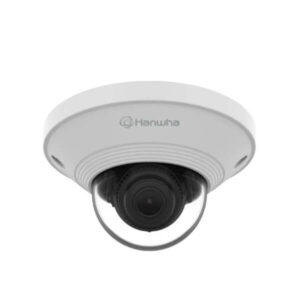
Hanwha Vision QNV-C8083R 5MP AI IR Vandal Dome Camera in Dubai, UAE
The Hanwha Vision QNV-C8083R is a 5MP AI-enabled IR vandal dome network camera engineered for commercial surveillance deployments that need high-detail imaging, adaptable lens coverage, event intelligence and durable installation characteristics. It is especially relevant where security teams want one compact dome camera to cover entrances, corridors, public-facing spaces, loading zones, retail floors, reception areas and other monitored zones without sacrificing integration flexibility.
For Dubai and UAE projects, the combination of a motorized varifocal lens, 30 m IR illumination, 120 dB wide dynamic range, PoE, edge storage and standards-based interoperability helps simplify specification across mixed lighting, mixed architecture and multi-site security environments.
Procurement Snapshot
Brand: Hanwha Vision
Model: QNV-C8083R
Type: 5MP AI IR Vandal Dome Camera
Lens: 3.2–10.2 mm motorized varifocal
IR: Up to 30 m
Protection: IP66, IK10
Power: PoE
Deployment: Dubai, UAE and regional project supply
Warranty: Contact FourTeck for current regional terms
Quick Procurement & Configuration Matrix
Brand / Model
Hanwha Vision QNV-C8083R
Product Type
5MP AI IR vandal dome IP camera
Recommended Workload
24/7 enterprise video surveillance and analytics
Scalability Limit
Determined by VMS, recorder, PoE and storage architecture
Power Requirements
PoE, maximum consumption around 12.95 W
Delivery Area
Dubai and UAE; export support subject to project terms
Storage
microSD/SDHC/SDXC, one slot, up to 256 GB
Warranty Guidance
Contact FourTeck for current UAE warranty and support options
Executive Product Architectural Overview
The QNV-C8083R sits in the category of intelligent network video endpoints rather than being merely an imaging device. That distinction matters for enterprise buyers because modern surveillance architectures increasingly depend on cameras to perform part of the detection, classification and metadata generation workload at the edge. Instead of streaming every scene as undifferentiated video and expecting the recorder or VMS to interpret everything, the camera can identify defined event types and distinguish people and vehicles. This gives integrators more flexibility when designing event-driven monitoring, operational dashboards, search workflows and storage policies.
At its imaging core, the camera provides 5MP resolution at up to 30 frames per second. That resolution sits above conventional Full HD while remaining practical for many network and storage budgets. The motorized 3.2–10.2 mm varifocal lens is especially useful in commercial projects where exact camera-to-subject distances are not always known during tendering. Installers can use the wider end to cover broad spaces or zoom toward narrower fields of view where identification detail is more important. Horizontal viewing spans roughly 95 degrees at wide to 29 degrees at tele, enabling one model to address different mounting positions without requiring an entirely different fixed-lens SKU.
Low-light behavior is supported by integrated infrared illumination with a viewable distance of up to 30 metres and by automatic day/night switching using a mechanical IR cut filter. Wide dynamic range rated at 120 dB assists in scenes where bright and dark zones coexist, such as building entrances with strong exterior daylight, loading bays, lobbies with glass facades or corridors opening into bright public areas. The practical value is not simply a more attractive image; it is better continuity of useful evidence across changing light conditions.
Compression and bandwidth management are central to multi-camera projects. The QNV-C8083R supports H.265, H.264 and MJPEG, with multiple stream profiles and Hanwha Vision WiseStream III technology. In a large estate, small efficiency improvements at each camera can materially affect recorder storage sizing, switch uplink utilization and retention costs. Buyers should therefore evaluate the camera as part of a complete video data pipeline: scene complexity, frame rate, resolution, codec, recording mode, analytics activity and retention period all influence the final infrastructure requirement.
The device also supports local microSD storage, providing an additional resilience layer or flexible edge recording option. For sites where network interruptions are possible, edge storage can contribute to continuity depending on the selected VMS and deployment design. It should not automatically be treated as a replacement for centralized recording in regulated or evidence-critical environments; rather, it is another architectural tool that can be integrated into a broader resilience strategy.
From an interoperability standpoint, support for ONVIF Profile S, G, T and M, together with SUNAPI, helps the camera fit into varied surveillance platforms. For UAE enterprises that may already operate mixed generations of NVRs, video management software, access control systems or security operations platforms, standards support reduces integration friction. Exact feature availability can still vary by third-party VMS version, device driver, firmware and licensing, so project validation remains essential before committing a large quantity.
Physical deployment is strengthened by IP66 environmental protection and IK10 impact resistance. These ratings make the camera appropriate for demanding indoor and outdoor-equivalent surveillance positions where exposure to dust, moisture or physical contact is a concern. Operating temperature guidance extends from approximately -30°C to +55°C, which is relevant for UAE environments, though outdoor installations still need correct enclosure positioning, cable sealing, sun exposure assessment, network surge protection and mounting practices.
Enterprise Business Value & ROI Benefits
Higher Evidence Detail
A 5MP stream provides additional scene detail compared with 1080p cameras. In practical terms, that can improve the usefulness of recorded footage where operators need to inspect faces, clothing, vehicle characteristics, object movement or activity zones. The exact identification result still depends on distance, lens setting, light and pixel density, so FourTeck recommends designing each view around the operational objective rather than resolution alone.
AI-Assisted Monitoring
Person and vehicle classification can reduce the burden of generic motion events by giving the surveillance platform more meaningful metadata. In properly configured scenes, this helps security teams prioritize events, build rule-driven alerts and speed up searches. Business intelligence functions such as people counting, vehicle counting, queue management and heatmaps can also support operational analysis beyond traditional security monitoring.
Flexible Field of View
The 3.2–10.2 mm motorized varifocal lens reduces the risk of choosing an unsuitable fixed focal length during procurement. Integrators can fine-tune framing to cover a broad area or a narrower detail-focused scene. This is valuable in projects where architectural conditions, camera heights or exact surveillance targets only become clear during installation and commissioning.
Storage & Bandwidth Efficiency
H.265 and WiseStream III provide tools for reducing unnecessary video data while preserving useful visual information. That can lower storage capacity pressure and uplink demand across multi-camera estates. Savings are highly dependent on scene complexity and recording policy, so sizing should still be calculated using realistic bitrate assumptions and the required retention duration.
Deployment Resilience
PoE simplifies cabling, microSD edge storage adds local recording capability, and standards-based interoperability broadens integration options. Together these characteristics can reduce the number of infrastructure dependencies at each camera point and give architects more options when planning failover, remote sites, branch deployments or staged migrations from older systems.
Durable Physical Design
IP66 and IK10 ratings support installation in areas where dust, water ingress and impact resistance matter. For UAE facilities, this can be particularly useful in parking areas, warehouses, covered outdoor zones, industrial premises, transport environments and public access areas. Correct installation practice remains essential to preserve environmental protection.
Return on investment in surveillance should be measured through the total system lifecycle, not the camera purchase price in isolation. A camera that offers adaptable optics, analytics, efficient compression and broad interoperability may reduce redesign effort, recorder load, false event investigation and future integration complexity. For enterprise procurement teams, those factors can translate into lower operational overhead and more predictable expansion. At the same time, every benefit depends on configuration quality. Analytics zones, focal length, mounting height, firmware, network quality and recording policy all affect outcomes, which is why technical validation before purchase is important.
Hardware & Technical Architecture Highlights
The QNV-C8083R uses a 1/2.8-inch CMOS imaging architecture and produces up to 5MP video at 30 frames per second. Its motorized varifocal optical path is one of the most important architectural elements for system designers because focal adjustment can be performed without physically replacing the lens. The camera’s wide setting is suited to situational awareness, while the tele setting supports tighter framing where more pixels need to be concentrated on a doorway, lane or transaction zone.
Integrated IR illumination extends visibility to approximately 30 metres when the scene becomes dark, and automatic day/night switching allows the imaging system to transition between color and monochrome operation. The 120 dB wide dynamic range pipeline helps manage scenes with strong contrast. Noise reduction is supported through WiseNR II and SSNR V, and the AI engine contributes to intelligent video processing and metadata generation.
On the network side, H.265 and H.264 serve as the principal codecs, while MJPEG remains available for compatible workflows. Up to five streaming profiles can be configured, allowing different consumers to receive different combinations of resolution, frame rate and compression. This matters when the same camera is being recorded at high quality while also feeding lower-bandwidth mobile viewing, analytics, remote monitoring or integration endpoints.
Edge storage is provided through one microSD/SDHC/SDXC slot supporting media up to 256 GB. The correct card endurance rating and recording policy should be selected for surveillance workloads. Network architecture can be simplified with PoE, with maximum power consumption stated around 12.95 W and typical consumption lower under ordinary conditions. Switch design should use the maximum budget rather than typical consumption when many cameras share a PoE power pool.
Analytics include person and vehicle classification, with vehicle types such as car, bus, truck, motorcycle and bicycle. Supported event concepts include motion detection, object detection, virtual line crossing and direction, and virtual-area rules such as loitering, intrusion, enter and exit. Defocus and tampering events can contribute to operational health monitoring. Business intelligence functions include people counting, vehicle counting, queue management and heatmaps, enabling selected deployments to extract operational information in addition to security footage.
Definitive Technical Specifications & Sizing Notes
| Specification | QNV-C8083R |
|---|---|
| Camera Type | 5MP AI IR vandal dome network camera |
| Imaging Device | 1/2.8-inch CMOS |
| Maximum Resolution / Frame Rate | 5MP / up to 30 fps |
| Lens | 3.2–10.2 mm, 3.2x motorized varifocal |
| Angular Field of View | H: 95°–29°, V: 69°–21°, D: 126°–36° |
| IR Distance | Up to 30 m |
| Wide Dynamic Range | 120 dB |
| Day / Night | Auto ICR |
| Compression | H.265, H.264, MJPEG |
| Streaming | Up to 5 profiles |
| Edge Storage | 1 x microSD/SDHC/SDXC, up to 256 GB |
| API / Interoperability | ONVIF Profile S/G/T/M, SUNAPI |
| Protection | IP66, IK10 |
| Operating Temperature | Approximately -30°C to +55°C |
| Power | PoE, maximum around 12.95 W |
| Dimensions / Weight | Approx. Ø140 x 110.2 mm / 875 g |
| Alarm / Audio | Supported via optional cable; configuration dependent |
Sizing should begin with the desired identification objective rather than only the megapixel number. A wide scene captures more area, but each subject occupies fewer pixels. A tighter field of view increases pixel density on the region of interest. Retention planning should then combine expected bitrate, recording schedule, number of cameras and redundancy policy. PoE switch selection should reserve enough power budget for maximum rated draw and should include uplink capacity appropriate for simultaneous streams. Where alarm or audio interfaces are required, verify the required optional cabling and supported accessories before ordering. Firmware, VMS compatibility and analytic availability should also be checked against the intended software platform because third-party feature mapping can vary.
Configuration, Sizing & Deployment Workbench
01 / Define the Surveillance Outcome
Start by defining what the camera must accomplish: broad situational awareness, recognition, identification, queue monitoring, entrance coverage, vehicle observation or analytics. This determines mounting height, angle and focal length. A camera placed too high or too far from the target may provide excellent overview footage but insufficient facial or plate detail. The motorized varifocal lens gives useful adjustment headroom, yet it cannot compensate for fundamentally incorrect positioning.
02 / Calculate Network & Recording Headroom
Estimate video bitrates using realistic scene conditions and recording modes. Busy scenes, rain, foliage, crowds and low-light noise can raise bitrate. Include the number of cameras sharing each access switch and uplink. For storage, calculate the required number of retention days and whether continuous, scheduled or event recording will be used. Reserve headroom for firmware changes, higher-quality settings and future camera additions.
03 / Validate PoE Capacity
Use the camera’s maximum power figure when budgeting switch capacity. Multiply maximum draw by the planned camera count and compare that total with the switch’s actual PoE power budget, not simply the number of PoE ports. Add margin for startup behavior, future devices and any additional powered accessories. Where long cable runs or harsh electrical environments exist, follow structured cabling and surge protection best practice.
04 / Check Analytics Suitability
AI classification performs best when subjects enter the scene at useful sizes and predictable angles. Avoid aiming the camera where strong reflections, extreme backlighting, obstructions or constantly moving backgrounds dominate the image. Configure analytics only after final focus and field of view are established. For counting and queue analytics, test real traffic patterns before treating the data as an operational metric.
05 / Confirm VMS, NVR & License Terms
Confirm that the target recorder or VMS supports the camera and the specific features required. ONVIF improves interoperability but does not guarantee that every advanced analytic or metadata feature is exposed by every third-party platform. Check channel licenses, analytics licenses, recording licenses, failover requirements and client access before finalizing quantity.
06 / Plan the Environment
Review mounting surface, cable entry, heat exposure, dust, moisture, vandal risk and service accessibility. IP66 and IK10 provide strong protection, but the installation must preserve the housing seals and use suitable cable glands, junction boxes and brackets where required. For exposed outdoor UAE sites, evaluate direct sunlight, ambient temperature, lightning risk and network surge protection as part of the complete installation design.
Industry Use Cases & Workload Scenarios
Banking & Finance
Branch entrances, ATM lobbies, corridors and customer areas can benefit from high-detail recording, WDR and intelligent classification. Financial-sector deployments typically require strict retention, access control and evidence policies, so the camera should be integrated into a validated recording and cybersecurity architecture.
Healthcare
Hospitals and clinics may use vandal-resistant domes in public corridors, entrances, pharmacies, reception zones and parking interfaces. Privacy, access permissions and camera placement must be aligned with organizational policy and applicable regulation.
Government & Public Sector
Government buildings can use the QNV-C8083R for entry monitoring, public-area surveillance and event-driven security workflows. Standards-based integration helps where centralized security operations platforms aggregate cameras across multiple facilities.
Logistics & Warehousing
Loading areas, warehouse aisles, dispatch zones and perimeter-adjacent covered areas can use the varifocal lens to adapt framing to specific operational lanes. Vehicle classification and counting may support both security and process visibility.
Retail & Hospitality
Retail stores, shopping environments, hotels and restaurants can combine security monitoring with people counting, queue management and heatmap functions. Operational use should be tested against real scene geometry and privacy requirements.
Education
Schools, universities and training campuses can deploy vandal-resistant domes at entrances, hallways, reception zones and common areas. PoE and multi-profile streaming simplify deployment across structured campus networks while allowing centralized recording.
Technical Feature Deep Dive 1: Processing, Throughput & Workload Performance Architecture
The performance profile of a network camera is determined by more than resolution. The QNV-C8083R combines sensor capture, image signal processing, compression, analytics and network delivery in one edge device. Each stage affects the quality and volume of data that reaches the recorder. The 5MP imaging pipeline gives security teams more spatial detail than 1080p while keeping the data footprint below that of higher-resolution 4K cameras under comparable compression settings. This middle ground is attractive for deployments that require improved investigative detail but must still scale across dozens or hundreds of cameras.
Frame rate is equally important. Up to 30 frames per second can support smooth motion capture in entrances, retail aisles, loading zones and areas with vehicles or fast-moving subjects. However, not every camera requires maximum frame rate. For static corridors or low-traffic areas, lower frame rates may be sufficient and can reduce storage. The system designer should therefore classify camera workloads rather than applying one identical stream profile across an entire estate.
Compression efficiency influences the economics of surveillance infrastructure. H.265 can significantly reduce video data compared with older codecs under appropriate conditions, while WiseStream III uses scene intelligence to improve efficiency further. The practical benefit becomes visible at scale: lower average bitrate can reduce recorder storage capacity, switch uplink demand and WAN usage for remote sites. But compression should not be pushed so aggressively that critical forensic detail is lost. Commissioning should compare live and recorded images under daytime, nighttime and motion conditions.
Multi-profile streaming lets one camera satisfy several consumers at once. A high-quality stream may be retained for evidence, a lower-resolution stream may feed a monitoring wall, and another profile may support mobile access or integration. This avoids forcing every application to consume the heaviest stream and helps protect network resources. In distributed UAE deployments, this architecture can be especially valuable where branch sites connect to a central security operations center over constrained WAN links.
Technical Feature Deep Dive 2: Security, Redundancy & System Resilience
Surveillance resilience is built in layers. The QNV-C8083R contributes through local edge storage, standards-based connectivity, rugged physical construction and event health indicators such as tampering and defocus detection. Edge storage can preserve video locally when a central recording path is temporarily unavailable, depending on how the VMS handles edge failover and retrieval. For critical systems, this should be combined with recorder redundancy, UPS-backed network infrastructure and segmented switching rather than treated as a standalone continuity measure.
Physical resilience is supported by an IP66 weather-resistance rating and IK10 impact resistance. These ratings are particularly relevant in public spaces, parking facilities, loading areas and other locations where the camera may be exposed to dust, water or accidental impact. The dome form factor also presents a compact profile and makes the direction of view less obvious than many bullet-style cameras, which can be advantageous in public-facing environments.
Cybersecurity depends on deployment practice as much as hardware capability. Cameras should be installed on appropriately segmented networks, use strong unique credentials, receive current firmware, restrict management access and expose only the services actually required. Recorder and VMS platforms should be updated and monitored as part of the same security lifecycle. Remote access should be designed through secure enterprise mechanisms rather than ad-hoc port forwarding. For regulated or sensitive environments, buyers should align the camera configuration with internal cybersecurity policy and third-party hardening guidance.
AI-assisted event filtering can also contribute to operational resilience by reducing alert fatigue. When a platform can distinguish likely people or vehicles from generic movement, operators may spend less time investigating irrelevant events. This does not eliminate the need for validation; analytics are probabilistic and scene-dependent. Event rules should be tested through representative day and night scenarios, and security procedures should never rely solely on one analytic trigger where human safety or critical asset protection is involved.
Technical Feature Deep Dive 3: Remote Management, Telemetry & Infrastructure Integration
Modern camera estates require repeatable management. ONVIF Profile S, G, T and M support helps the QNV-C8083R participate in standards-based discovery, streaming, recording and metadata ecosystems. Hanwha Vision SUNAPI can provide deeper integration where supported. For system architects, the important point is that camera management should be treated as an infrastructure discipline: inventory, addressing, time synchronization, firmware, certificates, user roles, stream templates, analytics profiles and event mappings should be governed consistently across sites.
Telemetry begins with basic health indicators such as connection status, storage state, video loss, defocus and tampering events. A mature VMS can transform these signals into maintenance workflows so that a camera fault is detected before an incident reveals a coverage gap. Large estates should establish alert ownership, escalation thresholds and routine camera health audits. In Dubai projects with geographically separated branches, this can reduce unnecessary site visits and improve service response planning.
Integration with broader infrastructure should also consider identity, network management and physical security convergence. Video may need to be associated with access-control events, alarm inputs, intercom activity or business operations. The optional alarm and audio connectivity can support selected integrations, while APIs and ONVIF can connect the camera to compatible third-party platforms. Exact interoperability must be checked at the software-version level because basic video compatibility does not always imply full analytic metadata support.
Remote administration must remain controlled. Use role-based permissions, network segmentation and approved remote-access paths. Where many cameras are deployed, central device management and firmware governance can reduce configuration drift. Commissioning documentation should record camera name, location, IP address, switch port, PoE budget, lens setting, analytics rules, retention policy and service ownership. This operational discipline often delivers as much long-term value as any individual camera feature.
What Buyers Should Check Before Purchase
Most procurement issues arise from incorrect sizing, missing accessories, recorder incompatibility or assumptions about delivery and warranty. Use the checklist below before issuing a purchase order.
01 / FIT — Configuration Fit & Model Sizing
Confirm the required viewing angle, subject distance, mounting height and identification objective. Validate whether 5MP, the 3.2–10.2 mm range and 30 m IR are appropriate for the scene. For large open areas, very long distances or specialized plate recognition, a different camera category may be more suitable.
02 / MATCH — Compatibility & Environmental Requirements
Check VMS or NVR support, firmware compatibility, PoE capacity, network throughput, mounting accessories and cable routes. For outdoor UAE installations, assess sun exposure, temperature, dust, water ingress risk and surge protection. Confirm optional cabling where audio or alarm I/O is required.
03 / TERMS — Availability, Delivery & Warranty Terms
Stock position, lead time and warranty coverage can vary by project quantity and sourcing route. Request written confirmation of delivery location, expected lead time, warranty process and any regional support conditions before purchase. For tendered projects, include the required documentation and compliance schedule in the inquiry.
04 / REQUEST — Quote Preparation Data Needed
Send the exact model, quantity, delivery emirate, required accessories, recorder or VMS platform, expected deployment date and any project-specific warranty or documentation requirement. Providing these details allows FourTeck to prepare a more accurate commercial and technical response.
UAE Regional Availability & Service Ecosystem
FourTeck supports UAE organizations with product sourcing, configuration validation, quotation preparation and delivery coordination. Availability depends on quantity, distribution stock and project timing, so buyers should request a current quotation rather than relying on a static stock assumption. For larger deployments, FourTeck can also help align cameras with compatible PoE switching, recording, storage and accessory requirements before purchase.
K1. Dubai Supply & Logistics Support
Dubai customers can request commercial supply for corporate offices, free zones, retail facilities, logistics sites, hospitality properties, schools and system-integration projects. FourTeck can coordinate model confirmation, quantity-based quotations, compatible accessories and delivery planning across Dubai. Staging or pre-deployment requirements should be specified in the inquiry so they can be assessed against project scope.
K2. Abu Dhabi & Al Ain Logistics Reach
For Abu Dhabi and Al Ain, FourTeck supports enterprise and project procurement across government, industrial, healthcare, commercial and infrastructure environments. Buyers can submit bill-of-material requirements for sourcing review, commercial quotation and delivery coordination. Large quantities or controlled-site deliveries should include access and timing requirements early in the procurement process.
K3. Sharjah & Northern Emirates Logistics Infrastructure
Sharjah and Northern Emirates customers can source the QNV-C8083R for commercial surveillance upgrades, new builds and multi-site deployments. FourTeck can assist with quotation handling, accessory alignment, project quantities and logistics coordination. Where sites have mixed legacy equipment, provide recorder and VMS details so compatibility can be reviewed.
K4. Ajman & Surrounding Emirates Logistics Coverage
Ajman buyers can request availability verification, delivery coordination and technical pre-sales guidance for the camera and related surveillance infrastructure. Supplying camera counts, installation environment and target recording platform helps streamline model validation and reduce procurement errors.
GCC & Pan-African Supply Chain Reach
FourTeck supports regional project inquiries that may require export documentation, cross-border logistics coordination and multi-country hardware sourcing. Freight, customs, taxes, certification and warranty conditions vary by destination and should be confirmed during quotation. For project exports, provide the destination country, consignee details, quantity and requested Incoterm or delivery expectation.
L1. Saudi Arabia (KSA) Export & Supply Support
Saudi enterprise and integrator inquiries can be supported with model validation, project quotation and regional supply coordination. Buyers should provide site requirements, quantity and any tender documentation so the sourcing route and commercial terms can be reviewed.
L2. Qatar Market Supply Reach
Qatar projects can request cross-border quotation and sourcing support for surveillance deployments. Delivery timing, customs documentation and warranty route should be agreed before order confirmation, particularly for project quantities.
L3. Oman Regional Distribution Support
Oman buyers can request procurement guidance, model confirmation and quote coordination for commercial, industrial, hospitality and public-sector surveillance projects. Compatible NVR, VMS and PoE requirements can be included in the same bill of materials.
L4. Kuwait Supply Chain Coverage
For Kuwait projects, FourTeck can coordinate project quotation and export supply requirements through its regional presence. Visit FourTeck Kuwait for localized inquiries and project routing.
L5. Kenya & East Africa Supply Infrastructure
Kenyan system integrators and enterprise buyers can request regional distribution support, technical inquiry routing and delivery coordination for surveillance projects. Visit FourTeck Kenya for local project engagement.
L6. Uganda Regional Procurement Support
Uganda customers can access localized inquiry response, project supply management and technology sourcing support. Visit FourTeck Uganda for procurement coordination.
L7. Pan-African Regional Logistics & Trade Reach
For multi-country African projects, FourTeck can assist with trade export management and coordinated supply across broader technology markets. Visit FourTeck Africa and FourTeck Global for regional project routing.
Related Hanwha Vision Products & Compatible Alternatives
| Model | Positioning | When to Consider |
|---|---|---|
| QNO-C8083R | 5MP AI IR bullet camera | Choose a bullet form factor when visible camera direction and different mounting preferences are desirable. |
| QNV-C9083R | Higher-resolution AI IR vandal dome family option | Consider where additional pixel detail is required and storage/network budgets can support it. |
| QNV-C8011R | 5MP IR vandal dome with fixed lens | Consider when a fixed focal field of view is known in advance and varifocal flexibility is not required. |
| QNV-C9011R | 8MP IR vandal dome with fixed lens | Consider where a wider fixed view with higher pixel count aligns better with the scene. |
Alternative selection should be driven by field of view, resolution target, mounting style and analytics requirements rather than by a simple higher-model-number comparison. A fixed-lens camera may be more economical when the mounting geometry is predictable, while a motorized varifocal camera offers valuable flexibility for uncertain site conditions. Higher-resolution models can provide additional detail but also increase storage and bandwidth requirements. FourTeck can help compare suitable Hanwha Vision models against the actual camera schedule and site drawings.
Why Enterprises Choose FourTeck
Enterprise surveillance procurement often spans cameras, mounts, PoE switching, NVR or VMS licensing, storage, UPS protection and installation dependencies. FourTeck approaches the camera as one component of that wider architecture. Pre-sales validation can help identify mismatched lens requirements, insufficient PoE capacity, recorder limitations or missing accessories before hardware reaches site.
Commercial support includes quotation preparation for project quantities, delivery coordination across the UAE and assistance with regional export inquiries. For warranty-sensitive projects, buyers can request current warranty and support terms in writing as part of the quotation. This is particularly important for tender submissions and long-term framework procurement where product lifecycle and support route matter as much as initial cost.
FourTeck can also help align the QNV-C8083R with compatible network and recording infrastructure. That reduces the risk of buying cameras in isolation and discovering later that switches, storage or software licensing were undersized. The objective is a procurement package that reflects the operational environment, retention requirement and deployment timeline rather than simply supplying a part number.
Frequently Asked Questions
1. What is the Hanwha Vision QNV-C8083R?
The QNV-C8083R is a 5MP AI-enabled IR vandal dome network camera. It combines a motorized 3.2–10.2 mm varifocal lens, infrared illumination up to 30 metres, 120 dB wide dynamic range, H.265/H.264 compression, PoE, microSD edge storage, ONVIF interoperability and AI-based person and vehicle analytics for professional surveillance applications.
2. Is the QNV-C8083R suitable for outdoor use in Dubai?
The camera carries IP66 environmental protection and IK10 impact resistance and has an operating-temperature range that extends to approximately +55°C. These characteristics support demanding deployments, but outdoor UAE installations still need correct mounting, sealed cable entry, sun exposure assessment, surge protection and adherence to the manufacturer’s installation guidance.
3. What lens does the QNV-C8083R use?
It uses a 3.2–10.2 mm, 3.2x motorized varifocal lens. The lens provides a horizontal field of view of roughly 95 degrees at the wide setting to 29 degrees at tele. This makes the camera adaptable for both broad area coverage and tighter framing without replacing the lens.
4. Does the camera have night vision?
Yes. The QNV-C8083R includes integrated infrared illumination with a viewable distance of up to approximately 30 metres and supports automatic day/night operation using an IR cut filter. Actual usable distance depends on scene reflectivity, lens framing, ambient light, mounting position and the level of detail required.
5. What AI analytics are supported?
The camera supports person and vehicle classification, including multiple vehicle types, and can use AI-assisted events for object detection, virtual lines and virtual areas. Business intelligence functions include people counting, vehicle counting, queue management and heatmaps. Availability within a specific VMS may depend on integration and software support.
6. Can the QNV-C8083R record to a microSD card?
Yes. It includes one microSD/SDHC/SDXC slot supporting cards up to 256 GB. Edge storage can be useful for local recording and resilience, but card endurance and retention time should be calculated for the selected recording profile. Critical systems commonly combine edge storage with centralized NVR or VMS recording.
7. Does it support ONVIF?
Yes. The QNV-C8083R supports ONVIF Profile S, G, T and M along with Hanwha Vision SUNAPI. These standards assist interoperability with compatible video management and recording systems. Buyers should still confirm model-level compatibility and advanced feature support with the intended VMS or NVR before large-scale deployment.
8. How is the camera powered?
The camera supports Power over Ethernet, allowing network data and power to use the same Ethernet cable. Maximum power consumption is around 12.95 W. For multi-camera deployments, the PoE switch should be sized against maximum demand with sufficient margin, rather than only comparing the number of available PoE ports.
9. Can FourTeck supply the QNV-C8083R in Dubai and other UAE emirates?
FourTeck can provide quotation and supply coordination for Dubai and other UAE locations, subject to current availability, quantity and project conditions. Buyers should submit the model, quantity, delivery location, target deployment date and any recorder, accessory or warranty requirements so the commercial response can be prepared accurately.
10. What details should I send for a project quote?
Provide the exact camera model, required quantity, delivery emirate, project timeline, preferred recorder or VMS, retention requirement, PoE switch availability and any needed accessories such as mounts, junction boxes, microSD cards or optional audio/alarm cabling. Site drawings or camera schedules are helpful for larger installations.
Request a QNV-C8083R Project Quote
Send FourTeck the model, quantity, delivery location, target deployment date, recorder or VMS platform and any accessory requirements. For larger projects, include your camera schedule, retention target and PoE/network constraints so the proposed bill of materials can be validated before purchase.