Hanwha Vision XNO-9082R 4K IR Bullet Camera in Dubai, UAE
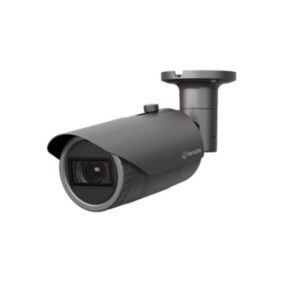
The Hanwha Vision XNO-9082R is a rugged 8MP network bullet camera engineered for high-detail surveillance across outdoor and exposed enterprise environments. It combines 4K recording at up to 30 frames per second, a 2.8–8.4 mm motorized varifocal lens, 40 m integrated infrared illumination, 120 dB extremeWDR and robust environmental protection for security projects that demand reliable image capture day and night.
For Dubai and UAE projects, the XNO-9082R is especially relevant to perimeter monitoring, logistics yards, warehouses, commercial campuses, transport approaches, critical entrances and mixed-light exterior scenes where camera durability, field-of-view flexibility and evidential clarity all matter.
Procurement Snapshot
Brand: Hanwha Vision
Model: XNO-9082R
Class: 8MP IR Bullet Network Camera
Lens: 2.8–8.4 mm, 3x motorized varifocal
IR: Up to 40 m
Power: PoE, 12 VDC or 24 VAC
Delivery: Dubai & UAE; regional export coordination available
Quick Procurement & Configuration Matrix
Brand / Model
Hanwha Vision XNO-9082R
Product Type
4K IR outdoor bullet IP camera
Recommended Workload
24/7 perimeter, yard, entrance and campus surveillance
Scalability
System scale depends on VMS/NVR, PoE and storage design
Power Requirements
PoE max 12.95 W; alternate 12 VDC / 24 VAC supported
Delivery Area
Dubai, UAE and project export destinations
Warranty Guidance
Contact FourTeck for current commercial warranty terms
Integration
ONVIF Profile S/G/T, SUNAPI and Wisenet open platform
Executive Product Architectural Overview
The Hanwha Vision XNO-9082R sits in the enterprise surveillance category where optical quality, environmental durability and system integration are more important than consumer-style feature counts. Its architecture starts with a 1/2.8-inch CMOS imaging sensor and 8MP output capability, producing up to 4K video at 30 frames per second. That combination matters to organisations that need usable detail across a wide scene while still maintaining motion fluidity for vehicles, people and security events. In practical terms, it gives security teams the pixel density needed for closer post-event review without forcing the camera into an ultra-narrow field of view.
A key design advantage is the 2.8–8.4 mm motorized varifocal lens. Instead of committing the installation team to one fixed viewing angle, the camera can be commissioned across a range of wide-to-telephoto perspectives. At the wide end, the horizontal field of view is approximately 114 degrees, while the telephoto end narrows toward roughly 40 degrees. This is useful in Dubai facilities where one camera model may need to serve multiple scene types: broad loading yards, long entrance lanes, gatehouses, warehouse exteriors, perimeter fences or access roads. Standardising on a flexible optical platform can simplify spares, documentation and maintenance compared with managing a larger mix of fixed-lens variants.
Night and mixed-light performance are central to the XNO-9082R design. Integrated infrared provides viewing distance up to 40 metres, allowing the camera to create usable monochrome imagery in complete darkness when the IR illuminators are active. During daytime or in colour low-light scenes, the camera is rated to 0.05 lux at F1.2 under the stated manufacturer test conditions. The 120 dB extremeWDR capability is particularly relevant for entrances, vehicle lanes and building approaches where bright sunlight and shaded areas can exist in the same frame. Instead of allowing highlights to wash out while shadows collapse, wide dynamic range processing helps preserve scene information across contrasting exposure zones.
For sites exposed to vibration, wind or mechanical movement, the camera incorporates digital image stabilization supported by a built-in gyro sensor. This is valuable on poles, boundary structures, industrial locations and transportation environments where subtle motion can reduce effective image sharpness. The objective is not to replace sound physical mounting; it is to improve resilience when environmental movement is unavoidable. For evidential systems, maintaining a more stable image can also improve the usefulness of downstream analytics and operator review.
The XNO-9082R also addresses the network and storage realities of 4K surveillance. H.265 and H.264 are supported alongside MJPEG, and WiseStream II helps reduce bandwidth and storage consumption by adapting compression to scene content. Enterprise buyers should view this as a system-level advantage rather than simply a camera feature. A project with dozens or hundreds of 4K streams can place material demands on access switches, uplinks, recording servers and retention storage. More efficient coding can help preserve image quality where it matters while lowering unnecessary data load in static regions of the scene.
Edge resilience is supported through dual microSD/SDHC/SDXC slots with a manufacturer-stated aggregate capacity up to 1 TB. This can be used for local recording strategies, recording failover, event buffering or distributed architectures depending on the selected recording platform. Buyers should still treat edge media as one layer in a broader retention design: final storage duration, redundancy and evidential requirements depend on recording bitrate, frame rate, number of cameras, event frequency and organisational policy.
From an integration perspective, ONVIF Profile S, G and T support, SUNAPI and the Wisenet open platform provide pathways for interoperability with compatible VMS, recording and application environments. For FourTeck-led procurement planning, the most productive approach is to evaluate the camera together with the intended NVR or VMS, PoE switch budget, uplink capacity, storage retention target, cybersecurity policy and environmental mounting conditions. This prevents a capable camera from being constrained by undersized supporting infrastructure.
Enterprise Business Value & ROI Benefits
The commercial value of the XNO-9082R emerges when its technical capabilities reduce operational friction across installation, monitoring, evidence retrieval and lifecycle management. The following value areas show how a correctly designed camera deployment can support more predictable security operations.
Higher Detail per Camera
8MP imaging gives operators more visual information for scene review than lower-resolution designs when lens position and subject distance are correctly planned. This can improve the usability of recorded evidence and may reduce the need to deploy a separate close-up camera in some moderate-distance scenes. Camera counts should still be driven by pixel density and scene objectives, not resolution alone.
Reduced Rework During Commissioning
The motorized varifocal lens gives installers room to tune framing after mounting. This can reduce the project risk associated with selecting a fixed focal length too early, particularly where actual site geometry differs from drawings. Remote or assisted lens adjustment also helps standardise deployment across a diverse campus while retaining scene-specific framing.
Night-Time Coverage
Integrated IR to 40 m reduces dependence on continuous visible lighting in darkness and supports 24-hour surveillance continuity. This is especially useful for yards, service roads, perimeter lines and logistics spaces that may not justify full-area white-light illumination. Actual infrared reach depends on scene reflectivity, lens position, mounting angle and weather.
Storage & Bandwidth Efficiency
H.265 plus WiseStream II can lower the network and storage burden compared with less efficient coding approaches. Across a large 4K estate, even modest bitrate reductions can have material effects on switch uplink sizing, recorder ingest, storage capacity and archive cost. Retention modelling should use expected scene activity rather than a single generic bitrate assumption.
Environmental Reliability
IP66 and IP67 weather protection, IK10 impact resistance and NEMA 4X suitability support deployment in exposed security positions. The rated operating temperature range of -50°C to +60°C, with startup above -30°C, covers demanding climates when the broader installation is engineered correctly. In UAE heat, solar loading and enclosure conditions must still be considered.
System Interoperability
ONVIF Profile S/G/T and Hanwha APIs reduce dependence on a closed single-device workflow. This helps organisations integrate cameras into supported third-party VMS platforms and preserves architectural choice during phased upgrades. Compatibility should always be validated against the exact software version and feature set needed by the project.
From a lifecycle perspective, the strongest return comes from avoiding redesign. A surveillance camera is one component in a chain that includes mounting, power, networking, recording, storage, monitoring, user permissions, cybersecurity controls and service processes. Selecting a camera with flexible optics, strong environmental ratings, multiple codec options and standards-based integration can reduce the chance that a later requirement forces premature replacement. FourTeck can help buyers map quantities, scene types and recording objectives into a complete quotation rather than treating the camera as an isolated line item.
Hardware & Technical Architecture Highlights
The XNO-9082R imaging chain is built around a 1/2.8-inch CMOS sensor feeding a 4K-class processing pipeline. The lens covers 2.8 to 8.4 mm and offers approximately 3x optical framing flexibility, which changes both field of view and target pixel density. At the wide setting the camera can observe broad areas; at the telephoto setting it concentrates available pixels over a narrower region. For security design teams, this means lens position should be treated as a sizing variable alongside mounting height and distance to target.
The camera supports automatic day/night switching with an infrared cut filter. During darkness, integrated IR illuminators provide up to 40 m rated visibility. ExtremeWDR rated at 120 dB is designed to handle high-contrast scenes, while SSNR V digital noise reduction can help suppress sensor noise in low illumination. These processing functions interact with exposure time, motion blur and bitrate; commissioning teams should therefore test live scenes rather than relying on one global profile for every camera.
A built-in gyro sensor enables digital image stabilization. This architecture is particularly useful for cameras mounted on poles or structures that may experience vibration. The processing engine also supports intelligent analytics, audio detection, sound classification, shock detection and face/upper-body related detection functions listed by the manufacturer. Business-intelligence functions include people counting, queue management and heatmap capabilities. Availability and performance of analytics can depend on firmware, camera view, scene conditions and selected integration platform.
On the storage side, dual microSD/SDHC/SDXC slots allow substantial edge recording. The manufacturer identifies a maximum combined capacity of up to 1 TB. Edge recording can support failover during temporary network interruption, local event capture or hybrid recording designs. Enterprises should use approved media, plan write endurance and define how edge footage will be reconciled with central storage after connectivity is restored.
Network architecture includes support for up to ten streaming profiles, enabling different combinations of resolution, codec and frame rate for recording, live view, mobile access or analytics consumers. This multi-stream approach helps avoid the inefficiency of forcing every client to consume the full 4K stream. H.265, H.264 and MJPEG provide codec flexibility, with WiseStream II intended to improve compression efficiency further.
Power can be delivered through PoE with a maximum manufacturer-listed draw of 12.95 W and a typical value around 10.5 W, or through 12 VDC or 24 VAC. For PoE deployments, switch budgets should include appropriate headroom for all cameras on the chassis rather than simply multiplying nominal consumption by port count. In outdoor networks, surge protection, grounding, cable quality, distance and pathway design are equally important to reliability.
Definitive Technical Specifications & Sizing Notes
| Specification | Hanwha Vision XNO-9082R |
|---|---|
| Imaging Device | 1/2.8 inch CMOS |
| Resolution / Frame Rate | Up to 4K / 30 fps |
| Minimum Illumination | Color 0.05 lux; B/W 0 lux with IR LED on, under manufacturer test conditions |
| Lens | 2.8–8.4 mm, 3x motorized varifocal |
| Field of View | H: approx. 114° wide to 40° tele; V: 62° to 22°; D: 133° to 46° |
| IR Viewable Length | Up to 40 m |
| Wide Dynamic Range | extremeWDR, 120 dB |
| Image Stabilization | Digital image stabilization with built-in gyro sensor |
| Compression | H.265, H.264, MJPEG; WiseStream II |
| Streaming | Up to 10 profiles |
| Edge Storage | Dual microSD/SDHC/SDXC slots, up to 1 TB combined |
| API / Integration | ONVIF Profile S/G/T, SUNAPI, Wisenet open platform |
| Environmental Ratings | IP66, IP67, IK10, NEMA 4X |
| Operating Temperature | -50°C to +60°C, 0–95% RH non-condensing; startup above -30°C |
| PoE Power | Max 12.95 W, typical 10.5 W |
| Alternate Power | 12 VDC or 24 VAC |
| Dimensions / Weight | Approx. Ø91 × 368.6 mm; 2.2 kg |
Buyers should treat these camera specifications as inputs to a wider surveillance design. The camera’s 4K resolution does not by itself determine identification performance at a gate or perimeter. Distance, field of view, subject size, lens position, mounting height and lighting all affect pixels on target. Likewise, the 40 m IR rating should not be interpreted as a guaranteed identification range because infrared effectiveness varies with surface reflectance, atmospheric conditions and scene geometry. Storage also needs project-specific modelling: frame rate, codec, scene motion, recording schedule, event rules and retention period all influence capacity. For PoE design, use the maximum power figure for conservative switch budgeting and include chassis headroom. Where the camera must integrate with an existing VMS, NVR or analytics platform, validate the exact firmware and software combination before volume purchase. Contact FourTeck for current availability, compatible recorder options and project sizing assistance.
Configuration, Sizing & Deployment Workbench
01 — Define the surveillance objective
Start with the required outcome: detection, observation, recognition, identification, vehicle monitoring, queue analysis or general scene awareness. A 4K camera can serve several roles, but the correct focal length and mounting position depend on the actual target. For a wide yard, the lens may remain near the wide end; for a controlled entrance, a narrower field may concentrate pixels where faces or vehicles pass.
02 — Model network headroom
Estimate expected bitrate under representative day and night scenes, then size access-switch ports, PoE budget and uplinks for simultaneous camera operation. Avoid designing uplinks at theoretical saturation. A resilient enterprise layout should leave operational headroom for burst traffic, firmware updates, additional streams and later camera expansion.
03 — Calculate recording retention
Define how many days of footage must be retained and whether recording is continuous, scheduled, motion-based or event-driven. Multiply the resulting average bitrate by camera count and retention period, then include storage overhead, resiliency and growth margin. WiseStream II can reduce consumption, but final sizing should be based on observed site activity.
04 — Select VMS / NVR integration
Confirm that the chosen recording platform supports the XNO-9082R at the required resolution, frame rate, codec, audio, analytics and edge-retrieval functions. ONVIF improves interoperability, but vendor-specific features may depend on native drivers or APIs. Validate the exact feature matrix before standardising across a large deployment.
05 — Plan environmental and mechanical installation
Review wall, ceiling, pole or parapet mounting, exposure to direct sun, vibration, salt, dust, rain and potential impact. The camera carries strong environmental ratings, but installation accessories, cable glands, junction boxes, surge protection and mounting hardware must be equally suitable. In coastal or industrial UAE environments, material compatibility and corrosion exposure deserve specific attention.
06 — Define cybersecurity and lifecycle controls
Place cameras within an appropriate network security architecture, apply strong credentials, restrict management access, maintain firmware and control outbound communications according to organisational policy. Surveillance systems are operational technology assets and should be monitored, inventoried and patched through a documented lifecycle process rather than left as unmanaged edge devices.
For large deployments, create a camera schedule containing location, mounting height, lens target, view objective, VLAN, switch port, PoE allocation, IP addressing, recording profile, retention class and maintenance owner. This turns procurement into a repeatable engineering process. FourTeck can use such a schedule to build a more accurate bill of materials covering cameras, compatible mounts, PoE switching, recorders, storage and supporting accessories.
Industry Use Cases & Workload Scenarios
Banking & Finance
Use the XNO-9082R for external entrances, parking approaches, service lanes and facility perimeters where 4K detail and strong dynamic range can help manage difficult daylight transitions. Financial institutions should integrate camera events and recording policies with their broader security operations and retention standards.
Healthcare
Hospitals and clinics can deploy the camera around ambulance approaches, loading zones, external corridors, car parks and campus boundaries. The motorized lens helps tune scenes of different widths, while weather resistance supports exterior locations. Privacy and retention policy must be aligned with local requirements and organisational governance.
Government & Public Sector
Government campuses often require robust cameras at boundary lines, access roads, service entries and civic facilities. The combination of 4K video, multiple integration methods and environmental ratings gives system designers flexibility for phased deployments. Cybersecurity, approved architecture and platform compatibility should be validated at project level.
Logistics & Warehousing
Logistics sites are a strong match because they combine large outdoor spaces, moving vehicles, night activity and mixed lighting. The 40 m IR capability can support dark zones, while WDR helps at gates and loading areas. Higher resolution is useful where operators need to review vehicle movement and handling incidents after the event.
Retail & Commercial Property
External storefronts, delivery bays, car parks and building approaches benefit from weather-resistant high-resolution coverage. People-counting or heatmap functions may add operational context in appropriate scenes, although analytics should be tested against actual camera angle, crowd density and business objectives before they are relied upon for reporting.
Education & Campus Security
Schools, universities and training campuses can use the camera for perimeter boundaries, gates, pedestrian approaches and parking areas. Wide-to-telephoto lens adjustment supports diverse campus geometry, and open integration interfaces help align the camera with central monitoring platforms used across multiple buildings.
Technical Feature Deep Dive 1: Processing, Throughput & Workload Performance Architecture
The performance profile of the XNO-9082R is best understood as an imaging pipeline rather than a single resolution number. Light enters through the motorized varifocal lens, reaches the 1/2.8-inch CMOS sensor and is transformed into a stream that must balance detail, motion handling, exposure, dynamic range, noise reduction and compression. At the headline level, 4K at up to 30 fps gives the camera a strong foundation for high-detail security footage. The real enterprise benefit is the ability to choose how much of that performance is consumed by each operational workflow.
A security control room may need the full-resolution stream recorded centrally while operator mosaics use a lower-resolution stream to display many cameras at once. A mobile client may need a still lighter profile. With up to ten streaming profiles supported, the camera can serve multiple consumers without forcing every device to decode the heaviest stream. This can reduce workstation load, WAN bandwidth and VMS display overhead while preserving high-quality evidence on the recorder.
Compression is equally important. H.265 can deliver better storage efficiency than older codecs in many surveillance scenes, and WiseStream II is designed to further optimise bandwidth according to image content. In a quiet perimeter scene, large areas may remain visually stable for long periods, while only a vehicle or person creates meaningful change. Smarter compression can devote available bits more efficiently instead of treating every region as equally complex. On a large site, this can translate into more practical retention periods or lower storage expansion pressure.
However, compression should not be pursued purely for minimum bitrate. Excessively aggressive settings can remove fine detail, particularly in motion, foliage, rain or low-light noise. The correct configuration is a measured compromise based on the scene objective. If the primary requirement is evidential review of vehicles at speed, operators may prefer higher bitrates and shorter shutter settings. If the scene is a static boundary with occasional motion, more aggressive efficiency may be acceptable. FourTeck can help translate these objectives into a camera and storage design, while final commissioning should use site footage to validate results.
The 120 dB extremeWDR capability strengthens performance in high-contrast conditions. Consider an entrance where the foreground is shaded under a canopy while bright Dubai sun dominates the background. A conventional exposure may render one region correctly and compromise the other. WDR processing combines exposure information to preserve more usable detail. This can improve operator situational awareness, but installers still need to avoid poor camera geometry such as aiming directly into intense light where a different mounting position would solve the problem more effectively.
Technical Feature Deep Dive 2: Security, Redundancy & System Resilience
Surveillance resilience starts with physical survivability. The XNO-9082R carries IP66 and IP67 ratings against environmental ingress, IK10 impact resistance and NEMA 4X classification. Those ratings make it appropriate for demanding external placements, but system resilience depends on the full installation path. An outdoor camera connected through an inadequately sealed junction box or poorly protected Ethernet route can still fail even if the camera body is robust. Procurement therefore needs to include suitable mounting accessories, cable protection, grounding and surge mitigation.
The operating range of -50°C to +60°C gives the camera broad climatic tolerance, although startup is specified above -30°C. In UAE projects the more relevant concern is usually high ambient heat combined with direct solar loading. Pole or façade placement should consider orientation, local heat sources and cable exposure. Hot equipment rooms can also affect PoE switches and recording hardware, so the surveillance environment must be engineered end to end.
Recording resilience can be strengthened through the camera’s dual microSD slots. With up to 1 TB combined edge storage, the device can retain local footage when central recording is temporarily unavailable, subject to configuration and platform support. This is particularly useful for remote gates, distributed compounds or networks where transient outages are possible. Edge storage should not be regarded as a complete backup system on its own; enterprises need a clear policy for media endurance, health monitoring, footage reconciliation and replacement.
Digital image stabilization supported by a gyro sensor adds another layer of operational resilience where mounting structures experience vibration. The feature can help maintain a steadier image and can protect the usefulness of analytics or operator viewing. It is still preferable to engineer a rigid mounting position, but stabilization provides insurance against movement that cannot be eliminated completely.
Cybersecurity resilience requires disciplined deployment. The camera should be installed on segmented networks appropriate to the organisation’s security policy, with unique credentials, controlled management access and a planned firmware-maintenance process. Unused services should be restricted where configuration allows, and management traffic should be limited to authorised administrative systems. The manufacturer’s Secure by Default and UL CAP related positioning should be considered alongside the buyer’s own security controls rather than as a substitute for them.
Power resilience also deserves planning. PoE simplifies cabling, but camera continuity depends on the upstream switch and UPS infrastructure. For critical scenes, placing surveillance switches on suitable UPS capacity can preserve recording through short power interruptions. Dual power-input options can support alternative architecture, though the exact design should follow site standards. FourTeck can help build a bill of materials that aligns cameras with PoE switch capacity, UPS runtime and recording infrastructure rather than sizing each layer independently.
Technical Feature Deep Dive 3: Remote Management, Telemetry & Infrastructure Integration
Modern enterprise surveillance systems succeed or fail on manageability. The XNO-9082R supports ONVIF Profile S, G and T as well as SUNAPI and Wisenet open platform capabilities, giving integrators several methods to connect video, events, recording and management workflows to broader security platforms. ONVIF Profile S is commonly associated with basic IP video streaming, Profile G with edge storage and recording functions, and Profile T with advanced streaming capabilities. Exact feature behaviour depends on both camera firmware and the receiving platform.
This matters for organisations operating mixed estates. A business may have an established VMS and want to add Hanwha cameras without replacing the entire recording layer. Standards-based compatibility can make that possible, but enterprise buyers should insist on validating the functions they actually need: full-resolution recording, motion events, audio, analytics metadata, edge playback, health status and configuration control may not all be exposed identically through every integration. A simple live-video test is not enough for a production acceptance plan.
Up to ten streaming profiles provide flexibility for different consumers across the infrastructure. Central recorders can ingest high-quality video, while local monitoring stations or remote applications use lower-bandwidth streams. This can reduce unnecessary data replication and allows network architects to shape traffic according to path constraints. On multi-site systems, lower-bandwidth remote streams can be especially valuable where branch connectivity is limited.
Telemetry should also cover device health. In a mature deployment, operators should know whether a camera is reachable, recording, time-synchronised, storing to edge media and running an approved firmware version. Management platforms may expose different subsets of this data, so design teams should define monitoring requirements before procurement. Camera estates become difficult to manage when health checking is left to manual visual inspection.
Analytics can provide operational signals beyond traditional recording. The XNO-9082R lists intelligent analytics, audio detection, sound classification, shock detection, people counting, queue management and heatmap functions. These features can support security and business workflows, but they must be applied to suitable camera angles and scenes. An analytics function tuned for one environment may perform differently in dense crowds, strong backlight or complex movement. Enterprises should run acceptance testing against actual use cases before basing operational decisions on analytics outputs.
What Buyers Should Check Before Purchase
The most common procurement mistake is to buy a camera from headline specifications without validating scene geometry, recording capacity, network power, software compatibility and environmental installation. Use the following checklist before placing a project order.
01 / FIT — Configuration Fit & Model Sizing
Confirm the required viewing objective and target distance. The XNO-9082R lens can move from a very wide scene toward a narrower telephoto view, but one position cannot maximise both area coverage and distant pixel density simultaneously. Record the desired field of view for each camera location and validate it using drawings or a site survey.
Also decide whether 30 fps is necessary for every camera. Lower frame rates can be appropriate for slower scenes and may reduce storage demand. Critical vehicle lanes or faster motion may justify higher frame rates. Apply profile settings by scene class rather than cloning one configuration across the site.
02 / MATCH — Compatibility & Environmental Requirements
Validate VMS or NVR support for the exact model and desired functions. Check PoE class and available switch budget, network cable length, outdoor pathway, surge protection and grounding. Where analytics are important, confirm supported metadata and event handling within the recording platform.
For exterior UAE deployments, consider direct sunlight, dust, humidity, salt exposure, vibration and cleaning access. The camera has strong ingress and impact ratings, but the mounting assembly and cable termination must match the environment as well.
03 / TERMS — Availability, Delivery & Warranty Terms
Ask for current lead time, quantity availability and commercial warranty terms at quotation stage. Enterprise supply can vary by project size and regional inventory. If the deployment is phased, request a schedule that aligns quantities with installation milestones.
For exports outside the UAE, confirm destination, required documentation, shipment method and any local compliance considerations. FourTeck can coordinate project logistics, but final transit and clearance requirements vary by country and order terms.
04 / REQUEST — Quote Preparation Data Needed
Provide the model, quantity, delivery location, expected project date and whether the quotation should include NVR/VMS, storage, PoE switching, mounts, UPS or installation accessories. For storage sizing, add desired retention days and recording mode. For optics, include approximate target distance and scene width where possible.
The more complete the project brief, the easier it is to create a coherent bill of materials and avoid gaps between camera capability and supporting infrastructure.
UAE Regional Availability & Service Ecosystem
FourTeck supports UAE buyers with quotation coordination, model validation, project bill-of-material review and logistics planning for Hanwha Vision surveillance deployments. Availability, exact delivery timing and warranty terms should be confirmed against the required quantity at the time of quotation. For multi-site projects, camera quantities can be mapped to delivery phases so staging and installation teams receive hardware in a controlled sequence.
K1. Dubai Supply & Logistics Support
Dubai organisations can request the Hanwha Vision XNO-9082R for corporate campuses, warehouses, free-zone facilities, retail estates, hospitality back-of-house areas, logistics yards and infrastructure projects. FourTeck can coordinate commercial quotations, compatible accessory review and delivery planning across Dubai. For larger deployments, buyers can provide a camera schedule and receive guidance on matching NVR/VMS, PoE switching and retention storage. Fast project response depends on quantity, configuration scope and current inventory position.
K2. Abu Dhabi & Al Ain Logistics Reach
FourTeck can support project sourcing and delivery coordination for Abu Dhabi and Al Ain organisations in government, industrial, energy, education and corporate sectors. Site teams should share expected camera counts, deployment milestones and recording architecture so the quotation can account for compatible infrastructure rather than cameras alone. Delivery timing and project staging are coordinated based on order scope and confirmed commercial terms.
K3. Sharjah & Northern Emirates Logistics Infrastructure
Sharjah and Northern Emirates buyers can use FourTeck for surveillance project quotation handling, model matching and delivery coordination. Industrial sites, warehouses, educational campuses and mixed commercial facilities often combine outdoor perimeter cameras with indoor cameras and central recording. FourTeck can help structure a consolidated supply package where required, subject to selected models and current availability.
K4. Ajman & Surrounding Emirates Logistics Coverage
For Ajman businesses, FourTeck can verify current XNO-9082R availability, prepare quantity-based quotations and provide pre-sales guidance on camera fit, PoE design, recording and compatible accessories. Surrounding-emirate deliveries can be planned according to project schedules, with final logistics confirmed at order stage.
GCC & Pan-African Supply Chain Reach
FourTeck supports regional technology procurement from the UAE for eligible projects across GCC and African markets. Cross-border projects typically require clear product quantities, destination details, commercial terms, shipment preferences and documentation requirements. Export timing, customs processes and local import obligations vary by country, so buyers should request project-specific logistics guidance rather than assuming UAE domestic delivery conditions.
L1. Saudi Arabia (KSA) Export & Supply Support
Saudi Arabian project teams can route inquiries through FourTeck for camera sourcing, configuration validation and quotation support. Enterprise surveillance projects should include model quantity, destination city, required accessories, recording environment and target delivery schedule. Export supply is coordinated according to current availability and agreed shipment terms.
L2. Qatar Market Supply Reach
Qatar buyers can request cross-border quotation support for Hanwha Vision camera deployments covering commercial, logistics, hospitality and infrastructure requirements. FourTeck can consolidate compatible cameras and supporting hardware where appropriate, with shipping and documentation requirements confirmed against the final destination.
L3. Oman Regional Distribution Support
For Oman projects, FourTeck can provide hardware procurement guidance, model selection support and commercial quotation coordination. Buyers should specify whether the requirement is for cameras only or a broader package including NVR, storage, PoE networking and accessories so the proposed system remains technically coherent.
L4. Kuwait Supply Chain Coverage
Kuwait organisations can request project quotation assistance and export supply coordination for surveillance deployments. Product quantities, destination and required support scope should be confirmed before shipment planning. Visit FourTeck Kuwait for regional inquiry routing.
L5. Kenya & East Africa Supply Infrastructure
Kenyan system integrators and enterprise buyers can use FourTeck for regional distribution support, technical inquiry routing and delivery coordination. Multi-camera projects benefit from a clear equipment schedule and retention requirement. Visit FourTeck Kenya for local market routing.
L6. Uganda Regional Procurement Support
Uganda buyers can request technology sourcing, project supply management and quotation support for Hanwha Vision equipment. FourTeck can coordinate cameras with compatible infrastructure where the required models and commercial terms are available. Visit FourTeck Uganda for regional inquiries.
L7. Pan-African Regional Logistics & Trade Reach
For multi-country African deployments, FourTeck can assist with consolidated project sourcing, trade export coordination and shipment planning across eligible markets. Large projects should provide country-by-country quantities, delivery destinations and deployment windows to reduce logistics ambiguity. Visit FourTeck Africa and FourTeck Global for broader regional routing.
Related Hanwha Vision Products & Compatible Alternatives
| Model | Form Factor | When to Consider It |
|---|---|---|
| XNV-9082R | 8MP IR vandal dome | Choose a vandal-dome form when the camera must be less directional in appearance or better suited to low-profile wall and ceiling deployment. |
| XND-9082RV | 8MP IR dome | Consider for protected indoor or semi-protected locations where a dome design better matches aesthetics and mounting requirements. |
| XND-9082RF | 8MP IR dome | A related 8MP option for projects that prefer dome architecture while maintaining similar imaging and lens characteristics. |
| XNB-9002 | 8MP box camera | Suitable when the project requires a box-camera platform and separate lens or housing strategy rather than an integrated IR bullet design. |
The correct alternative depends on mounting environment, vandal risk, appearance, lens needs, IR requirement and accessory strategy. A bullet camera is visually directional and convenient for perimeter work because the housing, lens and IR are integrated. Dome form factors can be preferable in areas where users want a more compact visual profile or where ceiling mounting is common. Box cameras offer flexibility for specialised optics and housings. FourTeck can compare the current Hanwha Vision portfolio against a site schedule and recommend alternatives without forcing every scene into the same enclosure type.
Why Enterprises Choose FourTeck
Enterprise camera procurement is most successful when product selection, infrastructure sizing and logistics are coordinated together. FourTeck supports buyers by reviewing the requested Hanwha Vision model against project requirements, checking what supporting equipment may be needed and preparing commercial quotations based on the supplied scope. This helps reduce common mismatches such as insufficient PoE capacity, incompatible recording platforms or storage estimates that do not reflect the required retention period.
For multi-site projects, FourTeck can work from equipment schedules that identify location, quantity and deployment phase. This allows quotation and delivery planning to be structured around the project rather than a one-time camera list. Where customers are replacing an existing surveillance estate, pre-sales review can also identify integration questions that should be answered before rollout.
Commercial support includes current availability checks at quotation stage, delivery coordination and warranty guidance according to the supplied product and order terms. FourTeck avoids treating every surveillance request as identical: a warehouse perimeter, a financial institution entrance and a school campus have different optics, retention and operational priorities. Buyers are encouraged to share enough project detail for the proposed bill of materials to reflect those differences.
Frequently Asked Questions
1. What is the Hanwha Vision XNO-9082R?
The XNO-9082R is an 8MP 4K infrared bullet network camera designed for professional surveillance. It uses a 1/2.8-inch CMOS sensor, supports up to 4K video at 30 fps, includes a 2.8–8.4 mm motorized varifocal lens and provides IR illumination up to 40 metres. Its IP66, IP67 and IK10 ratings make it suitable for demanding outdoor installations when the complete mounting and cabling system is correctly engineered.
2. Is the XNO-9082R suitable for outdoor use in Dubai?
Yes. The camera is rated IP66 and IP67 for environmental protection, IK10 for impact resistance and NEMA 4X. Its specified operating range extends to +60°C. Dubai deployments should still account for direct solar loading, dust, cable exposure, surge protection and the thermal limits of supporting PoE switches and recorders. Mounting accessories and junction boxes should match the environmental rating of the camera.
3. How far can the XNO-9082R see at night?
The integrated IR system is rated for a viewable distance up to 40 metres. Real-world performance depends on lens position, target reflectivity, mounting angle, weather and scene geometry. The IR distance should not be treated as a guaranteed identification range. If the project requires identification at a specific distance, the camera angle and target pixel density should be evaluated during design or commissioning.
4. Does the XNO-9082R support PoE?
Yes. The camera supports PoE and the manufacturer lists a maximum PoE power consumption of 12.95 W with typical consumption around 10.5 W. It also supports 12 VDC and 24 VAC power. When sizing a PoE switch, designers should use conservative maximum values, include spare power budget and account for every powered device on the switch.
5. Can it integrate with third-party VMS or NVR systems?
The XNO-9082R supports ONVIF Profile S, G and T as well as Hanwha SUNAPI and Wisenet open platform interfaces. These standards improve interoperability, but not every third-party VMS exposes every camera feature. Before a large purchase, validate the exact software version and required functions such as analytics events, edge playback, audio and health monitoring.
6. How much edge storage does the camera support?
The camera includes dual microSD/SDHC/SDXC slots and Hanwha states a combined maximum edge capacity up to 1 TB. Edge storage can support failover or local recording workflows. The usable retention period depends on bitrate, frame rate, recording mode and scene activity. Use surveillance-grade media suitable for sustained writes and monitor media health where the VMS supports it.
7. What is the advantage of the motorized varifocal lens?
The 2.8–8.4 mm motorized varifocal lens allows installers to adjust framing between a broad field of view and a narrower, more concentrated view without changing the camera model. This is useful across mixed enterprise sites because a common platform can cover yards, gates and building approaches. Final lens position should be selected according to target distance and required pixel density.
8. Does the XNO-9082R include analytics?
Yes. Manufacturer documentation lists intelligent analytics, audio detection, sound classification, shock detection, face or upper-body related detection, people counting, queue management and heatmap functions. Analytics performance depends on scene geometry, mounting, lighting, firmware and integration. For operational reporting, test the intended analytics in the real environment before relying on them for business or security decisions.
9. What information should I send FourTeck for a quotation?
Provide the XNO-9082R quantity, delivery location, required project date and whether you need cameras only or a complete surveillance package. For full-system sizing, include retention days, recording mode, expected camera count, existing VMS or NVR platform and whether PoE switches, storage, UPS and mounting accessories are required. Approximate target distance and scene width also help with optical planning.
10. Is the XNO-9082R available for projects outside Dubai?
FourTeck supports UAE-wide delivery coordination and can assist eligible export projects across GCC and African markets. Availability, lead time, shipping method, documentation and warranty terms depend on quantity and destination. Submit the destination country or city, project quantity and delivery window so the quotation team can confirm the appropriate commercial and logistics path.
Request a Project Quote for Hanwha Vision XNO-9082R
For a faster project quotation, send FourTeck the model, required quantity, Dubai/UAE delivery location and expected deployment timeframe. If you need a complete CCTV solution, also include the desired recording retention period, existing VMS/NVR platform, approximate total camera count, PoE switching requirement and any mounting or UPS needs. This allows the quotation to cover the supporting infrastructure required for a reliable deployment rather than supplying cameras in isolation.