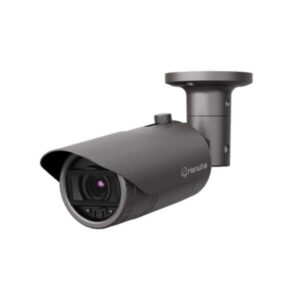
Hanwha Vision XNO-L6080RA 2MP IR Bullet Camera in Dubai, UAE
The Hanwha Vision XNO-L6080RA is a rugged 2MP H.265 network IR bullet camera engineered for professional surveillance where dependable full-HD evidence, flexible lens framing, low-light support and resilient outdoor construction are required. Its 3.2–10 mm motorized varifocal lens, up to 60 fps H.265/H.264 video, 120 dB WDR, 30 m integrated IR, PoE and event analytics make it a practical fit for enterprise perimeter, facility and operational monitoring in Dubai.
For UAE buyers, selection should be treated as part of an end-to-end surveillance architecture rather than as a stand-alone camera purchase. FourTeck can help validate field of view, recorder or VMS interoperability, PoE capacity, retention targets, edge storage, mounting, environmental exposure and project quantity before quotation.
Procurement Snapshot
Brand: Hanwha Vision
Model: XNO-L6080RA
Class: 2MP network IR bullet camera
Lens: 3.2–10 mm motorized varifocal
IR range: Up to 30 m
Power: PoE / project-dependent power design
Environment: IP66, IK10, NEMA 4X
Dubai compliance: Listed in SIRA approved-camera documentation
Supply status: Contact FourTeck for current options
Quick Procurement & Configuration Matrix
Hanwha Vision XNO-L6080RA.
Outdoor-ready 2MP H.265 IR bullet network camera.
Perimeter, entrances, yards, loading areas, campuses, corridors and general evidence capture.
Camera count is determined by VMS/NVR channels, storage, switching and uplink capacity.
PoE supported; confirm switch budget, cable distance and surge strategy per site.
Dubai, Abu Dhabi, Sharjah, Ajman, Al Ain and wider UAE; export support by project.
Terms depend on source, project, region and supply batch; confirm on quotation.
Validate exact field of view, low-light conditions, recording retention and compliance before purchase.
Executive Product Architectural Overview
The XNO-L6080RA sits in the professional IP-surveillance category where camera selection has to balance image quality, network efficiency, environmental resilience, deployment practicality and compatibility with the wider security stack. At its core is a 1/2.8-inch 2MP CMOS imaging platform that produces up to 1920 × 1080 video. Full-HD resolution remains a common enterprise baseline because it is detailed enough for general identification, process monitoring and evidential review while keeping bitrate and storage consumption more manageable than higher-resolution alternatives. The camera supports H.265 and H.264 at up to 60 frames per second across supported resolutions, with MJPEG also available. That combination gives integrators flexibility to prioritize efficiency, interoperability or specific operational workflows depending on recorder and VMS capabilities.
A defining element is the 3.2–10 mm motorized varifocal lens. Rather than forcing installers to accept a fixed field of view, the lens allows framing to be adjusted after the mounting position is established. At the wide end, the camera can cover broader scenes such as loading bays, building approaches, reception exteriors or warehouse lanes. Toward the tele end, it can narrow the view to concentrate pixel density on gates, access points, transaction areas or other targets that require more focused observation. Motorized focal adjustment reduces the need for repetitive manual lens work, while simple focus tools support practical commissioning.
Dubai surveillance deployments often combine strong daylight, deep shadows, reflective glass, vehicle headlights and nighttime transitions. The XNO-L6080RA addresses these conditions with 120 dB wide dynamic range, backlight and highlight compensation, digital noise reduction, day/night switching with removable IR cut filter behavior, defog and image stabilization features. Integrated infrared illumination extends viewing into darkness to approximately 30 metres under appropriate conditions. As with any IR camera, real-world reach depends on scene reflectivity, mounting height, target size, lens framing and ambient light, so design teams should treat the published IR distance as an engineering reference rather than a guaranteed identification distance.
The bullet housing is intended for exposed locations and carries IP66, IK10 and NEMA 4X protection references. IP66 addresses dust ingress and strong water jets, IK10 addresses impact resistance, and NEMA 4X adds relevance where outdoor enclosure robustness and corrosion resistance are procurement considerations. These ratings help the camera fit car parks, compound perimeters, logistics yards, external corridors, industrial sites and building facades, but installation quality remains critical. Proper junction boxes, weather sealing, cable glands, grounding, surge protection and mounting hardware should be specified in parallel with the camera.
From a network architecture perspective, PoE support simplifies cabling by carrying data and power over the Ethernet connection. This reduces local power-adapter dependency and lets organizations centralize camera power through managed PoE switches and UPS-backed network cabinets. The practical benefit is operational: cameras can remain tied to a structured, monitored network power domain, and maintenance teams can often isolate or restart ports remotely. However, PoE budgets must be calculated across all cameras, especially when many devices share one access switch or when environmental conditions increase power demand.
The camera also supports edge storage through SD/SDHC/SDXC media up to the supported capacity, enabling local buffering or event recording. Edge storage can improve resilience when the recorder path is interrupted, provided the VMS and recording architecture are configured to use it appropriately. Event analytics such as defocus detection, directional detection, motion detection, appear/disappear, enter/exit, loitering, tampering and virtual line functions can help shift operations from continuous manual viewing toward event-oriented workflows. These are not replacements for a complete analytics strategy, but they can provide useful triggers for alarms, recording and operator attention.
For a Dubai enterprise, the architectural value of the XNO-L6080RA is therefore not only that it records video. Its value is that it provides a controllable, standards-based edge device that can be integrated into a broader CCTV environment. FourTeck’s pre-sales role is to map that device into the surrounding design: PoE switching, VLANs, NVR or VMS channels, retention storage, monitoring workstations, access control integration, UPS runtime and compliance requirements. The result is a procurement decision based on system fit rather than a model number in isolation.
Enterprise Business Value & ROI Benefits
Operational Visibility
Full-HD video with flexible lens framing helps security teams observe the zones that matter without automatically moving to a higher-resolution platform. When camera placement is engineered correctly, this can control both acquisition cost and downstream storage demand while still delivering usable evidence for routine review.
Network Efficiency
H.265 and WiseStream II support are valuable where many cameras share WAN, LAN or recording infrastructure. Lower effective bitrate can reduce storage and network pressure relative to less efficient encoding, although real savings depend on scene motion, quality settings, frame rate and recorder policies.
Resilience
IP66, IK10 and NEMA 4X construction supports deployment in demanding external locations. Ruggedized housing can lower the operational risk associated with weather exposure and incidental impact, particularly when paired with correct mounting, sealing, surge protection and preventative maintenance.
Scalable Power Design
PoE enables structured power delivery from network closets. Enterprises can centralize backup power, monitor switch ports and simplify field cabling, which is especially useful across multi-camera sites. The return comes from reduced installation complexity and easier lifecycle support rather than from the camera alone.
Event-Driven Monitoring
Built-in event analytics can flag motion, tampering, line crossing or loitering conditions. Used carefully, this helps operators focus attention on exceptions instead of continuously scanning every live tile. Alert policy should be tuned to the environment to avoid excessive false events.
Deployment Flexibility
The motorized 3.2–10 mm lens gives project teams room to refine coverage during commissioning. This can reduce the chance that a fixed lens is too wide or too narrow after installation, particularly in sites where final camera positions shift slightly during civil or MEP work.
Business value in surveillance should be measured in terms of risk reduction, investigation speed, coverage quality, manageability and infrastructure efficiency. A camera that produces clear video but overloads storage, cannot survive the environment, or integrates poorly with the existing VMS may cost more over its lifecycle than a properly sized alternative. Conversely, a correctly designed XNO-L6080RA deployment can help standardize outdoor surveillance around a familiar 2MP baseline, create predictable PoE and storage requirements, simplify spares planning and provide consistent configuration across multiple properties.
Organizations with multiple UAE locations can also benefit from configuration consistency. Standardizing firmware policy, time synchronization, user roles, stream profiles, analytics, retention and naming conventions reduces support variation. This matters for facilities teams and security integrators because every exception adds troubleshooting overhead. FourTeck can help buyers translate project objectives into a bill of materials that includes not only cameras, but also PoE switching, NVR or VMS licensing, storage drives, rack components, UPS, mounting accessories and deployment services where required.
Hardware & Technical Architecture Highlights
The imaging chain begins with a 1/2.8-inch 2MP CMOS sensor and a 3.2–10 mm DC auto-iris motorized varifocal lens. The optical path is designed to support both broad and more focused surveillance views while maintaining practical light control across changing conditions. The maximum aperture ranges from F1.6 at wide to F2.9 at tele. This is important because lens position affects the amount of light reaching the sensor; buyers should expect nighttime performance to vary with zoom, ambient lighting and target distance.
The video processing pipeline supports multiple streams and three principal codec families: H.265 for higher compression efficiency, H.264 for broad legacy interoperability, and MJPEG where frame-by-frame JPEG delivery is required. Up to 60 fps H.265/H.264 can support scenes with faster movement, but most security projects will deliberately choose lower frame rates to balance evidence requirements against storage and bandwidth. The right setting is application dependent: a cash-handling zone, vehicle lane and quiet perimeter fence do not need identical frame-rate policies.
Image processing functions include 120 dB WDR, BLC, HLC, SSDR, SSNR V digital noise reduction, digital image stabilization, defog, white-balance controls, lens distortion correction and electronic shutter management. These controls are especially relevant in mixed-light environments. WDR helps when bright and dark areas coexist in the same view, HLC can reduce the impact of intense light sources, and noise reduction can improve low-light usability while also influencing bitrate. Excessive processing can introduce artifacts, so commissioning should be performed against actual operational scenes rather than default values alone.
Integrated infrared provides illumination to approximately 30 metres. Because infrared performance depends on reflective surfaces and framing, a narrow telephoto view can behave differently from a wide scene. Highly reflective walls close to the camera can cause overexposure while dark open areas may absorb IR. For critical night identification, FourTeck recommends validating target distance, mounting angle and any supplemental lighting requirements during design.
The network interface uses standard Ethernet and supports PoE, allowing data and power to share the structured cabling path. Network design should allocate camera VLANs, secure management access, NTP synchronization, QoS where needed and adequate uplink bandwidth. Cybersecurity should include firmware governance, strong credentials, disabled unused services, certificate management where supported, controlled administrator access and isolation from general user networks. Edge storage provides an additional recording layer that may be used for failover or local event capture depending on VMS capability.
Physical protection is equally important. The IP66, IK10 and NEMA 4X ratings indicate a camera built for harsh deployment. Nevertheless, the protection rating of the camera body does not automatically extend to external junctions. Cable entry, couplers, conduit transitions and junction boxes must maintain suitable environmental protection. In coastal or industrial areas, corrosion exposure should be assessed across the complete mount and fastener system.
Definitive Technical Specifications & Sizing Notes
| Category | Specification | XNO-L6080RA Detail |
|---|---|---|
| Imaging | Sensor / Maximum Resolution | 1/2.8-inch 2MP CMOS / 1920 × 1080 |
| Video | Maximum Frame Rate | H.265/H.264 up to 60 fps at supported resolutions; MJPEG up to 30 fps |
| Compression | Codecs | H.265, H.264, MJPEG; multiple streaming |
| Lens | Focal Length / Zoom | 3.2–10 mm motorized varifocal, 3.1x |
| Lens | Aperture | F1.6 wide to F2.9 tele |
| Field of View | Horizontal | Approximately 109.0° wide to 33.2° tele |
| Low Light | Minimum Illumination | Color 0.1 lux at F1.6 / BW 0 lux with IR LED on |
| IR | Viewable Distance | Up to 30 m under suitable scene conditions |
| Dynamic Range | WDR | 120 dB |
| Analytics | Events | Defocus, directional, motion, appear/disappear, enter/exit, loitering, tampering, virtual line |
| Storage | Edge Media | SD/SDHC/SDXC support; capacity should be confirmed against current approved media guidance |
| Network | Ethernet / Power | 10/100BASE-T Ethernet; PoE supported |
| Environmental | Protection | IP66, IK10, NEMA 4X |
| Compliance | Dubai | Model listed in Dubai SIRA approved-camera documentation |
Sizing begins with the scene, not the resolution label. Buyers should define the task for every camera: overview, detection, recognition or identification. The 3.2–10 mm lens can cover a broad range of scenes, but the required pixel density determines whether the mounting distance and focal length are appropriate. A gate where faces or plates need meaningful detail should be treated differently from a warehouse overview where situational awareness is the goal.
Storage should be calculated using intended codec, frame rate, image quality, scene activity, recording schedule, retention period and camera count. H.265 can reduce bandwidth compared with older compression methods, but there is no single fixed bitrate that applies to every site. Variable bitrate behavior changes with motion and noise. FourTeck can model the expected storage envelope and recommend recorder channels, drive capacity and RAID strategy where applicable. Network sizing should similarly account for camera uplinks, switch backplane capacity, PoE budget, redundant paths and WAN constraints for remote monitoring.
Configuration, Sizing & Deployment Workbench
01 / Define the surveillance outcome
List the exact purpose of each camera position. Specify whether the operator needs scene overview, person recognition, face identification, vehicle observation or process verification. This prevents the common procurement mistake of buying identical cameras for positions that have materially different image-detail requirements.
02 / Validate lens and mounting geometry
Record mounting height, target distance and desired horizontal scene width. The XNO-L6080RA offers a useful 3.2–10 mm adjustment range, but geometry still decides whether the camera can deliver the needed pixels on target. Confirm bracket type, aiming constraints and maintenance access before finalizing quantity.
03 / Size storage and retention
Determine recording hours, retention days, frame rate, codec and image quality. Include headroom for scene complexity and future policy changes. Edge storage can supplement the design, but primary retention should be calculated around the NVR or VMS architecture and required resilience.
04 / Engineer network and PoE capacity
Map each camera to an access switch, PoE budget and uplink. Include network segmentation, UPS runtime, cable distance, surge protection and cabinet capacity. For larger sites, uplinks and recording traffic should be modeled so that surveillance does not contend unpredictably with business applications.
05 / Confirm VMS and license terms
Check that the target NVR or VMS supports the camera profile and required functions. Some VMS platforms license per camera, per channel or per server. Analytics, failover, health monitoring or edge-retrieval behavior can vary by platform, so compatibility should be verified before purchase.
06 / Plan environmental and service access
IP66 and IK10 improve resilience, but the entire installation path still needs suitable weatherproofing. Confirm junction boxes, conduit, glands, brackets, grounding and accessible service positions. Coastal, dusty and industrial environments may justify additional corrosion and cleaning considerations.
A mature deployment also defines configuration templates before technicians arrive on site. Standardize IP-addressing method, naming convention, time source, stream profiles, recording policy, administrator roles and firmware baseline. This allows multiple cameras to be commissioned consistently and audited later. Security teams should document password ownership, credential rotation, certificate management and account deactivation processes. Where the surveillance network connects to a security operations centre, remote access should be mediated through approved secure pathways rather than exposing camera administration directly to the public internet.
For multi-site deployments, pilot a representative installation before releasing a large bill of materials. A pilot validates field of view, IR reflections, bandwidth, VMS behavior and alarm tuning under real operating conditions. It also identifies accessory gaps such as mounts, pole adapters or junction enclosures that are easy to miss in a camera-only quote. FourTeck can use the pilot findings to refine the final procurement list and reduce change orders during rollout.
Industry Use Cases & Workload Scenarios
Banking & Finance
Suitable for exterior approaches, staff entrances, service lanes, ATM surroundings and car parks where a rugged bullet form factor and controlled field of view are appropriate. Financial-sector projects should align camera coverage with internal security policy, retention requirements and access-control integration.
Healthcare
Hospitals and clinics can use the camera for ambulance approaches, service yards, parking areas and external corridors. Privacy policy and placement require careful governance; surveillance should cover safety and operational zones without unnecessarily intruding into sensitive patient areas.
Government & Public Sector
Public facilities may use the camera for perimeter lines, controlled approaches and infrastructure compounds. The model’s Dubai SIRA listing is relevant where local approved-equipment requirements form part of the project, while the complete system must still satisfy the applicable project and regulatory design.
Logistics & Warehousing
The varifocal lens and outdoor housing suit loading bays, dock approaches, yard lanes, warehouse exteriors and dispatch areas. Higher frame rates may be useful around movement-heavy zones, while H.265 helps control the storage load created by continuous operational activity.
Retail & Hospitality
External entrances, receiving zones, car parks and service corridors are natural placements. Retailers should coordinate cameras with lighting and signage so that glare and reflections do not reduce evidence quality, especially around glass storefronts or bright digital displays.
Education & Campuses
Schools and campuses can cover gates, drop-off lanes, parking, perimeter routes and service areas. Coverage should be designed around safeguarding policies, authorized monitoring roles and retention rules, with clear documentation of who can access or export footage.
Across all sectors, the same engineering principle applies: the camera should be chosen because its lens range, image pipeline, night behavior, housing and platform compatibility match a defined surveillance outcome. FourTeck can help convert site drawings and security requirements into a position-by-position camera schedule, identify where the XNO-L6080RA is a good fit, and flag areas that need a different resolution, lens, form factor or analytics capability.
Technical Feature Deep Dive 1: Processing, Throughput & Workload Performance Architecture
A network camera performs several tasks simultaneously: sensor capture, image enhancement, compression, analytics, network transmission and local event handling. The XNO-L6080RA’s ability to produce H.265 or H.264 streams at up to 60 fps gives integrators considerable freedom, but the highest frame rate should not automatically become the default. Frame rate is an architectural lever. Higher values improve temporal detail for fast motion but raise bitrate and storage demand. For many perimeter scenes, 15 to 25 fps may be sufficient; for vehicle movement or fast operational processes, a higher value may be justified. The correct setting should be defined per camera profile rather than globally.
Compression strategy has equally important consequences. H.265 is attractive when recorder and client compatibility is established because it can lower storage and bandwidth requirements for comparable image quality. H.264 remains valuable for broad interoperability, while MJPEG can support specialized use cases. WiseStream II can further assist efficiency by allocating compression resources according to image regions and movement. Real-world savings remain scene dependent, especially at night when sensor noise can increase image complexity and therefore bitrate.
The 120 dB WDR subsystem is central to performance in Dubai scenes where sunlit areas and shadowed interiors appear together. Consider a camera viewing a loading dock from under a canopy: the foreground may be dark while the external yard is strongly illuminated. WDR combines exposure information to maintain usable detail across both zones. Like any dynamic-range processing, it should be tuned with the target outcome in mind because aggressive settings can alter natural contrast or introduce artifacts in moving subjects.
The lens also forms part of the throughput architecture because field of view changes scene complexity. A very wide image may contain more moving objects, trees, traffic and textured surfaces than a narrow gate view, causing variable bitrate to rise. Security designers who model storage using a single bitrate for all cameras can therefore underestimate real requirements. FourTeck recommends calculating an engineering baseline and preserving spare storage and network capacity for peak complexity, maintenance periods and future configuration changes.
Technical Feature Deep Dive 2: Security, Redundancy & System Resilience
Physical durability is one layer of resilience. IP66 helps protect against dust and powerful water jets, IK10 addresses impact resistance, and NEMA 4X is relevant to robust outdoor enclosure performance. Those ratings are particularly valuable in exposed UAE installations, but system resilience extends beyond the housing. A camera may survive weather yet still become unavailable because of an unprotected Ethernet run, failed PoE switch, overloaded UPS or misconfigured recorder. Resilience therefore has to be built across the whole path from camera to storage.
PoE supports centralized power design. When camera switches are connected to suitably sized UPS systems, surveillance can continue through short mains interruptions and controlled shutdown events. Managed switches also provide visibility into port state, power consumption and link behavior. For critical sites, redundant core switching, recorder failover and segregated storage may be appropriate. The camera’s edge storage can add another layer, capturing video locally during specific events or network interruptions when supported by the management platform.
Cybersecurity resilience requires operational discipline. Cameras should be placed on dedicated security VLANs, protected by firewall policy and managed with unique strong credentials. Unused protocols should be disabled, firmware should be maintained under change control, and time should be synchronized to an authoritative source. This is especially important for evidential footage because inconsistent timestamps can complicate investigations. Administrative access should be logged where the VMS supports it, and user privileges should reflect job roles rather than broad shared accounts.
Analytics such as tamper and defocus detection can contribute to operational resilience by alerting the monitoring team when a camera is deliberately obstructed or unintentionally loses focus. Network-disconnect alarms can similarly indicate path failure. Alert rules need escalation ownership; without defined responders, alarms add noise but not resilience. A good deployment pairs technical triggers with documented incident handling, health checks and maintenance schedules.
Technical Feature Deep Dive 3: Remote Management, Telemetry & Infrastructure Integration
Enterprise surveillance scales only when administrators can manage configuration and health centrally. The XNO-L6080RA supports standards-based network operation and is designed to participate in NVR and VMS environments rather than operate solely as an isolated device. Central platforms can present live views, recording status, alarms and camera health, while configuration workflows may expose image, stream and event settings depending on the chosen software.
Integration planning should start with compatibility matrices and version control. A camera may stream video to a platform while some advanced functions remain unsupported by that platform’s current device driver. Buyers should identify which functions are mandatory: PTZ is not relevant here, but edge-storage retrieval, analytics events, health telemetry, multi-stream selection, motion metadata and secure transport may be. These requirements should be validated before a large purchase.
Telemetry is most useful when it feeds an operational process. Link-down events, recording failures, storage warnings or camera tamper alerts should reach the team that owns the response. Larger enterprises may integrate VMS events with security operations workflows or facilities ticketing. Even where formal integrations are not used, a routine health dashboard can reduce the risk of discovering failed cameras only after an incident.
Infrastructure integration also includes identity and access governance. Surveillance systems often contain sensitive footage, so administrative roles, export rights and operator permissions should be deliberately assigned. Remote access should use approved secure connectivity rather than open port forwarding. Backup of configuration and documentation helps accelerate recovery after device replacement. FourTeck can assist buyers in mapping cameras, network, recording and management layers into a coherent bill of materials and deployment plan.
What Buyers Should Check Before Purchase
The largest purchasing risk is not selecting a poor camera; it is selecting a capable camera for the wrong scene or pairing it with an undersized network, recorder or storage platform. Use the following checklist before approving the XNO-L6080RA for a project.
01 / FIT: Configuration Fit & Model Sizing
Define target distance, required scene width, mounting height and evidence objective. Confirm that 2MP resolution and the 3.2–10 mm lens deliver the necessary pixel density. If the scene requires fine detail over long distances, a higher-resolution or longer-lens model may be more appropriate. Record frame-rate targets and night conditions as part of the same decision.
02 / MATCH: Compatibility & Environmental Requirements
Verify NVR or VMS support, available licenses, PoE class and switch budget, cable path, mounting accessory, junction enclosure and environmental exposure. Confirm whether existing network and UPS infrastructure can absorb the additional cameras. If the project is near the coast, in a dusty industrial zone or exposed to washdown, review material and sealing requirements for the complete installation.
03 / TERMS: Availability, Delivery & Warranty Terms
Request current availability, lead time, region-specific warranty terms and any required project registration before issuing a purchase order. Product availability can change by territory and supply batch. For regulated projects, confirm the exact model code and current approval requirements rather than assuming that a related model shares the same approval status.
04 / REQUEST: Quote Preparation Data Needed
For an accurate FourTeck quotation, provide the model, quantity, Dubai or UAE delivery location, expected deployment date, existing recorder or VMS, approximate retention period and whether switches, storage, UPS or mounting accessories are required. Site drawings or camera schedules can significantly improve pre-sales validation for larger projects.
Buyers should also distinguish compliance approval from complete system acceptance. A camera being listed in a regulatory document can be important, but the overall project may still have requirements governing recorder type, storage duration, monitoring, network topology, installation practice, maintenance and final inspection. The project consultant, licensed security integrator and relevant authority should be consulted where formal compliance is required.
UAE Regional Availability & Service Ecosystem
FourTeck supports enterprise technology procurement across the UAE with a focus on configuration validation, quotation coordination and logistics planning. For XNO-L6080RA projects, the practical procurement scope can include camera quantities, PoE switching, network uplinks, NVR or VMS channels, surveillance drives, edge-storage media, UPS systems and mounting accessories. Current availability and lead times are configuration and supply-batch dependent, so buyers should request a project quote with location and deployment timeframe.
K1. Dubai Supply & Logistics Support
Dubai projects can include commercial offices, free-zone facilities, logistics parks, warehouses, hotels, retail sites, campuses and mixed-use properties. FourTeck can coordinate localized supply, project quantities, Free Zone delivery requirements, staging discussions and fast commercial quotation. For larger CCTV deployments, submitting a camera schedule allows pre-sales teams to identify where the XNO-L6080RA fits and where alternate models may be needed.
K2. Abu Dhabi & Al Ain Logistics Reach
FourTeck can support sourcing and quotation coordination for government, industrial, corporate and institutional buyers in Abu Dhabi and Al Ain. Projects in these areas often require carefully planned lead times, site-access coordination and documented equipment schedules. Buyers should provide delivery location, project milestone dates and any consultant-approved brand or model constraints with the inquiry.
K3. Sharjah & Northern Emirates Logistics Infrastructure
Sharjah and the Northern Emirates include a broad mix of industrial facilities, warehouses, educational campuses, hospitality sites and commercial properties. FourTeck can assist with quotation handling, deployment planning and commercial logistics while validating network and recording dependencies. Outdoor installations should include suitable mounts, sealed junctions and surge protection in the material schedule.
K4. Ajman & Surrounding Emirates Logistics Coverage
Businesses in Ajman and surrounding Emirates can request hardware availability verification, delivery coordination and technical pre-sales guidance. Where the camera is being added to an existing surveillance system, provide the NVR or VMS model and current channel count so that compatibility and licensing can be reviewed before purchase.
GCC & Pan-African Supply Chain Reach
FourTeck can support cross-border technology procurement for selected GCC and African projects with quotation coordination, export documentation assistance and logistics planning. Regional deliveries depend on destination, import rules, product availability, freight method and project scale. Buyers should provide the final destination, quantity, required delivery date and importer details early in the quotation process.
L1. Saudi Arabia (KSA) Export & Supply Support
For Saudi enterprise projects, FourTeck can coordinate regional inquiries, validate requested model codes and prepare project quotations based on quantity and delivery requirements. Surveillance deployments should also be checked against local regulatory and installation requirements applicable to the end site.
L2. Qatar Market Supply Reach
Qatari buyers and system integrators can request cross-border logistics coordination, project quotation and hardware sourcing. Share the camera count, VMS environment and target delivery window so that the quotation can address camera supply together with any supporting infrastructure.
L3. Oman Regional Distribution Support
Organizations in Oman can request procurement guidance for camera, networking and recording requirements. FourTeck can coordinate pricing and supply options based on current availability and destination. Outdoor installations should consider heat, dust, cable routing and surge protection as part of deployment design.
L4. Kuwait Supply Chain Coverage
For Kuwait projects, FourTeck can provide project quote assistance and export supply coordination through its regional channel. Visit FourTeck Kuwait for localized inquiry routing and project support.
L5. Kenya & East Africa Supply Infrastructure
Kenyan system integrators and enterprise buyers can request regional distribution support, technical inquiry routing and delivery coordination. Project teams should identify whether cameras are being supplied as stand-alone hardware or as part of a wider network, storage and power package. Visit FourTeck Kenya.
L6. Uganda Regional Procurement Support
Uganda customers can access localized inquiry response, project supply management and technology sourcing support. Quotations can be structured around camera quantity, supporting infrastructure and project destination. Visit FourTeck Uganda.
L7. Pan-African Regional Logistics & Trade Reach
For broader African markets, FourTeck can coordinate multi-country technology supply and export project discussions through FourTeck Africa and FourTeck Global. Exact freight, customs documentation, taxes and local compliance obligations depend on destination and are confirmed during quotation.
Related FourTeck Products & Compatible Alternatives
| Model Family | When to Consider It | Buyer Guidance |
|---|---|---|
| Hanwha XNO-L6080R | Closely related 2MP IR bullet requirement | Confirm exact suffix, regional availability and approval status before substitution. |
| Hanwha XNO-6080R | Longer IR and broader 2.8–12 mm lens range | Useful when project geometry or low-light reach calls for a different X-series bullet specification. |
| Hanwha XNV-L6080R | Vandal-resistant dome form factor preferred | Consider for lower-profile mounting or locations where dome architecture is operationally preferable. |
| Hanwha XND-L6080R | Indoor dome deployment | Appropriate where the site needs a related imaging platform in an indoor dome form. |
| Higher-resolution Hanwha bullet cameras | Greater forensic detail or wider scenes | Select when 2MP cannot meet the required pixel density at target distance. |
Alternatives should be selected by scene requirement rather than by model hierarchy alone. A dome may be visually preferable in public-facing interiors, while a bullet camera can simplify directional aiming and provide an obvious deterrent presence. A higher-resolution model may increase evidential detail but also raises bandwidth and storage requirements. Longer IR reach can improve nighttime coverage, but only when lens, mounting and scene reflectivity are aligned.
FourTeck can compare current Hanwha Vision options against the XNO-L6080RA based on required resolution, lens range, IR distance, form factor, environmental protection, analytics and VMS compatibility. Buyers with an approved camera schedule should send the complete schedule rather than sourcing each line independently, as a system-level review can identify accessory and infrastructure dependencies that individual line-item pricing may miss.
Why Enterprises Choose FourTeck
Enterprise buyers need more than a unit price. They need confidence that the requested product fits the system around it. FourTeck supports pre-sales validation across surveillance, networking, storage and power domains so that a camera request can be checked against the recorder, VMS, PoE switching, retention storage and deployment accessories that determine whether the project works in practice.
Quotation coordination is structured around project inputs such as model, quantity, delivery location and deployment schedule. Where specifications are configuration dependent, FourTeck avoids converting assumptions into fixed promises and instead confirms current options during the quote process. This is especially important when models have regional suffixes, approval dependencies or supply variations.
Delivery planning can address multiple UAE sites as well as selected export projects. For larger deployments, buyers can provide camera schedules, drawings or bills of quantities for commercial and technical review. Warranty handling is based on the supplied product, source and applicable terms, and buyers should request the warranty basis on the formal quotation where it is a project requirement.
Frequently Asked Questions
1. What is the Hanwha Vision XNO-L6080RA?
The XNO-L6080RA is a professional 2MP network IR bullet camera designed for enterprise and commercial surveillance. It supports up to 1920 × 1080 video, H.265/H.264 streaming up to 60 fps, a 3.2–10 mm motorized varifocal lens, 120 dB WDR, integrated IR to approximately 30 m, PoE, edge storage and rugged IP66, IK10 and NEMA 4X protection.
2. Is the XNO-L6080RA approved for Dubai projects?
The XNO-L6080RA appears in Dubai SIRA approved-camera documentation under Hanwha Vision. Project teams should still verify the current approval status and all applicable system requirements at the time of design or submission, because regulatory documents, project rules and approved-equipment conditions can change. The complete surveillance system may require additional approvals beyond the camera model itself.
3. What lens does the XNO-L6080RA use?
It uses a 3.2–10 mm motorized varifocal lens with approximately 3.1x optical range. This provides a horizontal field of view from roughly 109 degrees at the wide end to 33.2 degrees at the tele end. The motorized lens helps installers fine-tune framing after the camera is mounted, but site geometry should still be validated before purchase.
4. How far can the camera see at night?
The integrated IR system is specified for a viewable distance of up to approximately 30 metres. Real-world performance depends on target reflectivity, lens position, mounting angle, ambient light and nearby surfaces. A published IR distance should not be treated as a guaranteed facial-identification distance; critical night scenes should be assessed using field-of-view and pixel-density requirements.
5. Does the XNO-L6080RA support PoE?
Yes. PoE allows network data and power to use the same Ethernet connection, simplifying installation and allowing cameras to be powered from centralized managed switches. Project designers should still calculate switch PoE budget, uplink capacity, cable distance, UPS runtime and surge protection. A PoE-capable camera does not remove the need for a correctly engineered power and network design.
6. What recording formats are supported?
The camera supports H.265, H.264 and MJPEG video compression with multiple streaming. H.265 can reduce bandwidth and storage requirements when the recorder and viewing platform support it efficiently. H.264 is useful for compatibility with existing systems. Exact bitrates depend on frame rate, scene activity, image quality and compression settings, so storage should be calculated for the intended deployment.
7. Can the camera record locally?
The platform supports SD/SDHC/SDXC edge storage. Local recording can be useful for event capture or recording continuity when network connectivity is interrupted, depending on the camera and VMS configuration. Buyers should confirm supported card capacity, approved media guidance and whether the selected VMS can retrieve or synchronize edge recordings in the desired workflow.
8. What analytics does the XNO-L6080RA include?
Supported event functions include defocus detection, directional detection, motion detection, appear/disappear, enter/exit, loitering, tampering and virtual line. These can trigger operator alerts or recording workflows when integrated correctly. Analytics performance depends on scene geometry and configuration, so thresholds and zones should be tuned during commissioning rather than left at generic defaults.
9. Is the XNO-L6080RA suitable for outdoor use in the UAE?
Its IP66, IK10 and NEMA 4X ratings make it suitable for demanding outdoor installations when properly installed. UAE projects should still consider heat exposure, direct sun, dust, salt air, conduit routing, junction-box sealing, surge protection and maintenance access. The camera’s environmental rating covers the device, not every accessory or cable transition connected to it.
10. What information should I send FourTeck for a quote?
Send the model XNO-L6080RA, required quantity, Dubai or UAE delivery location, expected deployment timeframe, existing NVR or VMS platform, desired retention period and whether PoE switches, storage, UPS or mounting hardware are required. For larger projects, a camera schedule or drawing helps FourTeck validate lens fit, channel count, network load and accessory requirements before commercial quotation.
Plan Your XNO-L6080RA Procurement with FourTeck
For the fastest and most accurate quotation, send FourTeck the exact model, required quantity, final delivery location and target deployment date. If the camera is part of a wider CCTV rollout, include the NVR or VMS platform, retention requirement, PoE switch requirements and any mounting constraints. This allows the team to review system fit rather than quoting the camera in isolation.