SonicWall TZ370 TotalSecure Advanced Edition 1YR in Dubai, UAE
The SonicWall TZ370 is a compact branch and small-business firewall platform built around SonicOS 7, designed to combine perimeter security, application-aware control, secure connectivity, threat prevention, and centralized administration in one appliance. This 1-year TotalSecure Advanced bundle is positioned for organizations that want a firewall plus a coordinated security-services subscription rather than hardware alone.
For Dubai and UAE deployments, it is particularly suited to internet edge protection, distributed branch standardization, segmented office networks, secure remote access, cloud application control, and secure SD-WAN projects where operational simplicity is as important as raw throughput.
Procurement Snapshot
Brand: SonicWall
Model: TZ370
Manufacturer part reference: 02-SSC-6819
Bundle: TotalSecure Advanced Edition, 1 year as requested
Deployment class: Small business / branch edge
Region: Dubai and UAE
Commercial note: Contact FourTeck for current entitlement mapping, availability, lead time, and quotation.
Quick Procurement & Configuration Matrix
SonicWall TZ370, Gen 7 TZ Series firewall platform.
Next-generation firewall appliance with security-services bundle.
Internet edge, branch security, VPN, SD-WAN, application control, content filtering and threat prevention.
Designed for compact sites; sizing depends on inspected traffic, enabled services, VPN load and growth.
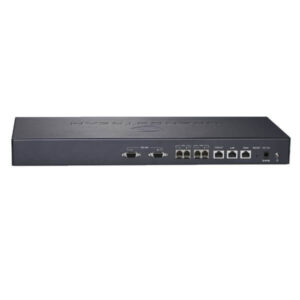
8 × 1GbE plus USB 3.0 and console connectivity per the TZ370 series datasheet.
Dubai, Abu Dhabi, Sharjah, Ajman, Al Ain and wider UAE; export support by project.
Use the manufacturer-rated adapter and confirm rack/PDU conditions before deployment.
Support and hardware coverage depend on the quoted bundle and regional entitlement; confirm on quotation.
Executive Product Architectural Overview
A modern branch firewall has to do considerably more than permit or deny traffic. It must identify applications, inspect encrypted sessions, separate trusted and untrusted zones, enforce acceptable-use policy, provide remote-access pathways, participate in site-to-site VPNs, expose useful telemetry, and remain manageable by a small IT team. The SonicWall TZ370 is designed around that reality. Rather than treating security, routing and branch operations as unrelated functions, it places them within the SonicOS 7 operating environment so administrators can define security zones, access rules, NAT behavior, VPN policy, application controls, gateway protection services and monitoring in a common operational model. This is important for small and midsize organizations because complexity is often the limiting factor in security operations. A platform that consolidates core controls can reduce the number of independent systems that must be patched, monitored and understood by the local team.
The TZ370 sits in SonicWall’s compact Gen 7 TZ family and is intended for smaller organizations and distributed branches. The architecture provides eight 1GbE interfaces, giving administrators useful physical port density for WAN, LAN, DMZ, voice, guest, management, camera, server or other segmented networks. The value of those ports is not simply the number of cables they accept. Properly designed, they allow a business to divide traffic into trust zones and apply different controls to each zone. A public-facing server network can be isolated from employee endpoints; a guest Wi-Fi segment can be prevented from reaching finance systems; IP phones can be separated from general workstation traffic; and a secondary internet circuit can be used for failover or policy-based path selection. Logical VLAN interfaces expand that segmentation model where switching infrastructure supports tagged networks.
For organizations moving business applications to SaaS platforms, the firewall also becomes an enforcement point between users and cloud services. Application-aware policies can help distinguish legitimate collaboration, storage and productivity traffic from unwanted applications or risky behavior. Content and DNS-related controls within the relevant licensed services can add additional policy layers. Advanced threat-protection services can inspect content for known malware and, where licensed, submit suspicious files for deeper analysis. These features matter because many attacks no longer arrive through obvious executable downloads; they can enter through documents, web sessions, compromised websites, credential theft, encrypted connections and remote access pathways. The branch edge therefore needs layered controls rather than a single packet-filtering function.
Secure connectivity is another architectural priority. Businesses in Dubai frequently operate across Free Zone offices, warehouses, retail outlets, clinics, schools, temporary project sites and remote staff. The TZ370 can participate in site-to-site VPN designs and secure SD-WAN strategies that help connect locations over ordinary internet links while maintaining policy control. The exact architecture should be chosen according to circuit speed, application sensitivity, latency, failover requirements and the number of sites. A small branch running cloud applications may prioritize resilient internet failover and straightforward central management, while a professional services office may prioritize remote access and inspection of outbound SaaS traffic. A retail environment may need tightly segmented payment, guest and operational networks. The same appliance can support different policy models, but the configuration should be driven by the business topology rather than copied from a generic template.
Centralized management is also relevant for multi-site operations. SonicWall provides management options including Network Security Manager, along with web interface, CLI, SSH, GMS and REST APIs on the TZ series. The practical benefit is consistency. A team responsible for ten branches should not depend on ten unrelated local configurations maintained by memory. Standard object naming, common security rules, coordinated firmware planning, alerting and reporting make a distributed environment easier to govern. For organizations with managed-service partners, central tooling also supports repeatable operations and documented change control.
The one-year TotalSecure Advanced bundle should be viewed as part of the architecture, not as an accessory. The useful security capabilities of a next-generation firewall depend heavily on active subscriptions, current signatures, cloud-delivered intelligence, malware-analysis services, content controls, DNS-related defenses, firmware access and support entitlements. For this reason, procurement teams should evaluate the appliance and the subscription term together. They should also confirm the exact service bundle mapped to the manufacturer part number on the current quotation, because historical SonicWall documents and channel catalogs can use different bundle mappings for older SKUs. FourTeck can help UAE buyers validate the requested bundle, deployment assumptions and renewal path before the purchase order is finalized.
Enterprise Business Value & ROI Benefits
Performance Without Oversizing
The commercial value of a correctly sized TZ370 is avoiding both extremes: buying an appliance too small for inspected traffic or purchasing a much larger platform that never approaches its capacity. Security throughput must be assessed with real services enabled, not by looking only at headline firewall throughput. When WAN speed, encrypted traffic ratio, VPN use and future growth are considered together, the TZ370 can provide a practical balance for compact locations.
Layered Threat Defense
A firewall that only blocks ports leaves major gaps. The security-services model adds controls such as gateway malware inspection, intrusion prevention, application policy, content controls and advanced threat analysis according to the active entitlement. Consolidating these functions at the edge can reduce dependence on multiple point appliances while still complementing endpoint, email and identity security.
Operational Consistency
Distributed branches often accumulate configuration drift. Central management, standardized policy objects, coordinated firmware and common reporting can reduce the administrative friction of maintaining many sites. The result is not simply fewer clicks: it is a better chance that a new branch is deployed with the same security baseline as an existing location.
Business Continuity
Dual-WAN strategies, VPN alternatives and secure SD-WAN policy can help a site remain productive when a primary circuit degrades or fails, provided the deployment includes appropriate secondary connectivity. For branches that depend on cloud ERP, POS, hosted voice or SaaS collaboration, network resilience has direct commercial value.
Security Segmentation
Physical interfaces and VLAN support enable a more disciplined trust model. Separating users, guests, servers, cameras, voice systems, operational devices and management networks can limit unnecessary lateral movement. Segmentation also makes policy easier to explain during audits because access can be documented by business function.
Lifecycle Predictability
Buying a defined subscription term creates a clear renewal milestone. Procurement teams can record the activation date, service term, support status and renewal owner instead of discovering expired protection only after an incident or firmware requirement. FourTeck can assist with renewal planning and commercial coordination.
The broader return on investment comes from reduced exposure to preventable incidents, simpler branch standardization, fewer emergency configuration changes and more predictable support. A firewall purchase should therefore be measured against the operational cost of unmanaged internet access, inconsistent VPNs, weak segmentation, unsupported firmware and manual troubleshooting. The TZ370 does not eliminate those risks automatically; value is realized when the appliance is properly sized, licensed, configured, monitored and maintained. That is why procurement and deployment planning should be treated as one process.
For UAE organizations with several sites, standardization can be particularly valuable. When each branch uses the same firewall family and similar policy structure, internal teams and service providers can build reusable runbooks for onboarding, failover tests, VPN changes, rule reviews, firmware maintenance and incident response. Standardization also simplifies spare strategy and skills development. Instead of technicians learning a different firewall at every site, they can deepen expertise in one operating model and escalate unusual cases more effectively.
Hardware & Technical Architecture Highlights
The TZ370 architecture is built for compact edge deployments where port density, inspected traffic and manageability matter more than datacenter-scale modularity. The appliance provides eight 1GbE interfaces, two USB 3.0 ports and a console interface. This physical design gives small offices enough interfaces to build meaningful separation without immediately depending on a large routed core. Typical assignments can include primary WAN, secondary WAN, trusted LAN, guest or wireless uplink, DMZ, voice, management and a dedicated services segment. The actual port plan should be aligned with the switching design so that security boundaries are deliberate rather than accidental.
SonicOS 7 provides the policy and services layer. Security zones can represent different trust levels, address and service objects can standardize policy references, and NAT rules can define how internal systems reach external networks or how approved services are published. Stateful inspection tracks connection context, while application-aware and intrusion-prevention functions add deeper decision-making when the appropriate services are enabled. The operational implication is that policy can be written around business traffic rather than only around IP addresses and ports.
The TZ370 series also supports expandable storage, with the current Gen 7 datasheet indicating optional storage expansion up to 256GB and 32GB included for the series. Local storage can support functions such as logging, reporting or other platform services depending on software version and configuration. Buyers should not assume that storage capacity replaces a centralized log-retention platform. If regulatory, forensic or long-term retention requirements apply, log volume, retention duration, export method and centralized analytics should be designed separately.
Management interfaces include Network Security Manager, CLI, SSH, web UI, GMS and REST APIs. Different organizations will use different combinations. A single-site administrator may rely primarily on the web interface, while an MSP or enterprise operations team may use centralized tooling and APIs. API capability is especially relevant where firewall information needs to feed asset, orchestration or monitoring workflows, but automation should still be governed by change controls and credential security.
From a resilience standpoint, the TZ370 itself should be placed within a broader continuity design. Internet redundancy, upstream switching, power protection, configuration backups, firmware maintenance and support entitlement all affect real availability. A firewall connected to a single ISP and unprotected power remains a single point of service interruption regardless of appliance capability. UAE branch sites should therefore review UPS runtime, cooling, cabinet ventilation, surge protection, dual-WAN availability and recovery procedures as part of deployment.
Definitive Technical Specifications Table & Sizing Notes
| Specification | TZ370 Guidance | Buyer Note |
|---|---|---|
| Operating system | SonicOS 7 | Confirm supported firmware release at deployment. |
| Ethernet interfaces | 8 × 1GbE | Plan WAN, LAN, DMZ and segmented networks before cabling. |
| USB | 2 × USB 3.0 | Use only for supported SonicWall workflows and accessories. |
| Console | 1 console interface | Maintain secure administrative procedures. |
| VLAN interfaces | Up to 128 for TZ370 series | Logical scale must still be matched to policy complexity and operations. |
| Access points supported | Up to 16 for TZ370 series | Confirm SonicWave model compatibility and licensing. |
| Single Sign-On users | Up to 1,000 for TZ370 series | Not a substitute for throughput sizing. |
| Storage | 32GB included; expansion options up to 256GB indicated for series | Configuration dependent; confirm current accessory support. |
| Management | NSM, Web UI, CLI, SSH, GMS, REST APIs | Management service entitlement may vary. |
| Wireless | W model supports integrated wireless; standard TZ370 is wired | Do not confuse TZ370 with TZ370W. |
| Subscription term | 1 year as requested | Confirm activation, support and renewal dates on order. |
| Manufacturer part reference | 02-SSC-6819 as supplied by customer request | Current entitlement mapping should be validated on quotation due historical channel/catalog differences. |
Sizing a firewall requires more than comparing the ISP line rate with a single throughput figure. Real traffic may be encrypted, may pass through intrusion prevention, gateway malware inspection, content controls and application identification, and may include simultaneous site-to-site VPN or remote-access workloads. Each security function consumes resources, and traffic patterns are rarely uniform. A 500 Mbps office where most traffic is ordinary SaaS browsing behaves differently from a 500 Mbps site moving large encrypted backups, running many VPN tunnels or supporting high session counts.
Buyers should document the current peak WAN utilization, contracted circuit rate, expected growth, number of users, device count, VPN requirements, major applications, encrypted traffic percentage, required security services and branch criticality. They should also estimate how long the appliance is expected to remain in service. A firewall that is comfortable today but has no capacity for a circuit upgrade may create an avoidable replacement project. FourTeck can use these inputs to help determine whether the TZ370 is appropriately sized or whether another TZ model should be evaluated.
Configuration, Sizing & Deployment Workbench
01 — Establish Real Traffic Demand
Record primary and backup ISP speeds, actual peak utilization, expected 24- to 36-month growth and any planned circuit upgrades. Do not size only for today’s average usage. Determine whether full security inspection must remain active at peak load, because bypassing protection to recover performance defeats the purpose of the platform.
02 — Map Users, Devices and Sessions
Count employees, guest devices, phones, printers, cameras, IoT systems, servers and other endpoints. User count alone can hide session-heavy workloads. A retail branch with payment terminals, cameras and guest Wi-Fi may have fewer employees but more concurrent devices than an office of similar size.
03 — Define Security Services
Identify which inspection and protection services must be enabled, including intrusion prevention, gateway anti-malware, application control, content filtering, DNS-related controls, advanced threat analysis and SSL/TLS inspection where permitted and appropriate. Licensing, privacy policy, certificate deployment and endpoint compatibility should all be considered before enabling decryption broadly.
04 — Design Segmentation
Create a zone and VLAN plan based on business trust boundaries. Typical segments include corporate users, servers, voice, CCTV, guest Wi-Fi, building systems, POS, management and DMZ. Document which segments need to communicate and deny unnecessary lateral access by default.
05 — Plan VPN and SD-WAN
List site-to-site tunnels, remote users, cloud connectivity and partner VPNs. For dual-WAN or SD-WAN deployments, document path selection, failover behavior, health checks and application priorities. A tested failover policy is more valuable than a theoretical redundant link.
06 — Confirm Subscription Terms
Record the exact bundle, service term, activation date, renewal owner and support entitlement. Because older datasheets and channel catalogs may associate historical part numbers differently, require the quotation to state the final service suite clearly. This protects procurement, IT and finance from assuming different entitlements.
07 — Prepare the Physical Environment
Confirm rack or shelf placement, ventilation, ambient temperature, UPS support, cable labeling, ISP handoff type and management access. Small appliances are often placed in improvised cabinets where heat and power quality become the actual reliability bottleneck.
The deployment should conclude with validation, not merely installation. Test internet access, failover, critical applications, published services, VPNs, DNS behavior, security policies, logging and alert delivery. Save a configuration backup, document administrative ownership and schedule the first rule review. If the firewall replaces an older appliance, maintain a rollback plan until all critical workflows have been verified. For multi-site projects, pilot one representative location before mass rollout so policies, templates and operational procedures can be refined with real traffic.
Industry Use Cases & Workload Scenarios
Banking & Finance Branches
Smaller financial offices require strict segmentation, secure connectivity to centralized applications, controlled internet access and clear administrative accountability. The TZ370 can form the branch security edge where traffic volumes fit its sizing profile. Payment or regulated environments should be designed against the organization’s compliance requirements rather than assuming a firewall alone creates compliance.
Healthcare & Clinics
Clinics can separate clinical workstations, administrative systems, guest Wi-Fi, cameras and connected devices. Secure VPN connectivity may link the site to centralized records or hosted services. Policy should account for privacy, medical-device dependencies and the risk of disrupting essential systems during aggressive inspection.
Government & Public Sector
Small government branches and service points may use the platform for segmented access, secure tunnels, application controls and centrally governed policies. Procurement should align firmware, logging, hardening, support and data-handling requirements with the responsible authority’s standards.
Logistics & Warehousing
Warehouse sites often mix office users, handheld scanners, cameras, label printers, ERP terminals, IoT devices and guest access. Segmentation and resilient internet connectivity are therefore central requirements. A dual-WAN design can reduce disruption to cloud warehouse and transport systems where a second circuit is available.
Retail
Retail branches can isolate point-of-sale systems from guest Wi-Fi, digital signage and employee devices while maintaining secure connectivity to head office or cloud applications. Standardized firewall templates help retailers deploy repeatable controls across multiple stores.
Education
Schools and training centers typically require content controls, staff/student segmentation, guest access, cloud application access and protection for administrative systems. The platform can support these functions when user, device and throughput requirements remain within the selected model’s capacity.
Technical Feature Deep Dive 1: Processing, Throughput & Workload Performance Architecture
Firewall performance is best understood as a chain of inspection stages rather than a single speed. A basic stateful firewall can forward traffic with relatively little analysis, but next-generation security adds more work: application identification, intrusion signatures, malware scanning, reputation checks, policy lookup, logging and sometimes decryption. Each additional stage adds security value and consumes processing resources. For this reason, the throughput number that matters most is the one that reflects the intended security policy. If an organization will enable intrusion prevention and malware scanning on all outbound traffic, it should size against inspected traffic rather than the maximum stateful figure.
Encrypted traffic complicates this further. Modern web and cloud sessions are predominantly encrypted, which limits what a firewall can inspect unless TLS/SSL decryption is configured. Decryption can improve visibility but introduces CPU overhead, certificate-management requirements and privacy considerations. It can also create application compatibility issues with certificate pinning or sensitive services. A practical deployment starts by defining which categories of traffic require inspection, which should be excluded for legal or technical reasons, and how certificates will be trusted on managed endpoints. That policy should then be tested under realistic load.
Session behavior is equally important. A branch with many short web sessions, voice traffic, persistent cloud connections, software updates and remote users can stress state tables differently from a simple throughput test. Administrators should monitor connection counts and resource utilization after deployment, especially during business peaks. Capacity planning should be revisited when adding a new SaaS platform, increasing remote users or upgrading the internet circuit. The objective is to keep enough headroom for bursts, failover and security updates rather than operating continuously at the edge of capacity.
Secure SD-WAN extends the performance discussion from inspection to path quality. Where two internet links are available, traffic can be steered according to link health and policy. Critical applications may use the path with better latency or packet loss, while less sensitive traffic follows a different route. The business outcome is improved continuity without requiring a dedicated private circuit for every branch. However, SD-WAN is not automatic resilience: health thresholds, failback behavior, DNS dependencies, VPN routes and application priorities all need to be tested.
Technical Feature Deep Dive 2: Security, Redundancy & System Resilience
The security model of the TZ370 is layered. Stateful inspection establishes connection context; access rules define permitted communication; intrusion prevention analyzes traffic patterns and known exploit signatures; gateway anti-malware checks supported content; application controls identify and regulate applications; content and DNS-related services can restrict risky destinations; and advanced threat protection can provide deeper analysis for suspicious files when covered by the active service bundle. None of these layers should be viewed as a complete defense by itself. The strongest deployment combines firewall controls with endpoint security, identity protection, email security, backup, vulnerability management and user awareness.
Segmentation is one of the highest-value resilience functions because it limits how far an incident can spread. A ransomware infection on a guest or user network should not automatically gain access to camera systems, payment devices, management interfaces or servers. Segmentation starts with topology but succeeds through access policy. Teams should explicitly document required flows and remove broad any-to-any rules. Temporary exceptions should have owners and review dates. Over time, a firewall rulebase can become less secure simply because obsolete entries are never removed.
Administrative security is equally critical. Management access should be restricted to trusted networks or secure remote paths, protected by strong authentication and assigned to named administrators. Shared credentials make incident investigation and change accountability difficult. Configuration backups should be protected, firmware updates should follow a documented process, and alerts should be routed to monitored destinations rather than personal inboxes that may be ignored.
Resilience also depends on external systems. A branch firewall requires stable power, upstream connectivity, reliable DNS and often authentication services. A UPS should cover the firewall, ISP equipment and key switches long enough for short power events or controlled shutdown. If business continuity requires dual WAN, the secondary link should use an independent failure domain where possible. Two circuits from the same last-mile provider may not deliver the independence assumed by the design. Quarterly failover testing is a practical way to discover problems before an outage.
Technical Feature Deep Dive 3: Remote Management, Telemetry & Infrastructure Integration
A security device becomes operationally valuable when its telemetry reaches the people and systems responsible for acting on it. The TZ370 platform supports multiple management methods, including Network Security Manager, web interface, CLI, SSH, GMS and REST APIs. A single-site business may require only a carefully managed web interface and email alerts. A multi-site enterprise or MSP may need centralized policy, inventory, firmware planning and reporting. The management design should match the number of devices and the maturity of the operations team.
Central management can reduce configuration drift by allowing templates and common policies to be reused. For example, every retail branch may have the same guest network, POS segment, head-office VPN and monitoring destinations, while only WAN addresses and local subnet ranges differ. Consistency accelerates deployment and troubleshooting because engineers know what a normal site should look like. It also makes exception handling visible: when one branch differs, the change can be documented rather than hidden in an individual appliance.
Telemetry should support both security investigation and service operations. Security teams may need denied connections, threat events, authentication activity and application visibility. Network teams may care about WAN loss, tunnel status, bandwidth and interface errors. Management may need concise availability or security summaries. The same data should not be presented identically to every audience. A useful design routes detailed logs to technical analysts while generating operational dashboards and alerts that highlight conditions requiring action.
REST API capability can support integration with asset systems, automation or reporting workflows, but automation must not bypass governance. API credentials should have the least privilege required, secrets should be stored securely, and automated changes should be logged. Before using automation for firewall policy, organizations should establish a review and rollback process. The advantage of integration is repeatability, not uncontrolled speed.
What Buyers Should Check Before Purchase
The largest procurement mistakes occur when a correct product is purchased with an incorrect assumption: wrong bundle entitlement, insufficient inspected throughput, missing VPN requirements, unsupported wireless expectations, inadequate port planning, expired subscriptions or an unrealistic delivery schedule. Use the checklist below before issuing the purchase order.
01 / FIT — Configuration Fit & Model Sizing
Confirm WAN speed, real peak utilization, user count, device count, inspected traffic, SSL/TLS decryption needs, VPN tunnels and growth horizon. Consider the effect of enabling multiple protection services simultaneously. If the organization expects a major circuit upgrade or new branch workload during the hardware lifecycle, size with that future state in mind.
02 / MATCH — Compatibility & Environmental Requirements
Confirm that the standard TZ370, rather than the wireless TZ370W, is required. Review switch VLAN capability, ISP handoff, rack or shelf space, UPS coverage, management network, authentication dependencies, supported VPN peers and any wireless controller requirements. Check whether local storage expansion or specific accessories are part of the project.
03 / TERMS — Availability, Delivery & Warranty Terms
Request a written quotation that identifies product, manufacturer part reference, subscription name, term, support entitlement, delivery destination and commercial validity. Because historical channel documentation can map older part numbers differently, require the exact subscription entitlement to be restated on the quote. Avoid assuming online catalog wording overrides the final distributor entitlement.
04 / REQUEST — Quote Preparation Data Needed
Provide the requested quantity, business or project name, delivery emirate, deployment date, primary and backup internet speed, number of sites, required VPN connections, remote-user count, security services expected, renewal preference and whether configuration assistance is needed. Better input produces a more accurate commercial and technical recommendation.
UAE Regional Availability & Service Ecosystem
FourTeck supports UAE technology procurement through quotation coordination, model validation, licensing clarification, delivery planning and project logistics. For security appliances, availability should always be checked against the exact model, subscription term and manufacturer part mapping because hardware and service bundles can have different lead times. Buyers can submit site count, quantity, required delivery date and configuration context to receive a project-oriented response rather than a generic catalog quote.
Dubai Supply & Logistics Support
Dubai organizations can request supply coordination for offices, Free Zone entities, retail sites, hospitality locations, warehouses and branch projects. FourTeck can assist with quotation turnaround, product/bundle validation, delivery planning and pre-deployment requirement capture. For multi-site projects, staging information such as site names, WAN details and intended VLAN structure can be collected in advance to simplify rollout planning.
Abu Dhabi & Al Ain Logistics Reach
For Abu Dhabi and Al Ain, FourTeck can coordinate sourcing and delivery for corporate, industrial, education, healthcare and government-related projects subject to project terms and required documentation. Buyers should provide delivery location, quantity and target deployment date early, particularly where site access or procurement approvals impose fixed windows.
Sharjah & Northern Emirates Logistics Infrastructure
Sharjah and Northern Emirates projects can be supported with quotation handling, availability verification and delivery coordination. Branch organizations should include circuit speeds and site topology in the inquiry so the firewall model can be reviewed before purchase rather than after installation.
Ajman & Surrounding Emirates Logistics Coverage
Ajman buyers can request technical pre-sales guidance, licensing clarification and delivery coordination for single-site and multi-site requirements. Where a project involves replacement of an existing firewall, include the current model and active VPN count to help identify migration considerations.
GCC & Pan-African Supply Chain Reach
FourTeck can coordinate regional technology supply for qualified projects that require cross-border logistics, export documentation and configuration validation. Delivery terms, taxes, duties, regulatory requirements, support eligibility and manufacturer channel rules vary by destination, so each export quotation should be reviewed individually.
Saudi Arabia (KSA) Export & Supply Support
Saudi Arabian enterprise and branch projects can be supported through regional inquiry routing, configuration review and commercial coordination. Project teams should provide end-user location, quantity, deployment schedule and required service term so the quotation can reflect appropriate supply conditions.
Qatar Market Supply Reach
Qatar projects can request cross-border sourcing and quotation support for branch firewall deployments. For multi-site requirements, a bill of materials should distinguish hardware, subscriptions, spares and any accessories to simplify customs and project receiving.
Oman Regional Distribution Support
Oman buyers can request procurement guidance for SonicWall appliances and related services, subject to current regional availability and entitlement. Deployment assumptions should be stated early where the firewall is part of an SD-WAN or site-to-site VPN rollout.
Kuwait Supply Chain Coverage
For Kuwait, FourTeck can coordinate project quotation and export supply planning. Regional inquiries can also be routed through FourTeck Kuwait.
Kenya & East Africa Supply Infrastructure
Kenyan system integrators and enterprise buyers can request regional distribution coordination, technical inquiry routing and project logistics through FourTeck Kenya.
Uganda Regional Procurement Support
Uganda projects can be supported with localized inquiry response, technology sourcing and project supply coordination through FourTeck Uganda.
Pan-African Regional Logistics & Trade Reach
For broader African technology projects, FourTeck can coordinate multi-country inquiries and export logistics based on project scope. Visit FourTeck Africa and FourTeck Global for regional project routing.
Related FourTeck Products & Compatible Alternatives
SonicWall TZ270
Consider for smaller sites with lighter inspected-traffic requirements where cost and compactness take priority. Validate security throughput before selecting it as a substitute.
SonicWall TZ370W
Consider when integrated wireless capability is specifically required. Verify regional wireless model, radio standard, licensing and deployment layout rather than assuming it directly replaces managed access points.
SonicWall TZ470
Consider for higher growth expectations, stronger interface requirements or more demanding branch workloads. This can provide useful headroom where the TZ370 would operate too close to capacity.
SonicWall TZ570 Series
Consider for larger branches and more demanding security inspection, especially where interface, PoE or resilience requirements exceed the compact TZ370 design.
The best alternative is not automatically the next larger model. Buyers should compare real WAN demand, inspection services, site criticality, expected growth, interface requirements, wireless architecture and support lifecycle. A larger appliance may be justified by future circuit upgrades or heavier TLS inspection; a smaller appliance may be perfectly adequate for a low-bandwidth remote office. FourTeck can compare models against a common workload profile so the decision is based on capacity and risk rather than model naming alone.
Why Enterprises Choose FourTeck
Enterprise firewall procurement is most effective when commercial sourcing and technical validation happen together. FourTeck’s role is to help buyers translate a product request into an order that matches the intended deployment. That includes checking model fit, clarifying the requested subscription term, capturing site and WAN requirements, coordinating quotation details and planning delivery. Where a manufacturer part reference has historical mapping differences across channel documentation, the commercial response should explicitly restate the bundle entitlement so all stakeholders are working from the same assumption.
For multi-site projects, FourTeck can help structure the requirement by site, quantity and deployment phase. This reduces the chance that hardware arrives without the right subscriptions, accessories or timing. Procurement teams can also request renewal planning information so subscription expiry is tracked as part of the asset lifecycle. Post-sales warranty and support processes remain subject to the purchased entitlement and manufacturer terms, and FourTeck can help route support-related commercial questions where applicable.
The objective is evidence-led procurement: no invented stock claims, no assumed prices, and no unverified performance promises. Buyers receive the most useful result when they provide clear technical and logistical inputs, allowing the quotation to identify configuration-dependent items and current options before commitment.
Frequently Asked Questions
1. What type of organization is the SonicWall TZ370 designed for?
The TZ370 is designed for small and midsize organizations, lean branches and distributed offices that need next-generation firewall functions in a compact platform. Suitable deployments include professional offices, clinics, retail branches, schools, warehouses and service locations. Final suitability depends on inspected throughput, user and device count, VPN demand, enabled security services and future internet-speed growth.
2. What does the one-year TotalSecure Advanced bundle provide?
The requested bundle is intended to combine the TZ370 appliance with a one-year security-services and support entitlement that can include advanced threat protection, gateway malware defenses, intrusion prevention, application controls, content filtering, DNS-related protection, cloud management/reporting and support. Exact entitlement should be confirmed on the current quotation because historical SKU mappings and channel descriptions can differ.
3. How many Ethernet interfaces does the TZ370 provide?
The SonicWall Gen 7 TZ370 series datasheet lists eight 1GbE interfaces, together with USB 3.0 and console connectivity. Those ports can be assigned to WAN, LAN, DMZ and other segmented networks according to the design. Physical port count does not determine overall capacity, so inspected throughput and security workload must still be sized separately.
4. Is the standard TZ370 a wireless firewall?
The standard TZ370 is the wired model. SonicWall also offers wireless variants in the TZ family, commonly identified with a W suffix such as TZ370W. Buyers who require integrated wireless should confirm the exact wireless model and regional compatibility. Larger or multi-AP environments may be better served by dedicated managed access points rather than relying on an integrated radio.
5. Can the TZ370 be used for secure SD-WAN?
Yes, the TZ370 can participate in SonicWall secure SD-WAN designs. This is useful for branches with multiple internet circuits that need application-aware path selection, health monitoring and failover. Effective SD-WAN requires deliberate configuration of probes, thresholds, routes, VPNs and failback behavior; simply connecting two WAN links does not automatically create resilient application delivery.
6. How should a Dubai business size this firewall?
Start with contracted WAN speed, actual peak usage, expected growth, encrypted traffic percentage, security services to be enabled, VPN load, number of users and device count. Add headroom for traffic bursts and planned circuit upgrades. If deep inspection or extensive TLS decryption is required, assess performance under those conditions rather than relying on a basic firewall throughput figure.
7. Does the TZ370 support centralized management?
The TZ370 series supports multiple management methods, including Network Security Manager, web UI, CLI, SSH, GMS and REST APIs. Central management is especially valuable for organizations with multiple branches because it can help standardize policy, coordinate firmware, improve visibility and reduce configuration drift. Specific cloud-management and reporting capabilities can depend on the purchased entitlement.
8. Why is SKU confirmation important for 02-SSC-6819?
Current channel catalogs can list 02-SSC-6819 as a TZ370 TotalSecure Advanced one-year bundle, while some older Gen 7 documentation associates the same historical reference differently. To avoid procurement ambiguity, the FourTeck quotation should explicitly state the appliance model, service-suite name, term and support entitlement. The quote, distributor entitlement and manufacturer activation details should be treated as the final commercial reference.
9. Can FourTeck deliver the TZ370 outside Dubai?
FourTeck can coordinate technology supply inquiries across the wider UAE and, for eligible projects, GCC and African markets. Delivery availability, export documentation, duties, support eligibility and lead time vary by destination. Provide the delivery city or country, quantity and required deployment date so the quotation can reflect the appropriate logistics route.
10. What information should be sent when requesting a quote?
Provide the model or part reference, quantity, delivery location, required date, number of sites, primary and backup ISP speeds, approximate users and devices, VPN requirements, desired security services and whether migration or configuration assistance is required. For replacement projects, include the current firewall model. This information helps FourTeck validate the fit and prepare a more accurate project quotation.
Request a SonicWall TZ370 Project Quote
Send FourTeck the required model, quantity, delivery location, site count, WAN speed and deployment timeframe. If this is a firewall replacement, include the existing model, VPN count and any planned internet upgrade. The team can then coordinate current bundle validation, availability, commercial terms and delivery planning for Dubai, the wider UAE or eligible export projects.