
ZKTeco Speed Gate Turnstile in Dubai, UAE
A premium pedestrian access-control platform for organizations that need fast, controlled entry through swing barriers with flexible authentication and lane configurations.
This page covers the current ZKTeco SBTL8000/SBTL8200 speed-gate family as the verified technical reference. The exact supplied gate, lane count, passage width, reader arrangement, controller, ingress protection and software integration should be confirmed against the site plan before purchase.
RFID, QR or facial options
Configuration review
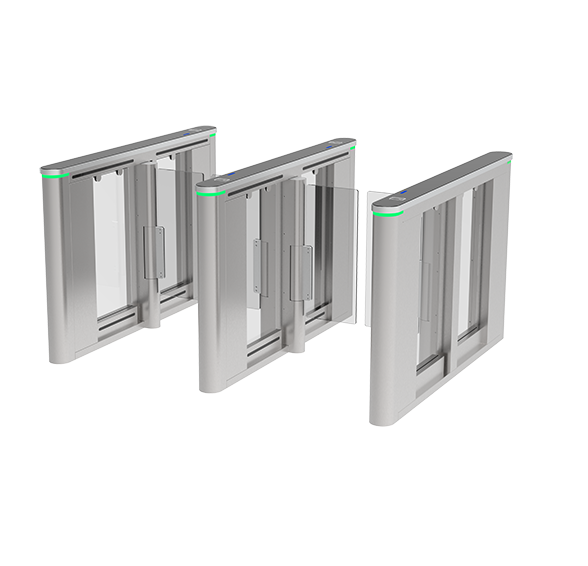
A controlled pedestrian lane designed around access decisions
The ZKTeco speed-gate platform is designed to sit at the physical boundary between a public or semi-public entrance and a controlled business area. Instead of relying on a receptionist, manual barrier or simple door alone, a speed gate creates a defined pedestrian lane and opens only when the connected access-control process permits passage. That makes it relevant to corporate lobbies, office towers, campuses, finance environments, government facilities, hotels, premium residential reception zones and other locations where identity verification and orderly movement must work together.
For the current SBTL8000/SBTL8200 family, ZKTeco separates the decision into a single-lane SBTL8000 series and a dual-lane SBTL8200 series. The standard lane width is 660 mm, while an optional 1000 mm passage is available for projects that need a wider route. This matters because lane planning is not simply a cosmetic decision. It affects the reception layout, accessibility planning, circulation capacity, the number of cabinets required and the physical space that must be reserved before electrical and floor works are completed.
Authentication is also configuration dependent. The verified family supports under-mount RFID or QR-code options and post-mount facial authentication arrangements. ZKTeco lists optional C3-series or InBio-series controllers, with third-party controller use depending on available chassis space. In practical terms, the gate should be selected as one part of the wider access-control design: credentials, controller, software, reader location, fire-alarm behavior, power and network connectivity all need to work as a coordinated system.
For UAE buyers, FourTeck can help translate those technical choices into a purchase requirement. A useful discussion normally starts with the number of lanes, expected daily traffic, preferred credential, required passage width, indoor or exposed installation area, existing access-control platform, fire-alarm interface requirement and the number of sites. That approach reduces the risk of purchasing attractive entrance hardware that later needs unplanned controller changes, mounting work or reader substitutions.
Why a properly planned speed gate changes the entrance experience
The main value is not simply that the barrier moves quickly. A correctly designed installation combines controlled passage, user guidance, credential choice and safety behavior into one predictable entrance process.
Controlled movement without creating a heavy checkpoint feel
The servo-driven swing movement is designed for smooth passage, while the sensor array helps the gate monitor the lane. In a reception environment, this can support a more professional flow than an improvised physical barrier. The result is especially useful where employee traffic is regular throughout the day and the entrance needs to remain orderly without looking like an industrial security point.
Multiple credential paths
RFID, QR code and facial-authentication options allow the entrance design to match existing staff cards, visitor workflows or touch-free identity processes. Because reader placement and controller selection vary, the credential method should be confirmed before the gate is ordered.
Passage protection and emergency behavior
The current family includes anti-pinch and anti-tailgating functions, a power-off unlock device and a fire-alarm release connection. These features matter when a turnstile is placed on a routine pedestrian route that must also support safe exit behavior under abnormal conditions.
Designed to become part of the access-control system
A speed gate creates the most value when the physical lane, access controller, reader and management platform are considered together. ZKTeco lists ZKBio CVAccess and ZKBio CVSecurity support depending on the equipped controller. This lets project teams plan the gate as a managed security endpoint rather than a stand-alone piece of entrance furniture.
Single and dual-lane planning
The SBTL8000 and SBTL8200 family structure gives designers a practical way to build one or more controlled lanes. The right combination depends on corridor width, peak arrivals, accessible passage requirements and whether entry and exit share the same bank.
Maintenance-oriented design data
ZKTeco publishes an MCBF figure of 10 million and an MTTR figure of 60 minutes for the current family. These are useful planning references for facilities teams assessing a product intended for repeated daily use, while actual service arrangements still depend on project scope and local support planning.
The important details are the lane, reader and environment
The ZKTeco Speed Gate Turnstile is most useful when buyers treat it as a configurable entrance-control family. The chassis is built from SUS304 stainless steel, the barrier is transparent acrylic, and the top section uses an aluminium cover with a tempered-glass lid in the current SBTL8000/SBTL8200 series. A servo motor drives the swing movement, with average movement timing listed at 0.3 to 0.6 seconds and adjustable opening and closing timing.
Pedestrian detection is handled by 12 pairs of infrared sensors as standard, with 18 pairs optional. That detail should be considered alongside the project’s expected traffic and safety requirements rather than viewed as an isolated specification. ZKTeco also distinguishes flow by authentication method, listing approximately 30 passengers per minute for facial authentication or QR use and 35 passengers per minute for RFID. Real-world throughput will still depend on how quickly users present credentials, how the system is configured and how the surrounding reception process is organized.
Environmental selection needs particular attention in the UAE. The family is listed for indoor/outdoor application, with standard IPX4 water resistance and an IP65 configuration available through customized internal components. The IP65 option increases the overall device height by 14 mm. Buyers planning an exposed entrance should therefore confirm the exact protection version, site shelter, floor drainage, power routing and reader installation before treating a generic product description as sufficient for procurement.
ZKTeco SBTL8000 / SBTL8200 Series specifications
These figures describe the current official series reference used for this FourTeck listing. Exact supplied details should be confirmed on the selected model and project configuration.
| Specification | Current family reference | Buyer note |
|---|---|---|
| Brand | ZKTeco | Entrance-control product family |
| Models | SBTL8000 Series / SBTL8200 Series | Single lane / dual lane |
| Barrier | Transparent acrylic, swing movement | Confirm barrier arrangement with lane design |
| Motor | Servo motor | Average movement 0.3–0.6 s, adjustable timing |
| Lane width | 660 mm standard / 1000 mm optional | Confirm accessibility and floor plan |
| Infrared sensors | 12 pairs standard / 18 pairs optional | Based on selected configuration |
| Authentication | RFID, QR code, facial authentication options | Reader mounting differs by method |
| Flow reference | Facial: 30/min; QR: 30/min; RFID: 35/min | Actual flow depends on user and access process |
| Controller | Not equipped by default; optional C3/InBio series | Third-party controller subject to chassis space |
| Software | ZKBio CVAccess / ZKBio CVSecurity | Depends on equipped access controller |
| Ingress protection | IPX4 standard; IP65 customized option | IP65 changes overall device height by 14 mm |
| Working temperature | −20°C to 70°C | Site conditions still require project review |
| Chassis | SUS304 stainless steel, metallic gray | Top cover: aluminium with tempered-glass lid |
| Safety / security | Anti-pinch, anti-tailgating, power-off unlock, fire-alarm release | Final behavior depends on installation and configuration |
| Communication | Fire-alarm relay port ×1, RS485 ×1 | Coordinate with controller and fire-alarm design |
| Reliability references | MCBF 10 million; MTTR 60 minutes | Vendor reference figures, not a service guarantee |
| Certifications | CE, FCC | Confirm project-specific compliance requirements |
Choosing the correct specification begins with the passage, not the brochure. A 660 mm lane may suit a standard controlled route, while a project that needs a wider accessible passage may require the 1000 mm option and a different layout allowance. The authentication choice also affects the physical installation: an RFID or QR reader can be positioned differently from a facial terminal, and the controller decision affects management software, wiring and integration. Outdoor or semi-exposed sites should confirm whether the standard IPX4 version is sufficient or whether the customized IP65 arrangement is required. Finally, facilities teams should review power, floor fixing, network paths, fire-alarm release behavior, cable containment and future maintenance access before the gate line is finalized. FourTeck can help collect these inputs so the quotation describes a deployable system rather than only a cabinet model.
Configuration and buyer guidance
The highest-risk mistake is choosing the gate before confirming the entrance layout and credential process. Use the questions below to turn the project into a clear bill of requirements.
How many lanes are actually needed?
Estimate normal and peak pedestrian flow, identify whether entry and exit share lanes, and decide whether one wider passage is required. This determines whether the project should use single-lane modules, dual-lane modules or a mixed bank.
Which credential will users present?
Staff cards, visitor QR codes and facial authentication create different reader, mounting and user-experience requirements. Confirm whether one method or multiple methods are needed before selecting reader panels and terminals.
What controls access decisions?
Identify the current controller, credential database and management software. If the project will use C3, InBio or another controller, confirm available cabinet space, wiring and software support before purchase.
Is the location exposed to weather?
Do not treat “outdoor” as a single condition. Review canopy cover, water exposure, dust, floor drainage, temperature, cleaning practices and reader protection. Select the ingress-protection configuration around the actual site.
How will emergency release be handled?
Coordinate the fire-alarm release input, power-loss behavior and exit plan with the building’s approved life-safety design. Gate logic should support, not replace, the site’s required emergency procedures.
What should go into the quote request?
Send lane quantity, required width, credential method, controller preference, software environment, site exposure, project location, target date, installation scope and warranty expectations. Photos or a lobby drawing can make the review more useful.
Ideal business use cases
A speed gate makes sense where organizations need to control pedestrian movement while maintaining a polished entrance. The strongest fit is a site with repeat users, defined credentials and a reception or security process that can support the lane.
Corporate lobbies and office headquarters
Corporate reception areas often need a balance between security and hospitality. A controlled speed-gate bank can separate the public lobby from staff-only floors while supporting employee credentials and a structured visitor process. QR access can be useful for pre-registered guests when the wider visitor system supports it, while RFID remains familiar for staff cards. The design should consider reception desk position, accessible passage, lift lobby direction and how visitors receive temporary authorization.
Education and campus buildings
Universities, training centers and controlled campus buildings can use gates to define entry to student or staff zones. Peak arrival periods make lane-count planning important; a gate line should be sized for real class-change or morning traffic rather than average daily volume.
Finance and controlled offices
Financial offices and other controlled workplaces often need a visible boundary between reception and internal operations. Speed gates can complement access-control policies by ensuring the authorization decision is tied to a physical lane instead of relying only on a door or guard observation.
Government and public-service facilities
Facilities with staff-only internal zones can use controlled lanes to distinguish public circulation from authorized access. The project should separately plan staff credentials, visitor access, emergency release and any integration with building security operations.
Premium residential and hospitality reception
Where the entrance design must remain visually clean, slim speed-gate cabinets and transparent barriers can support controlled access without the visual weight of a full-height turnstile. The credential and visitor process should still be easy for residents, guests and front-desk teams.
Multi-tenant commercial buildings
A multi-tenant lobby can use speed gates as the common physical access layer before users reach lifts or tenant floors. The important question is not only whether the gate accepts a card, but how tenant credentials, temporary visitors and security exceptions are administered across the building.
ZKTeco Speed Gate Turnstile Lane Flow and Pedestrian Sensing
The gate is designed to move people through a defined lane after a valid access decision, while infrared sensing helps the system understand pedestrian position. In the current family, 12 pairs of infrared sensors are standard and 18 pairs are optional. This is significant because a speed gate does more than open and close; it must coordinate barrier movement with a person moving through the passage.
For a buyer, the practical question is whether the planned lane bank can handle real peak demand. ZKTeco publishes flow references of 30 passengers per minute for facial or QR authentication and 35 passengers per minute for RFID. Those values should be treated as design references, not guaranteed lobby throughput. A user who has to find a QR code on a phone, a visitor who stops to ask reception, or a card holder who presents a credential incorrectly can slow the real process.
A strong design therefore considers the full journey: where people queue, where they present credentials, whether the reader is obvious, how quickly the barrier opens, where the lane exits and whether users immediately meet a lift queue or another security point. FourTeck can help buyers review the lane count and credential flow together instead of relying only on a theoretical people-per-minute figure.
ZKTeco Speed Gate Turnstile Authentication and Access Integration
The current family supports multiple authentication approaches, but the gate itself should not be treated as the identity database. The access decision depends on the reader, controller and management environment selected for the project. ZKTeco lists under-mount RFID and QR options, post-mount facial authentication, optional C3-series or InBio-series controllers and support for ZKBio CVAccess or ZKBio CVSecurity depending on the equipped controller.
Before ordering, buyers should document what system already exists. If the building has an established card format, central access database, visitor-management application or security operating procedure, the gate must fit that environment. A procurement request that simply says “speed gate with face reader” is not enough to guarantee a workable system. FourTeck can help structure the requirement around the credential, controller, software and physical mounting path so the hardware choice supports the intended access workflow.
ZKTeco Speed Gate Turnstile Safety, Environment and Site Readiness
A speed gate is installed in a place people physically walk through, so site readiness matters as much as access-control logic. The current ZKTeco family includes anti-pinch and anti-tailgating functions, a power-off unlock device and active door release through the fire-alarm interface. These capabilities should be incorporated into the approved site design and tested during commissioning rather than treated as substitute wording for local life-safety requirements.
Environmental choice is particularly important for entrances near external doors, podiums or semi-open areas. ZKTeco lists IPX4 as the standard water-resistant version and an IP65 option with customized internal components. The IP65 arrangement changes the product height, so it should be selected before final architectural coordination. A sheltered lobby and an open outdoor gate line are not equivalent deployment conditions.
Facilities teams should also plan how technicians will reach panels and internal components after installation. Gates placed tightly against joinery, decorative walls or fixed furniture can become difficult to service even when the product itself is maintainable. Power supplies, network points, RS485 wiring, fire-alarm cable and any reader connections need proper containment and labeling.
The best time to solve these issues is before flooring, stone work and reception joinery are completed. FourTeck can review drawings, lane quantities and integration requirements early so procurement supports the architectural and security design instead of forcing late changes.
What Buyers Should Check Before Purchase
The most important purchase risk is choosing a gate by appearance or family name without defining the lane layout, reader, controller and installation environment. Confirm those four areas first and the rest of the quotation becomes much clearer.
Configuration Fit
Decide whether the project needs an SBTL8000 single lane, an SBTL8200 dual-lane arrangement, or a combination. Confirm standard versus wider passage, the number of controlled directions and the expected peak arrival pattern. A lobby that feels quiet at midday can become congested at the start of a workday, so lane quantity should reflect peak demand rather than average occupancy.
Compatibility Check
Confirm the card technology, QR workflow or facial terminal before selecting reader hardware. Review the existing controller and management software, then verify power, RS485 or other required wiring, fire-alarm release interface and network availability. If a third-party controller is intended, chassis space and integration responsibilities should be agreed before ordering.
Availability and Warranty
Ask for the exact model and selected protection level on the quotation. Availability can vary by model, lane configuration, reader option and quantity. Warranty handling should also be confirmed for the actual supplied item and project scope. Do not assume that a generic family warranty statement automatically describes installation labor, onsite response or every accessory.
Quote Preparation
For a useful quote, provide lane count, site drawing or entrance width, standard or accessible passage requirement, credential type, controller/software details, indoor or exposed installation, project city, quantity, target delivery date, installation expectations and any required handover documentation. This makes it easier to identify missing readers, controllers, cabling or services before purchase.
Buyers also benefit from considering long-term operating questions. Who will add and remove users? How will visitors receive temporary access? Who tests emergency release? Which team owns controller backups and software credentials? What happens if the reception layout changes? These are operational questions rather than brochure specifications, yet they often determine whether a speed-gate project remains easy to manage after the installation team leaves. FourTeck can help turn these questions into a practical scope for product, accessory and service quotation.
UAE Availability and Service Support
FourTeck supports ZKTeco speed-gate inquiries across Dubai and the wider UAE with help for model selection, configuration review, quote preparation, delivery coordination and warranty guidance. Availability can change according to the selected gate family, lane arrangement, ingress-protection option, authentication devices, controller, order quantity and supplier status. For that reason, the most useful request identifies the intended configuration rather than asking only whether “a ZKTeco speed gate” is available.
Dubai, Abu Dhabi, Sharjah and Ajman Coverage
Businesses in Dubai, Abu Dhabi, Sharjah, Ajman and other UAE locations can contact FourTeck for speed-gate product inquiries, access-control planning and quotation assistance. The same buying questions apply across locations: how many lanes are required, what passage width is appropriate, how users will authenticate, which controller and software are involved, whether the site is indoors or exposed, and whether installation or integration support is part of the project. FourTeck can help buyers review these requirements before the final model and accessories are quoted. Delivery, service coordination and warranty handling depend on the selected product, quantity, project location and agreed scope, so they should be confirmed as part of the commercial discussion rather than assumed from a generic product title.
GCC and Africa Availability
FourTeck also supports business technology inquiries through regional channels serving selected GCC and Africa markets. Organizations in Saudi Arabia, Qatar, Oman, Kuwait, Bahrain, Kenya, Uganda and other supported markets can discuss entrance-control requirements, product sourcing and project coordination. Availability, delivery methods, warranty handling, installation options and controller or reader choices may vary by country and supplier route.
For cross-border projects, the request should include the destination country, quantity, lane arrangement, credential method, controller/software requirement, installation scope and target timeline. Regional buyers can also review FourTeck resources through FourTeck Kenya, FourTeck Uganda, FourTeck Africa and FourTeck Kuwait where relevant to the project.
Other Options Buyers May Consider
The best alternative depends on lane count, cabinet style, credential options and entrance environment. These ZKTeco models and categories are useful comparison points when the SBTL8000/SBTL8200 family is not the only suitable route.
ZKTeco SBTL8200 Series
Consider the SBTL8200 when the design needs the dual-lane member of the current speed-gate family. It shares the same general technology direction as the SBTL8000 series while supporting a dual-lane layout. Confirm the final cabinet count and site footprint with the entrance drawing.
ZKTeco SBTL7000 Series
A compact single-lane swing-barrier family that can suit projects comparing cabinet size, lane width and authentication options. Review environmental conditions and exact model features before substituting it for the SBTL8000 family.
ZKTeco SBTL7200 Series
A dual-lane companion in the SBTL7000 generation. It can be relevant when a project is comparing footprint, lane arrangement and budget across ZKTeco swing-barrier families.
ZKTeco SBTL6000 Series
A modular swing-barrier family supporting multiple verification methods. It may fit projects where reader modularity is more important than matching the newer SBTL8000 design language.
Why Buyers Choose FourTeck
Entrance-control procurement crosses security, facilities, IT and construction responsibilities. FourTeck’s role is to help the buyer define those interfaces before the product is finalized, so the commercial request reflects a workable project scope.
Buyers who are still defining the wider security project can review FourTeck CCTV and access-control solutions or the broader business IT and infrastructure services. For direct product help, use the FourTeck contact page.
Frequently Asked Questions
These answers focus on the practical decisions that matter when buying a ZKTeco speed gate for a business entrance.
What is this ZKTeco speed gate used for?
It is used to create a controlled pedestrian lane at entrances such as corporate lobbies, campuses, commercial buildings and other secured areas. The gate opens after the connected access-control system approves the user. Depending on configuration, the project can use RFID, QR code or facial authentication. The gate should be planned together with the controller, reader, software and emergency-release design.
Is the SBTL8000 family single lane or dual lane?
The current official family distinguishes the SBTL8000 Series as single lane and the SBTL8200 Series as dual lane. Buyers can combine the appropriate modules when planning a larger entrance bank. The correct arrangement depends on the lobby width, desired number of passages, entry and exit direction, peak traffic and whether an accessible wider lane is required.
Can I choose a wider passage?
Yes. ZKTeco lists 660 mm as the standard lane width and 1000 mm as an optional width for the current SBTL8000/SBTL8200 family. A wider lane can be important for accessibility or specific circulation requirements, but it changes the physical layout. Confirm the required clear passage and the complete gate-bank footprint before floor and reception works are finalized.
Does the gate include an access controller?
The current family reference states that a controller is not equipped by default and lists C3-series or InBio-series controllers as optional. Third-party controller use is subject to available chassis space. The controller is an important part of the project because it affects credential handling, event management and supported software, so it should be confirmed on the quotation.
Can the speed gate be used outdoors?
The current series is listed for indoor/outdoor application, but the protection level matters. IPX4 water resistance is standard, while an IP65 configuration is available with customized internal components. An exposed UAE installation should be reviewed for rain, dust, shade, drainage, reader protection and cable entry. FourTeck can help confirm which protection level should be requested.
Which authentication method should a business choose?
Choose the method that matches the existing access policy and user journey. RFID is familiar for employees with cards; QR can support digital visitor workflows; facial authentication can provide a touch-free experience. The best choice depends on the controller, software, visitor process, card technology, privacy requirements and how quickly users need to move through the entrance.
How should I estimate the number of lanes?
Start with peak traffic, not average daily occupancy. Count how many people arrive during the busiest 10 to 20 minutes, whether entry and exit happen at the same time, and how credentials are presented. Then consider queue space and accessible passage. Published throughput figures are useful references, but actual flow depends on user behavior and the surrounding reception process.
Can FourTeck help with configuration and installation planning?
FourTeck can assist with requirement review, product selection, configuration discussion, quotation, delivery coordination and project planning based on the agreed scope. For installation planning, provide the entrance drawing, lane quantity, reader type, controller/software details, power and network information, site exposure and desired project timeline. The team can then identify which product and service items should be discussed.
How do I request a quote in Dubai or the UAE?
Send FourTeck the required quantity, number of lanes, preferred passage width, credential method, controller or software environment, indoor or outdoor installation conditions, delivery location and target date. If available, include a lobby drawing or site photos. This gives the sales and technical team enough context to discuss a suitable configuration instead of quoting an incomplete generic gate.
Need Help Choosing the Right Speed-Gate Configuration?
FourTeck can review the entrance layout, lane quantity, passage width, credential type, controller, software environment, installation conditions, delivery location and warranty expectations before preparing a quotation. A clear requirement helps avoid missing readers, controllers, accessories or site work.
Share the lane count, required width, authentication method, quantity, project location, site conditions and expected installation scope.