
ZKTeco University Attendance System in Dubai, UAE
A configurable ZKTeco campus solution for scheduling students, capturing classroom attendance and turning attendance events into more usable records for academic administration.
The solution is not one fixed terminal. Universities can combine supported software, biometric or card-based attendance devices, classroom access points and server resources according to student count, course structure, campus layout and reporting requirements. FourTeck can help scope the practical bill of materials before a quotation is prepared.
Product Overview
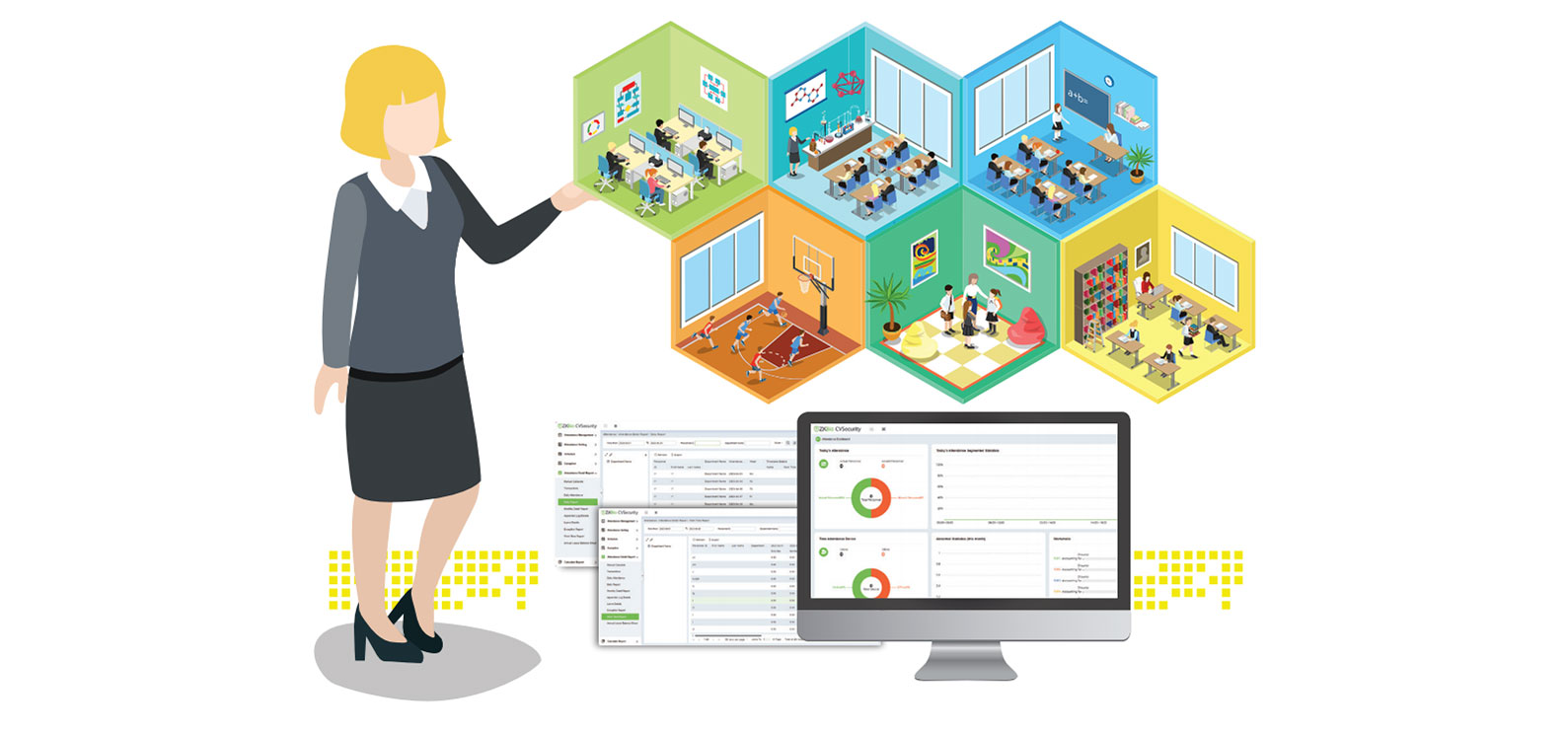
Universities usually need more than a staff clocking system. Academic attendance must follow class schedules, different faculties, changing rooms, temporary courses, students who attend multiple subjects and large numbers of attendance events created during short class-change periods. ZKTeco’s Smart University approach addresses that broader environment by linking student schedules with attendance capture at classrooms or controlled entry points.
For student attendance management, ZKTeco documents the ability to create standard or temporary courses, generate an individual schedule for each student and use classroom access control or FaceKiosk devices for attendance. The platform can produce facial-recognition attendance statistics, calculate class hours automatically and provide attendance feedback for students and teachers. These functions can reduce the administrative effort of manual roll calls while giving the institution a more consistent source of attendance information.
The final architecture depends on how the campus wants attendance to work. A university may use facial recognition at teaching rooms, RFID cards for selected areas, fingerprint terminals for staff, or a combination. Some projects may focus on academic attendance only. Others may connect attendance with access control, visitor management, dormitory access, video security or wider campus services through ZKBio CVSecurity. ZKTeco also positions BioTime 9.5 as a centralized web-based time-and-attendance platform that can communicate with compatible push devices over Ethernet, Wi-Fi, 3G or 4G and can integrate with third-party HR or ERP systems through its API.
For UAE buyers, the key buying decision is therefore not simply which attendance terminal has the largest face capacity. The project should start with student count, timetable structure, classroom count, campus network readiness, expected authentication method, privacy policy, reporting workflow and required integrations. FourTeck can review those details and help map them into a suitable software and hardware combination before supply.
Key Business Benefits
The strongest benefit is a more structured attendance process that fits the way an education institution actually operates. The value comes from connecting schedules, identity verification, attendance records and administrative review rather than treating each classroom as an isolated clocking point.
Attendance tied to academic schedules
When attendance is associated with planned classes, administrators can review records in the context of courses and teaching hours rather than only seeing generic entry and exit punches. This is particularly useful where students move between different classrooms throughout the day.
Multiple identity methods
Depending on the selected terminal, the environment can use face, fingerprint, palm, card or password methods. That gives the university flexibility to choose a method that fits classroom flow, security policy and user experience.
Centralized multi-device management
BioTime 9.5 is designed for centralized management of compatible devices and its current Middle East datasheet lists support for up to 500 devices on a single server, with ZKTeco advising buyers to contact them for capacity expansion requirements.
More consistent attendance records
Automated capture can reduce dependence on hand-written lists and scattered spreadsheets. Clearer records can help registrar, faculty and administration teams review absences, attendance hours and exceptions with less manual reconciliation.
A path toward broader campus management
ZKTeco’s Smart University solution extends beyond attendance into access control, dormitory management, video functions, campus consumption and room-booking scenarios. A university can therefore plan attendance as one layer of a wider campus system when that broader integration is genuinely required.
Role-based administration
Web-managed platforms make it easier to centralize administrative access. The correct permission design should still be planned carefully so academic, IT and security teams see only the functions and data required for their role.
Product Highlights
The ZKTeco Smart University model is designed around the practical needs of a campus rather than one generic attendance rule. Its student attendance functions support course scheduling, individual student schedules and classroom attendance through access control or FaceKiosk devices. Facial attendance statistics and automatic class-hour calculations help turn raw entry events into information that academic teams can use.
For campuses that need a wider security layer, ZKBio CVSecurity provides a web-based platform covering modules such as personnel, attendance, access control, visitor management and other smart subsystems. Current releases also provide RESTful interfaces for attendance transactions, attendance devices and FaceKiosk functions. The exact interfaces, licenses and modules required should be confirmed for the selected version before procurement.
Technical Specifications
This is a solution specification, so several values depend on the selected software platform, license, server and attendance terminal. The table separates confirmed ZKTeco capabilities from configuration-dependent project choices.
| Area | Confirmed / Planning Detail |
|---|---|
| Brand | ZKTeco |
| Product type | Configurable university / campus attendance management solution |
| Student attendance functions | Course scheduling, individual student schedules, classroom access control or FaceKiosk attendance, facial attendance statistics and automatic class-hour calculation |
| Software choices | ZKTeco Smart University with ZKBio CVSecurity for integrated campus scenarios; BioTime 9.5 for centralized time and attendance scenarios; final selection configuration dependent |
| Authentication | Fingerprint, face, palm, RFID and password are supported across BioTime-compatible device families; exact method depends on terminal |
| Device connectivity | BioTime 9.5 supports compatible push devices using Ethernet, Wi-Fi, 3G or 4G |
| BioTime device scale | Current 2026 Middle East datasheet lists up to 500 devices on one server; contact ZKTeco / FourTeck for expansion planning |
| BioTime database | PostgreSQL (default), Microsoft SQL Server 2019 / 2022, MySQL 8.0 or Oracle 19c |
| BioTime server OS | Windows Server 2016 / 2019 / 2022 or Windows 10 / 11 according to current Middle East documentation |
| BioTime minimum server guidance | Dual-core 2.4 GHz or faster, 4 GB available RAM or above, 100 GB available storage or above; final server sizing should reflect project scale |
| Integration | BioTime includes API integration capability; ZKBio CVSecurity provides RESTful interfaces for multiple modules including attendance and FaceKiosk functions |
| Security | ZKTeco Smart University documentation references TLS 1.2 and AES-128 / AES-256 for client-server communication; ZKBio CVSecurity documentation also references 256-bit AES data protection |
| Licensing | Configuration dependent; confirm device count, users, modules and integration requirements |
| Warranty | Based on selected hardware, software license and supplier terms; request current guidance |
| UAE availability | Contact FourTeck for current software, terminal and project-supply options |
When choosing the final configuration, start with peak load rather than average load. A campus may have thousands of students, but the real design pressure occurs when several hundred users arrive at classrooms within a short period. Terminal placement, authentication speed, network segmentation, server resources and data synchronization should be planned around these class-change windows. The software license also needs to reflect the number of devices and any required modules. If the institution already has student information, HR or ERP systems, integration should be reviewed early so identifiers, departments, course data and reports are not duplicated unnecessarily. FourTeck can use these inputs to recommend a more practical architecture and identify which details need vendor confirmation.
Configuration and Buyer Guidance
A successful attendance deployment starts with process design. Before choosing software licenses and terminals, map how students enter classrooms, how late arrivals are handled, whether staff attendance is part of the same project and which system owns the official student record.
How many students and devices?
Share total student population, active users, classroom count, entrances and the number of attendance points expected in each building. This affects license and server planning.
Which identity method fits?
Face recognition may support touchless flow, while card or fingerprint methods may fit other policies. Device choice should reflect user volume, privacy requirements and the physical installation environment.
What reports are required?
Define whether the institution needs class-level attendance, daily summaries, exception reports, attendance hours, faculty review or exports to another academic system.
Does it need integration?
Confirm student IDs, HR identifiers, course data and target systems before installation. API availability does not automatically guarantee a finished integration; field mapping and workflow logic still need project work.
What network and server resources exist?
Review VLANs, IP addressing, switch capacity, Wi-Fi coverage where used, server operating system, database choice, backup policy and access to the system from administrative teams.
Prepare a useful quote brief
Send FourTeck the student count, campus buildings, classroom count, preferred attendance method, integration needs, expected quantity, delivery location and target project date.
Ideal Business Use Cases
The system is most useful where attendance is repeated, high-volume and operationally important. It can support several education scenarios, but the configuration should be shaped around the actual academic workflow rather than copying a generic office attendance design.
Class-by-class student attendance
Universities with many modules, lecture rooms and timetable changes can use schedule-linked attendance to reduce manual roll calls. The value is highest where administrators need to know whether a student attended a specific class rather than simply entered the campus.
Faculty and staff attendance
A campus can maintain staff attendance as a related workflow using BioTime-compatible devices and scheduling features. Staff rules should remain separate from student academic rules when policies differ.
Multi-building campuses
Central web management is useful when teaching blocks, laboratories, administration buildings and satellite locations need one attendance platform rather than multiple disconnected databases.
Controlled classroom or laboratory entry
Where attendance and access are intentionally connected, compatible access devices can create an attendance event while also enforcing entry permission for selected learning spaces.
Education groups with several sites
Centralized management can help groups standardize attendance rules and reporting across campuses, provided network connectivity, server capacity, licensing and local administration roles are planned correctly.
ZKTeco University Attendance System – Class Schedule and Attendance Capture
The most important difference between a university attendance project and a basic employee clocking project is context. A student may enter the same building every day but attend different modules, rooms and instructors. ZKTeco’s Smart University design addresses this by allowing standard and temporary courses to be created in advance and by generating an individual schedule for each student.
Attendance can then be captured through classroom access control or FaceKiosk devices. That creates a direct relationship between identity, the attendance point and the planned class. Facial-recognition attendance statistics and automatic class-hour calculations can help administrators review participation with less manual interpretation. The institution should still define how late entry, early departure, timetable changes, duplicate punches and excused absence are handled because those policy decisions determine whether automated reports match academic rules.
ZKTeco University Attendance System – Centralized Management and Integration
A campus deployment can involve dozens or hundreds of attendance points. Central management becomes important because administrators need visibility of device status, attendance records, schedules and exceptions without visiting each building. BioTime 9.5 is positioned by ZKTeco as a web-based centralized platform and the current Middle East datasheet lists support for 500 devices on a single server, with larger capacity requiring further consultation.
Integration still needs careful project design. A university may want student master data to originate in a student information system, while attendance events flow back to an academic portal. Another institution may only need a scheduled report export. These are different integration scopes. FourTeck can help identify which data must move, which system remains authoritative and which vendor interface should be confirmed before the solution is quoted.
ZKTeco University Attendance System – Security and Campus Policy Fit
Attendance information can include biometric templates, identity data and detailed movement or class records, so security and policy design should be considered during procurement rather than after installation. ZKTeco’s Smart University documentation references TLS 1.2 and AES-128 / AES-256 encryption between client and server, while ZKBio CVSecurity documentation lists 256-bit AES data protection. These technical controls are useful, but they do not replace the university’s own governance responsibilities.
Define identity policy
Decide which users require face, fingerprint, card or another method and document the reason. Different user groups do not necessarily need the same authentication method.
Control administrative access
Separate registrar, faculty, HR, IT and security privileges where possible. Attendance review and device administration are different responsibilities.
Plan retention and backup
The institution should decide how long attendance records are kept, how the database is backed up and how restore testing will be handled.
For a UAE education institution, local policy, contractual obligations and any applicable privacy requirements should be reviewed by the buyer’s own governance or legal team. FourTeck can support the technology design and help document the selected components, while the institution remains responsible for determining the lawful and appropriate use of biometric attendance data.
What Buyers Should Check Before Purchase
The biggest purchase risk is choosing attendance devices before the university has defined the timetable workflow, peak traffic, data integration and authentication policy. The right terminal is the result of the design, not the starting point.
Configuration Fit
Confirm student count, faculty count, classroom count, number of attendance points, timetable complexity, authentication method, expected peak arrivals and whether staff attendance is included. These details influence terminal quantity, license scope and server sizing.
Compatibility Check
Review the existing network, VLANs, server operating system, database preference, student or HR platform, card technology if already deployed and any current ZKTeco terminals that may need to remain in service.
Availability and Warranty
Ask for the current software version, license model, hardware lead time, included accessories and warranty terms for each selected terminal. Availability can change with device model, quantity and project timing, so it should be confirmed at quotation stage.
Quote Preparation
Provide campus locations, required quantity, student population, use case, preferred attendance method, integration requirement, installation scope, target date and delivery location. This gives FourTeck enough detail to prepare a more useful proposal.
Also check practical accessories that are easily missed: power supplies where applicable, PoE requirements for network-connected units, mounting positions, enclosures for special environments, network ports, structured cabling, server backup, database capacity, enrollment process and administrator training. If similar ZKTeco terminals are being compared, focus on authentication method, user capacity, supported software and installation environment rather than model appearance. FourTeck can help narrow suitable options once these project inputs are known.
UAE Availability and Service Support
FourTeck supports ZKTeco attendance and access-control inquiries across Dubai and the UAE with assistance for solution selection, software and terminal review, quotation requests, delivery coordination and warranty guidance. Because a university system is normally assembled from several components, availability can vary by software license, biometric terminal, quantity, mounting requirement and project timeline.
Dubai, Abu Dhabi, Sharjah, and Ajman Coverage
Education institutions in Dubai, Abu Dhabi, Sharjah, Ajman and other UAE locations can contact FourTeck for project guidance and quotation support. The team can review whether the requirement is a simple attendance deployment, a multi-building campus project or a wider attendance-plus-access-control system. That distinction matters because software modules, hardware quantities and installation tasks can be very different even when the same ZKTeco brand is used.
For campus projects, buyers should share the number of locations and whether each site will connect to one central server. Network availability, WAN design, administrator roles and local enrollment processes should be planned before the equipment is ordered. FourTeck can help coordinate the procurement discussion so the requested products match the intended UAE deployment.
GCC and Africa Availability
FourTeck also supports business technology inquiries through regional platforms serving selected GCC and Africa markets. Universities and education groups in Saudi Arabia, Qatar, Oman, Kuwait, Bahrain, Kenya, Uganda and other locations can discuss ZKTeco attendance requirements through the relevant regional inquiry channel. Product availability, delivery options, software licensing, warranty handling and implementation scope can vary by country and supplier status.
Regional projects should be planned with local network conditions, import lead times, installation responsibility and after-sales expectations in mind. A multi-country education group may also need different commercial arrangements even if the technical architecture remains similar. Useful regional links include FourTeck UAE, FourTeck Kenya, FourTeck Uganda, FourTeck Africa and FourTeck Kuwait.
Other Options Buyers May Consider
Not every university needs the full Smart University scope. Some buyers only need time-and-attendance software, while others need deeper access control or a wider campus security platform. The related options below help frame that decision without assuming one architecture is suitable for every institution.
FourTeck CCTV and Access Control Solutions
Useful when the project includes controlled doors, visitor access, surveillance or broader facility security in addition to attendance.
BioTime 9.5-centric deployment
A more focused path for centralized attendance using compatible ZKTeco push devices when wider smart-campus modules are not required.
ZKBio CVSecurity platform
Suitable for projects that need attendance alongside access control, visitor management and other integrated security modules.
Face-based classroom terminals
Consider compatible FaceKiosk, ProFace or SpeedFace families where touchless attendance and controlled entry are priorities. Exact model selection should follow capacity and software checks.
Card-based campus attendance
A practical alternative for institutions with an established student card environment that want to avoid introducing biometrics for every user group.
Why Buyers Choose FourTeck
Campus attendance projects have several moving parts: software version, license scope, terminal model, server design, network access, mounting, enrollment, reporting and integration. FourTeck’s role is to help business and education buyers turn those separate decisions into a clearer procurement requirement before ordering.
Discuss student count, classroom flow, administrator needs and required reports before selecting hardware.
Match the software, terminal family, network method and server resources to the intended deployment.
Prepare a project quotation around confirmed quantities and requirements rather than a generic single-device price.
Coordinate availability and delivery planning based on the selected bill of materials and project location.
Review existing ZKTeco devices, student systems, database preferences and network conditions that may affect the design.
Clarify the applicable support and warranty terms for the exact software and hardware included in the quotation.
Frequently Asked Questions
What is the system used for?
It is used to organize and capture attendance for students and, where required, staff across a university or college. ZKTeco’s Smart University design can link student schedules with classroom access control or FaceKiosk attendance, then calculate class hours and produce attendance information for students, teachers and administrators.
Is it one fixed ZKTeco product?
No. It is better treated as a configurable solution. The final deployment may combine ZKTeco Smart University functions, ZKBio CVSecurity or BioTime 9.5 with compatible face, fingerprint, palm, RFID or password-capable terminals. Software modules, device count and server resources depend on campus requirements.
Can it track class-by-class student attendance?
ZKTeco’s Smart University documentation specifically describes student course scheduling and classroom attendance through access control or FaceKiosk devices. It also references facial-recognition attendance statistics and automatic calculation of class hours. The exact rules for lateness, exceptions and course mapping should be configured to the institution’s policy.
Can FourTeck help choose the correct terminals?
Yes. FourTeck can review the required authentication method, expected users, peak class-change traffic, installation location, existing card technology, network availability and chosen software platform. Those details help narrow suitable ZKTeco terminal families and identify any accessories or infrastructure that should be included.
Does BioTime 9.5 support large device deployments?
The current 2026 ZKTeco Middle East datasheet lists a maximum of 500 devices on a single BioTime server and advises customers to contact ZKTeco for capacity expansion. Real sizing should also consider user count, transaction volume, server resources, database design and the number of simultaneous administrative users.
Can it integrate with an existing student or HR system?
ZKTeco provides integration interfaces in its attendance and security platforms, including API capability in BioTime and RESTful interfaces in ZKBio CVSecurity. Whether a specific student information, ERP or HR platform can be integrated depends on data fields, authentication, version support and the workflow the university wants to automate.
Is the solution available in the UAE?
FourTeck can support UAE inquiries and prepare a quotation for the selected software, terminals and related project items. Availability is configuration dependent and can vary by license, hardware model, order quantity and project date. Buyers should request a current availability check rather than assuming every device is immediately available.
What information is needed for a university attendance quote?
Provide student and staff counts, campus locations, classroom count, number of attendance points, preferred face/card/fingerprint method, existing ZKTeco devices, software or database preferences, integration requirements, installation scope, quantity, delivery location and target date. This helps FourTeck prepare a solution-focused quotation instead of a generic device list.
Can the same project include access control?
Yes, if access control is part of the requirement and the selected devices and software modules support it. ZKTeco’s Smart University and ZKBio CVSecurity platforms are designed for broader integrated campus scenarios. The institution should decide which doors need controlled access separately from where attendance capture is needed.
How should a university choose between biometrics and cards?
Choose according to identity assurance, user flow, privacy policy, existing campus cards, environment and maintenance expectations. Face recognition can support touchless operation, while RFID cards may fit institutions that already issue student cards. Some campuses use different methods for students, staff and restricted rooms rather than one method everywhere.
Need Help Designing the Right Campus Attendance Setup?
FourTeck can review your student population, timetable workflow, software requirements, terminal quantity, authentication method, integration needs, delivery location and expected project date before preparing a quotation.
Share the campus count, number of students, required attendance points, preferred identity method, existing systems and target deployment schedule.