
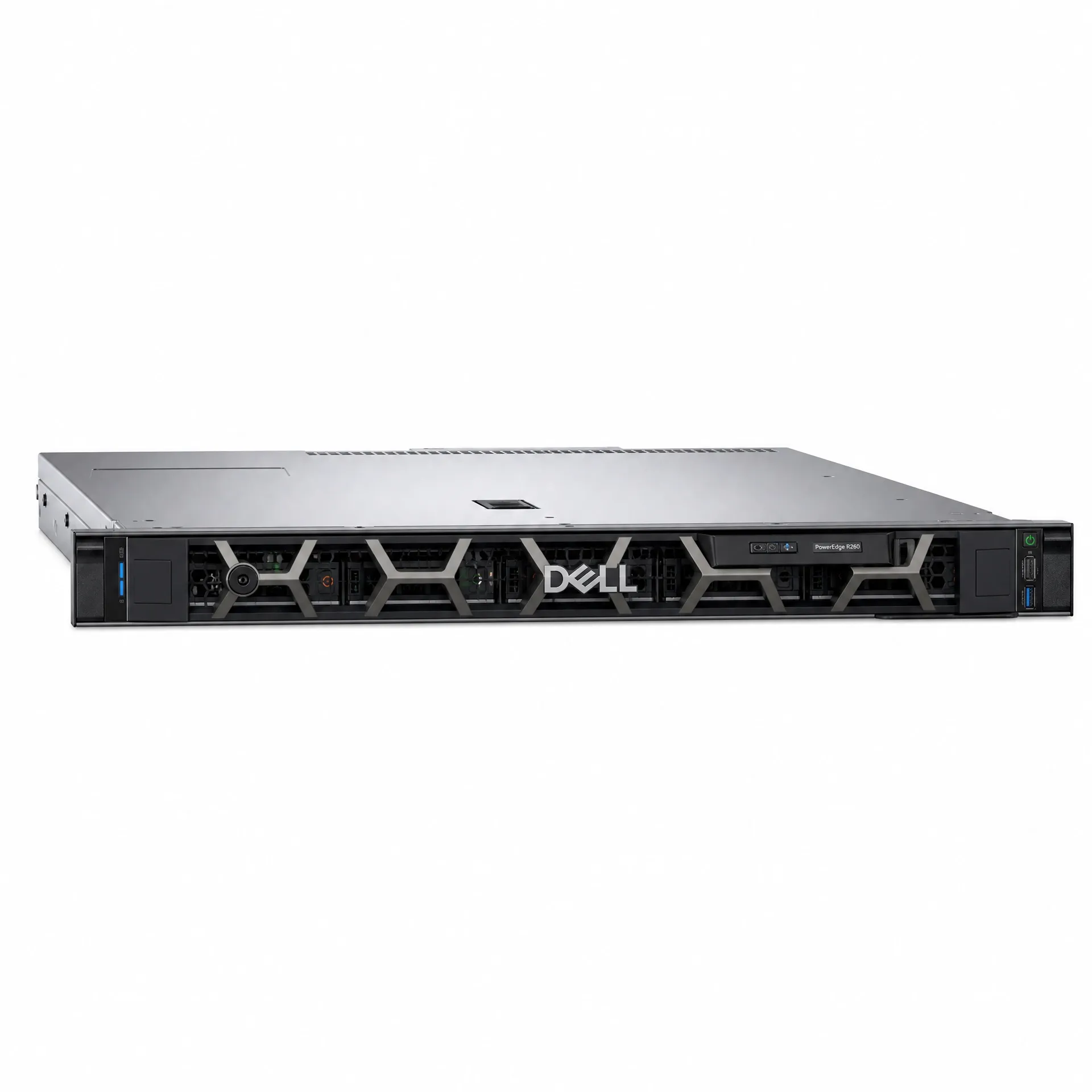
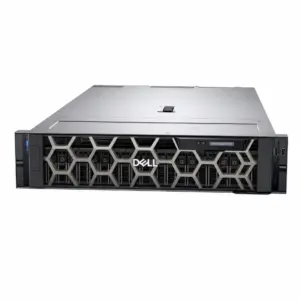
Dell PowerEdge R260 2 × 3.5" Server in Dubai, UAE
The Dell PowerEdge R260 is a compact 1U single-socket rack server for organizations that want enterprise management, ECC memory, hot-plug storage capability and controlled rack deployment without moving to a larger dual-socket platform. This selected Dubai configuration pairs the Intel Xeon 6 Performance 6315P with 16GB UDIMM memory and two 16TB SAS hot-plug hard drives, giving buyers a clear foundation for branch infrastructure, business applications, local storage services, backup staging and edge workloads.
It is particularly suitable when rack density, predictable administration and straightforward serviceability matter more than very high core counts or accelerator support. Buyers should size RAID mode, controller selection, memory capacity, networking and operating-system licensing around the actual workload before final order placement.
Procurement Snapshot
CPU: Intel Xeon 6 Performance 6315P, 4C/4T, 2.80GHz, 12MB cache, 55W.
Memory: 16GB ECC UDIMM in the selected configuration.
Storage: 2 × 16TB 12Gbps 7.2K SAS 512e 3.5-inch hot-plug drives.
Power: 1 × 700W Titanium PSU; non-redundant in this chassis option.
Support: 3 Years Basic Warranty, subject to final Dell service entitlement and regional terms.
Quick Procurement & Configuration Matrix
Dell PowerEdge R260.
Single-socket 1U rack server.
Branch applications, file services, backup staging, monitoring, light virtualization and edge workloads.
Single processor platform; memory and storage expansion are platform and chassis dependent.
Selected 700W Titanium PSU requires compatible 200–240VAC or supported DC input conditions.
Dubai, UAE and coordinated regional export supply.
Three years Basic Warranty in the requested configuration; validate service tags, response terms and country entitlement at order stage.
Dell rails included; verify rack depth, cable management, PDU plug type and airflow direction before installation.
Executive Product Architectural Overview
The PowerEdge R260 sits in a useful architectural position for organizations that need genuine rack-server characteristics but do not require the scale, cost profile or operational complexity of a larger dual-socket system. The platform is a 1U design built around a single processor socket, ECC DDR5 UDIMM memory and Dell’s server-management ecosystem. In practical terms, that means it can be deployed into a standard rack, managed consistently with other PowerEdge infrastructure, monitored remotely through iDRAC, and serviced using conventional enterprise server workflows. For a branch office, professional services company, retail head office, warehouse, school, clinic, small data room, security operations site or application appliance deployment, that compact architecture can be more appropriate than repurposing a workstation or desktop-class tower.
This specific configuration has been shaped around capacity and straightforward business use. The Intel Xeon 6 Performance 6315P is a 4-core, 4-thread processor running at a 2.80GHz base frequency with 12MB cache and a 55W thermal design point. It is not intended to behave like a high-core-count virtualization host, yet it can be well suited to infrastructure services whose bottlenecks are predictable and modest. Examples include directory or utility services, print and file roles, small database instances, monitoring collectors, access-control applications, branch ERP components, local application services, backup landing zones and supporting services that benefit from continuous server-grade operation. Because the processor count is modest, buyers should be disciplined about workload consolidation: a few light services may be appropriate, while many CPU-intensive virtual machines, high-concurrency databases or analytics jobs should be sized onto a higher-core configuration or a larger PowerEdge family.
The 16GB ECC UDIMM allocation is a sensible starting point for a focused single-purpose server, but memory is often the first resource to review before production deployment. Modern operating systems, endpoint-management servers, line-of-business applications and virtualization layers can consume memory quickly once caching, security agents, database buffers and monitoring services are considered. Dell documents the R260 with four DDR5 ECC UDIMM slots and platform memory capacity that varies by supported DIMM selection. FourTeck can therefore treat 16GB as the baseline supplied configuration rather than the assumed endpoint. If the server will run Windows Server roles, a hypervisor, SQL workloads, several containers, a backup application catalogue or multiple infrastructure agents, increasing memory before go-live may reduce paging, improve responsiveness and create safer operating headroom.
Storage is the defining feature of this requested build. Two 16TB enterprise SAS 3.5-inch hot-plug drives provide 32TB of raw media capacity before RAID overhead, formatting, file-system reservation and application allocation. SAS is appropriate where the buyer wants an enterprise storage interface, hot-plug serviceability and compatibility with a validated SAS-capable controller path. The 7.2K rotational speed emphasizes capacity and dependable sequential storage behavior rather than very high random I/O performance. In other words, this layout can make strong sense for file repositories, archive-oriented business data, backup staging, surveillance-management metadata, log aggregation or other capacity-heavy roles, but it should not automatically be treated as the ideal design for latency-sensitive transactional databases. Buyers with high IOPS requirements may prefer SSD or NVMe choices in a different front-bay configuration, while buyers using the two large SAS disks should select an appropriate RAID strategy and controller based on the required balance of usable capacity, resilience and rebuild behavior.
The use of two drives creates a particularly important design decision: if resilience is required, RAID 1 is commonly considered because it mirrors data between disks, but it reduces usable capacity to approximately the size of one drive before file-system overhead. If maximum raw capacity is the priority and no disk-level redundancy is required, alternative modes may be possible depending on the controller, though that increases the business impact of a drive failure. RAID is not a substitute for backup. FourTeck recommends treating the server’s local disk design, backup retention, off-system copies and recovery objectives as separate decisions. A resilient disk set protects against a disk event; it does not protect against accidental deletion, ransomware, application corruption, administrator error or site-level incidents.
The 700W Titanium power supply provides an efficient power-delivery option for the selected platform, but in the R260 it is a single non-redundant PSU design. That detail has direct implications for business continuity. The server can still be protected through a properly sized UPS, monitored PDU and disciplined maintenance process, yet there is no second hot-swap power supply available to take over if the installed PSU or its single feed is lost. For branch environments this may be an acceptable commercial tradeoff. For services with strict uptime requirements, buyers should compare the R260 with a model that supports redundant power supplies or design application resilience above the hardware layer through clustering, replication or alternate service nodes.
iDRAC9 Basic gives the platform an embedded management foundation. Remote management capability matters because server lifecycle work extends beyond the operating system: administrators need visibility into hardware health, firmware state, event logs, power conditions and component status. The exact feature set depends on the installed iDRAC license tier, so advanced capabilities associated with higher iDRAC editions should not be assumed. For IT teams standardizing on Dell PowerEdge, this distinction can be addressed during procurement by deciding whether Basic is sufficient or whether an Enterprise-class license is justified for richer remote-console and automation requirements.
For Dubai and UAE buyers, the architectural value of this R260 is therefore less about headline component count and more about fit: compact rack density, validated enterprise components, local high-capacity SAS storage, ECC memory, Dell lifecycle management and a configuration that can be reviewed against the actual business workload. FourTeck can help confirm controller choice, RAID intent, memory headroom, operating-system licensing, network-adapter requirements, rack compatibility and delivery planning before final purchase.
Enterprise Business Value & ROI Benefits
Right-Sized Performance
A 4-core Xeon 6 configuration can be financially attractive when the workload does not need large processor counts. Rather than paying for unused compute resources, a business can allocate budget to memory, storage protection, backup, licensing or additional branch systems. This value depends on workload sizing: it is most effective when application demand is known, steady and within the processor envelope.
Large Local Capacity
Two 16TB SAS disks create substantial local capacity for a compact 1U server. This can reduce dependence on separate storage appliances for modest branch deployments and can consolidate file or backup staging roles into a controlled rack platform. Usable capacity depends on RAID level and formatting, so procurement decisions should use protected usable capacity rather than headline raw terabytes.
Operational Reliability
ECC memory, enterprise SAS drives, hot-plug storage design and PowerEdge hardware monitoring provide a more disciplined operational foundation than desktop-class hardware. Reliability is not a single specification; it comes from component validation, thermal management, planned monitoring, backups, maintenance processes and correctly sized power protection working together.
Simplified Rack Standardization
A 1U form factor helps businesses standardize server deployment in branch racks or compact data rooms. Dell rails support controlled installation and service access, while common PowerEdge management conventions can reduce the learning curve for teams already operating Dell servers. Standardization can lower troubleshooting time and improve documentation consistency across multiple sites.
Energy-Conscious Platform
The selected 55W processor and 700W Titanium PSU create an efficient power foundation for a compact server, although actual consumption depends on installed drives, memory, PCIe cards, workload intensity and environmental conditions. Efficiency benefits are strongest when the server is appropriately sized and consolidated rather than significantly over-provisioned or underutilized.
Lifecycle Visibility
iDRAC9 provides hardware-level visibility that can improve diagnosis and maintenance planning. A remote administrator can use platform telemetry and event information to distinguish hardware issues from operating-system problems, reducing unnecessary site visits. Feature availability depends on the iDRAC license edition, so buyers should choose the management tier that fits their support model.
Return on infrastructure investment is rarely determined by purchase price alone. The real business case includes rack space, power, cooling, software licensing, administrative time, outage risk, spare capacity, backup design and the expected refresh period. The R260 can deliver strong value when deployed for a clearly bounded workload that benefits from enterprise server features but does not justify a larger platform. A branch that needs local file storage, a backup target and a small application role may gain more from one carefully configured R260 than from several unmanaged desktop systems. Conversely, an environment expecting rapid virtual-machine growth, high transaction volumes or large in-memory workloads should invest in more compute and memory headroom from the outset. FourTeck’s pre-sales approach can therefore focus on avoiding both under-sizing and unnecessary over-buying, because either outcome carries lifecycle cost.
Business continuity should also be considered part of the return calculation. The hot-plug drive design helps simplify disk service, but this requested chassis uses a single power supply. If downtime is expensive, buyers should combine the server with a properly specified online UPS, monitored power distribution and tested recovery procedures, or select a platform offering redundant PSUs. Similarly, the presence of two large hard drives should lead to an explicit RAID and backup decision. A mirrored pair reduces usable local capacity but protects against a single-disk failure; independent backup copies protect against a different set of risks. When these controls are planned at procurement time, the server becomes part of a recoverable business service rather than an isolated hardware purchase.
Hardware & Technical Architecture Highlights
The R260 is built around Intel’s server platform architecture for a single-socket entry rack system. The selected Xeon 6 Performance 6315P provides four physical cores and four threads with a 12MB cache and support for DDR5 memory. Its 55W processor power envelope makes it appropriate for a compact chassis where predictable thermals and modest compute demand are expected. From a systems-architecture perspective, the important point is not only clock speed but the workload profile: services with moderate concurrency, infrastructure functions and lightly threaded applications can be a good fit, while heavily parallel workloads should be sized onto higher-core processor options.
Memory is ECC DDR5 UDIMM, and the platform provides four DIMM slots. ECC matters because it can detect and correct certain memory errors that would otherwise risk application instability or silent data corruption. For the supplied 16GB configuration, administrators should still review the operating system and application working set. Memory expansion should follow Dell-supported population rules and matched specifications. Higher capacity can improve caching, database buffer space and virtual-machine density, but memory speed may depend on processor and DIMM configuration. Buyers should therefore regard the platform’s headline maximum and the selected 16GB build as two different layers: one describes architectural capability; the other describes the system being quoted.
The front storage architecture in this build uses two 3.5-inch hot-plug bays. Dell documents SAS3 capability up to 12Gbps, with actual drive behavior determined by the controller and media. The two 16TB 7.2K SAS disks emphasize capacity. A hardware RAID controller such as supported PERC options may be selected where write-back protection, RAID features or management integration are required; alternatively, software RAID support depends on the chosen drive path and operating-system design. Controller selection should never be treated as a minor accessory because it determines RAID capabilities, performance characteristics, cable topology and recovery procedures.
PCIe expansion is intentionally constrained by the 1U entry-server format. Network adapter requirements, storage controller placement and any other validated expansion cards should be mapped before ordering. The R260 is not an accelerator platform, so GPU-dependent workloads should be directed to a different system family. For ordinary branch services, however, a carefully chosen network adapter can be more important than additional expansion: businesses should decide whether they require standard Ethernet, higher-speed uplinks, redundancy, VLAN segmentation, dedicated backup traffic or management separation.
Thermal design combines compact chassis airflow with fan assemblies managed by the platform. Rack installation should maintain front-to-rear airflow, avoid obstructed bezels, provide adequate cold-air intake and preserve service clearances. Dubai environments place particular importance on conditioned server-room temperature, dust control and stable power. Servers should not be placed in unconditioned closets simply because the chassis is small. Heat, particulate contamination and poor airflow can reduce stability and shorten component life.
The selected 700W Titanium power supply is a high-efficiency unit but is non-redundant in the R260. This means power architecture becomes part of the system design. A UPS can protect against utility interruption and voltage events, while a monitored PDU improves load visibility, but neither creates PSU redundancy inside the server. Where the business requires maintenance without power-path interruption, a different server class may be more appropriate. Where the workload can tolerate planned maintenance or is replicated elsewhere, the R260’s simpler power design can remain commercially sensible.
Management is anchored by iDRAC9 and Dell’s broader OpenManage ecosystem. Hardware-level health, event information, firmware management and lifecycle tooling help administrators operate the server independently of the installed operating system. The requested iDRAC9 Basic 16G license should be reviewed against remote-console requirements because some advanced functions require higher license tiers. This is especially relevant when the server will be placed in a remote branch where physical access is inconvenient.
Definitive Technical Specifications & Sizing Notes
| Specification | Selected Configuration | Buyer Sizing Note |
|---|---|---|
| Platform | Dell PowerEdge R260 | 1U single-socket rack server intended for entry enterprise, branch and edge roles. |
| Chassis | 2 × 3.5-inch hot-plug drive chassis | Ideal when large-capacity 3.5-inch media matters more than higher bay count. |
| Processor | Intel Xeon 6 Performance 6315P, 4C/4T, 2.80GHz, 12MB cache, 55W | Suitable for moderate compute demand; higher-core options should be considered for dense virtualization or heavy databases. |
| Memory | 16GB ECC UDIMM | Increase for virtualization, database caching, larger Windows Server roles or multi-application consolidation. |
| Drive 1 | Dell 16TB SAS, 12Gbps, 7.2K, 512e, 3.5-inch hot-plug | Capacity-oriented rotational storage; random I/O is lower than SSD or NVMe media. |
| Drive 2 | Dell 16TB SAS, 12Gbps, 7.2K, 512e, 3.5-inch hot-plug | Can form a mirrored pair if a compatible RAID controller and RAID 1 policy are selected. |
| Raw Storage | 32TB raw | Protected usable capacity depends on RAID level, formatting and application reservation. |
| Power Supply | 1 × 700W Titanium | Non-redundant PSU; combine with UPS and correct PDU planning where required. |
| Management | iDRAC9 Basic 16G | Confirm whether Basic includes every remote-management feature required by the support team; higher iDRAC tiers are available depending on configuration. |
| Rails | Dell rails included | Validate rack depth, mounting standard and cable-management requirements. |
| Warranty | 3 Years Basic Warranty | Final service level, response terms and geographic entitlement should be confirmed on the order and service tag. |
The table above describes the requested build, not every configuration the R260 can support. Buyers should distinguish platform capability from selected bill of materials. For example, Dell lists multiple processor, memory, storage-bay and controller choices for the R260, but changing the chassis or controller after deployment may be more complicated and costly than selecting correctly at procurement stage. The two 16TB SAS drives are ideal where large local capacity is the goal, yet the usable capacity and fault tolerance depend on RAID mode. If RAID 1 is selected, the system gains single-disk redundancy but effectively exposes the capacity of one drive. If the application needs high transactional performance, consider SSD or NVMe-oriented alternatives rather than assuming that a 12Gbps SAS interface makes a 7.2K rotational disk behave like flash media.
Likewise, 16GB of memory can support light server roles but may be restrictive for virtualization, database workloads or heavily instrumented Windows environments. FourTeck can help model memory headroom, controller selection, NIC requirements, operating-system licensing and rack power before order placement. Configuration dependent items should be confirmed against the final Dell quotation and service entitlement.
Configuration, Sizing & Deployment Workbench
01 — Define the Primary Workload
Start by naming the workload, not the hardware. Is the server primarily a file repository, backup target, domain-services node, line-of-business application host, monitoring server, database host or virtualization platform? The selected 6315P is strongest when compute demand is moderate and predictable. If the application vendor recommends more than four cores, sustained high CPU utilization or significant parallel processing, move to a higher-core R260 processor or a larger PowerEdge family before deployment.
02 — Size Memory for the Working Set
Treat 16GB as an initial allocation. Calculate the operating-system requirement, application baseline, cache or database buffer, security agents, monitoring overhead and expected growth. For virtualization, add the memory assigned to each guest plus hypervisor overhead and reserve. A memory-starved system can make adequate CPU and storage appear slow, so it is often economical to increase RAM before go-live rather than troubleshoot paging after deployment.
03 — Convert Raw Capacity into Protected Capacity
Two 16TB disks provide 32TB raw, but protected usable space is lower. A mirror provides approximately one drive’s nominal capacity before formatting while maintaining a second copy on the other drive. Confirm whether the application needs RAID 1, whether a compatible PERC controller is included, how hot-spare strategy will be handled, and how long a large-capacity drive rebuild may take. Capacity planning should also reserve free space for file-system health and growth.
04 — Match I/O to Media Type
The 16TB 7.2K SAS drives prioritize capacity. Large sequential file operations and backup data may fit well, but high-frequency random reads and writes can be constrained by rotational latency. Review application IOPS, queue depth, block size and latency expectations. If performance targets are strict, redesign around SSD or NVMe-capable configurations instead of adding CPU to solve a disk-bound problem.
05 — Plan Network Port Density and Segmentation
Map production traffic, backup traffic, management access, clustering or replication traffic and any VLAN requirements. The right NIC selection depends on switch infrastructure, cabling and throughput needs. A branch server may be comfortable on standard Ethernet; a backup repository moving very large datasets may benefit from higher-speed connectivity if the storage subsystem can sustain it. Include switch-port availability and transceiver or DAC requirements in the same bill of materials.
06 — Validate Software and License Terms
Processor core count can affect application and operating-system licensing. Confirm whether Windows Server, database software, backup software, virtualization licensing or security products are licensed per core, per socket, per host, per virtual machine or per user. A hardware configuration that looks economical can carry different software costs depending on the selected edition and deployment model.
07 — Engineer Power, Rack and Cooling
Confirm rack depth, rail compatibility, PDU outlet type, available power circuit, UPS runtime and cold-air delivery. The 700W rating is the PSU capacity, not a statement that the server will continuously draw 700W. Actual consumption depends on configuration and load. Because the R260 uses a single PSU, the power design should explicitly address what happens if that PSU, PDU outlet or upstream feed fails.
08 — Define Backup and Recovery Before Production
Choose recovery-point and recovery-time objectives, then design backup copies to satisfy them. RAID helps maintain operation through certain disk failures but does not replace backup. Consider off-server storage, immutable or offline copies where appropriate, application-aware backup, restore testing and documented ownership. A server is production-ready only when its recovery process has been validated, not merely when the operating system boots.
Industry Use Cases & Workload Scenarios
Banking & Finance Branch Services
The R260 can support controlled branch infrastructure such as authentication, file services, reporting utilities, print services or small local applications where central data-center systems remain authoritative. Financial organizations should enforce encryption, endpoint controls, restricted management access and resilient backups. Transaction-heavy database systems should be separately sized rather than assumed to fit this 4-core, capacity-HDD configuration.
Healthcare & Clinic Infrastructure
Clinics and healthcare offices can use a compact server for local infrastructure roles, document repositories, departmental applications or backup staging. Storage protection, access control, audit logging and tested recovery are essential when data is operationally sensitive. Application vendors should confirm CPU, memory and database requirements before purchase, particularly for imaging or high-volume clinical systems.
Government & Public Sector Offices
For branch or departmental deployments, the R260 provides rack-standard hardware, ECC memory and Dell lifecycle tooling in a space-efficient chassis. It can host controlled infrastructure functions, local utility applications or document services. Procurement teams should align hardware with mandated security baselines, supported operating systems, asset-management requirements and service-entitlement policies.
Logistics & Warehouse Operations
Warehouses often need local systems for inventory interfaces, label printing, handheld-device middleware, local file storage, monitoring and backup continuity if WAN connectivity is interrupted. The R260’s compact design suits controlled equipment rooms, while the dual 16TB drive build can provide useful local capacity. UPS protection and environmental control are especially important in industrial locations.
Retail & Multi-Site Business
Retailers can standardize the R260 as a branch server for store applications, local reporting, content repositories, backup or management services. A consistent hardware template across sites can simplify documentation and spares planning. Network segmentation and centralized monitoring should be designed so local service continuity does not create unmanaged security risk.
Education & Training Campuses
Schools and training organizations can use the server for directory services, shared files, small learning applications, print management, backup staging or lab-management functions. Capacity should be planned around student data growth and retention. If many virtual machines or database-backed learning systems are expected, memory and processor choices should be increased beyond the baseline build.
Technical Feature Deep Dive 1: Processing, Throughput & Workload Performance Architecture
Performance sizing begins by separating compute throughput from storage throughput. The Xeon 6 Performance 6315P supplies four cores and four threads, meaning the operating system has four primary execution contexts rather than the much larger thread counts available from higher-tier processors. This can be advantageous for software licensed by core or for focused workloads that benefit from reasonably strong per-core behavior but do not need extensive parallelism. It also places a clear boundary around consolidation density. A server tasked with file services and a small line-of-business application may operate comfortably, while a host expected to run a dozen busy virtual machines may encounter CPU scheduling pressure long before the storage capacity is exhausted.
The 2.80GHz base frequency is only one performance dimension. Cache behavior, memory latency, application instruction mix, turbo behavior, I/O waits and operating-system scheduling also affect effective throughput. Buyers should therefore use vendor workload guidance and, where available, measured utilization from the system being replaced. If an existing server spends most of its time below 25 percent CPU but runs out of storage, this R260 build could be a logical capacity-focused replacement. If the existing system routinely operates above 70 percent CPU during business peaks, copying only its memory and storage capacity into a 4-core replacement would be risky.
Storage performance requires similar discipline. A 12Gbps SAS interface represents link capability, not the mechanical performance of a 7.2K disk. Rotational drives deliver strong capacity economics and can perform well for sequential transfer, yet random I/O latency remains governed by mechanical seek and rotational delay. With two drives, RAID 1 can improve read flexibility while preserving a mirrored copy, but write performance still has to commit data to both members. For backup staging, large file repositories, archives and workloads dominated by sequential access, that can be entirely appropriate. For databases generating thousands of random I/O operations per second, SSD-based designs are generally the more relevant architectural direction.
Memory acts as the bridge between processing and storage. A server with sufficient RAM can cache frequently used data and reduce disk access; a memory-constrained server may page to disk and amplify latency. This is why 16GB should be reviewed in context rather than considered automatically adequate. File services can benefit from cache, database engines intentionally consume memory for buffers, and virtualization reserves memory for each guest. Upgrading RAM often yields more practical benefit than increasing processor frequency when the bottleneck is memory pressure.
Network throughput forms the final leg of the path. Even if storage can sustain a workload, a 1GbE link caps transfer performance far below the theoretical SAS interface rate. Backup repositories, large file transfers and replication may justify faster networking, but the switch infrastructure must support it. System design should therefore trace the entire data path: application to memory, memory to storage, storage to controller, controller through system buses, and finally through NIC, switch and uplink. FourTeck can help buyers avoid single-component thinking by matching the complete path to the intended business workload.
Technical Feature Deep Dive 2: Security, Redundancy & System Resilience
Server resilience is layered. At the component level, ECC memory helps protect against certain memory errors, while hot-plug drives can allow failed media to be replaced without dismantling the chassis. Dell PowerEdge platforms also incorporate secure boot and firmware integrity capabilities at the platform level, with exact features dependent on configuration and firmware. These controls form a stronger base than ordinary client hardware, but they still require policy, patching and operational discipline from the administrator.
The largest resilience decision in this build is the two-disk storage design. With two 16TB drives, RAID 1 is a common approach when uptime through a single-drive failure is required. A mirror reduces usable capacity but maintains two copies of each block. This should not be confused with backup because both mirrored disks remain inside the same server and under control of the same operating environment. Malware, administrator error, file corruption or physical damage can affect both copies. A production deployment should therefore combine disk resilience with external backup and a tested restore path.
Large-capacity disks also influence recovery planning. Rebuilding a multi-terabyte mirror can take substantial time, during which the surviving disk carries the active load and the array is exposed to another failure. Administrators should monitor predictive drive alerts, keep backup copies current and define spare procurement procedures. For critical data, backup recovery may be more important than relying exclusively on an array rebuild. Where very high availability is required, a single R260 should not be expected to provide application-level continuity by itself; replication, clustering or another service node may be necessary.
Power is another deliberate tradeoff. The requested 700W Titanium supply is efficient but not redundant. A UPS can protect against utility loss, brownouts and short outages, and a monitored PDU can provide load awareness, but if the internal PSU fails the server will still stop. Buyers should compare that risk against application criticality. Some branch systems can tolerate hardware repair because business processes have manual fallback or centralized services. Others require continuous operation and should be deployed on platforms with dual power supplies or designed with redundant servers.
Security management should include iDRAC access controls, management-network isolation, firmware lifecycle planning, least-privilege administration, secure boot settings and protected credentials. iDRAC should not be exposed directly to untrusted networks. Instead, administrators commonly place management interfaces on dedicated VLANs, access them through controlled VPN or jump-host paths and monitor authentication events. The Basic license provides the requested management baseline; buyers needing advanced remote console, automation or lockdown features should evaluate higher iDRAC editions.
Physical security matters as well. Rack locks, controlled data-room access, asset labels and documented service procedures reduce the risk of unauthorized removal or tampering. In Dubai offices and warehouses, environmental resilience should include UPS sizing, cooling, dust control and cable protection. A resilient server is therefore the result of coordinated hardware, power, network, backup, access and operational controls rather than any single specification.
Technical Feature Deep Dive 3: Remote Management, Telemetry & Infrastructure Integration
The value of iDRAC9 becomes most visible when the operating system is unavailable. Traditional remote administration tools depend on Windows, Linux or the hypervisor being healthy enough to respond. A baseboard management controller operates independently and can report hardware state, event logs and other platform information even when the main OS is not functioning normally. For branches spread across Dubai, Abu Dhabi, Sharjah or other locations, this distinction can reduce unnecessary technician travel and shorten diagnosis time.
The selected iDRAC9 Basic 16G edition should be treated as a defined license tier rather than a generic promise of every remote-management function. Dell offers different iDRAC editions with differing capabilities. Procurement teams should list the exact operational requirements: remote power control, console access, virtual media, telemetry, directory integration, automation APIs, system lockdown or advanced monitoring. If a requirement belongs to a higher edition, licensing it during procurement is usually cleaner than discovering the gap during an incident.
PowerEdge management can also integrate with Dell OpenManage tools and common infrastructure workflows. This is useful for organizations operating multiple Dell servers because inventory, health status, firmware baselines and maintenance processes can be standardized. Integration benefits grow with fleet size. A single branch server can be managed manually, but ten or twenty distributed servers benefit from centralized lifecycle visibility and repeatable configuration practices.
Telemetry should feed operational decisions, not merely dashboards. Temperature, fan state, power behavior, drive alerts, memory events and firmware health can signal developing problems before users notice application impact. Administrators should define alert routing, severity thresholds and ownership. An alert that is never assigned is only information; an alert integrated into service management becomes an actionable maintenance trigger.
Infrastructure integration extends beyond management software. The R260 should be documented in asset inventory, rack elevation diagrams, IP address management, DNS, monitoring, backup catalogues and change-management records. Network teams should know which ports carry production, backup and management traffic. Security teams should know which interfaces require restricted access. Facilities teams should know rack position, PSU load and UPS dependence. This shared context turns a physical server into a governed infrastructure component.
For remote sites, an additional planning question is who can perform hands-on tasks. Hot-plug drives make replacement simpler, but someone still needs authorized access and a clear procedure. Dell rails support controlled service access in the rack, while component labels and documented service steps reduce error. FourTeck can support pre-sales configuration and procurement coordination so that the delivered hardware matches the management, rack and service model expected by the customer.
What Buyers Should Check Before Purchase
The most expensive server mistake is often not buying the wrong brand; it is buying a configuration that does not match workload, resilience, rack, licensing or service expectations. Use the four checks below as a procurement gate before issuing a purchase order.
01 / FIT — Configuration Fit & Model Sizing
Confirm that four processor cores are sufficient for current and three-year workload growth. Review peak CPU utilization, application vendor recommendations, memory working set, virtual-machine count and expected user concurrency. Validate whether 16GB RAM is enough or should be increased before deployment. Translate 32TB raw disk capacity into protected usable capacity based on the intended RAID level. If the workload is performance-sensitive rather than capacity-sensitive, consider flash storage or a larger platform instead of forcing the R260 into an unsuitable role.
02 / MATCH — Compatibility & Environmental Requirements
Validate the storage controller, drive support, network interface requirements, operating-system compatibility and application certification. Check rack depth, rail type, airflow, PDU outlet, UPS sizing and cable path. Confirm that the data room provides conditioned cooling and appropriate dust control. Where the server connects to SAN, backup appliances or managed switches, verify optics, transceivers, VLANs and firmware interoperability. Compatibility should be signed off before shipment, not discovered while installing the server.
03 / TERMS — Availability, Delivery & Warranty Terms
Ask for current configuration availability, estimated delivery window, warranty entitlement and service response terms on the final quotation. Three years Basic Warranty is requested here, but actual service coverage should be checked against Dell service records and the delivery country. For project orders, identify whether systems require staging, asset tagging, serial-number capture, rack delivery coordination or delivery to a Free Zone. Export projects should define consignee details, documentation responsibilities and destination requirements.
04 / REQUEST — Quote Preparation Data Needed
Provide model, quantity, delivery location, required deployment date, operating-system preference, RAID policy, memory target, network interface needs and any mandatory support level. If the server replaces an existing system, include current CPU, RAM, used storage, peak utilization and application names. For backup use, provide protected data volume, daily change rate, retention period and backup window. For virtualization, list the number of virtual machines and their assigned resources. Better input produces a more accurate bill of materials and reduces revision cycles.
Buyers should also distinguish between what is included in the quoted server and what is part of the surrounding solution. A rack server may require operating-system licenses, CALs, virtualization software, backup software, UPS capacity, network cables, switch ports, additional NICs, RAID controller selection or installation services. These are not automatically implied by the server name. FourTeck can structure a project quotation so that hardware, licenses and integration dependencies are clear, making internal approval easier for IT, procurement and finance teams.
UAE Regional Availability & Service Ecosystem
FourTeck supports UAE enterprise buyers with configuration review, quotation coordination, sourcing, delivery planning and project communication. Availability can vary by exact processor, drive, memory, controller, support term and project quantity, so current supply should be confirmed on the quotation rather than assumed from a generic product listing. For planned deployments, providing the required delivery date and installation location allows logistics and staging decisions to be aligned earlier.
K1. Dubai Supply & Logistics Support
Dubai customers can request project quotes for mainland offices, data rooms, commercial facilities and Free Zone environments. FourTeck can coordinate configuration validation, quantity-based sourcing, serial-number capture requirements, delivery windows and rack-related accessories. Where a customer is replacing legacy servers, pre-sales discussion can compare current workloads with the proposed R260 configuration to reduce under-sizing. Fast quotation turnaround depends on receiving complete technical and delivery information, particularly for project quantities or non-standard options.
K2. Abu Dhabi & Al Ain Logistics Reach
Organizations in Abu Dhabi and Al Ain can use FourTeck for enterprise hardware quotation coordination, configuration review and delivery planning across corporate, industrial, education, healthcare and government-adjacent environments. Project teams should provide site access requirements, delivery windows and any documentation needed for controlled facilities. Where systems are intended for remote sites, FourTeck can also help ensure that rails, power, management and storage configuration are defined before dispatch.
K3. Sharjah & Northern Emirates Logistics Infrastructure
Sharjah and Northern Emirates customers can request R260 supply for branch systems, manufacturing facilities, warehouses, schools, offices and regional data rooms. Delivery coordination can be aligned with site receiving procedures and project schedules. Because environmental conditions vary significantly between commercial offices and industrial sites, buyers should specify rack, cooling and power conditions when the server will operate outside a conventional data room.
K4. Ajman & Surrounding Emirates Logistics Coverage
Ajman businesses can request availability validation, project quotation and technical pre-sales guidance for this PowerEdge R260 configuration. FourTeck can help confirm whether 16GB memory and dual 16TB SAS storage suit the intended workload, whether a RAID controller is required, and how the 700W single-PSU design should be protected with UPS power. Delivery coordination should include final site contact, address, access restrictions and required timeline.
GCC & Pan-African Supply Chain Reach
FourTeck can coordinate regional inquiries where enterprise buyers require Dubai-based sourcing, export documentation support and cross-border hardware logistics. Final freight, duties, taxes, warranty eligibility and import requirements depend on destination and transaction terms. Regional projects should therefore provide consignee details, destination city, quantity, required delivery window and preferred Incoterms so the quotation can be prepared accurately.
L1. Saudi Arabia (KSA) Export & Supply Support
Saudi enterprise buyers and integrators can request configuration validation, project pricing and export supply coordination for PowerEdge server requirements. For multi-site rollouts, standardizing processor, memory, storage controller, drive type and support terms helps simplify deployment. FourTeck can route technical questions before quotation and coordinate shipment documentation based on destination requirements.
L2. Qatar Market Supply Reach
Qatar-based customers can request hardware sourcing and project quotation for branch infrastructure, corporate data rooms and system-integration projects. The proposed configuration should be checked against operating-system licensing, rack standards and local support expectations before dispatch. Project quantities may require lead-time planning around processor and drive availability.
L3. Oman Regional Distribution Support
Oman buyers can coordinate PowerEdge procurement through FourTeck for corporate, education, hospitality, industrial and technology integration projects. Supplying accurate delivery locations and technical requirements early helps ensure the quotation includes the required rails, management license, storage controller and support term.
L4. Kuwait Supply Chain Coverage
Kuwait customers can request project quote assistance and export supply coordination through FourTeck Kuwait. For server projects, provide the target workload, quantity, disk protection requirements and desired support level so the configuration can be reviewed before shipment.
L5. Kenya & East Africa Supply Infrastructure
Kenyan system integrators, enterprises and project buyers can coordinate regional distribution inquiries through FourTeck Kenya. Cross-border projects should identify destination, required documentation, deployment dates and whether systems need standardized imaging, asset records or other staging information.
L6. Uganda Regional Procurement Support
Uganda customers can route localized inquiries through FourTeck Uganda for project supply management, technology sourcing and delivery coordination. Server orders should include a clear bill of materials and support expectations so alternatives can be identified if a particular component has a longer lead time.
L7. Pan-African Regional Logistics & Trade Reach
For broader African technology projects, FourTeck can coordinate multi-country sourcing and trade inquiries through FourTeck Africa and FourTeck Global. Requirements should include country, consignee, quantity, project schedule, warranty expectations and any mandated technical standards. Cross-border service eligibility should always be confirmed before order placement because support entitlements can vary by destination.
Related FourTeck Products & Compatible Alternatives
| Alternative | When to Consider It | Primary Tradeoff |
|---|---|---|
| Dell PowerEdge R260 with higher-core Xeon 6 | Choose a higher-core R260 processor when the same compact 1U form factor is desired but the workload needs more parallel compute, more virtual machines or heavier application processing. | Higher processor cost and potentially higher power or cooling demand. |
| Dell PowerEdge R260 SSD/NVMe-oriented build | Prefer flash media where random I/O latency and transactional performance matter more than maximum low-cost capacity. | Higher cost per terabyte and potentially different chassis requirements. |
| Dell PowerEdge R360 | Consider when the project requires greater expandability, different storage options or a more capable entry rack platform while remaining within a compact form factor. | Higher acquisition cost and configuration complexity. |
| Dell PowerEdge R660-class platform | Use for dense virtualization, larger databases, more demanding CPU and memory requirements, or environments requiring a much broader enterprise feature set. | Substantially higher budget, power and cooling requirements. |
| Dell PowerEdge Tower Alternative | A tower server can be a better operational fit where no rack exists and acoustic or office-location factors matter more than rack density. | Consumes more floor space and may not align with standardized rack infrastructure. |
The best alternative is determined by the reason the R260 is being considered. If the main attraction is low rack footprint but CPU headroom is uncertain, a higher-core R260 may preserve the same operational model. If storage performance is the bottleneck, changing processor may have little effect; an SSD or NVMe-oriented configuration is more logical. If business continuity requires redundant power supplies, broader PCIe expansion or substantially larger memory, moving to a higher server family can be more economical than trying to extend an entry platform beyond its intended design. FourTeck can compare alternatives against workload, rack, power, warranty and budget requirements rather than presenting models as interchangeable.
Why Enterprises Choose FourTeck
Enterprise server procurement benefits from technical interpretation as much as from product availability. FourTeck can review the proposed processor, memory, storage and support configuration against the stated business workload before quotation. This helps identify issues such as insufficient RAM for virtualization, a missing RAID controller, an unsuitable drive type for high-I/O databases, or a support plan that does not match the organization’s recovery expectations.
For project purchasing, FourTeck can coordinate quotation revisions, quantity-based sourcing, delivery addresses, rack accessories, warranty requirements and regional logistics. Where multiple servers are required, using a consistent bill of materials can simplify deployment and documentation. If a component becomes unavailable, equivalent or higher suitable options can be discussed transparently rather than silently substituted.
Post-purchase support planning also matters. Customers should retain service tags, final invoices, warranty entitlement information and configuration records. FourTeck can assist with procurement-side warranty coordination and advise customers to validate Dell service terms for the delivery region. No server supplier can remove the need for internal backup, monitoring and change control, but a clear purchasing process can ensure the delivered platform is appropriate for those operational practices.
Frequently Asked Questions
1. Is the Dell PowerEdge R260 suitable for a small business server in Dubai?
Yes, when the workload fits its single-socket 1U design. This 4-core Xeon 6 configuration can suit file services, branch applications, monitoring, backup staging and other moderate workloads. Buyers should verify memory and storage performance before deployment. For dense virtualization, large databases or high transaction volumes, a higher-core processor, more RAM or a larger PowerEdge platform may be more appropriate.
2. How much usable storage will I get from two 16TB SAS drives?
The two drives provide 32TB of raw manufacturer-rated capacity. Usable storage is lower after formatting and depends on RAID configuration. If RAID 1 mirroring is used, usable capacity is approximately one drive’s nominal capacity before file-system overhead because the second drive stores a mirror. Confirm the RAID controller and protection policy before ordering.
3. Are the 16TB drives hot-plug?
Yes, the specified Dell 16TB SAS drives are 3.5-inch hot-plug drives and the requested R260 chassis supports two 3.5-inch hot-plug bays. Hot-plug design simplifies replacement when a supported RAID and operating configuration allows service without shutting down the system, but administrators should still follow Dell service procedures and confirm drive-state information before removal.
4. Is 16GB RAM enough for Windows Server?
It can be enough for some light Windows Server roles, but adequacy depends on installed applications, user load, security agents and caching requirements. Virtualization, databases and multi-role deployments commonly benefit from more memory. Buyers should calculate the operating-system baseline, application working set and future growth rather than using 16GB as a universal recommendation.
5. Does the R260 support RAID with these SAS drives?
The R260 supports Dell storage-controller options that can provide hardware RAID for supported SAS/SATA configurations. The exact RAID capability depends on the controller included in the final bill of materials. Buyers using two 16TB SAS drives should confirm whether RAID 1 or another intended mode is supported and whether controller cache or related features are required for the workload.
6. Is the 700W Titanium power supply redundant?
No. In the PowerEdge R260, the 700W Titanium option is a single non-redundant power supply. A UPS can protect against upstream power interruption, but it does not provide internal PSU redundancy. Workloads that require continued operation through a PSU failure should use application-level redundancy or a server platform designed with redundant power supplies.
7. What does iDRAC9 Basic provide?
iDRAC9 is Dell’s embedded server-management controller for hardware monitoring and lifecycle administration. The Basic license provides an entry management feature set, while advanced remote console, automation and security functions may require higher iDRAC editions. Buyers should list required remote-management functions and select the license tier that supports their operational model.
8. Can the R260 be used as a virtualization host?
Yes, the platform can run supported virtualization software, but this particular 4-core, 16GB configuration is better suited to light virtualization than dense consolidation. Virtual-machine count depends on CPU, memory and storage I/O requirements. Increasing RAM and reviewing processor core count are usually the first steps when several production VMs are planned.
9. Is three years of Basic Warranty included?
Three years Basic Warranty is part of the requested configuration. The exact service response, coverage hours and geographic entitlement should be validated on the final Dell quotation and service tag because warranty terms can vary by product, destination and purchased support package. Customers should retain invoice and service-tag details for future support coordination.
10. What information should I send FourTeck for a quotation?
Send the required quantity, delivery location, deployment deadline, preferred operating system, RAID requirement, memory target, network interface needs and support level. If this server replaces an existing system, include current CPU, RAM, used storage and application names. For backup or virtualization use, provide data volume, retention period or VM resource estimates so the configuration can be sized more accurately.
Request a Dell PowerEdge R260 Project Quote
To prepare an accurate quotation, send FourTeck the Dell PowerEdge R260 model, required quantity, delivery city, target deployment date, operating-system preference, RAID requirement, desired memory capacity and any network or warranty requirements. If the server is intended for backup, file storage, virtualization or a named business application, include the workload details so the 4-core processor, 16GB memory and dual 16TB SAS storage can be validated against expected demand.
For Dubai and UAE projects, FourTeck can coordinate configuration review, sourcing, delivery planning and pre-sales clarification. Regional GCC and African inquiries can also be routed for export quotation and logistics coordination based on destination requirements.
Reviews
There are no reviews yet.