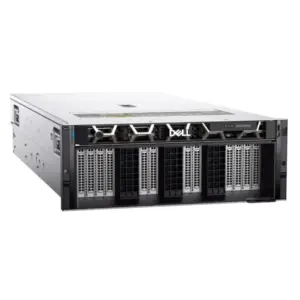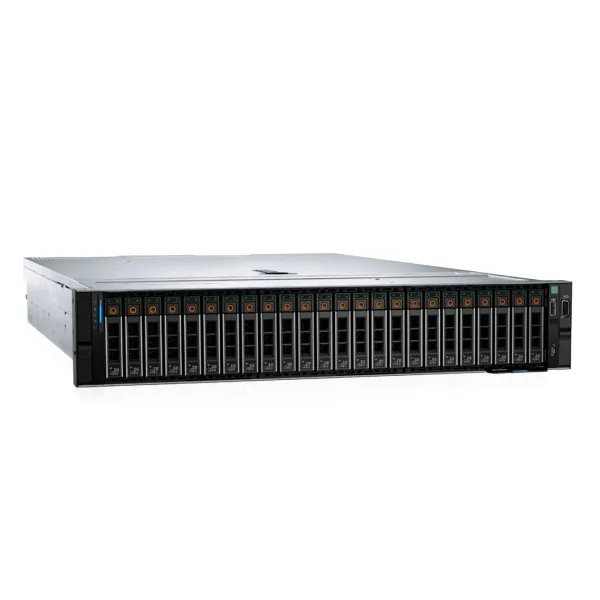
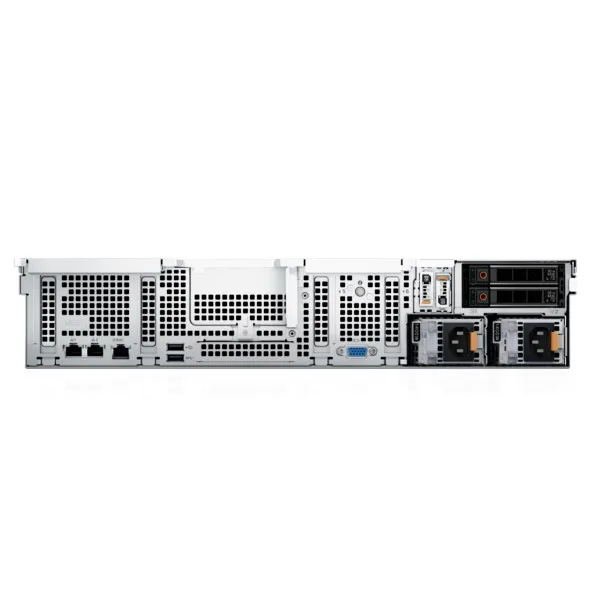
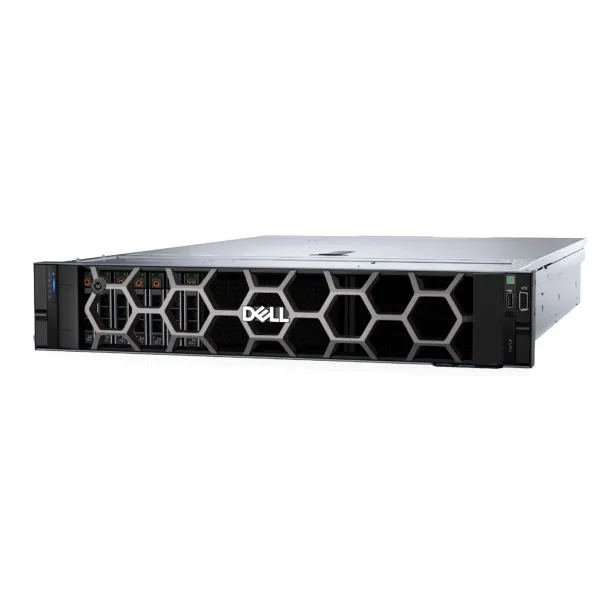
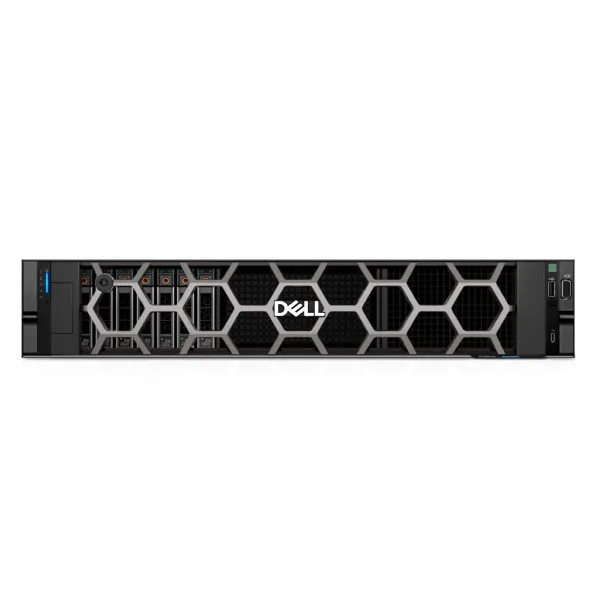
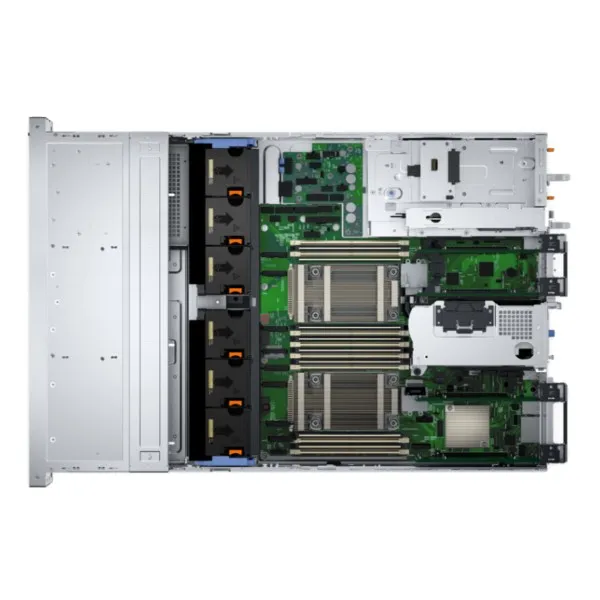
Dell PowerEdge R760xs Server in Dubai, UAE
The Dell PowerEdge R760xs is a feature-optimized 2U rack server designed to deliver a disciplined balance of compute density, enterprise storage capacity, remote manageability, and air-cooled operational practicality. This specified Dubai configuration combines a 12-core Intel Xeon Silver 4510 processor with DDR5 memory, mixed solid-state and high-capacity SAS storage, hardware RAID, redundant hot-plug power, and iDRAC9 Enterprise management.
For UAE organizations consolidating infrastructure, modernizing file and application services, building virtualization capacity, or deploying a dependable storage-rich server node, this configuration provides a strong starting point while preserving chassis-level expansion headroom for future drives, memory, networking, and supported options.
Procurement Snapshot
CPU: Intel Xeon Silver 4510, 12 cores, 2.4GHz base.
Memory: 32GB DDR5-4800 RDIMM supplied.
Storage: 1 × 1.92TB SATA SSD plus 2 × 16TB 12Gbps SAS 7.2K hot-plug HDD.
RAID: PERC H755 SAS Front.
Power: Dual 700W hot-plug redundant PSUs, 1+1.
Management: iDRAC9 Enterprise 16G.
Quick Procurement & Configuration Matrix
Dell PowerEdge R760xs, 16th-generation PowerEdge platform.
2U enterprise rack server, two-socket capable chassis.
Virtual machines, VDI foundations, file services, infrastructure applications, backup and software-defined storage roles.
This 3.5-inch platform supports up to 12 front SAS/SATA drives on supported chassis configurations; other limits are configuration dependent.
Configured with dual 700W hot-plug PSUs in 1+1 redundancy. Facility input and rack PDU compatibility must be validated.
Dubai, Abu Dhabi, Sharjah, Ajman, Al Ain and wider UAE, with regional export coordination available.
Coverage varies by service tag, selected Dell service level, country entitlement and quotation. Confirm terms before purchase.
32GB RAM, 1.92TB SATA SSD, 2 × 16TB SAS HDD, PERC H755, dual 700W PSU, iDRAC9 Enterprise, sliding rails and dual-port 1Gb LOM.
Executive Product Architectural Overview
The Dell PowerEdge R760xs occupies a useful position in enterprise infrastructure design: it is not intended to be an everything-at-once server loaded with the maximum possible accelerator count, memory slot count, and specialized internal devices. Instead, it is a feature-optimized 2U platform created around the workloads that appear repeatedly in real business environments: virtual machines, virtual desktop infrastructure, software-defined storage, file and application services, infrastructure databases of moderate scale, backup repositories, management platforms, and general-purpose compute. For procurement teams in Dubai, that distinction matters because many projects do not need an ultra-dense specialist platform; they need predictable capability, serviceability, expansion space, and a lifecycle that can be operated by a standard infrastructure team.
The supplied configuration uses one Intel Xeon Silver 4510 processor. This 5th Generation Intel Xeon Scalable CPU provides 12 cores and 24 threads at a 2.40GHz base frequency, giving the server an enterprise-class foundation for mixed infrastructure workloads without automatically pushing the project into a much higher core-count licensing profile. That balance can be valuable where software is licensed per core, where workload concurrency is moderate, or where a buyer expects to expand after measuring actual production utilization. The R760xs platform itself is two-socket capable, but processor expansion, heatsinks, risers, memory population, power requirements, firmware compatibility, and software licensing should all be reviewed as a coordinated design rather than assuming that a second CPU can simply be added later with no other implications.
Memory begins at 32GB of DDR5-4800 RDIMM in this quote. This is enough for operating system services, basic infrastructure roles, light application hosting, and initial deployment work, but it should be viewed as a starting configuration for many virtualization projects rather than a final density target. The platform uses registered ECC DDR5 memory and provides multiple DIMM slots, enabling capacity growth as workloads become better characterized. Infrastructure architects should size memory based on active working sets, hypervisor overhead, database cache requirements, virtual desktop concurrency, and failover design. The practical rule is to avoid buying only for today’s average consumption; production systems benefit from enough headroom to handle patch windows, node maintenance, temporary VM concentration, workload bursts, and future service growth.
Storage is where this particular build becomes especially relevant to organizations that prefer large, serviceable nearline capacity. The 3.5-inch chassis can support up to 12 front SAS/SATA drives on supported R760xs configurations. The supplied set combines a 1.92TB SATA SSD with two 16TB 12Gbps SAS 7.2K hot-plug HDDs and a PERC H755 controller. This layout enables the design to separate lower-latency operating or application storage from high-capacity data tiers, although the actual RAID plan must be chosen around the workload. A two-disk HDD set may be mirrored for resilience, but capacity, rebuild exposure, performance, hot-spare strategy, backup policy, and future disk additions must be considered before production commissioning. Buyers should not treat raw drive capacity as usable protected capacity.
The server also includes dual 700W hot-plug power supplies in a 1+1 redundant arrangement. Redundant power is operationally important only when it is connected to genuinely independent upstream power paths where possible. In a well-designed rack, each PSU should feed a separate PDU or protected power branch, ideally supported by correctly sized UPS infrastructure. The quoted ReadyRails sliding rails simplify rack servicing because the system can be extended from the rack for maintenance without full removal, while cable management arm requirements can be addressed separately if the deployment standard calls for one.
Remote operations are anchored by iDRAC9 Enterprise 16G. This is particularly valuable for distributed businesses, managed service providers, regional data centers, and UAE organizations whose infrastructure teams support servers outside normal office access windows. Out-of-band management allows administrators to inspect health, power state, hardware events, firmware and lifecycle information independently of the installed operating system. Combined with Dell OpenManage tooling and standard interfaces such as Redfish, it can become part of a broader operational model rather than being used only when something fails.
Network connectivity in the supplied configuration is provided by a Broadcom 5720 dual-port 1Gb onboard LOM. Dual 1Gb ports can be suitable for management, modest application traffic, basic file services, or smaller branch roles. However, virtualization, backup, storage replication, clustered applications, and high-throughput data movement often justify 10GbE, 25GbE, or other supported network expansion. FourTeck can help map the server to the existing switching fabric, VLAN architecture, transceiver or DAC standards, uplink redundancy, and expected traffic profile before the system is ordered or expanded.
Enterprise Business Value & ROI Benefits
Performance With Licensing Discipline
The Xeon Silver 4510 offers 12 physical cores and 24 threads, making this configuration suitable for organizations that need solid enterprise compute without automatically paying for a very high core-count CPU. This can be important when commercial software, virtualization products, backup platforms, or databases carry per-core cost implications. The platform leaves room to scale, but the initial processor can help align capital cost and recurring licensing with real utilization.
Storage Growth Without Immediate Chassis Replacement
A 12-bay 3.5-inch capable chassis gives buyers a practical path to add capacity over time. Starting with two 16TB SAS HDDs and a 1.92TB SSD keeps the initial bill of materials focused while preserving physical bay headroom. Expansion still requires RAID, power, thermal, drive-type, and support validation, but the chassis can reduce the risk of replacing an entire server simply because the initial disk set becomes too small.
Service Continuity Through Redundant Power
Dual hot-plug power supplies reduce dependence on a single PSU. When connected to independent upstream power paths, one supply can continue carrying the server if the other power source, cable, or PSU is taken offline. This does not replace UPS protection or disaster recovery, but it removes a common single point of failure and supports planned maintenance with less disruption.
Operational Efficiency With Remote Management
iDRAC9 Enterprise allows administrators to inspect hardware condition, perform remote console operations, manage lifecycle tasks, and respond to incidents without relying entirely on the host operating system. For multi-site companies, this can reduce unnecessary site visits and shorten response time when the server is in a secure data room, colocation facility, branch office, or customer location.
Air-Cooled Deployment Practicality
The R760xs is designed for conventional air-cooled infrastructure. That makes it easier to place into many existing data centers and enterprise server rooms without redesigning the facility around liquid cooling. Correct rack airflow, blanking practices, inlet temperatures, power density, and front-to-rear clearance still matter, but the platform fits established operational patterns familiar to most infrastructure teams.
Enterprise Serviceability
Hot-plug drives, hot-plug redundant power, sliding rails, embedded management, and modular server components support a maintenance model built around fast diagnosis and controlled replacement. Serviceability has direct business value because the cost of a server is not limited to acquisition: technician time, outage duration, access coordination, change windows, and spare-part logistics all influence total operational expense.
Hardware & Technical Architecture Highlights
At platform level, the PowerEdge R760xs is a 2U two-socket-capable system built around Intel Xeon Scalable processors and Dell’s 16th-generation PowerEdge architecture. The system supports 4th and 5th Generation Intel Xeon Scalable options depending on configuration, with an Intel C741 chipset. The selected Xeon Silver 4510 is a 5th Generation part with 12 cores, 24 threads, 30MB cache, up to 4.1GHz turbo frequency, a 150W thermal design power, PCI Express 5.0 support, and two-socket scalability. These processor-level capabilities do not mean every PCIe lane or topology is available in every server build; actual riser layouts and slot availability are configuration dependent.
The memory subsystem uses ECC DDR5 registered DIMMs. The supplied module is 32GB DDR5-4800 RDIMM. The R760xs platform provides 16 DDR5 DIMM slots, and current Dell platform information lists memory speeds and maximum capacities that vary according to processor generation, DIMM population, module type, and firmware support. Proper memory population is more than a capacity calculation. Balanced placement across memory channels helps preserve bandwidth, while virtualization and database workloads often benefit from scaling memory before scaling CPU because memory pressure can cause paging, cache misses, storage I/O amplification, or reduced VM consolidation ratios.
The front storage architecture in this build is based on a 3.5-inch chassis capable of up to 12 front SAS/SATA drives in supported configurations. The PERC H755 provides enterprise hardware RAID functionality for supported SAS and SATA devices. The supplied 1.92TB SATA SSD and two 16TB SAS HDDs serve different performance roles: the SSD favors latency and IOPS, while 7.2K SAS hard drives favor economical capacity and enterprise connectivity. A production design can separate boot, application, data, backup, archive, or cache functions, but every tier should be protected according to the business impact of failure.
The storage bus and RAID controller do not remove the physical realities of rotating media. Large-capacity HDD arrays require careful consideration of rebuild times, fault-domain exposure, RAID level, patrol read policies, hot spares, backup integrity, and restore objectives. RAID protects availability against selected disk failures; it is not a substitute for backup, immutable copies, replication, or cyber-recovery design. Similarly, adding more disks can improve aggregate throughput, but workload pattern matters: sequential backup streams behave differently from database random I/O or virtual machine storage.
Power architecture is configured with two 700W hot-plug supplies in 1+1 redundancy. Dell offers several PSU classes across the R760xs family, but the correct PSU choice depends on CPU count, memory population, drives, adapters, accelerators, and input-voltage environment. A redundant PSU pair should be planned alongside rack-level power distribution, UPS runtime, branch circuit capacity, and the ability to lose one feed without exceeding the remaining feed’s safe operating limit.
Cooling uses a front-to-rear air path with hot-swappable fan options depending on configuration. Installing higher-power CPUs, denser storage, or expansion cards can change fan requirements. Rack design therefore needs to preserve cold-aisle intake, hot-aisle exhaust, cable clearance, and perforated-door airflow. The quoted ReadyRails sliding rails support maintenance access and standardized rack installation, but data-center teams should validate rack depth, mounting-hole type, weight loading, PDU location, and rear clearance.
The Broadcom 5720 dual-port 1Gb LOM provides basic Ethernet connectivity. This is a useful baseline for management networks, infrastructure services, and moderate traffic, but it should not be assumed sufficient for every workload. High VM density, east-west traffic, backup windows, NAS workloads, replication, or hyperconverged designs may require faster OCP or PCIe network adapters. Networking should be sized from measured or estimated throughput, not simply from port count.
Definitive Technical Specifications & Sizing Notes
| Specification | Supplied / Platform Detail | Buyer Note |
|---|---|---|
| Model | Dell PowerEdge R760xs | 2U, two-socket-capable enterprise rack server. |
| Chassis | 3.5-inch front-drive chassis, up to 12 drives | Supported front bays accept SAS/SATA HDD/SSD configurations; exact backplane options matter. |
| Processor | 1 × Intel Xeon Silver 4510 | 12 cores, 24 threads, 2.40GHz base; platform supports a second CPU with configuration validation. |
| Memory | 32GB DDR5-4800 RDIMM | Expansion should follow supported population rules and workload sizing. |
| SSD | 1 × 1.92TB SATA SSD | Single-drive use does not provide disk-level redundancy unless another protection method is designed. |
| HDD | 2 × 16TB SAS 12Gbps, 7.2K, 3.5-inch hot-plug HDD | Can be designed as a mirror where appropriate; usable capacity depends on RAID level. |
| RAID Controller | PERC H755 SAS Front | RAID policy should reflect performance, resilience, rebuild risk and future disk growth. |
| Power | 2 × 700W hot-plug PSU, 1+1 redundant | Validate input voltage, dual-feed design, UPS and rack PDU capacity. |
| Management | iDRAC9 Enterprise 16G | Supports remote out-of-band administration and lifecycle operations. |
| Rails | ReadyRails sliding rails without cable management arm | Check rack depth, cabinet compatibility and cable routing standard. |
| Networking | Broadcom 5720 dual-port 1Gb onboard LOM | Higher-speed adapters may be required for virtualization, backup or storage traffic. |
| Optical Drive | None | OS and firmware deployment are normally performed through network, USB or remote management workflows. |
This specification should be read as a defined bill of materials inside a broader configurable platform. The exact quoted server includes the components listed above, while the R760xs family supports additional processor, memory, network, storage, PCIe, boot-device, power and service choices. Procurement teams should separate three questions: what is supplied now, what the chassis is physically capable of supporting, and what future upgrade remains commercially and technically valid for the service tag. This prevents a common mistake where a platform maximum is interpreted as an entitlement for a particular build.
Sizing should begin with workload metrics. For compute, estimate sustained and peak CPU utilization, concurrency, application thread behavior, and licensing cost. For memory, calculate active memory plus failover headroom and growth. For storage, distinguish usable capacity from raw capacity, then evaluate IOPS, latency, sequential throughput, rebuild behavior and backup windows. For networking, identify management, production, storage, replication and backup flows. For power, calculate rack-level redundancy and UPS requirements under realistic maximum load rather than only idle consumption. FourTeck can help translate these values into a configuration review before quotation.
Configuration, Sizing & Deployment Workbench
01 — Define Workload Headroom
Start with actual application behavior rather than model names. Capture present CPU utilization, expected transaction or user growth, peak-period concurrency, batch windows and maintenance events. The 12-core Xeon Silver 4510 can be a cost-conscious choice for many infrastructure services, but a server expected to consolidate dozens of busy VMs, host dense VDI users, or run CPU-intensive analytics may require a higher-core processor, a second CPU, or multiple nodes. Reserve headroom for antivirus scans, backup agents, patching, live migration, failover concentration and unexpected workload spikes.
02 — Size Memory From Active Demand
The supplied 32GB RDIMM is a valid starting point but should be challenged against the intended role. A file server may operate comfortably with modest memory, while virtualization, databases, VDI and in-memory services can consume much more. Determine the sum of active VM memory, hypervisor overhead, file cache, database buffers and failover reserve. Plan DIMM population so that future upgrades do not force premature replacement of small modules. Memory speed can vary with processor and population, so the best configuration is one that balances capacity, bandwidth and expansion path.
03 — Translate Raw Storage Into Protected Usable Capacity
Two 16TB SAS drives provide 32TB raw HDD capacity, but a mirrored configuration would provide approximately one drive’s worth of usable capacity before formatting and filesystem overhead. The 1.92TB SATA SSD is separate and should not be assumed to be protected by the HDD mirror. Decide whether the SSD is intended for operating system, applications, metadata, caching, or a fast data tier. If it contains critical data, consider a second matching SSD or a supported dedicated boot solution. For larger arrays, evaluate RAID level, hot spares and rebuild exposure.
04 — Match Network Port Density to Traffic Classes
The Broadcom dual-port 1Gb LOM is adequate for many management and moderate application roles, but it can become a constraint for VM migration, image deployment, backup, replication or storage traffic. Identify each logical traffic class and its peak bandwidth. Consider link aggregation or adapter redundancy where supported, but remember that aggregation does not necessarily accelerate a single flow. If the server will connect to 10/25GbE switching, specify the appropriate supported OCP or PCIe adapter and matching optics, DACs, transceivers and switch ports.
05 — Validate Software & License Terms
Hardware sizing and software economics are linked. Windows Server editions, database platforms, backup suites, hypervisors, security agents and commercial middleware may license by core, socket, VM, user, device, capacity, or subscription. The 12-core CPU can therefore be financially attractive in some scenarios, while other workloads may justify more cores to reduce server count. Confirm minimum core rules, virtualization rights, high-availability licensing, support subscriptions and version compatibility before finalizing the bill of materials.
06 — Plan Rack, Cooling & Power Before Delivery
The R760xs is a 2U rack system. Verify available rack units, cabinet depth, rail compatibility, floor loading, cable clearance, cold-air intake and hot-air exhaust. The supplied dual 700W PSUs should ideally connect to independent PDUs where the facility provides A/B feeds. Confirm UPS sizing and runtime against the whole rack, not just this server. Also consider the extra load of future disks, adapters, memory and a second processor. Data-center readiness prevents deployment delays caused by missing PDU sockets, wrong power cords, blocked airflow or insufficient switch ports.
Industry Use Cases & Workload Scenarios
Banking & Finance
Regional finance teams can use the R760xs for infrastructure applications, document services, internal virtualization clusters, branch workloads, reporting systems, backup staging and security management servers. The key design priority is resilience: redundant power, protected storage, strong access controls, backup verification and monitored remote management should be part of the deployment. Core counts and software licensing also deserve careful review when databases or commercial platforms are involved.
Healthcare
Clinics, hospitals and healthcare groups may deploy the server for application services, departmental systems, imaging workflow support, file repositories or virtual infrastructure. Large SAS drives can suit retention-heavy workloads, while the SSD can support lower-latency services. Healthcare teams should define availability, encryption, backup, access logging and disaster-recovery objectives according to the sensitivity and criticality of the information hosted.
Government & Public Sector
Government environments often prioritize lifecycle control, remote administration, standardized rack infrastructure and auditable change processes. The PowerEdge management stack and serviceable 2U design can fit centralized or departmental deployments. Procurement teams should align configuration with approved operating systems, security baselines, support entitlements, data-residency policy and formal capacity planning rather than buying solely against a generic specification.
Logistics & Distribution
Warehouses, freight operators and distribution companies can use the platform for ERP support, database services, file shares, integration engines, barcode or warehouse applications, surveillance management support and branch virtualization. The 3.5-inch drive capacity helps when operational records, documents and archives grow steadily. Dual power and remote management are useful in sites where IT staff are not permanently present.
Retail & Multi-Site Business
Retail groups can consolidate back-office workloads such as inventory services, analytics staging, ERP modules, file services and VM hosting at head office or regional hubs. Remote management can reduce branch support effort, while a carefully designed backup workflow can move data between store, head office and cloud or secondary sites. Network bandwidth should be sized for synchronization and backup windows rather than only user traffic.
Education
Schools, colleges and universities can deploy the R760xs for directory services, lab virtualization, learning platforms, file storage, administrative applications, backup and research support. The value of the 12-bay chassis is its expansion flexibility: capacity can grow as digital learning content and departmental data increase. Memory and network upgrades should be planned early if the system will host many simultaneous VMs or virtual desktops.
Technical Feature Deep Dive 1: Processing, Throughput & Workload Performance Architecture
The Xeon Silver 4510 is best understood as a balanced enterprise processor rather than a maximal-core-count device. Its 12 cores and 24 threads are well suited to infrastructure services whose value comes from consistent response, predictable scheduling and enterprise platform features rather than raw parallelism alone. At 2.40GHz base frequency with higher turbo behavior under suitable conditions, the CPU can support general application servers, virtualized infrastructure, file services, management platforms and mixed office workloads. Buyers should evaluate whether their applications favor per-core speed, thread count, memory bandwidth or I/O throughput because those factors change the most economical server design.
For virtualization, CPU sizing should be expressed as a consolidation model. Count the virtual CPUs assigned to planned VMs, apply realistic utilization rather than assuming every vCPU is active simultaneously, and reserve capacity for the hypervisor and maintenance events. Overcommitting CPU can be perfectly reasonable for lightly loaded VMs, but aggressive overcommit may create scheduling contention when several machines peak at once. Memory is often the limiting resource before CPU in general enterprise virtualization, so the 32GB starter configuration should be expanded if the R760xs will host more than a small number of guests.
Storage throughput is a separate performance plane. A 1.92TB SATA SSD can provide substantially lower latency than 7.2K rotating disks, but one SSD also represents one device and therefore one failure domain unless mirrored or otherwise protected. The pair of 16TB SAS HDDs brings capacity and hot-plug serviceability. When configured as RAID 1, reads can benefit from access to both disks while writes maintain duplicate data. For backup or archive workloads that need more capacity and throughput, additional disks and suitable RAID levels can spread I/O across more spindles. The correct design depends on whether the dominant pattern is random I/O, sequential streaming, metadata operations or large-file transfer.
Network throughput must not be ignored when storage is expanded. A single 1GbE link has a theoretical line rate far below the aggregate sequential capability of many multi-disk arrays, and protocol overhead further reduces application throughput. For a simple application server this may not matter, but a backup repository ingesting data from multiple hosts can quickly become network-bound. The same applies to VM migration or large file transfers. A well-sized R760xs should therefore be considered as a system: CPU, memory, local storage, RAID, NICs and upstream switches need to be balanced so that one inexpensive component does not constrain the rest of the investment.
Technical Feature Deep Dive 2: Security, Redundancy & System Resilience
PowerEdge security is designed across hardware, firmware and management layers. The R760xs family includes capabilities such as Secure Boot, cryptographically signed firmware, Silicon Root of Trust, secure erase functions, TPM options and system lockdown capabilities depending on licensing and configuration. These mechanisms are most effective when they are integrated into an operating procedure: firmware sources should be controlled, administrative accounts should follow least privilege, management networks should be isolated appropriately, logs should be collected, and lifecycle changes should follow change control.
iDRAC9 Enterprise is especially important because the management controller has privileged access to the server. It should never be treated like an ordinary user-facing network service. Place it on a dedicated management VLAN or protected network where possible, restrict source access, use strong authentication, keep firmware current, disable unused services and integrate event monitoring with the organization’s operations process. Where supported by the environment, Redfish and OpenManage tooling can automate inventory and lifecycle operations, but API credentials should be protected and access should be role-based.
Redundancy begins with the configured dual 700W power supplies. In a true 1+1 design, the server can tolerate a PSU failure, but operational resilience also depends on the upstream path. If both supplies connect to the same PDU, UPS and circuit, a single upstream fault can still shut down the system. Ideally, PSU A and PSU B should connect to independent protected feeds. Monitoring should alert on a failed PSU promptly so the server does not remain unnoticed in a non-redundant state.
Storage resilience requires equally careful thinking. The two 16TB SAS drives can be mirrored where the selected operating plan calls for it, allowing the HDD tier to survive one drive failure. Large drives can take significant time to rebuild, so monitoring, spare availability and backup integrity matter. The separate 1.92TB SATA SSD must be considered on its own: if it carries the operating system or business data and remains a single disk, it is a single disk failure domain. Buyers can address this through a second SSD, supported boot subsystem, replication, rapid restore design or another architecture appropriate to the workload.
Resilience also has a procedural dimension. Firmware maintenance, failed-drive replacement, operating-system patching, backup testing, recovery documentation and capacity alerts are part of system availability. A server with redundant hardware can still suffer extended downtime if no one knows the RAID layout, if backups are untested, if replacement media are incompatible, or if remote management credentials are unavailable during an incident. FourTeck can help buyers clarify component choices, while the customer’s operational team should document the full service lifecycle.
Technical Feature Deep Dive 3: Remote Management, Telemetry & Infrastructure Integration
iDRAC9 Enterprise turns the server into a remotely manageable infrastructure asset independent of the host operating system. Administrators can use out-of-band management for power operations, remote console access, hardware health inspection, event review and many lifecycle activities even when the installed OS is unavailable. This separation is useful during failed boot scenarios, network misconfiguration, driver problems or maintenance windows because the administrator retains a control path to the hardware.
Lifecycle management is particularly valuable when an organization operates multiple PowerEdge systems. Standardized firmware baselines, inventory data and repeatable configuration reduce variation between servers. Dell OpenManage Enterprise and related integrations can centralize management for supported fleets, while interfaces such as Redfish make it possible to integrate hardware operations into automation workflows. The goal is not automation for its own sake; the business value comes from reducing manual inconsistency, shortening maintenance windows, producing better asset records and responding faster to hardware events.
Telemetry also enables a more proactive support model. Temperature, fan status, power state, storage health, memory events, PSU condition and component inventory can be monitored before users report an application failure. In a Dubai data center, where environmental temperatures outside the facility can be high and cooling continuity is critical, facility monitoring and server telemetry should work together. A server may report rising inlet temperature, for example, while the data-center team correlates the event with CRAC performance or rack airflow.
Network design for management should remain separate from production traffic where feasible. The R760xs has a dedicated iDRAC Ethernet interface, and the host has its own network adapters. Infrastructure architects can place management traffic on restricted VLANs, limit firewall paths and centralize access through bastion systems or VPNs. This reduces exposure and simplifies auditing. The supplied Broadcom 5720 dual-port 1Gb LOM can then serve production or infrastructure traffic as designed, while optional higher-speed adapters can support throughput-heavy workloads.
Remote management also supports distributed operational models. A UAE headquarters team can supervise servers in branch locations, regional sites or colocation facilities without physically visiting each rack for routine tasks. This does not eliminate the need for hands-on service, but it can make remote diagnosis much more precise. A field engineer can arrive knowing whether the suspected issue is a failed drive, PSU, fan or another component, improving maintenance coordination and reducing unnecessary downtime.
What Buyers Should Check Before Purchase
A server quote is only complete when configuration, compatibility, service terms, power, rack fit, network integration, software licensing and recovery requirements have been reviewed together. The checklist below helps UAE procurement teams prevent avoidable gaps between a technically valid bill of materials and a production-ready deployment.
Configuration Fit & Model Sizing
Confirm the intended applications, operating system, VM count, user concurrency, CPU profile, memory working set and storage growth rate. Decide whether 32GB RAM is sufficient or only a starter module. Determine whether the single Xeon Silver 4510 provides enough compute headroom and whether future two-socket expansion is part of the roadmap. Map the 1.92TB SSD and two 16TB SAS disks to clear roles and protection levels. Do not buy on chassis potential alone; buy for a documented workload with measurable growth assumptions.
Compatibility & Environmental Requirements
Validate rack depth, rail mounting, available 2U space, PDU socket types, input voltage, UPS capacity and cable reach. Confirm that the Broadcom dual-port 1Gb networking matches the switching environment or specify faster adapters. Review OS and hypervisor compatibility, driver support, HBA or RAID requirements, supported drive types, and firmware baselines. If the server will enter a cluster, match network, processor and storage assumptions to the other nodes and the chosen software platform.
Availability, Delivery & Warranty Terms
Ask for current lead time, whether the system is factory-configured or assembled from validated options, the exact warranty or Dell support entitlement, delivery location, installation scope and any required export documentation. Service coverage can vary by country and service tag, so confirm the support model for the final deployment address. For urgent projects, identify which items are critical-path components because CPUs, drives, NICs or memory modules may have different sourcing timelines.
Quote Preparation Data Needed
Provide the required quantity, final delivery city, preferred warranty term, operating system requirement, target workload, memory capacity, desired RAID level, usable storage requirement, network speed, rack details and deployment date. If the requirement is replacing an existing server, include the current model, approximate utilization and data volume. For virtualization, add VM count and memory. For backup, add ingest volume and retention. Better input data produces a more accurate bill of materials and reduces revisions during approval.
UAE Regional Availability & Service Ecosystem
FourTeck supports UAE buyers with sourcing coordination, configuration review, quotation preparation, delivery planning and pre-sales clarification for enterprise server projects. Availability and exact lead time are always configuration dependent because processors, drives, memory, adapters and service packages can have different supply conditions. Sharing a complete requirement early allows the team to validate the bill of materials, identify alternatives where appropriate and coordinate logistics against the intended deployment date.
K1. Dubai Supply & Logistics Support
For Dubai customers, FourTeck can coordinate PowerEdge R760xs quotations for corporate offices, data centers, system integrators, hospitality groups, financial organizations, retail operations, logistics companies and Free Zone entities. Support can include configuration matching, RAID and storage discussion, memory and NIC expansion guidance, delivery scheduling and staging coordination where agreed. Buyers with time-sensitive projects should provide quantity, site location and required delivery window so availability can be checked against the exact component set.
K2. Abu Dhabi & Al Ain Logistics Reach
Organizations in Abu Dhabi and Al Ain can request sourcing assistance and project quotations for government, industrial, energy, education, healthcare and corporate infrastructure requirements. Server deployments in these environments often involve formal technical compliance, specified warranty terms, rack standards and approval workflows. FourTeck can help align the requested R760xs configuration with the submitted technical schedule and coordinate delivery planning after commercial confirmation.
K3. Sharjah & Northern Emirates Logistics Infrastructure
Sharjah and Northern Emirates buyers can use FourTeck for enterprise hardware sourcing, configuration clarification and commercial delivery planning. This is useful for manufacturing, education, trading, logistics, professional services and multi-branch organizations that require centralized servers without maintaining a large internal procurement team. Buyers should identify rack location, power environment, network speed and workload scope so the server arrives with fewer deployment-stage changes.
K4. Ajman & Surrounding Emirates Logistics Coverage
Businesses in Ajman and nearby Emirates can request hardware availability verification, delivery coordination and technical pre-sales guidance for the R760xs and compatible accessories. FourTeck can review whether the supplied 32GB memory, single 1.92TB SSD, two 16TB SAS disks and 1Gb networking are suitable for the intended role or whether the requirement would benefit from additional RAM, mirrored SSD storage, higher-speed networking or expanded RAID capacity before purchase.
GCC & Pan-African Supply Chain Reach
FourTeck can coordinate regional enterprise hardware inquiries beyond the UAE, including quotation support, configuration validation, export documentation assistance and cross-border logistics planning subject to destination, product availability and applicable trade requirements. International buyers should provide consignee details, delivery country, quantity, required service terms and any customs documentation needs during the quotation stage.
L1. Saudi Arabia (KSA) Export & Supply Support
Saudi enterprise projects can be supported with regional inquiry routing, bill-of-material validation and quotation coordination for servers, storage, networking and related data-center components. For R760xs requirements, buyers should identify the final city, rack environment, quantity, desired support coverage and application workload so that power, memory, networking and drive selections can be reviewed as one system.
L2. Qatar Market Supply Reach
Qatari businesses and system integrators can request cross-border sourcing coordination for Dell PowerEdge projects. The commercial process can include exact configuration review, current component availability, documentation planning and delivery coordination. For infrastructure refreshes, sharing the existing server profile and target workload helps determine whether the selected Xeon Silver, memory and storage layout provides appropriate headroom.
L3. Oman Regional Distribution Support
Buyers in Oman can engage FourTeck for enterprise hardware procurement guidance and quotation coordination. This is relevant for Muscat-based corporate infrastructure, industrial sites, hospitality environments and regional branch operations. Project teams should confirm import requirements, required warranty model, delivery terms and whether local deployment partners are involved before shipment planning.
L4. Kuwait Supply Chain Coverage
For Kuwait projects, FourTeck can assist with server sourcing, project quote preparation and export coordination. Visit FourTeck Kuwait for regional inquiry routing and country-specific procurement support. Configuration requirements should include compute, memory, usable storage, RAID, network speed and support expectations.
L5. Kenya & East Africa Supply Infrastructure
Kenyan system integrators, enterprises and project teams can request regional distribution support, technical inquiry routing and delivery coordination through FourTeck Kenya. Server projects should account for power quality, UPS design, rack cooling, local network infrastructure and the availability of replacement drives or other field-replaceable parts during the service lifecycle.
L6. Uganda Regional Procurement Support
Organizations in Uganda can use FourTeck Uganda for localized inquiry response, technology sourcing and project supply coordination. The R760xs can be considered for central business applications, virtualization, storage-rich branch infrastructure and institutional computing, with final sizing determined by local workload and service requirements.
L7. Pan-African Regional Logistics & Trade Reach
For multi-country African requirements, FourTeck Africa and FourTeck global can support broader inquiry routing, project supply planning and trade coordination. Multi-site projects benefit from standardizing processor, memory, RAID, NIC and management configurations while documenting local power, rack and support differences by country.
Related FourTeck Products & Compatible Alternatives
The correct alternative depends on whether the project requires more compute density, more memory slots, a different chassis form factor or a lower entry cost. FourTeck can quote neighboring PowerEdge models after reviewing the workload rather than treating every server in the family as interchangeable.
| Alternative | When to Consider It |
|---|---|
| Dell PowerEdge R760 | Choose when the project needs a broader high-performance configuration envelope, more memory capacity or accelerator flexibility than the feature-optimized R760xs. |
| Dell PowerEdge R660 | Consider when rack density is a priority and a 1U form factor better fits the data-center strategy, subject to storage and expansion requirements. |
| Dell PowerEdge R760xd2 | Evaluate for storage-heavy designs that prioritize very large direct-attached capacity and data-intensive repository roles. |
| Dell PowerEdge R550 / successor class | Useful to compare when the workload is more cost-sensitive and does not require the full generation-specific feature set of the R760xs. |
| Dell PowerEdge T560 class tower server | Consider for offices or sites without a full rack environment where a tower-capable enterprise platform is operationally easier to deploy. |
Within the R760xs itself, alternative configurations can be more important than alternative models. A virtualization build may prioritize additional memory and faster Ethernet. A backup build may prioritize more 3.5-inch SAS drives, a carefully selected RAID level and higher ingest bandwidth. A database-oriented system may require additional SSD or NVMe options, more memory and a different processor. A branch infrastructure server may keep the supplied CPU and storage but add a mirrored boot arrangement and extended support. FourTeck can compare these paths based on capacity, performance, downtime tolerance and project budget.
Why Enterprises Choose FourTeck
Pre-Sales Configuration Review
FourTeck can review processor, memory, storage, RAID, networking, rails, power and service requirements together so buyers receive a configuration aligned to the stated workload rather than a disconnected list of parts.
Project Quote Coordination
Enterprise quotes can be prepared around quantity, delivery location, required support term and deployment schedule. Current availability and lead time remain subject to the exact configuration and supply conditions.
Delivery Planning
For UAE and export projects, delivery planning can include site location, logistics documentation, staging expectations and coordination with the customer’s implementation schedule where agreed.
Warranty & Lifecycle Guidance
Support entitlement, warranty term and service coverage can be clarified during quotation so the purchased system aligns with the customer’s operating model and deployment country.
The practical benefit is risk reduction. Enterprise buyers frequently lose time when a server is ordered with insufficient memory, the wrong rack accessory, inadequate network speed, an unsuitable RAID layout or unclear warranty terms. A structured pre-sales review helps identify those issues before the hardware reaches the data center. FourTeck’s role is to help procurement and technical teams converge on a clear bill of materials and supply plan, while final workload validation, application licensing and organizational security policy remain customer responsibilities.
Frequently Asked Questions
1. Is the Dell PowerEdge R760xs suitable for virtualization?
Yes. Dell positions the R760xs for common enterprise workloads including virtual machines and VDI. This specific 32GB configuration is better viewed as an entry point for virtualization because memory often becomes the first consolidation limit. For production VM hosting, FourTeck can help size additional DDR5 memory, faster networking, protected boot storage and the required RAID layout around VM count, utilization and failover needs.
2. How many 3.5-inch drives can the R760xs support?
The R760xs supports a front-bay configuration with up to 12 × 3.5-inch SAS/SATA HDDs or SSDs. The exact backplane and factory configuration determine what is available on a particular system. This quoted build includes one 1.92TB SATA SSD and two 16TB 3.5-inch SAS hot-plug HDDs, leaving chassis-level expansion potential subject to controller, cabling and supported drive validation.
3. What RAID configuration should be used with the two 16TB SAS drives?
For many business workloads, two drives are commonly configured as RAID 1 to protect against a single disk failure, but the correct choice depends on capacity, performance and recovery objectives. RAID 1 would provide approximately one drive’s raw capacity before formatting overhead. Buyers should also maintain independent backups because RAID protects availability from selected hardware failures but does not protect against deletion, malware or site loss.
4. Is the single 1.92TB SATA SSD redundant?
No. A single physical SSD is a single device failure domain unless the application uses another resilience mechanism. If the 1.92TB SSD will hold the operating system or important applications, consider a second matching SSD, a supported BOSS boot solution, replication or a documented restore process. FourTeck can help review the intended SSD role and recommend an appropriate protected layout.
5. What does iDRAC9 Enterprise provide?
iDRAC9 Enterprise provides out-of-band server management independent of the installed operating system. Administrators can remotely monitor hardware health, access the console, perform power operations and support lifecycle tasks. It is particularly valuable for servers in data centers, branches or colocation sites. For security, iDRAC should be placed on a protected management network with strong authentication and controlled administrative access.
6. Are the dual 700W power supplies truly redundant?
The configured power supplies operate in a 1+1 redundant arrangement, allowing the server to continue operating if one PSU fails under supported load conditions. Full power-path resilience also requires good facility design. Ideally, each PSU should connect to a different protected PDU or feed so that one upstream electrical fault does not remove power from both supplies simultaneously.
7. Is dual-port 1Gb Ethernet enough for this server?
It can be enough for management, moderate application traffic, small file services and branch roles, but it may be restrictive for virtualization, backup ingest, replication or storage-intensive traffic. The right speed depends on measured throughput and the upstream switching environment. If the workload needs higher bandwidth, supported OCP or PCIe network adapters can be specified with corresponding switch ports and cabling.
8. Can the server be upgraded to a second processor later?
The PowerEdge R760xs is a two-socket-capable platform, but a later second-CPU upgrade must be validated against the exact system configuration. Processor model compatibility, heatsink and cooling requirements, memory population, risers, power budget, licensing and firmware can all be affected. It is best to plan the likely two-socket requirement during initial procurement rather than assume every accessory needed for expansion is already present.
9. Does the system include an optical drive?
No. This specified configuration has no optical drive. Modern PowerEdge deployments normally use network-based installation, USB media, remote virtual media through management tools, or automated operating-system deployment. If a legacy installation process depends on optical media, discuss the workflow before purchase so an alternative deployment method or compatible external device can be planned.
10. How can I request a Dubai quotation for this exact configuration?
Send FourTeck the model name Dell PowerEdge R760xs, required quantity, delivery location, deployment timeframe and any required warranty term. Include whether you want the exact 32GB / 1.92TB SSD / 2 × 16TB SAS configuration or need changes to memory, RAID, networking or storage. Providing workload details allows the technical team to flag obvious sizing gaps before the commercial quote is finalized.
Plan Your Dell PowerEdge R760xs Procurement
For a precise quotation, submit the Dell PowerEdge R760xs model, required quantity, delivery city, preferred deployment date and support term. If you need a configuration review, also include the workload type, VM or user count, memory target, usable storage target, RAID preference, network speed and rack environment. FourTeck can use this information to coordinate a configuration and supply plan for Dubai, wider UAE or eligible regional projects.