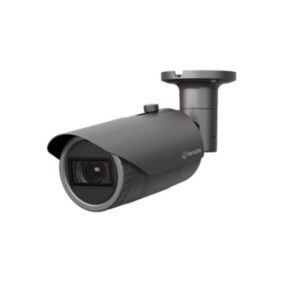
Hanwha PNV-A9081R 4K AI IR Vandal Dome Camera Dubai
The Hanwha PNV-A9081R Dubai requirement is typically driven by a need for high-detail 4K surveillance, dependable outdoor construction, intelligent analytics and flexible scene framing in one professional network camera. The PNV-A9081R is a Hanwha Vision P Series 4K AI IR vandal dome camera built around an 8 megapixel imaging platform, a 4.5–10 mm motorized varifocal lens, integrated IR illumination and AI-based object classification. It is particularly relevant to businesses, commercial buildings, warehouses, campuses, hospitality properties, logistics facilities, retail environments and enterprise security teams that need more than basic motion recording.
Fourteck supports UAE buyers with model selection, quotation, CCTV design discussions, network and PoE planning, NVR/VMS compatibility review, storage sizing, installation coordination and deployment guidance. Final availability, accessories, recorder compatibility, firmware features and project compliance should be confirmed against the exact scope before ordering.
AI Analytics
30m IR
4.5–10mm Varifocal
IK10+ Vandal Resistance
Is the PNV-A9081R the right camera for your site?
Choose the PNV-A9081R when the scene needs a combination of high resolution, adjustable field of view, outdoor durability and intelligent event filtering. A basic fixed-lens camera can be sufficient for a small indoor room, but larger entrances, loading zones, outdoor walkways, perimeter transition points, parking interfaces and high-value operational areas often benefit from the ability to tune the lens after the camera position is known. The PNV-A9081R’s motorized 4.5–10 mm range allows the installer to move between a wider contextual view and a tighter scene without changing the camera.
Its AI engine can classify people, faces, vehicles and license plates, which can help reduce the operational burden created by conventional pixel-based motion events. The practical value is not simply “AI” as a label. It is the ability to build searches, alerts and review workflows around recognized object classes and analytics events rather than treating every movement in the frame as equally important.
The model is also well suited to exposed or higher-risk mounting locations because Hanwha specifies IP66, IP67, IP6K9K, IK10+ and NEMA 4X environmental/mechanical protection. Even with those ratings, correct mounting, sealing, cable entry, junction accessories, weather exposure, cleaning access and maintenance planning remain essential for a dependable real-world installation.
Verified PNV-A9081R specification snapshot
| Camera type | 4K AI IR vandal dome network camera |
|---|---|
| Image sensor | 1/1.8-inch CMOS |
| Maximum resolution | 3840 × 2160 (4K / 8MP) |
| Maximum frame rate | Up to 30 fps / 25 fps depending on 60 Hz / 50 Hz operation |
| Lens | 4.5–10 mm, 2.2× motorized varifocal, P-Iris |
| Horizontal field of view | Approx. 101.4° wide to 45.5° tele |
| IR illumination | WiseIR, up to 30 m |
| WDR | 120 dB |
| Compression | H.265, H.264, MJPEG; WiseStream III supported |
| AI classifications | Person, face, vehicle and license plate, with attributes and BestShot support |
| Edge storage | Two microSD/SDHC/SDXC slots, up to 256 GB each / 512 GB total |
| Power | PoE+ (IEEE 802.3at Class 4) or 12 V DC |
| Environmental / vandal ratings | IP66, IP67, IP6K9K, IK10+, NEMA 4X |
| Dimensions / weight | Ø180 × 125 mm; approximately 1.9 kg |
Specifications can change with regional product revisions and firmware. Confirm the current Hanwha documentation, compatible accessories and planned recording platform for the exact project before procurement.
For entrances and mixed lighting
120 dB WDR, day/night operation, AI-based noise reduction and the adjustable lens help when entrances must handle bright exteriors, shaded interiors and changing traffic through the same scene.
For warehouses and logistics
4K detail, vehicle/person classification, IR, local storage options and flexible field of view can support loading bays, dispatch areas, yard interfaces and controlled operational zones.
For enterprise security teams
ONVIF profiles, secure communications, 802.1X options, event integrations and configurable analytics make the camera more suitable for structured IP surveillance environments than a basic standalone CCTV device.
For exposed mounting points
Weather and vandal ratings make the dome appropriate for demanding placements, provided installation accessories, cable sealing, power, cleaning access and local site conditions are handled correctly.
Why 4K resolution matters in a professional CCTV design
A 4K camera provides substantially more pixels than a 1080p camera, but the practical benefit depends on how those pixels are used. In a wide lobby or exterior approach, 4K can preserve more detail across the scene and give operators more useful digital zoom during recorded review. In a narrower scene, it can support stronger subject detail at a given distance. However, 4K also increases the need for sensible bitrate, storage, network and retention planning. A buyer should therefore avoid evaluating the PNV-A9081R only by resolution.
For example, a Dubai warehouse that wants 30 days of retention across many 4K cameras should calculate expected bitrate, recording mode, motion/event policy, hours of activity, codec settings and redundancy before deciding on NVR and disk capacity. WiseStream III and H.265 can help improve bandwidth/storage efficiency, but actual consumption remains scene dependent. Busy entrances, foliage, reflective surfaces, moving vehicles, rain, changing illumination and high-detail backgrounds can all affect encoded bitrate.
Fourteck can help align camera count, resolution, retention, recorder capacity, hard-disk sizing and network uplinks so the deployment is designed as a complete surveillance system rather than a collection of individual cameras.
4.5–10 mm motorized varifocal lens: what it changes on site
Lens selection determines whether a camera captures the right balance between context and detail. The PNV-A9081R covers an approximate horizontal field of view from 101.4° at the wide end to 45.5° at the tele end. That range is useful where the camera position is known but the exact framing must be tuned during commissioning. A wider setting can show more of a reception area or loading zone, while a tighter setting can concentrate available pixels on a doorway, vehicle lane or specific operational area.
The right setting should be based on the surveillance objective. “See the whole area” is different from “recognize a person at the door” or “capture vehicle activity at a controlled entrance.” The installer should evaluate mounting height, target distance, angle of incidence, foreground obstructions and expected movement. The PNV-A9081R also provides DORI reference distances under EN 62676-4 methodology, but DORI values should be treated as planning references rather than guaranteed identification performance in every scene because lighting, angle, motion, compression and installation quality all influence the final image.
For UAE buyers comparing fixed-lens and varifocal dome cameras, this adjustability is one of the strongest reasons to consider the PNV-A9081R for professional projects with site-specific framing requirements.
AI analytics: from raw motion to operationally useful events
The camera’s AI engine supports classification of people, faces, vehicles and license plates. Hanwha also lists attribute information, BestShot functionality and a range of analytics events including object detection, line crossing/direction, area-based loitering, intrusion, enter/exit, face-mask detection, social distancing, slip-and-fall detection, people counting, queue management, heatmap, vehicle counting and crowd counting. Feature availability can be firmware and configuration dependent, so a project should validate the required analytics against the planned software platform and current camera firmware.
For security operations, classification can make alerts more meaningful. A perimeter zone may need to react differently to a person than to general scene movement. A retail or service area may use people-counting or queue-management information for operational visibility. A warehouse may focus on human and vehicle movement around loading or restricted areas. The camera also supports conventional events such as motion, defocus, tampering, audio detection, sound classification and shock detection, allowing a deployment to combine AI-driven and standard rules.
Analytics should always be commissioned against the actual environment. Camera angle, height, object size, occlusion, lighting and field-of-view choices directly affect analytics performance. A well-positioned camera with carefully tuned rules is more valuable than enabling every event type at once.
IR, low light and difficult illumination
Hanwha specifies 0.05 lux color sensitivity at F1.6 and integrated WiseIR illumination up to 30 m, with 0 lux operation when the IR LED is on in black-and-white mode. This makes the camera useful in locations where ambient light falls significantly after business hours. IR performance still depends on the scene. Reflective walls, license plates, nearby surfaces, glass, insects, dust, rain and objects close to the camera can influence exposure, so installation should include night testing rather than assuming daytime framing will automatically produce optimal night footage.
The 120 dB WDR function helps scenes with strong contrast, such as building entrances with daylight outside and darker interiors. Digital image stabilization with a built-in gyro sensor can also help reduce the visual impact of vibration in suitable situations. These capabilities are particularly useful in mixed indoor/outdoor transition zones common in commercial facilities, parking interfaces and logistics sites.
Network, VMS and integration planning
The PNV-A9081R is an IP network camera and should be planned as part of the IT/security architecture. Hanwha lists IPv4/IPv6 networking, RTSP, HTTPS, SNMP, QoS, MQTT and other common network protocols, together with ONVIF Profiles S, G, T and M, SUNAPI and the Hanwha Vision Open Platform. This provides useful integration options, but the exact feature set available inside an NVR or third-party VMS depends on the VMS version, device driver, plugin and configuration.
For enterprise projects, network design should account for camera VLANs, PoE budget, switch uplinks, multicast/unicast behavior where used, NTP, secure credentials, firewall policy, remote administration, monitoring, firmware maintenance and recorder connectivity. The camera supports PoE+ under IEEE 802.3at Class 4 as well as 12 V DC, giving integrators flexibility in power design. Hanwha lists typical PoE consumption around 17 W and a maximum of 20 W, so the switch should be sized for the total camera load with adequate power headroom.
Fourteck can review the CCTV requirement alongside switching, structured cabling, rack, UPS and network infrastructure. This is useful where a customer wants one coordinated bill of materials rather than discovering late in the project that the existing PoE switch, uplink capacity or rack power was undersized.
Edge storage and recording resilience
The camera includes two microSD/SDHC/SDXC slots and Hanwha specifies support for up to 256 GB per slot, for a total of 512 GB. Edge storage can be useful for local recording, event buffering or resilience strategies depending on the VMS/NVR design. It should not automatically be treated as a replacement for centralized recording when the business requires long retention, multi-camera search, centralized audit, redundant storage or formal evidence management.
A strong project decides where recordings should live, how many days must be retained, whether 24/7 or event recording is required, how users will search/export footage, and what happens if a network link or recorder becomes unavailable. Storage sizing should be calculated from expected bitrate and retention rather than simply multiplying camera count by disk capacity.
Cybersecurity features relevant to managed networks
Professional surveillance cameras are network endpoints, so cybersecurity is part of the buying decision. Hanwha lists encrypted firmware, secure boot, signed firmware, digest authentication, brute-force protection, IEEE 802.1X options, HTTPS, secure WebSocket communication, IP-based access control, credential protection, access/system/event logging, device certificates and AES-256 encryption for SD-card partitions. The product is also listed with IEC 62443-4-2 component security certification.
These controls are most effective when the surrounding deployment is also managed properly. Use unique credentials, restrict administrative access, keep firmware under change control, place cameras on an appropriate network segment, review logging, disable unnecessary exposure to the internet and align remote access with the organization’s security policy. For multi-site enterprise deployments, standardizing these practices is as important as selecting the camera model itself.
Outdoor and vandal-resistant design for UAE sites
The PNV-A9081R uses an aluminum housing and is specified with IP66, IP67, IP6K9K, IK10+ and NEMA 4X ratings. Hanwha lists an operating range down to -50°C and up to +55°C, with the note that startup should occur above -30°C. In the UAE, the upper temperature and environmental design are more relevant, but the published rating should not be confused with a guarantee that every mounting location will remain within safe thermal limits.
Direct solar load, enclosed mounting spaces, reflective façades, dust, saline environments, cleaning methods and poor cable sealing can all affect long-term reliability. An outdoor CCTV design should therefore consider shade, orientation, mounting accessories, conduit/junction protection and maintenance access. For coastal or exposed facilities, corrosion considerations and accessory material compatibility also deserve attention.
The IK10+ vandal resistance is valuable for reachable or public-facing areas, but physical risk still needs to be managed through mounting height, location, conduit protection and camera placement. A vandal-resistant dome is a strong mechanical choice, not a substitute for overall physical-security design.
Typical deployment scenarios in Dubai and the UAE
Corporate buildings
Use the camera at main entrances, service access points, reception interfaces, external walkways or sensitive operational zones where 4K detail and structured analytics are useful.
Warehouses and logistics
Loading bays, dispatch lanes, staff entrances and yard transition points can benefit from the combination of high resolution, vehicle/person classification and strong enclosure ratings.
Retail and commercial property
High-value entrances, customer-access interfaces, external storefront approaches and service corridors may require more detail and better event filtering than standard fixed indoor domes.
Hotels and hospitality
Back-of-house routes, vehicle approaches, staff/service access and selected external areas can use the vandal-resistant design and tunable field of view while preserving an unobtrusive dome form factor.
Education and campuses
Entrances, common outdoor circulation, controlled gates and facilities areas may benefit from 4K coverage and AI object filtering when deployed under the organization’s privacy and security policies.
Industrial and utility sites
The enclosure, network security features and analytics make the model relevant to monitored access points and operational perimeters where camera durability and managed-network integration matter.
How it compares with a standard 4MP indoor dome
| Decision point | PNV-A9081R | Typical basic 4MP indoor dome |
|---|---|---|
| Resolution | 4K / 8MP, suitable when extra scene detail is valuable | Lower pixel count, often sufficient for smaller indoor scenes |
| Lens | Motorized 4.5–10 mm varifocal for commissioning flexibility | Often fixed focal, simpler but less adjustable |
| Analytics | AI-based classification and business-intelligence options | Usually motion/event functions with more limited classification |
| Outdoor / vandal suitability | Designed for demanding exposed installations with multiple environmental ratings and IK10+ | May be intended only for indoor protected locations |
| Best use | Enterprise, commercial, logistics, exposed and analytics-driven scenes | Cost-sensitive indoor rooms, small offices and straightforward monitoring |
The PNV-A9081R is not automatically the best choice for every camera position. Using a premium 4K AI vandal dome in a small, low-risk indoor room can be unnecessary. A better system design uses higher-capability cameras where their optical, environmental and analytics features create clear value, while using more economical cameras in simpler areas.
PNV-A9081R procurement checklist
Scene objective: define whether the camera must detect, observe, recognize or identify subjects and what distance matters.
Mounting: confirm ceiling/wall position, junction or mounting accessory, conduit route, height and service access.
Network: validate PoE+ budget, switch ports, VLAN design, uplink capacity, addressing and cybersecurity policy.
Recording: decide NVR/VMS, retention period, bitrate profile, redundancy and edge-storage role.
Analytics: identify the specific events required and confirm them against firmware/VMS support.
Integration: check ONVIF/VMS driver support, alarm I/O, audio, MQTT or API requirements where relevant.
Regulatory/project requirements: for Dubai or other regulated projects, verify the current authority, consultant and project requirements applicable to the installation rather than relying on an old approval list.
Commercial scope: request pricing with camera quantity, accessories, recorder/storage, switching, cabling, installation and support requirements so the quote reflects the complete project.
Fourteck support for Hanwha PNV-A9081R Dubai projects
Fourteck can support customers who are evaluating the Hanwha PNV-A9081R Dubai camera as part of a new CCTV deployment, an expansion or a higher-resolution upgrade. The useful starting point is the business requirement: location, camera count, expected viewing distance, lighting, retention days, existing NVR/VMS, network infrastructure and installation scope. From there, the project can be matched to the right camera, mounts, PoE switching, recorder/storage and services.
For a wider CCTV discussion, review Fourteck’s CCTV & Access Control Systems UAE page. If installation planning is part of the requirement, see CCTV Camera Installation Dubai. Buyers comparing a simpler indoor Hanwha dome can also review the Hanwha QND-7012R 4MP IR Dome Camera Dubai page as a different class of deployment.
Because camera supply, firmware, accessories, VMS integration and project schedules can vary, Fourteck should confirm current availability and final compatibility before ordering. The objective is to quote the complete requirement accurately rather than promise generic stock or fit that may not match the site.
UAE deployment considerations by location
Dubai: commercial towers, warehouses, hospitality, retail, logistics and mixed-use properties often combine indoor and exposed camera positions. Buyers should verify current project/authority requirements, especially where surveillance installations fall under regulated security frameworks. Fourteck can help prepare the technical bill of materials and coordinate model selection with installation scope.
Abu Dhabi: enterprise, institutional, industrial and hospitality buyers may prioritize centralized management, secure network integration, storage retention and structured project documentation. The PNV-A9081R fits best where its 4K detail, analytics and environmental design are needed rather than using the same camera indiscriminately at every point.
Sharjah and Ajman: warehouses, workshops, commercial premises, schools and residential/community projects often need practical exterior coverage and strong night performance. Camera quantity, PoE switching and storage should be planned together to avoid under-sizing.
Wider UAE: for multi-site businesses, standardizing camera models, firmware, naming, VLANs, retention and VMS policy can simplify ongoing administration. Where harsh outdoor conditions are expected, the final enclosure, mount, cable sealing and environmental plan should be reviewed as part of the project design.
Frequently asked questions
Request a Hanwha PNV-A9081R Dubai quotation
Send Fourteck the required quantity, installation location, intended coverage, recording days, existing NVR/VMS details and whether you also need PoE switching, storage, cabling or installation. This allows the team to confirm compatibility and prepare a more accurate project quotation for the Hanwha PNV-A9081R Dubai requirement.
For the latest product firmware, manuals and model-specific technical documents, verify the current Hanwha Vision support documentation before final commissioning.