Quick Procurement & Configuration Matrix
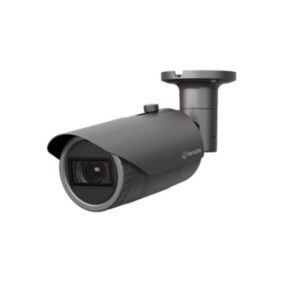
Hanwha Vision QNE-C9013RL.
8MP AI dual-light flateye network surveillance camera.
Fixed-view entrances, exterior approaches, corridors, loading bays, retail and general enterprise perimeter observation.
Per-camera architecture supports up to five streaming profiles and up to twenty unicast users; system scale depends on VMS, NVR, network and storage design.
PoE IEEE 802.3af Class 3; typical 4.5 W and maximum 10 W.
Dubai, UAE and regional project destinations subject to current availability and logistics confirmation.
-40°C to +60°C operation; startup above -30°C; IP66/IP67 and IK10.
Warranty terms vary by source channel and project; request written terms on the FourTeck quotation.
Executive Product Architectural Overview
The Hanwha Vision QNE-C9013RL belongs to the class of fixed-view intelligent IP cameras designed to move more useful decision-making toward the camera edge. Instead of treating the camera purely as an image sensor that sends a continuous stream to a recorder, this model combines an 8-megapixel imaging pipeline, local analytics, multiple encoding profiles, edge storage support and secure network services. That architecture matters for enterprise deployments because the useful output of a surveillance system is not simply hours of video; it is the ability to obtain clear evidence, find events efficiently, reduce avoidable alarms and maintain predictable network and storage consumption across hundreds or thousands of endpoints.
At the imaging layer, the QNE-C9013RL uses a 1/2.8-inch CMOS sensor and supports a maximum resolution of 3840 × 2160. The fixed 3.0 mm lens provides a wide 108-degree horizontal field of view, 59-degree vertical view and 127-degree diagonal view. This is particularly relevant for entrances, vestibules, building corners, wide pedestrian approaches, loading areas and general scene-overview positions where the purpose is to cover a broad scene rather than isolate a distant subject. Fixed focus also simplifies commissioning because there is no remote zoom decision to manage later. The trade-off is equally important: buyers should not select this model when a project requires telephoto reach or field-adjustable focal length. A correct surveillance design should use the lens specification as a deliberate design input rather than assume that higher resolution compensates for every distance or identification requirement.
The low-light system combines conventional infrared illumination and warm-white visible light. Both are rated for up to 30 metres under the manufacturer’s defined conditions. The warm light is specified at approximately 3000K, offering the possibility of full-colour scene illumination at night, while IR provides discreet monochrome surveillance when visible light is not appropriate. The camera can therefore support different operational philosophies: discreet observation, visible-light deterrence, or event-driven lighting. This dual-light approach can be useful in Dubai logistics, hospitality, retail and mixed-use properties where some zones benefit from minimal visual disturbance while others benefit from an obvious illumination response when a person or vehicle enters a defined area.
The analytics engine is a major differentiator. The camera can classify people and vehicles, with vehicle types including car, bus, truck, motorcycle and bicycle, while also supporting functions such as object detection, virtual line, direction, loitering, intrusion, enter and exit events. Business-intelligence capabilities include people counting, queue management, heatmap and vehicle counting. The goal is not to replace a full VMS analytics platform in every project, but to create useful metadata closer to the source. When the VMS and operational procedures are designed to use that metadata, security teams can reduce the volume of nuisance events generated by ordinary pixel motion and make investigations more targeted.
On the video side, H.265, H.264 and MJPEG are supported. WiseStream III can reduce bandwidth requirements by allocating encoding resources more intelligently, while WiseNR II applies object-aware noise reduction. The camera supports up to five streaming profiles, allowing an integrator to configure separate streams for recording, live multi-view displays, mobile access or analytics consumers. This is important because a surveillance network rarely has a single video consumer. A primary recording stream may be high resolution and evidence-oriented, while a low-bandwidth secondary profile can serve operators who view many tiles simultaneously. Properly separated profiles reduce the temptation to compromise the main recording quality simply to accommodate a monitoring workstation or remote connection.
The networking architecture is designed for mainstream enterprise IP environments. The Ethernet interface is 10/100BASE-T over RJ-45 and power is supplied via IEEE 802.3af PoE Class 3, with maximum consumption specified at 10 W. Protocol support includes IPv4 and IPv6, HTTPS, TLS, SNMP, QoS, LLDP, CDP, NTP, RTSP, SRTP, MQTT and other common services. ONVIF Profiles S, G, T and M plus SUNAPI and Hanwha Vision Open Platform support give system designers multiple integration paths. Compatibility should still be validated against the selected recorder or VMS version because standards compliance does not guarantee that every proprietary analytic event or metadata field is exposed identically across all third-party platforms.
For UAE buyers, the environmental envelope is especially relevant. The camera is rated IP66 and IP67 against dust and water ingress and IK10 against mechanical impact. The manufacturer specifies operation from -40°C to +60°C with startup above -30°C. The aluminum housing, weather sealing and supported humidity range make the unit suitable for demanding external conditions when installed in accordance with manufacturer guidance. However, real projects should still account for direct solar loading, enclosure colour, mounting orientation, cable routing, lightning and surge protection, network cabinet temperature, PoE switch thermal loading and cleaning schedules in dusty environments. FourTeck can help procurement teams translate the camera specification into a deployable bill of materials rather than treating the camera SKU as the entire solution.
Enterprise Business Value & ROI Benefits
High-Detail Evidence Capture
An 8MP image can preserve substantially more scene detail than lower-resolution designs when lens placement and subject distance are appropriate. That extra pixel density supports stronger post-event review, more useful digital zoom during investigation and better coverage of wide scenes. The financial value appears when one camera position can satisfy the intended evidence requirement without excessive overlap, provided the DORI and scene geometry are checked during design.
Reduced Alarm Noise
AI classification can distinguish people and vehicles from many forms of environmental motion. In a correctly configured system, this can reduce the burden created by foliage, light change or other non-target activity. Fewer meaningless notifications allow operators to concentrate on events with higher operational relevance. The benefit becomes more pronounced across large estates, where even a modest reduction in nuisance alarms can save significant review time every week.
Dual-Light Night Strategy
Integrated infrared and warm-white lighting lets designers decide whether a zone should remain discreetly monitored, be illuminated in colour, or use visible lighting as part of an event response. This flexibility can reduce the need for separate illuminators in suitable scenes and can improve colour information at night. Actual illumination performance remains dependent on subject distance, surface reflectance, ambient light, weather and installation geometry.
Bandwidth Efficiency
H.265 combined with WiseStream III gives system architects tools to reduce transport and storage demands while retaining useful evidence. Lower average bitrates can defer switch uplink expansion, reduce WAN pressure for distributed monitoring and extend recorder retention within a fixed storage budget. Sizing should still be based on measured or conservatively estimated scene activity rather than a single marketing compression percentage.
Resilient Deployment
IP66, IP67 and IK10 ratings support deployment in exposed or accessible positions where dust, rain and impact resistance matter. A robust housing can lower premature replacement risk and broaden placement options. Total resilience still depends on correct glands, cable protection, mounting hardware, surge protection and installation workmanship, so these should be incorporated into the procurement scope rather than assumed to be included automatically.
Operational Continuity
MicroSD edge storage can provide local recording capability for event capture or continuity strategies when the central recorder or network path is disrupted. The standard specification supports one microSD/SDHC/SDXC slot up to 256 GB, with separate OnCloud-specific support noted by Hanwha for higher capacities using certified media. Retention and write endurance should be checked against actual recording mode and card specification.
The practical return on investment for a camera such as the QNE-C9013RL comes from architecture rather than one feature. A camera that produces clear evidence but floods operators with false alerts creates a labour cost. A camera that generates excellent images but consumes excessive bandwidth can force premature network upgrades. A camera with sophisticated analytics that does not integrate cleanly with the selected VMS can become an isolated endpoint. The business case is strongest when image geometry, analytics, compression, recording, network capacity and response procedures are designed together. FourTeck can support this procurement process by checking the requested camera against the intended scene, VMS, network and retention plan before quantity is finalized.
Hardware & Technical Architecture Highlights
The camera’s architecture begins with a 1/2.8-inch CMOS imager feeding an internal processing pipeline that performs exposure control, wide dynamic range processing, noise reduction, analytics and multi-codec encoding. The maximum image is 3840 × 2160, and H.265 or H.264 can run at up to 30 fps in 60 Hz regions or 25 fps in 50 Hz regions. This matters for motion-heavy scenes such as gates or vehicle lanes because frame rate influences the temporal detail available during fast activity. MJPEG is also supported, although the highest-resolution MJPEG stream carries lower frame-rate limits and should be treated as an integration or specialist option rather than the default recording codec.
The fixed 3.0 mm F1.6 lens is matched to a wide overview application. Manufacturer figures list a 108° horizontal, 59° vertical and 127° diagonal field of view, with a minimum object distance of 0.5 m. Mechanical adjustment allows pan from 0° to 350°, tilt from 0° to 75° and rotation from 0° to 360° during installation. These adjustment ranges help a technician frame the image after mounting while preserving a low-profile flateye design. Because the lens is fixed, correct placement must be established before installation; an error in mounting distance cannot later be solved by optical zoom.
The image-processing stack includes automatic day/night switching with ICR, BLC, SSDR and 120 dB WDR for difficult mixed-light scenes. WiseNR II and SSNR V provide noise-reduction functions, while lens distortion correction and electronic shutter controls are available for scene tuning. In practical deployments, these controls influence the balance between exposure, motion sharpness, noise and compression load. For example, a very slow shutter can produce a bright scene but blur moving subjects, while excessive gain can amplify noise and increase bitrate. Commissioning should therefore be performed against the actual operational objective, not merely to create the brightest static picture.
The camera contains 2 GB RAM and 1 GB flash, plus a microSD storage slot. Network communication runs over 10/100BASE-T Ethernet. Up to five streaming profiles can be created, unicast supports up to twenty users, and multicast is supported. This enables a structured video-distribution plan where one stream is optimized for recording, another for operator grids and another for remote access or specialist consumers. The security architecture includes encrypted firmware, secure boot, signed firmware, digest authentication, brute-force prevention, IEEE 802.1X options, HTTPS, secure WebSocket, SRTP, IP-based access control, credential protection, log management, a device certificate and AES-256 encrypted SD-card partitions.
Power is supplied via IEEE 802.3af PoE Class 3. Typical consumption is approximately 4.5 W, while the maximum is 10 W. For small installations, this may appear trivial, but enterprise deployments should calculate the aggregate PoE budget with reserve capacity and account for switch operating temperature. A 48-port switch populated with cameras should not be designed on average consumption alone; maximum endpoint draw, switch power supply rating, uplink requirements, redundancy and environmental derating are all part of a reliable camera network design.
Definitive Technical Specifications & Sizing Notes
| Area | Specification | Buyer Relevance |
|---|---|---|
| Imager | 1/2.8-inch CMOS, max 3840 × 2160 | Supports 8MP evidence capture for broad scene coverage. |
| Frame Rate | H.265/H.264 up to 30/25 fps | Suitable for general enterprise motion capture; select recording rate based on risk. |
| Lens | 3.0 mm fixed, F1.6 | Wide scene coverage rather than long-range telephoto identification. |
| Field of View | H 108°, V 59°, D 127° | Useful for entrances, approaches, corridors and wide exterior views. |
| Low Light | 0.034 lux colour; 0.0034 lux B/W | Supports low-light operation; actual scene quality depends on exposure and environment. |
| Illumination | IR 30 m; warm-white light 30 m, 3000K | Allows discreet infrared or visible full-colour night strategies. |
| WDR | 120 dB | Helps manage scenes containing bright and dark regions. |
| Analytics | Person/vehicle classification, line, area, loitering, intrusion, counting and more | Can improve event relevance and operational search workflows. |
| Codecs | H.265, H.264, MJPEG; WiseStream III | Enables bandwidth and storage tuning across different consumers. |
| Streams | Up to 5 profiles; up to 20 unicast users | Supports separate recording, live-view and remote-access profiles. |
| Storage | 1 × microSD/SDHC/SDXC, standard specification up to 256 GB | Useful for edge recording, event capture or resilience design. |
| Integration | ONVIF S/G/T/M, SUNAPI, Open Platform | Broad integration choices; validate VMS feature mapping before deployment. |
| Network | RJ-45 10/100BASE-T | Standard enterprise Ethernet connection. |
| Power | PoE 802.3af Class 3; 4.5 W typical / 10 W max | Simplifies cabling; calculate switch PoE budget at scale. |
| Protection | IP66, IP67, IK10 | Supports exposed and vandal-risk environments when correctly installed. |
| Operating Range | -40°C to +60°C; startup above -30°C | Broad environmental envelope; site thermal conditions still need validation. |
| Dimensions / Weight | Ø140 × 99.6 mm; 790 g | Important for mounting, coordination drawings and installer access. |
Sizing should begin with the surveillance objective. Manufacturer DORI figures provide a useful reference under EN 62676-4 methodology: approximately 55.8 m detect, 22.3 m observe, 11.2 m recognize and 5.6 m identify. Those values are not guarantees for every scene, because lighting, movement, angle, compression, mounting height and the target itself influence results. If a project needs reliable facial identification at a gate, for example, the mounting geometry should be checked against the identify distance rather than simply placing the camera wherever cabling is easiest. Storage should be calculated from resolution, frame rate, codec, bitrate mode, scene activity, retention period and recording schedule. Network design should consider aggregate bitrate and PoE load with engineering headroom. Mounting accessories, back boxes and brackets are configuration dependent; contact FourTeck for current compatible options and project-specific validation.
Configuration, Sizing & Deployment Workbench
01 — Define the Evidence Objective
Start with what an operator must accomplish: detect presence, observe behaviour, recognize a known subject or identify an unknown subject. Map each camera position to that objective and compare expected subject distance to the lens geometry and DORI reference. Do not use the 8MP label as a substitute for scene design. A wide 3.0 mm lens spreads pixels across a broad field, which is valuable for overview but reduces pixel density on distant targets.
02 — Establish Recording Quality and Retention
Select resolution, frame rate, codec and bitrate policy according to risk. A loading bay with fast vehicle movement may need more temporal detail than a low-traffic storage corridor. Define retention in days and determine whether recording is continuous, scheduled, event-driven or hybrid. Storage capacity must include all cameras, practical bitrate assumptions, redundancy overhead and a safety margin. Edge microSD can complement central recording but should not automatically replace a recorder for regulated evidence retention.
03 — Validate Network Capacity
For each access switch, total the expected video bitrate and maximum PoE demand, then verify uplink capacity and power budget. Include switch overhead, other network devices and future growth. Where cameras connect across buildings or distributed sites, review WAN capacity, QoS policy and remote-viewing demand. Separate streaming profiles can prevent a mobile client or multi-camera wall from consuming the same bitrate as the evidentiary recording stream.
04 — Match VMS and Analytics
Confirm that the selected VMS or NVR supports the QNE-C9013RL and exposes the required events, metadata and search functions. ONVIF offers broad interoperability, but advanced AI functions may depend on specific drivers, firmware or integrations. Where person/vehicle classification, counting or queue analytics are business requirements, test the complete workflow from camera event to operator interface rather than checking only basic live video.
05 — Engineer the Night Scene
Decide whether the scene should use IR, warm-white light or an event-driven combination. Check reflective walls, glass, signage, number plates and nearby objects that may cause glare. White light can provide valuable colour information, but it may be unsuitable where residents, guests or drivers could be disturbed. IR is discreet but produces monochrome images and can be affected by close reflective surfaces. Commission after dark to verify real performance.
06 — Plan Environmental and Mounting Details
Confirm wall, ceiling, pole or accessory requirements before ordering. Select corrosion-appropriate fixings, protect exposed cable routes, seal entries correctly and provide surge protection where required by site standards. In Dubai, direct sun and hot service areas can raise equipment temperatures above ambient assumptions, so positioning and switch cabinet ventilation matter. Consider cleaning access in dusty environments and ensure the selected height still supports serviceability.
07 — Set Cybersecurity and Maintenance Policy
Use unique credentials, HTTPS, role-based access, network segmentation and 802.1X where appropriate. Keep firmware under change control and verify compatibility before updates in critical environments. Configure NTP to preserve evidence timestamps, centralize logs where required and document the camera IP, switch port, location and firmware baseline. Security cameras are networked computing devices and should be governed by the same disciplined lifecycle practices as other enterprise endpoints.
Industry Use Cases & Workload Scenarios
Banking & Finance
Branch approaches, staff entrances, service corridors and exterior ATM-support areas can benefit from high-resolution fixed overview coverage and person/vehicle classification. Financial institutions should integrate the camera into retention, access-control and incident-management policies, and should validate privacy masking and evidence export workflows against internal compliance requirements.
Healthcare
Hospitals and clinics can use flateye cameras at ambulance approaches, service areas, pharmacies, public entrances and external walkways. The wide lens supports situational awareness, while WDR helps where entrances combine bright exterior light with shaded interiors. Privacy and patient-sensitive areas must be handled through policy, camera placement and masking rather than technology alone.
Government & Public Sector
Public facilities often require durable cameras, secure communications, auditability and standards-based integration. IP66/IP67 and IK10 ratings support exposed positions, while 802.1X, HTTPS, signed firmware and secure boot align with stronger endpoint governance. Procurement teams should confirm required certifications, firmware policy and approved VMS versions for each project.
Logistics & Warehousing
Vehicle yards, loading docks, dispatch doors and pedestrian routes can use person/vehicle analytics to prioritize relevant motion. The warm-light option is useful where colour evidence is important after dark, while infrared allows discreet monitoring in other zones. For fast vehicle lanes, shutter and frame-rate settings should be commissioned specifically for motion clarity.
Retail & Hospitality
Retail stores, malls, hotels and restaurant properties can use the wide fixed view for entrances, exterior queues, service doors and delivery areas. People counting, queue management and heatmap functions may support operational analysis when the VMS exposes them appropriately. Lighting strategy should consider guest experience and avoid unnecessary visible illumination.
Education
Schools, universities and training campuses can use the camera across gates, external corridors, parking approaches and building entrances. Wide coverage and strong environmental protection suit distributed campus conditions. Network segmentation, access permissions and clear retention policies are particularly important where video covers students, staff and visitors.
Technical Feature Deep Dive 1: Processing, Throughput & Workload Performance Architecture
The performance architecture of the QNE-C9013RL should be viewed as a coordinated pipeline rather than a collection of headline specifications. The sensor captures a high-resolution scene, the image processor controls exposure and dynamic range, the analytics engine classifies objects and generates event metadata, and the encoder produces one or more network streams. Each stage influences the next. High gain in a dark scene can generate image noise; noise makes compression less efficient; higher bitrate increases storage and transport load. Conversely, well-controlled illumination allows the camera to produce cleaner frames that are easier to compress and more useful to both human operators and analytics.
At 8MP, the camera can deliver H.265 or H.264 at up to 30 fps in a 60 Hz environment. That gives designers flexibility to use full frame rate where motion fidelity is important or reduce frame rate where retention efficiency matters more. Many enterprise scenes do not need 30 fps continuously. A corridor, for example, may be satisfactorily recorded at a lower frame rate if policy permits, while a busy vehicle gate may benefit from additional frames. The correct setting should therefore come from risk and evidence requirements rather than from automatically choosing the maximum value on every device.
WiseStream III provides an additional efficiency layer. Its purpose is to reduce bandwidth by assigning encoding resources intelligently, especially around objects of interest. In system design terms, compression efficiency can influence three capital areas at once: recorder disk capacity, network uplink utilization and remote-site WAN consumption. The manufacturer promotes substantial potential savings, but project sizing should use conservative bitrates until field measurements exist. Scenes with trees, rain, reflective surfaces, crowds or rapid motion can require more data than a quiet indoor hallway.
The five-profile streaming capability is especially useful in mature VMS environments. A high-quality primary profile can feed the recorder, a moderate secondary profile can supply operator workstations, and a lower profile can support mobile or constrained WAN viewing. Separating these consumers avoids a common mistake where one compromised stream must satisfy every use case. It also allows central recording to retain the intended evidence quality even when dozens of operators are simultaneously opening live views.
Technical Feature Deep Dive 2: Security, Redundancy & System Resilience
A modern camera is an authenticated network endpoint, and the QNE-C9013RL includes controls intended to protect both firmware integrity and communications. Secure boot and signed firmware help prevent unauthorized code from becoming the trusted runtime. Encrypted firmware adds another layer around the update package. Digest authentication, brute-force prevention and IP-based access controls provide tools for governing user and network access, while HTTPS, WSS and SRTP support protected communications. IEEE 802.1X options allow the camera to participate in enterprise network access-control policies rather than relying only on physical switch-port security.
Security configuration should be implemented as part of commissioning. Default or shared credentials should not be used. Management access should be restricted to appropriate VLANs or administrative networks, unnecessary services should be disabled where supported, and device time should be synchronized with a trusted NTP source. Firmware changes should be controlled, tested against the VMS and documented. Event, access and system logs can support troubleshooting and forensic review when they are preserved as part of the wider monitoring architecture.
Resilience also includes local recording. The standard edge-storage specification supports a microSD card up to 256 GB, enabling local capture during selected events or network interruption strategies. Edge storage is valuable, but it introduces media-endurance and lifecycle questions. Continuous high-bitrate recording can generate substantial write volume, so enterprise-grade cards and planned replacement intervals may be appropriate. OnCloud documentation separately notes support for higher-capacity certified Hanwha media in that service context; buyers should distinguish that scenario from the standard local storage specification.
Physical resilience is addressed through IP66, IP67 and IK10 ratings. These ratings do not make installation quality irrelevant. Water ingress frequently occurs through cable paths, poorly sealed joints or unsuitable third-party accessories rather than through the camera housing itself. Impact resistance can protect against incidental or deliberate contact, but mounting substrate strength and fastener selection remain critical. A resilient system therefore combines rated hardware with correct mechanical installation, surge protection, stable PoE power and a network design that provides alternate monitoring paths where business risk requires them.
Technical Feature Deep Dive 3: Remote Management, Telemetry & Infrastructure Integration
The QNE-C9013RL supports a broad set of network protocols that allow it to operate inside managed enterprise environments. SNMP can contribute status information, NTP maintains time consistency, QoS can help prioritize video traffic where the network design uses it, and LLDP or CDP can improve infrastructure visibility depending on the switching platform. HTTPS and secure transport options support administrative and video access, while MQTT can participate in event-driven integrations. These capabilities are most valuable when they are documented and intentionally configured rather than left at factory defaults.
ONVIF Profiles S, G, T and M provide standards-based mechanisms for functions including streaming, recording-related capabilities and metadata integration, while SUNAPI offers Hanwha-specific API access. This combination gives integrators flexibility, but feature depth varies among third-party VMS platforms. Basic live video may work through a generic ONVIF connection while sophisticated analytics metadata requires a native driver. A procurement test should therefore include the exact operational workflow: event reception, bookmarking, metadata search, alarm acknowledgment, export, user permissions and health monitoring.
Remote management also depends on how the camera is segmented and reached. Direct exposure to the public internet should not be the default design for enterprise surveillance. Secure remote operations normally use protected management paths, VPNs, access brokers or cloud architectures with defined identity controls. The camera supports direct cloud connection, but the suitability of any cloud workflow should be evaluated against data residency, cybersecurity and contractual requirements for the specific organisation.
Telemetry can reduce maintenance cost when camera health, link state and storage status are monitored centrally. Rather than discovering a failed camera only during an incident investigation, administrators can use VMS health tools and network monitoring to identify loss of communication, abnormal errors or recording gaps. The QNE-C9013RL can generate alarm events including network disconnect and analytics triggers. A mature deployment turns these events into service processes with ownership, escalation and documented restoration procedures.
What Buyers Should Check Before Purchase
The largest camera procurement risks are usually not hidden in the camera specification. They appear when scene geometry, mounting accessories, VMS support, storage retention, PoE budget or warranty expectations are left undefined. Use the four checkpoints below before issuing a purchase order.
01 / FIT — Configuration Fit & Model Sizing
Confirm the actual target distance and evidence objective for each position. The 3.0 mm lens is wide and fixed, so it is excellent for scene overview but is not a substitute for a varifocal or telephoto camera where identification is required farther away. Confirm required frame rate, recording resolution, day/night mode and whether the dual-light behaviour aligns with the site. Validate the quantity against the coverage plan, not simply the number of existing legacy cameras.
02 / MATCH — Compatibility & Environmental Requirements
Check VMS or NVR compatibility, firmware requirements, ONVIF feature mapping and analytic support. Confirm PoE switch capacity and whether VLAN, 802.1X, NTP and certificate policies can be implemented. Verify mount type, back box or bracket, cable path and environmental exposure. Where cameras face intense sun, reflective façades or vehicle headlights, include commissioning time for WDR, shutter and exposure tuning.
03 / TERMS — Availability, Delivery & Warranty Terms
Request a written quotation stating the exact model, quantity, delivery destination, lead time, warranty conditions and included accessories. Product availability can vary by region and channel. For project deployments, ask whether the quotation includes cameras only or also brackets, microSD cards, PoE switches, NVR/VMS licenses, storage, patching and installation services. This avoids comparing incomplete quotations that appear cheaper but exclude necessary infrastructure.
04 / REQUEST — Quote Preparation Data Needed
Send FourTeck the QNE-C9013RL model, required quantity, Dubai or UAE delivery location, target deployment date, preferred recorder or VMS, approximate retention period and whether mounting accessories are needed. For larger projects, include a camera schedule or floor plan where available. These details allow the commercial and technical teams to identify obvious gaps before pricing and reduce revision cycles during procurement.
UAE Regional Availability & Service Ecosystem
FourTeck supports UAE organisations that require enterprise surveillance hardware sourcing, pre-sales specification review, quotation coordination and delivery planning. Current inventory, source channel, warranty and lead time should be confirmed at quotation stage. For multi-camera projects, configuration validation can include lens suitability, accessory requirements, PoE planning, recording architecture and expected deployment schedule.
K1. Dubai Supply & Logistics Support
Dubai buyers can request project quotations for corporate offices, hotels, logistics facilities, retail estates, schools, data-centre support areas and Free Zone deployments. FourTeck can coordinate camera quantities, compatible accessory requirements, staging expectations and delivery details across major Dubai business districts and industrial areas. Fast quotation handling is most effective when the inquiry includes exact model, quantity, destination and required date.
K2. Abu Dhabi & Al Ain Logistics Reach
For Abu Dhabi and Al Ain projects, FourTeck can coordinate sourcing and quotation support for government, industrial, education, healthcare and corporate surveillance requirements. Larger opportunities may require formal bill-of-material validation, documentation and staged delivery. Buyers should provide site or project references and required warranty terms so that commercial conditions can be aligned before purchase.
K3. Sharjah & Northern Emirates Logistics Infrastructure
Sharjah and Northern Emirates customers can obtain deployment planning support, quotation coordination and commercial logistics assistance for single-site or multi-site camera refresh projects. Industrial zones and warehouse environments should include network cabinet and environmental details where the camera infrastructure may operate in high heat or dusty service spaces.
K4. Ajman & Surrounding Emirates Logistics Coverage
Ajman businesses can request hardware availability verification, delivery coordination and technical pre-sales guidance for the QNE-C9013RL and related surveillance infrastructure. FourTeck can help identify whether the camera alone is being purchased or whether brackets, recording, storage and switching are required to complete the deployment.
GCC & Pan-African Supply Chain Reach
FourTeck supports regional project inquiries that may require export coordination, commercial documentation, configuration validation and cross-border technology logistics. Export availability, shipping terms, local import requirements and manufacturer warranty applicability should be confirmed for each destination before order placement.
L1. Saudi Arabia (KSA) Export & Supply Support
Saudi enterprise projects can request configuration validation, regional inquiry routing and project quotation support. Buyers should provide quantity, destination city, planned VMS and required deployment date so that availability and export arrangements can be reviewed.
L2. Qatar Market Supply Reach
Qatar customers can request cross-border logistics coordination, project quotation and sourcing support for enterprise surveillance deployments. Larger projects benefit from a complete camera schedule and accessory list to reduce compatibility errors.
L3. Oman Regional Distribution Support
Oman buyers can obtain procurement guidance, model confirmation and quotation coordination. Project teams should identify whether requirements include cameras only or a complete video platform with NVR/VMS, storage and switching.
L4. Kuwait Supply Chain Coverage
For Kuwait, FourTeck can coordinate project quote assistance and export supply discussions. Regional buyers can also review FourTeck Kuwait for localized inquiry routing and project coordination.
L5. Kenya & East Africa Supply Infrastructure
Kenyan system integrators and enterprises can request regional distribution support, technical inquiry routing and delivery coordination for surveillance projects. Visit FourTeck Kenya for local project engagement.
L6. Uganda Regional Procurement Support
Uganda projects can receive localized inquiry response, project supply management and technology sourcing coordination through FourTeck Uganda, subject to product availability and shipping conditions.
L7. Pan-African Regional Logistics & Trade Reach
For broader African technology deployments, FourTeck can coordinate multi-country project supply and export discussions. Buyers can engage through FourTeck Africa and FourTeck global channels for regional requirements.
Related FourTeck Products & Compatible Alternatives
Alternative selection should be driven by lens requirement, resolution, analytics depth and mounting environment. Within Hanwha Vision’s broader camera portfolio, buyers can consider the QNE-C8013RL where a related lower-resolution option is appropriate, or other Q-series fixed dome, bullet and varifocal models when the scene requires a different focal length or form factor. A bullet camera may offer easier visual direction and different mounting flexibility for perimeter applications, while a dome can better suit indoor architectural environments. A varifocal model becomes preferable when final mounting distance is uncertain or when identification is required at greater range.
| Option | When to Consider It |
|---|---|
| Hanwha QNE-C8013RL | Consider when the related flateye platform fits the site but the specific resolution and feature mix should be compared against project needs. |
| Hanwha Q-Series Varifocal Camera | Select when optical field adjustment or longer identification distance is more important than a compact fixed-lens design. |
| Hanwha Q-Series Bullet Camera | Useful for perimeter or directional outdoor positions where bullet form factor and different lens options better match site geometry. |
| Hanwha Q-Series Dome Camera | Useful where an architectural dome appearance, recessed mounting options or indoor ceiling deployment is preferred. |
| Higher-Tier Hanwha AI Camera | Consider for projects requiring advanced analytics, specialist sensor formats, enhanced low-light performance or additional cybersecurity and resilience features. |
FourTeck can help compare candidate models against the same scene objective rather than comparing specification sheets in isolation. Share the target distance, mounting height, desired field of view and recording platform to narrow the shortlist.
Why Enterprises Choose FourTeck
Enterprise procurement becomes easier when the commercial quotation reflects the technical requirement. FourTeck’s role is to help buyers turn a camera model request into a clearer bill of materials by checking model identity, quantity, accessory requirements, delivery destination and project timing. For surveillance deployments, this can extend to reviewing PoE needs, network assumptions, recording architecture and mounting requirements before purchase.
FourTeck also supports quotation coordination for UAE and regional projects, including staged or multi-location deliveries where required. Availability and lead time are not assumed; they are confirmed during the inquiry process. Buyers can request explicit warranty terms, source details and compatible accessories on the written quotation so procurement and technical teams are working from the same information.
Post-sales support requirements should also be defined before order placement. For larger projects, keep the model, serial-number records, firmware baseline and deployment location documented so future troubleshooting and warranty coordination are faster. This disciplined approach is more valuable than simply selecting the lowest unit price because surveillance infrastructure is expected to remain operational and supportable throughout a multi-year lifecycle.
Frequently Asked Questions
1. What is the Hanwha Vision QNE-C9013RL?
The QNE-C9013RL is an 8MP AI dual-light flateye network camera from Hanwha Vision. It uses a 3.0 mm fixed lens, supports up to 3840 × 2160 resolution, H.265/H.264 video, integrated infrared and 3000K warm-white illumination up to 30 metres, AI person and vehicle classification, PoE networking, edge storage and IP66/IP67/IK10 environmental protection.
2. Does the QNE-C9013RL record 8MP at 30 fps?
Yes. Hanwha Vision specifies H.265 and H.264 operation up to 30 fps in 60 Hz environments or 25 fps in 50 Hz environments at the camera’s supported resolutions, including the 8MP maximum. Actual system recording rate also depends on recorder settings, available bandwidth, storage policy and the selected stream profile.
3. How far can the camera see at night?
The integrated infrared and warm-white illumination are each specified for a viewable length of up to 30 metres. This is an illumination figure, not an automatic identification distance. Subject detail at night depends on lens geometry, exposure, movement, reflectivity, ambient light and camera angle. Use DORI planning and a night commissioning test for evidence-critical positions.
4. What AI analytics are available?
The camera supports AI-based person and vehicle classification, including several vehicle types, along with object detection, virtual line, direction, loitering, intrusion, enter and exit events. It also supports functions such as people counting, queue management, heatmap and vehicle counting. Feature availability inside a VMS can vary, so the required workflow should be validated with the chosen platform.
5. Is the QNE-C9013RL suitable for outdoor use in Dubai?
The camera is rated IP66 and IP67 for ingress protection and IK10 for impact resistance, with a specified operating range from -40°C to +60°C and startup above -30°C. Those ratings support demanding outdoor use, but Dubai installations should still account for direct solar heating, cable sealing, dust, surge protection, bracket selection and PoE switch operating temperature.
6. What storage does the camera support?
The standard camera specification includes one microSD/SDHC/SDXC slot supporting up to 256 GB. Hanwha also documents higher-capacity certified media in an OnCloud edge-recording context. Buyers should distinguish the standard local-storage specification from service-specific storage support and choose high-endurance media where continuous or heavy event recording is expected.
7. Does it work with third-party VMS platforms?
The QNE-C9013RL supports ONVIF Profiles S, G, T and M as well as SUNAPI and Hanwha Vision Open Platform. This provides broad integration options, but advanced analytics, metadata search and event handling can depend on the VMS driver and version. FourTeck recommends validating the exact required features before purchasing large quantities.
8. How is the camera powered?
The camera is powered by IEEE 802.3af PoE Class 3 through its Ethernet connection. Hanwha specifies typical consumption of about 4.5 W and maximum consumption of 10 W. For multi-camera deployments, calculate the switch PoE budget using maximum load with appropriate reserve and confirm the switch remains within its thermal and electrical limits.
9. What should I provide to get a Dubai quotation?
Provide the exact model QNE-C9013RL, required quantity, Dubai delivery location, desired deployment or delivery date, preferred recorder or VMS, retention target and whether mounting accessories, microSD cards, PoE switches or installation materials are required. For larger projects, a camera schedule or site drawing helps FourTeck identify compatibility or sizing issues before quotation.
10. What warranty applies?
Warranty coverage depends on the supply channel, project terms and regional conditions. FourTeck recommends requesting the warranty duration, return or repair process, exclusions and required proof of purchase in writing on the final quotation. This avoids assuming that warranty terms from another country or reseller automatically apply to a Dubai or UAE project.
Request a QNE-C9013RL Project Quote
For an accurate FourTeck quotation, submit the model QNE-C9013RL, required quantity, Dubai or UAE delivery location and expected deployment timeframe. If the project includes a recorder or VMS, also provide the platform name, retention target and approximate camera count. Include any requirement for mounting brackets, back boxes, microSD storage, PoE switching or related infrastructure so the quotation can be aligned with the deployment rather than the camera SKU alone.