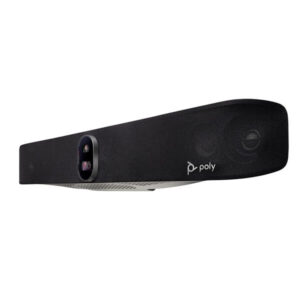
HP Poly Studio E60 Smart Camera in Dubai, UAE
The Poly Studio E60 is a 4K smart mechanical PTZ camera built for larger meeting spaces where presenters, whiteboards, and participants may sit well beyond the reach of a typical fixed-view conferencing camera.
For business buyers, the practical value is reach and control: 12x optical zoom, motorized pan and tilt, intelligent presenter tracking and group framing, plus flexible USB and network connectivity. FourTeck can help confirm whether the E60 matches your room geometry, collaboration platform, mounting plan, cabling, and wider conferencing architecture before a quotation is prepared.
A camera designed for depth, movement and presentation-led rooms
The HP Poly Studio E60 Smart Camera is not simply a webcam with a longer lens. It is a dedicated meeting-room camera whose mechanical pan, tilt and optical zoom are intended to keep useful detail visible across larger spaces. HP positions the model for large conference rooms, boardrooms and classrooms, where a presenter may move between the display, lectern, whiteboard and audience rather than sit in one fixed position.
The main PTZ camera provides 12x optical zoom, a 71-degree horizontal field of view, motorized pan of plus or minus 170 degrees and tilt of plus or minus 30 degrees. That combination matters when a room has significant depth. Optical zoom can bring a distant speaker or presentation area closer without relying only on digital enlargement, while the mechanical movement lets the camera recompose the image as attention changes around the room.
HP also equips the E60 with Poly DirectorAI functions for presenter tracking and group framing. A separate AI lens supports automatic tracking and framing within a wider 107-degree horizontal field of view. In practical terms, this gives the system more context about what is happening in front of the camera while the mechanical PTZ lens handles the tighter conferencing image. For training, executive presentations, education, town-hall style sessions and hybrid workshops, that can reduce the need for a participant to continuously manage camera presets or manually move the view.
The E60 also fits enterprise deployment patterns. It provides USB-B connectivity, a 10/100/1000 Mbps Ethernet interface that supports PoE+, a 12 V DC input, an infrared remote control and a Kensington lock slot. HP lists compatibility with leading conferencing platforms and certifications for Microsoft Teams, Zoom and Tencent. Poly Lens software provides a management path for Poly endpoints, which is relevant when IT teams need consistent device configuration, updates and visibility across multiple rooms.
For UAE buyers, the main question is not whether 4K and 12x zoom sound impressive; it is whether the camera matches the room and the rest of the conferencing design. FourTeck can review room dimensions, seating depth, mounting position, platform, codec or room system, display arrangement, network and power availability, and the expected presentation workflow. That review helps prevent common mistakes such as choosing a camera with insufficient reach, mounting it too high or too far off-axis, or ordering the camera without checking how it will connect to the selected conferencing environment.
Why the E60 makes sense in rooms that need more camera reach
The strongest benefits appear when the room is too deep or presentation-led for a fixed wide-angle camera. Each capability below connects to a practical meeting or deployment requirement.
Optical zoom preserves useful detail across deeper rooms
A 12x optical zoom gives the camera genuine lens-based reach. For a boardroom, classroom or presentation room, this helps a remote attendee see a person or content area that sits farther from the front display. It also gives room designers more flexibility when the camera cannot be mounted extremely close to every speaking position. The buyer benefit is not simply a larger zoom number; it is the ability to plan a room around realistic seating and presentation distances.
Presenter tracking supports movement
When a presenter walks between a screen and a discussion area, intelligent tracking can keep the session visually coherent. This is useful in lessons, training, executive briefings and workshops where staying seated is not practical. It can also reduce dependence on manual camera operation during ordinary meetings.
Group framing helps remote participants follow the room
Group framing is valuable when meeting attendance changes or participants shift position. Instead of leaving an unnecessarily wide static shot, the camera can adapt the composition around the people who are actually present, helping the far end see faces and interactions more clearly.
USB, Ethernet and PoE+ create practical installation choices
The E60 can connect over USB and also provides Gigabit Ethernet with PoE+ support. For system integrators and IT teams, this can simplify cable planning or make it easier to place the camera where power outlets are inconvenient, depending on the room architecture. A 12 V DC input remains available as another power path. The included wall mount handles a common installation scenario, while optional ceiling or display mounts can be considered when the room design requires a different sightline.
Poly Lens supports fleet-minded IT teams
Organizations with more than one Poly room can benefit from a management approach rather than treating each camera as an isolated device. Poly Lens is designed to give IT visibility and control across Poly endpoints, supporting configuration, software updates and operational insight at scale.
Platform certification reduces procurement uncertainty
HP lists the E60 as certified for Microsoft Teams, Zoom and Tencent. Certification does not eliminate the need to check the complete room design, but it gives buyers a stronger starting point when standardizing conferencing technology around established collaboration platforms.
A focused combination of optical control and intelligent framing
The E60 combines a mechanically controlled PTZ camera with an AI lens, rather than asking one fixed lens to perform every task. The main camera reaches into the room with optical zoom, while the wider AI view helps DirectorAI understand the presentation area and people in front of the system. This design is especially relevant when the room has a clear front-of-room camera position but activity can happen across a broad stage, boardroom table or teaching zone.
Video output reaches 4K resolution at up to 30 frames per second. Buyers should still plan around the complete meeting platform and network path, because the visible quality experienced by remote participants can be affected by conferencing-service settings, bandwidth, display resolution, lighting, room distance and the connected room endpoint. A 4K sensor does not by itself guarantee a 4K meeting stream in every platform.
The included IR remote provides straightforward camera control for installations that benefit from local operator input. LED indicators show standby and power state. A two-element beamforming microphone array is listed in HP specifications, but buyers should not treat the E60 as an all-in-one room audio solution; larger conference rooms normally require audio to be designed around the selected room system, microphones, speakers and acoustic environment.
HP Poly Studio E60 technical details
The following details are based on HP Middle East product specifications and the official Studio E60 product page. Final accessories, regional package content and integration details should be confirmed for the exact part number being ordered.
| Specification | Details |
|---|---|
| Brand / Model | HP Poly Studio E60, product 9W1A6AA |
| Camera type | Smart mechanical pan-tilt-zoom camera |
| Resolution | Up to 4K UHD / 3840 × 2160 at 30 fps |
| Camera sensors | Total camera resolution listed as 2 × 8 MP |
| Optical zoom | 12x optical |
| Pan / tilt | Pan ±170°; tilt ±30° |
| Field of view | PTZ camera: 71° horizontal; 78.1° diagonal. AI lens: automatic tracking/framing within 107° HFOV |
| Smart camera modes | Poly DirectorAI, presenter tracking, group framing |
| Focus | Auto focus |
| Ports | 1 × USB-B; 1 × RJ-45 10/100/1000 Mbps Ethernet supporting PoE+; AC/DC power jack |
| Power | AC/DC 12 V; Power over Ethernet PoE+ injector support |
| Microphone | Two-element beamforming microphone array |
| Compatible operating systems | Android; Windows |
| Mounting | Wall mount included; optional ceiling or display mounts sold separately |
| Dimensions | 20 × 15 × 16.5 cm |
| Weight | 1.79 kg |
| Operating temperature | 0 to 40°C |
| Included items | 5 m Ethernet cable, wall mount kit, quick start guide, warranty card, E60 camera, 2 m USB-B to USB-A cable, IR remote control |
| Manufacturer warranty | Poly standard one-year limited warranty; regional terms should be confirmed for the supplied unit |
When selecting this camera, focus first on room depth, desired framing and the connected conferencing architecture. A 12x optical zoom is most useful when the room genuinely needs to isolate a person or presentation zone at distance. The 71-degree PTZ field of view is not intended to behave like an ultra-wide huddle-room lens; instead, the camera is designed to pan, tilt and zoom across a larger environment. Confirm where people sit, how far the nearest and farthest seats are from the planned camera position, and whether the camera can maintain a natural eye line from that location.
Also confirm whether the installation will use USB, IP connectivity or a supported room-system integration, and how power will be provided. PoE+ may help reduce local power requirements, but network switching, power budget and supported architecture must still be checked. If the camera will be ceiling- or display-mounted, include the correct optional mount in the bill of materials. FourTeck can use a room sketch, photos, platform requirement and quantity to help narrow the suitable deployment approach.
Match the camera to the room before matching it to a price
For a camera like the E60, the largest purchase risk is selecting by specification alone. Room geometry and integration determine whether the optical capability can actually be used well.
How deep is the room?
Measure from the intended camera position to the nearest and farthest important speaking positions. A deep classroom or boardroom can benefit from optical reach; a shallow room may be better served by a wider fixed camera or video bar.
What will connect to the camera?
Identify the room system, conferencing computer, codec or other endpoint that will use the E60. Compatibility should be verified for the exact platform and connection method rather than assumed from a USB or Ethernet connector alone.
Where should it be mounted?
Wall mounting is supported with the included kit. Ceiling and display mounts are optional. Keep sightline, obstruction, display placement, cable routing and service access in mind before finalizing the position.
How will audio be handled?
The camera has a two-element beamforming microphone array, but larger rooms typically require a deliberate conferencing-audio design. Confirm microphone pickup, speaker coverage and room acoustics separately from the camera choice.
Do you need central management?
If several rooms are being deployed, include Poly Lens administration and device lifecycle requirements in the design. Firmware, settings and fleet visibility matter more as the number of endpoints grows.
What should you send for a useful quote?
Share room dimensions, camera position, collaboration platform, existing room system, quantity, mounting preference, delivery location and required date. Photos or a simple room sketch can be especially useful.
Where this camera fits naturally
The E60 is most compelling when a room has depth, a defined front camera position and movement that benefits from mechanical tracking. It is less about putting a camera on every display and more about solving specific shared-space requirements.
Large boardrooms and executive meeting rooms
Long boardroom tables create a common camera challenge: a wide shot can show everyone, but people at the far end may appear small, while a camera with insufficient optical reach cannot isolate an active speaker cleanly. The E60’s 12x optical zoom and mechanical pan/tilt give room designers more ability to focus on specific speaking positions. Presenter tracking and group framing can support natural meetings where attention shifts between an executive, a group discussion and the front display. Before ordering, confirm the complete room system and microphone architecture so camera and audio coverage are planned together.
Training and learning spaces
Instructors often move around the front of a room, point to a display or board and address participants from different positions. Presenter tracking helps keep the teaching activity in view, while optical zoom can provide a tighter shot when the instructor is farther from the camera. This makes the model relevant for corporate academies, universities and professional training centers.
Hybrid presentations and town halls
For presentation-led sessions, remote attendees need more than a static view of the full room. A PTZ camera can move from a presenter to a panel or audience area, while intelligent tracking can reduce the operator workload. The E60 suits spaces where the presentation area is defined and where the camera can be mounted with a clear line of sight.
Government and institutional meeting rooms
Formal meeting spaces often need predictable equipment placement, clear remote visibility and centralized IT oversight. USB and Ethernet connectivity, PoE+ support, physical mounting choices and Poly Lens management can fit structured room deployments. Exact platform, network and security requirements should be reviewed as part of the project.
Multi-room enterprise standardization
An enterprise may use different camera classes for different room sizes while keeping management within the Poly ecosystem. The E60 can form the large-room camera tier where optical zoom is needed, while smaller rooms may use all-in-one bars or wider fixed cameras. This approach can make support and user experience more consistent without forcing one device into every room type.
Poly Studio E60 12x Optical Zoom and Mechanical PTZ
Optical zoom is the defining reason to consider the E60 over a conventional wide-angle room camera. With 12x optical zoom, the lens changes focal length to bring distant subjects closer without depending entirely on digital enlargement. In a long boardroom or classroom, that can make a real difference when remote viewers need to see a speaker’s face, a podium area or a section of the room at a useful scale.
The camera can pan through a wide mechanical range of plus or minus 170 degrees and tilt plus or minus 30 degrees. This lets the system redirect attention across a broad physical space. However, the practical result still depends on installation. If the camera is mounted too high, too low or significantly off-center, the best optical performance can still produce an awkward perspective. That is why room geometry should be reviewed before deciding on a wall, ceiling or display mount.
For buyers comparing a PTZ camera with an ultra-wide fixed camera, the question is simple: do you need to see the entire room at once, or do you need to move and zoom toward specific people and presentation zones? Compact rooms often benefit from width. Larger, deeper rooms often benefit from controlled reach. The E60 is aimed at the latter scenario.
Poly Studio E60 DirectorAI Presenter Tracking and Group Framing
Mechanical movement is most useful when the camera knows where to point. Poly DirectorAI provides the intelligent layer that helps the E60 follow presentation activity and adapt framing around participants. HP lists presenter tracking and group framing as core smart-camera modes, supported by an AI lens with a wide 107-degree horizontal field of view for automatic tracking and framing.
Intelligent framing should be treated as an assistance layer, not a substitute for room planning. Lighting, obstructions, presenter movement, seating arrangement and camera location still affect performance. In a carefully designed room, however, tracking can reduce the need for someone to repeatedly operate the remote or switch presets during a routine presentation. This is particularly relevant for education, training and hybrid briefings where the speaker needs to concentrate on content rather than camera control.
Poly Studio E60 Connectivity, Power and IT Management
Enterprise meeting rooms often fail at the cabling and management stage rather than the camera-specification stage. The E60 gives IT teams several practical building blocks: USB-B, Gigabit Ethernet, PoE+ support, a 12 V DC input, a Kensington lock location, status LEDs and support for Poly Lens management. These details affect how cleanly the camera can be installed and maintained.
USB or network path?
Decide which supported architecture the room will use before pulling cables. A USB cable supplied with the unit is 2 m, while HP includes a 5 m Ethernet cable. Longer-distance designs may require a different approved cabling approach or room-system architecture.
PoE+ can simplify placement
Power over Ethernet Plus can reduce dependence on a nearby power outlet when used in a supported network design. Check switch power budget, cable category, distance and the exact supported connection method before assuming PoE+ alone completes the installation.
Plan device lifecycle
For multi-room deployments, decide who owns firmware updates, configuration standards and health monitoring. Poly Lens can support administrative visibility and control across Poly devices, helping IT teams manage deployments more consistently.
The important buyer takeaway is that camera deployment is part of an AV and IT system. Include network ports, power, mounting, room-system compatibility, firmware policy and support ownership in the purchase plan. A well-specified camera connected through an improvised infrastructure can create more operational work than a properly designed room using slightly fewer headline features.
What Buyers Should Check Before Purchase
The biggest risk is buying the right camera for the wrong room architecture. Before requesting a quote, confirm room size, camera position, platform, connection method, audio design and mounting so the E60’s optical reach can actually be used as intended.
Configuration Fit
Start with distance. If participants are close to the display, a very wide lens may matter more than 12x zoom. If the room is deep and meetings frequently focus on a presenter or distant seat, the E60 becomes more compelling. Share room length, table layout, front wall position and the required camera sightline so the selection can be tested against actual use.
Compatibility Check
Confirm the room endpoint, conferencing platform and intended USB or IP connection. HP lists Microsoft Teams, Zoom and Tencent certifications, but a complete room may include a codec, conferencing PC, controller, microphone system and displays. Compatibility needs to be checked as a system, not inferred from the camera certification alone.
Availability and Warranty
HP lists a standard one-year limited warranty for the product. Buyers should confirm the supplied part number, regional warranty handling and any project support expectations before purchase. Availability and delivery timing can vary with supplier position, quantity and required accessories, so FourTeck will provide current commercial guidance rather than relying on a permanent stock claim.
Quote Preparation
For a project quote, provide model preference, quantity, room dimensions, conferencing platform, existing Poly or third-party room equipment, wall or ceiling position, cabling requirements, delivery location and target date. If installation or configuration help is needed, include that scope so the proposal can separate product supply from deployment services.
Also consider the accessories that do not appear in a camera-only specification. The included wall mount may be sufficient for a standard front-wall installation, but ceiling or display mounting requires the appropriate optional hardware. Larger rooms may need additional microphones, speakers, room controllers, displays or a modular conferencing system. Networked deployments require appropriate switching and PoE+ planning. If the room is being upgraded from an older camera, verify whether existing cabling, mounting points and room-system software can be reused safely. These details can influence total project cost more than the camera itself, so they are worth clarifying before commercial approval.
Procurement support for room-camera projects in the UAE
FourTeck supports business inquiries for the HP Poly Studio E60 across Dubai and the UAE with assistance focused on product selection, configuration review, quotation, delivery coordination and warranty guidance. Availability is not presented as permanent or guaranteed because the exact position can change by part number, supplier status, quantity and project timing.
FourTeck can help review room depth, intended use, platform, mounting and connected room equipment before the order is finalized. This is useful when buyers are deciding between a dedicated PTZ camera, a wider smart camera or an all-in-one video bar.
Once the required model, quantity and accessories are confirmed, delivery options can be reviewed against the project location and required schedule. Larger deployments should allow time for accessory matching, commercial approval and room-readiness checks.
The manufacturer lists a standard one-year limited warranty. FourTeck can help buyers clarify the warranty details associated with the supplied unit and discuss any broader support expectations for the conferencing environment.
Support for meeting-room projects across major UAE business areas
Businesses in Dubai, Abu Dhabi, Sharjah and Ajman can contact FourTeck for product availability, configuration guidance and quote assistance. The objective is to establish a correct bill of materials for the room rather than simply ship a camera without understanding how it will be used. For a single boardroom, that may mean confirming one camera, the correct mount and the intended connection to an existing room system. For a multi-site rollout, the discussion may also include consistent mounting, firmware management, spare strategy, room naming, cabling standards and support ownership.
Delivery coordination depends on order quantity, destination, supplier position and project requirements. Buyers planning several rooms should identify which spaces are truly large enough to need optical PTZ reach and which rooms would be better served by a smaller all-in-one device. This room-by-room approach can prevent over-specification while maintaining a consistent collaboration standard across the organization.
GCC and Africa inquiry support for business technology projects
FourTeck also supports technology inquiries across selected GCC and Africa markets through regional inquiry channels. Organizations working across the UAE, Saudi Arabia, Qatar, Oman, Kuwait, Bahrain, Kenya, Uganda and other Africa locations can discuss project requirements, but availability, delivery methods, warranty handling and configuration support may vary by country and supplier route.
For cross-border room-standardization projects, provide the number of sites, room types, preferred platform, model list and target implementation schedule. A standardized E60 deployment may make sense for large presentation rooms, while smaller offices may need a different Poly camera or all-in-one room system. Coordinating the requirement centrally can make accessory selection and management planning clearer even when procurement routes differ by market.
Regional visitors can also use FourTeck platforms for Kenya technology inquiries, Uganda business IT requests, Africa regional support and Kuwait inquiries.
Other options buyers may consider
The E60 is a camera component, so some projects need a compatible room platform, controller or a different camera class. These FourTeck pages can help buyers understand the wider Poly collaboration portfolio before choosing a final bill of materials.
Poly Studio G62
For a room that needs separate cameras, microphones, controllers and AV components, a modular conferencing platform can be more appropriate than an all-in-one bar. Review the G62 when the project requires a flexible room architecture and confirm exact peripheral compatibility for the intended software mode.
Poly TC10 Touch Controller
A room controller may be part of a larger Poly meeting-room design when users need a dedicated interface for meeting control or scheduling. Confirm compatibility with the selected room system before ordering.
HP Poly Video Conferencing Solutions
Compare USB, all-in-one, modular, camera and PC-based Poly options when the room requirement is not yet fixed. This is useful for buyers standardizing multiple spaces of different sizes.
Choose Poly by Room Size
If you are unsure whether your space really requires PTZ reach, start with a room-size comparison. Camera field of view, seating distance and platform architecture often narrow the shortlist quickly.
Poly Video Conferencing in Dubai
Browse FourTeck’s Poly video conferencing category when the requirement includes cameras, room systems, bars and related collaboration equipment rather than one preselected model.
Procurement guidance that starts with the room requirement
Professional conferencing cameras sit at the intersection of IT, AV, networking and room design. FourTeck’s role is to help buyers turn a model request into a practical procurement requirement that can be quoted and deployed with fewer surprises. That means asking about the room before assuming the camera is the only item needed.
FourTeck can review the required model, part number, quantity and current procurement options without presenting unverified permanent stock claims.
Room dimensions, camera position, mounting, cabling and platform can be discussed before the bill of materials is finalized.
If the project needs a modular room system, controller, alternative camera or another accessory, FourTeck can help identify the relevant category and items to evaluate.
Commercial requests can be prepared around quantity, delivery location, required date and deployment scope rather than a generic one-unit request.
Delivery planning can be aligned with the confirmed supplier position, order quantity and project location after the required configuration is established.
Buyers can clarify the manufacturer’s listed warranty and discuss any additional support expectations that apply to the wider meeting-room environment.
For organizations with several locations, FourTeck can also help structure the requirement by room type. This matters because the E60 is designed around larger-room reach; using it indiscriminately in small rooms may not be the most efficient or user-friendly design. A practical standard may use the E60 in deep boardrooms and presentation spaces while using other Poly solutions in smaller rooms. That keeps the standard consistent at the platform and management level while allowing the camera hardware to fit the physical room.
Questions business buyers ask about the Studio E60
What is the HP Poly Studio E60 used for?
It is a smart mechanical PTZ camera designed for larger shared spaces such as conference rooms, boardrooms and classrooms. Its 12x optical zoom and motorized pan/tilt allow the camera to frame people or presentation areas at a distance, while Poly DirectorAI supports presenter tracking and group framing. It is most useful where a fixed wide-angle webcam cannot provide enough reach.
Is the E60 suitable for a small meeting room?
It can physically operate in a smaller room, but that does not mean it is the best fit. The E60 is positioned for large rooms where optical reach and PTZ movement add value. A compact room may benefit more from a wider field-of-view camera or an all-in-one video bar. Compare room depth, seating distance and platform workflow before choosing by model alone.
Does the Poly Studio E60 support 4K video?
Yes. HP specifies up to 4K UHD resolution at 30 frames per second. Actual meeting quality can still depend on the conferencing platform, connected room system, network bandwidth, lighting, display capability and service settings. The 4K sensor provides high capture detail, but every remote meeting will not automatically transmit or display a full 4K stream.
How does the 12x optical zoom help in a boardroom?
Optical zoom lets the camera tighten the view on a distant speaker or part of the room using the lens rather than relying only on digital enlargement. In a long boardroom, that can make faces and speaking positions easier for remote attendees to see. The benefit is strongest when the camera has a clear, well-planned front-of-room position and the room genuinely has enough depth to need zoom reach.
Can the E60 track a presenter automatically?
Yes. HP lists presenter tracking and group framing through Poly DirectorAI. An AI lens provides a wider field of view for automatic tracking and framing, while the main PTZ camera can create the tighter meeting image. Performance still depends on room conditions, lighting, camera placement and the way people move through the presentation area.
What connections and power options does it use?
The E60 includes USB-B, a 10/100/1000 Mbps RJ-45 Ethernet interface with PoE+ support and a 12 V DC power jack. The correct connection method depends on the selected room architecture. Confirm the conferencing endpoint, supported integration method, cable distance and network power budget before installation.
What comes in the box?
HP lists the camera, a 5 m Ethernet cable, wall mount kit, quick start guide, warranty card, 2 m USB-B to USB-A cable and IR remote control. Optional ceiling and display mounts are sold separately. Package contents should still be checked against the exact regional part number supplied for the project.
Is the camera available in Dubai and the UAE?
FourTeck supports UAE inquiries and can check current procurement options for the required quantity and configuration. Availability can change with supplier status, part number, order quantity and project timing, so it is better to request a current quote than rely on a permanent stock statement. Include your delivery location and required date when contacting the team.
Can FourTeck help choose between the E60 and another Poly camera?
Yes. The most useful comparison starts with room size, seating depth, desired field of view, need for optical zoom, presentation movement, platform and whether the room should use a camera component or an all-in-one bar. FourTeck can review those points and help identify which Poly product class is more suitable before preparing the quotation.
Can businesses request bulk supply for multiple rooms?
Yes, business buyers can request project or multi-room quotations. For a useful proposal, provide the number of rooms, room types, quantity, preferred platform, intended mounting method, required accessories, delivery locations and target schedule. Different rooms may need different Poly products, so standardizing by room class rather than forcing one model everywhere can produce a more practical deployment plan.
Need Help Planning the Right Meeting-Room Camera Setup?
FourTeck can review the room dimensions, intended presentation style, existing conferencing platform, mounting location, connection method, quantity, delivery point and warranty expectations before preparing a quote. The goal is to make sure the camera is selected as part of a workable room design rather than as an isolated specification.
Share the model, room size, platform, quantity, delivery location, required date and any mounting or installation needs.