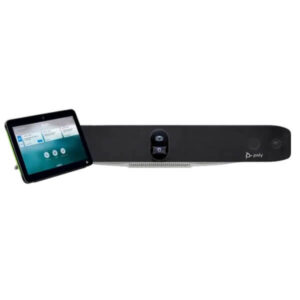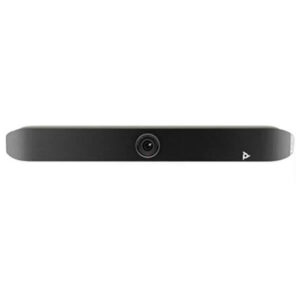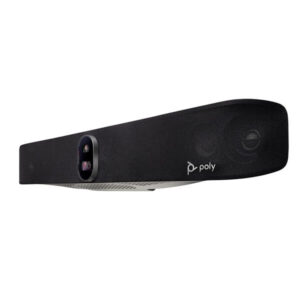
HP Poly Studio V12 in Dubai, UAE
A premium USB video bar built for huddle spaces and small meeting rooms, combining a 20 MP 4K camera, intelligent framing, integrated microphones and stereo speakers in one manageable room device.
It is a strong fit for organizations that want a consistent BYOD or meeting-PC experience without assembling separate cameras, microphones and speakers. Final room design should still account for power, mounting, conferencing platform, cable routing and the users who will operate the space.
120° Horizontal FOV
DirectorAI Framing
A Small-Room Video Bar Designed Around Simpler Hybrid Meetings
The HP Poly Studio V12 is built for one of the most common collaboration problems in modern offices: a meeting room is physically small, but the expectation for video, audio and ease of use is still high. Instead of relying on a laptop webcam, a separate speakerphone and a collection of loosely connected accessories, the V12 consolidates the main room audio-video functions into a single USB device. That reduces the number of components users have to understand when they enter the room and gives IT a more consistent endpoint to manage.
For video, the system uses a 20 MP camera capable of 4K Ultra HD capture and a 120-degree horizontal field of view. The wide view is useful when participants sit close to the display or around a compact table, because the camera can include more of the room without forcing people to crowd together. Poly DirectorAI adds speaker, group and people framing modes so the camera can adapt the composition to what is happening in the room rather than leaving every call on a fixed wide shot.
Audio is equally important in a small room. Integrated microphones are specified for pickup within 4.57 metres, while Poly NoiseBlockAI and Acoustic Fence technologies are designed to control distracting sound and keep conversations more focused. Built-in speakers remove the need for a separate room speaker in many standard deployments. For business buyers, the practical benefit is a more predictable meeting space where a user can connect through USB and use the bar as the room camera, microphone and speaker.
The V12 is relevant to organizations standardizing BYOD rooms, where employees bring a laptop and connect to room peripherals, as well as small spaces that use a Windows-based conferencing PC. HP lists compatibility with leading collaboration platforms and certifications including Microsoft Teams, Zoom and Chromebook. The exact user experience still depends on the selected computer, conferencing application, room configuration and software policy, so buyers should plan the room as a complete workflow rather than viewing the video bar in isolation.
For UAE projects, FourTeck can help review room size, mounting position, power method, cabling, required quantity and conferencing platform before a quote is prepared. This matters especially when organizations are equipping multiple rooms, because a repeatable design can simplify deployment, user training and ongoing support across the site.
Why the V12 Makes Sense for Small Collaboration Spaces
The strongest value is not a single specification; it is the combination of camera, audio, USB simplicity and management features in a form designed specifically for smaller rooms.
Wide framing without making the room feel wider than it is
A 120-degree horizontal field of view helps capture people seated close to the camera, which is common in huddle spaces. The 20 MP sensor provides the image detail needed for intelligent framing to work with more visual information. For buyers, this means the room can remain compact while still giving remote participants a useful view of the team.
One USB room endpoint
Combining camera, microphone and speakers into one bar reduces the number of devices that employees must select inside a meeting application. A simpler device path can reduce avoidable call-start friction, especially in shared rooms where many different people use the same equipment.
DirectorAI follows the meeting dynamic
Speaker, people and group framing modes allow the camera view to change with the conversation. This can make remote attendees feel less like they are watching a static security camera view and more like they are participating in a meeting where attention follows the people speaking.
Designed to keep room sound more focused
NoiseBlockAI and Acoustic Fence technologies address two common causes of meeting fatigue: distracting background sounds and unwanted audio outside the intended conversation area. They do not replace good room acoustics, but they provide additional signal control that can be valuable in offices where huddle rooms sit near corridors, open work areas or other active spaces.
Flexible power planning
The V12 can be powered through supported PoE++ or a USB-C power adapter. That gives room designers options when deciding whether power should come from the network side or from a local adapter near the display. The final choice should be confirmed with the actual switch, injector and cable plan.
Centralized device visibility
Poly Lens provides a management path for configuration, updates, status and device insights. Organizations deploying more than one room can benefit from having a repeatable management method rather than treating every conference room peripheral as an isolated device.
What Stands Out in Practical Room Deployment
The V12 is not an all-in-one appliance with a built-in conferencing operating system; it is a USB video bar intended to work with a computer or conferencing PC. That distinction is important. For a BYOD space, the user typically brings the meeting application on the laptop. For a room-PC design, the conferencing PC hosts the platform while the V12 provides the room camera and audio endpoint.
The camera combines 4K capture, a 20 MP sensor and 5x digital zoom with DirectorAI framing. In small rooms, that mix supports both wide group views and more selective framing as the meeting changes. HP also notes that higher video resolutions may not be supported by every operating system or computer and recommends lower settings where necessary for performance and latency. Buyers should therefore treat 4K as a device capability, not as a guarantee that every conferencing session will transmit in 4K.
On the physical side, the unit ships with a removable display clamp, removable privacy cap, USB-C cable and Ethernet cable. Optional VESA, wall and table mounting approaches are supported through accessories. This makes the mounting decision a meaningful part of procurement, especially where the display bezel, room furniture or cable routing makes a standard top-of-display clamp unsuitable.
HP Poly Studio V12 Technical Details
The table below focuses on the main purchasing and deployment facts confirmed by HP. Regional bundles, radio variants, power accessories and packaging can differ, so the final quotation should be checked against the exact part number.
| Specification | Details |
|---|---|
| Brand / model | HP Poly Studio V12 |
| Product type | Premium USB video bar for huddle and small meeting rooms |
| Camera resolution | 20 MP; 4K UHD up to 3840 × 2160 |
| Field of view | 120° horizontal; 132° diagonal |
| Zoom | 5x digital |
| Frame rate | 30 fps |
| Smart framing | Poly DirectorAI with speaker, people and group framing |
| Microphone pickup | Built-in microphones; up to 4.57 m / 15 ft pickup range |
| Audio technologies | Poly NoiseBlockAI, Poly Acoustic Fence, automatic gain control; built-in speakers |
| Ports | 2 × USB Type-C 5 Gbps, 2 × USB Type-A 5 Gbps, 1 × RJ-45 10/100/1000 Mbps Ethernet supporting PoE++; Mini Phoenix audio connector noted by HP for platform-dependent use |
| Wireless | Wi-Fi 802.11a/b/g/n/ac; Bluetooth 5.0 on supported radio version |
| Power | PoE++ or supported USB Type-C power adapter; exact power kit depends on selected deployment |
| Management | Poly Lens management and configuration workflow |
| Platform compatibility | USB device mode; HP lists Microsoft Teams, Zoom and Chromebook certifications and compatibility with leading conferencing platforms |
| Dimensions | 57.7 × 6.7 × 7.8 cm (W × D × H) |
| Weight | 1.35 kg |
| Included items | Video bar, quick start guide, removable privacy cap, removable monitor clamp, 1.83 m USB-C cable and 2 m Ethernet cable |
| Warranty | Poly standard one-year limited warranty; local terms should be confirmed for the quoted unit |
| Regional configuration | Configuration dependent; confirm power supply, radio version, mounting accessories and part number |
Choosing the correct configuration starts with the room, not the camera specification. A small meeting room may use the standard display clamp, while a wall-mounted display or unusual screen depth may require a dedicated mount. Likewise, a project using PoE++ must confirm that the switch or injector can deliver the required power; HP documentation states that the V12 requires 65 W when powered through the supported PoE path. If the room will use a local USB-C power adapter, that adapter should be included in the bill of materials if it is not part of the selected regional bundle.
The computer side also matters. Buyers should confirm the operating system, conferencing application, USB connectivity, room-PC design and any corporate restrictions on software. 4K camera capability does not mean every meeting application, computer or network will carry 4K video. For a multi-room deployment, FourTeck can help prepare a repeatable configuration so each room uses the same power, mount, cable and management approach where practical.
Configuration and Buyer Guidance
For most buyers, the model name is only the starting point. The room design, power path, meeting platform and mounting choice determine whether the deployment will be clean and repeatable.
Start with seating distance and room geometry
The V12 is positioned for huddle and small rooms, with microphone pickup specified to 4.57 metres. Confirm where participants will sit in relation to the bar, whether the camera will be mounted above or below the display, and whether the table layout keeps users inside the expected pickup and framing area. A wide field of view helps in compact rooms, but it does not compensate for a room that is substantially larger than the product class.
Choose PoE++ or local power deliberately
If PoE++ is preferred, verify the exact injector or switch capability and cabling. If local USB-C power is preferred, make sure the correct power adapter is included in the quote. Power is a common detail that can delay an otherwise simple room deployment.
Define BYOD or room PC
A BYOD room expects users to bring the meeting application on a laptop. A room-PC setup uses dedicated compute. These workflows affect cable access, user instructions, software deployment and management. Confirm the workflow before selecting accessories.
Match the meeting application
HP lists leading platform compatibility and certifications, but organizations should still validate the exact operating system, application version, room-PC design and corporate device policies used in the project.
Standardize multi-room deployments
For ten rooms, twenty rooms or more, consistency becomes more valuable than one-off improvisation. Standardize the mount, cable path, power method, labels, software baseline and user instructions wherever the room designs allow it.
Ideal Business Use Cases
The V12 is most compelling where the room is small, meetings are frequent and users need an obvious, repeatable way to join video calls with better room audio and framing than a laptop alone can provide.
Huddle rooms used by mixed teams
Small rooms often host quick project discussions, customer calls, interviews and manager check-ins. These meetings may involve two people one hour and six people the next. The wide field of view and automatic framing modes help the camera adapt to changing participant patterns, while the integrated audio system gives the room a dedicated voice path. This is especially useful for hybrid teams where remote attendees need to follow who is in the room and who is speaking.
BYOD meeting spaces
For organizations that do not want a dedicated conferencing appliance in every small room, users can connect a laptop over USB and run their preferred meeting application. The room still benefits from a proper camera, microphones and speakers while the meeting platform remains on the user’s computer.
Small Windows meeting rooms
The V12 can connect to conferencing PCs and can be managed with the Poly Lens room workflow. This makes it relevant where IT wants a dedicated compute model rather than asking every user to provide a laptop connection.
Client-facing consultation rooms
Professional services teams, recruitment rooms, clinics, education offices and customer-success teams can use a small video room for more focused external conversations. The physical privacy cover is also useful in shared spaces where occupants want an obvious visual way to block the lens between calls.
Multi-room office refresh
Organizations refreshing several similar huddle rooms can benefit from a common video bar model, mount strategy, power plan and management process. The advantage comes from repeatability: users see the same controls and IT supports fewer different room device combinations.
HP Poly Studio V12 DirectorAI Framing
In a small room, fixed framing can be surprisingly poor. A wide shot keeps everyone visible, but it can make participants appear small on the far end. A tight shot looks more engaging, but it may exclude people as they move or as a second participant joins. DirectorAI provides speaker, people and group framing modes so the camera can adjust the composition to the style of meeting taking place.
The buying benefit is not simply that the camera “moves automatically.” The more important outcome is reduced dependence on users manually changing camera positions. In a room that may host dozens of different employees in a week, automatic framing supports a more self-service experience. It is still worth training users on when to use a wide group view versus a more focused speaker or people mode, because the correct framing choice depends on whether the meeting is a presentation, a discussion or an interview.
HP Poly Studio V12 Audio Focus and Room Clarity
A meeting room can have a strong camera and still deliver a poor experience if remote participants hear keyboard noise, hallway activity or voices from nearby spaces. The V12 uses integrated microphones together with NoiseBlockAI and Acoustic Fence technologies to reduce distracting sound and focus the audio experience around the intended conversation area. HP specifies microphone pickup up to 4.57 metres, which aligns with the product’s positioning for smaller rooms.
Room acoustics still matter. Hard glass walls, loud ventilation, large open doors or reflective surfaces can affect call quality regardless of the device. Buyers should therefore view noise processing as part of the solution, not a replacement for sensible room design. For rooms close to open-office traffic, Acoustic Fence can be particularly relevant because the goal is to reduce audio pickup outside the intended meeting zone.
HP Poly Studio V12 Deployment and Management Flexibility
The physical installation can be adapted to different room constraints. The standard package includes a removable display clamp, while HP documents optional VESA, wall and table mounting approaches. The V12 can be placed above or below the display, and below-display mounting can use inverted video where supported. This matters when screens are already installed, furniture prevents a top mount or the camera needs to sit closer to eye level.
Power planning is similarly flexible, with supported PoE++ and USB-C adapter options. The network connection can also support device onboarding to Poly Lens Cloud where that management model is used. From an IT perspective, the goal is to create a room endpoint that can be configured, updated and inspected using a defined management workflow rather than requiring hands-on attention for every change.
Deployment decision checklist
- Confirm whether the standard display clamp fits the actual monitor or screen.
- Decide whether above-display, below-display, wall, VESA or table positioning is preferred.
- Confirm the room will use BYOD laptops or a dedicated conferencing PC.
- Verify the required USB cable path and whether the supplied length is sufficient.
- Choose PoE++ or a compatible USB-C power adapter and include the correct accessories.
- Plan whether Ethernet onboarding and centralized management are required.
- Document the final room configuration so future rooms can repeat it consistently.
What Buyers Should Check Before Purchase
The most important purchase risk is assuming that the video bar alone completes the room. A successful deployment also depends on the correct power method, mounting hardware, computer workflow, conferencing platform and cable plan.
Configuration Fit
Confirm that the room is genuinely a small collaboration space and that the 4.57 m microphone pickup range suits the seating plan. Decide whether the standard display clamp is enough or whether a VESA, wall or table accessory is required. For rooms that are substantially deeper or wider, evaluate a larger-room video solution rather than forcing a small-room model into an unsuitable space.
Compatibility Check
Check the computer or room PC, operating system, USB connectivity and conferencing application. If PoE++ will power the unit, confirm the network hardware can provide the required power. If a USB-C adapter will be used, verify that it is included as a separate line item where needed. Also confirm cable lengths and cable pathways before installation.
Availability and Warranty
Availability can vary by part number, radio version, accessory bundle, supplier status and project quantity. HP lists a standard one-year limited warranty for the referenced hardware, but local warranty handling should be confirmed with the quoted unit. Buyers should avoid assuming that a power adapter, remote control or optional mount is included unless the quotation explicitly lists it.
Quote Preparation
Provide the number of rooms, expected participants, room dimensions, platform, BYOD or room-PC workflow, display size, preferred mount, power preference, delivery city and required date. If the project is a multi-room rollout, include whether installation, standardization, configuration assistance or warranty guidance is required so the quote can reflect the full deployment rather than only the video bar.
Buying Support for Dubai and UAE Meeting-Room Projects
FourTeck supports product inquiries across Dubai and the UAE with help around product selection, room-fit review, quotation, delivery coordination and warranty guidance. Availability should be confirmed at the time of inquiry because the exact part number, accessory bundle, power option, order quantity and supplier position can affect lead time and commercial terms.
For a single huddle room, the main questions may be straightforward: how the bar will mount, what powers it and which laptop or conferencing PC connects to it. For a larger office project, buyers may also need a repeatable bill of materials, consistent cable lengths, standardized mount choices, asset information and a rollout plan. FourTeck can review these details before quotation so the request reflects the room requirement rather than just a model number.
Dubai, Abu Dhabi, Sharjah and Ajman Coverage
Businesses in Dubai, Abu Dhabi, Sharjah, Ajman and other UAE locations can contact FourTeck for meeting-room technology inquiries, quotation support and delivery coordination. A useful request should include the required quantity, room type, selected conferencing platform, preferred power method, mounting requirements and delivery destination. For project orders across multiple offices, buyers can also identify which rooms share the same design and which locations require different mounts, cable routes or local installation conditions. This helps create a more practical purchasing plan and reduces the chance that accessories are missed when equipment is deployed across several sites.
GCC and Africa Business Technology Inquiries
FourTeck also supports business technology inquiries through regional channels serving selected GCC and Africa markets. Organizations with projects in Saudi Arabia, Qatar, Oman, Kuwait, Bahrain, Kenya, Uganda and other supported destinations can use the regional FourTeck platforms to discuss product requirements. Availability, delivery methods, warranty handling and final configuration can vary by country, local distributor position and order quantity, so regional requests should be reviewed individually.
For cross-border deployments, consistency is usually more important than simply buying the same model name everywhere. Confirm the correct regional part number, power accessory, radio version, supported warranty path and installation standards for each destination. Large rollouts may also need a common room design document that identifies what is fixed globally and what can vary by country.
Regional inquiry links include FourTeck UAE, FourTeck Kuwait, FourTeck Kenya, FourTeck Uganda and FourTeck Africa.
Other HP Poly Models Buyers May Consider
The right alternative depends mainly on room size, desired camera capability, audio reach and whether the requirement is for USB video conferencing or a more integrated room system. The options below are useful reference points when the V12 is not the exact fit.
HP Poly Studio R30
A small-room USB video bar that may suit buyers with more basic room requirements. HP positions the R30 with an 8 MP 4K camera and integrated audio. It is worth considering when the project does not require the V12’s 20 MP camera or multiple power options.
HP Poly Studio V52
A premium USB video bar positioned for medium rooms. Buyers should consider the V52 when the room is larger, participants sit farther from the display or the project calls for a product designed around a broader medium-room use case.
HP Poly Studio USB
A USB video bar for medium rooms with established Poly camera and audio features. It can be relevant for buyers working with an existing standard based on the earlier Studio platform.
HP Poly Studio V72
A premium USB video bar positioned for large rooms with dual 4K camera capability. It is an alternative when room depth and participant scale are well beyond the intended V12 use case.
Why Business Buyers Contact FourTeck
Business collaboration purchases often fail at the small details: the camera fits the room but the power adapter was not included, the display clamp does not suit the screen, the cable does not reach the meeting PC, or the selected platform workflow was never confirmed. FourTeck’s role is to help buyers organize those practical details before the order is finalized.
FourTeck works with SMB, enterprise, education, hospitality, professional-services and other business buyers that need practical product matching rather than a generic retail transaction. If the V12 is not the best fit for the room, the better outcome is to identify that before purchase and review a more suitable Poly option.
HP Poly Studio V12 Buyer FAQs
These answers focus on the questions that usually affect model suitability, accessories, installation and quotation.
What is the HP Poly Studio V12 used for?
It is a USB video bar for huddle and small meeting rooms. It combines the room camera, microphones and speakers so a laptop or conferencing PC can use one integrated audio-video endpoint. It is suitable for hybrid meetings, customer calls, internal collaboration and small shared spaces where users need better framing and room audio than a laptop alone normally provides.
Is the V12 suitable for a large conference room?
HP positions the V12 for small rooms, and its built-in microphone pickup is specified up to 4.57 metres. A large room may require a video solution designed for greater depth, wider participant coverage or different audio expansion. Buyers should provide the room dimensions and seating layout before selecting the model, especially if participants will sit far from the display.
Does it work with Microsoft Teams and Zoom?
HP lists Microsoft Teams and Zoom certifications and positions the V12 for leading conferencing platforms over USB. The exact workflow still depends on the laptop or room PC, operating system, conferencing application and corporate configuration. For a dedicated room project, it is good practice to confirm the complete software and compute design before ordering the hardware.
Does the HP Poly Studio V12 need a power supply?
Yes, the bar needs supported power. HP documents PoE++ and USB-C power adapter options. The referenced A9DD8AA unit is commonly listed as a no-power-supply configuration, so buyers should confirm whether the required PoE++ kit or USB-C adapter is included in the selected quotation. The correct power approach should be planned before installation.
Can it be mounted below the display?
Yes. HP documentation states that the V12 can be mounted above or below a display, and inverted video is supported for below-monitor placement when using suitable VESA or wall mounting accessories. The standard package includes a removable display clamp, while VESA, wall and table mounting options may require separate accessories.
Can FourTeck help choose the correct accessories?
Yes. FourTeck can review mounting, power, cable, room-compute and deployment requirements as part of the quotation process. Send the display size, room layout, intended mounting position, preferred power method and whether the room uses BYOD laptops or a dedicated conferencing PC. This helps identify the accessories that should be included with the requested unit.
Is HP Poly Studio V12 available in Dubai?
FourTeck accepts Dubai and UAE inquiries for the V12 and related meeting-room products. Actual availability should be confirmed when you request a quote because supplier position, selected part number, accessories, quantity and project timing can change. Provide the required quantity and delivery location so the team can review current sourcing and delivery options.
What should I include in a bulk project request?
Include the number of rooms, room sizes, expected participants, collaboration platform, BYOD or dedicated compute model, preferred mounts, power strategy, delivery locations and target dates. If the project needs installation, standardized configuration or warranty guidance, include that as well. A room schedule is especially useful for larger deployments because it shows which spaces can share one standard design.
How is the V12 managed after deployment?
HP documents Poly Lens workflows for setup, configuration, updates, logs and cloud-based management. Ethernet onboarding is optional when the organization wants to connect the device to the management platform. The exact administration method should follow the organization’s current HP Poly software standard, security policy and room-compute design.
How do I choose between V12, V52 and V72?
Start with room size and participant distance. HP positions the V12 for small rooms, the V52 for medium rooms and the V72 for large rooms. Camera architecture and audio reach also differ. If the room sits between categories or has unusual seating, share the dimensions and use case with FourTeck so the selection is based on the actual environment rather than model naming alone.
Need Help Finalizing the Right Room Configuration?
FourTeck can review the room size, required quantity, meeting platform, mounting, power choice, delivery location and warranty expectations before preparing a quote. This is particularly useful when multiple meeting rooms need one repeatable standard.
Share the model, room dimensions, quantity, platform, preferred mounting position, power method, delivery location and target project date.