Quick Procurement & Configuration Matrix
Samsung QN43QN90F, 43-inch QN90F family.
Neo QLED 4K Mini LED smart television.
Premium video, boardroom content, hospitality, retail playback and high-frame-rate gaming.
Single-display endpoint; multi-screen projects require external AV distribution, control or signage architecture.
Regional mains specification varies by supplied version; UAE buyers should confirm 220–240V-compatible stock.
Dubai, Abu Dhabi, Al Ain, Sharjah, Ajman and other Emirates, subject to current logistics terms.
Warranty duration and service channel depend on region and supplier terms. Confirm on quotation.
Best for managed TV/AV use; continuous-duty digital signage requirements should be assessed separately.
Executive Product Architectural Overview
The Samsung QN43QN90F belongs to the 2025 QN90F premium Neo QLED family and addresses a specific procurement challenge: many organizations need a relatively compact display footprint but still want premium processing, high dynamic-range presentation, controlled reflections and fast motion support. A 43-inch format is often selected because the viewing distance is shorter, the mounting surface is constrained or the display must coexist with cabinetry, collaboration furniture, a reception feature wall or hospitality room architecture. Conventional small-format televisions can satisfy basic playback, but they may compromise on processor class, peak motion support, connectivity consistency or screen treatment. The QN90F family moves the smaller size into a more advanced performance tier.
At the display layer, Samsung uses a 4K 3840 × 2160 Neo QLED architecture with Quantum Mini LED-based backlighting. The practical objective is granular light control across the screen so that bright highlights and darker scene areas can be managed with greater precision than a simpler edge-lit implementation. For procurement teams, the relevance is not only cinematic contrast. Business presentation content frequently mixes bright white backgrounds, fine dark text, logos, photographic imagery and video windows. A higher-control backlight system can make mixed content look more deliberate, particularly in executive offices, customer-facing lounges and premium meeting spaces where visual quality contributes to the perceived quality of the environment.
The NQ4 AI Gen3 Processor is the central image-processing engine identified by Samsung for this family. It handles scaling, scene analysis, color, contrast and motion-oriented picture enhancement functions. The architectural importance is that the display can receive a mixture of sources that are not all native 4K: laptop presentations, streaming platforms, conferencing endpoints, digital signage players, set-top boxes and legacy media libraries can all arrive at different resolutions and bitrates. The television’s 4K AI Upscaling Pro function is intended to improve lower-resolution content for the 4K panel. Buyers should still recognize that no upscaler can reconstruct information that never existed in the source, but a strong processing pipeline can reduce the visible mismatch between source classes in everyday mixed-source deployments.
Samsung also specifies Glare Free treatment on the QN90F family. In the UAE this has direct operational relevance. Offices, villas, hospitality rooms, reception areas and retail interiors often have large glazed surfaces, strong daylight, polished floors or directional architectural lighting. These conditions can produce reflections that distract from presentation content or reduce subjective contrast. A reflection-reduction approach does not eliminate every environmental challenge, and installation teams should still avoid placing the display directly opposite uncontrolled sunlight, but it increases the range of rooms in which the screen can remain comfortable and legible without relying solely on closing blinds or raising brightness.
Motion performance is another defining characteristic. Samsung lists a 120Hz refresh rate with support up to 165Hz through Motion Xcelerator on published 43-inch QN90F specifications. This matters most for fast-moving gaming, high-frame-rate PC content and motion-intensive video. In enterprise use, the benefit can also appear in moving dashboards, sports-focused hospitality, training simulations and multimedia environments where judder or blur is especially visible. Published regional documentation also identifies four HDMI inputs, with high-frame-rate support on current variants, enabling a compact endpoint to accommodate multiple fixed sources without immediately requiring an external switcher.
The smart platform and network stack make the product more than a passive panel. Ethernet, Wi-Fi 5 and Bluetooth 5.3 appear on current Samsung regional specifications, while eARC supports higher-bandwidth audio return to compatible sound systems. In a managed deployment, however, buyers should decide whether the built-in smart platform will be the primary application layer or whether the television will behave as a controlled display endpoint fed by an external media player, conferencing codec or AV-over-IP receiver. External endpoints can simplify fleet standardization because software updates, access policies, content scheduling and device replacement are managed independently from the television platform.
The most important architectural caveat is duty cycle and use model. The QN43QN90F is a premium television, not a purpose-built commercial signage panel with an enterprise signage operating-hours rating, centralized signage CMS commitment, RS-232 integration profile or continuous-duty warranty by default. For reception signage, menu boards, security monitoring walls or prolonged fixed-image applications, FourTeck recommends comparing the workload against Samsung commercial display families before choosing. Where the project calls for premium television features, smart services, high refresh capability, excellent mixed-media presentation and compact form factor, the QN43QN90F is a strong candidate. Where the project calls for 16/7 or 24/7 signage governance, specialized commercial signage may be the more appropriate architecture.
Enterprise Business Value & ROI Benefits
Premium Performance in a Compact Footprint
A 43-inch screen can be easier to deploy in private offices, executive suites, hotel rooms and smaller collaboration areas than 55-inch and larger panels. The business value is space efficiency without dropping to an entry-class picture engine. Organizations can maintain a premium visual standard across spaces where the wall geometry, furniture position or viewing distance limits display size. This helps design teams avoid oversized installations that feel visually intrusive while still providing 4K detail and advanced processing.
Reflection Management
Glare management can reduce the operational friction caused by bright windows, ceiling lights and reflective interiors. Instead of continuously adjusting curtains, changing meeting seating positions or increasing brightness solely to fight reflections, users can work with a screen designed to reduce distracting glare. The result can be a more consistent viewing experience across daytime and evening use, which is especially relevant in Gulf-region buildings with strong natural light and extensive glazing.
High-Frame-Rate Capability
Up-to-165Hz motion support allows the display to serve high-performance gaming, simulation and compatible PC workloads in addition to normal TV and presentation content. For hospitality projects, gaming lounges, executive entertainment areas and premium residential developments, this can consolidate use cases onto one display rather than requiring separate equipment classes. The value depends on the connected source and supported resolution, so the source GPU, cable specification and HDMI path should be validated as a complete chain.
Source Consolidation
Four HDMI inputs reduce dependence on an external switcher for smaller rooms. A typical deployment may connect a conferencing device, presentation PC, media player and gaming console simultaneously. Fewer external components can reduce cable clutter, power adapters and single-purpose devices. For larger managed AV systems, a matrix or AV-over-IP architecture may still be preferred, but the onboard port density gives installers useful flexibility during phased deployment or mixed-use operation.
Audio Integration Flexibility
eARC and optical audio output support practical connection to compatible soundbars, AV receivers and installed-room audio systems. This can simplify premium meeting rooms and hospitality environments where the visual endpoint must hand off audio cleanly to a more capable speaker system. Q-Symphony availability on compatible Samsung sound systems can provide another option, although exact behavior and supported combinations should be checked against the chosen sound product.
Lifecycle Flexibility
Because the television can accept both network-driven smart applications and external HDMI endpoints, businesses can alter the operating model over time. A display that begins as a streaming and presentation endpoint can later be paired with a dedicated room system, IPTV receiver or managed media player. This reduces the need to replace the panel solely because the application layer changes, provided the display continues to meet duty-cycle and operational requirements.
Return on investment for a premium television is not measured only by purchase price. It also involves installation simplicity, the number of use cases consolidated, user satisfaction, reduced support tickets caused by reflections or source switching, and the period for which the display remains suitable as room functions evolve. The QN43QN90F can be cost-effective when its advanced features are actively used. A project that only needs static informational signage, for example, may achieve better lifecycle economics with a commercial panel designed for long operating hours and centralized content control. Conversely, a project that needs high-quality video, smart applications, gaming-grade motion and executive-room aesthetics may extract more value from the QN90F platform than from a basic commercial screen.
Reliability planning should also include the external environment. The television should be installed with adequate ventilation, correct wall-mount hardware, surge protection where appropriate, and a stable network if smart applications are part of the workflow. In managed rooms, an upstream UPS for networking and source electronics can help reduce disruptive reboots during short power events, although the TV’s own power draw and UPS compatibility must be calculated before specifying backup time. These surrounding design choices often have a greater influence on service continuity than a single headline specification.
Hardware & Technical Architecture Highlights
The QN43QN90F is best understood as an integrated image-processing system rather than as a panel alone. At the front of the chain is the source interface layer. Four HDMI ports on published variants allow the TV to accept multiple digital video sources, while Ethernet and Wi-Fi 5 support IP connectivity for smart services and network functions. Bluetooth 5.3 provides a short-range wireless path for compatible peripherals and audio devices. The HDMI audio return channel supports eARC, which is useful where the display acts as the central source-selection point and returns high-quality audio to an external sound system.
The processing pipeline is centered on Samsung’s NQ4 AI Gen3 Processor. In practical terms, this platform performs the computational work required to analyze source material and map it to the characteristics of the 4K panel. Upscaling is particularly important because many real installations receive mixed source resolutions. A 1080p presentation system, compressed streaming video or legacy set-top box must be mapped across more pixels than the source natively contains. Samsung’s 4K AI Upscaling Pro function is designed to manage that translation with scene-aware processing. It should be treated as an enhancement system, not as a substitute for high-quality source content.
Behind the LCD layer, the Neo QLED architecture uses Mini LED-based illumination controlled through Samsung’s contrast system. Smaller lighting elements allow more granular modulation than conventional large LED backlights. This supports stronger local contrast control, especially in scenes that contain intense highlights next to dark areas. For office content, the same principle can help preserve the visual distinction between bright interface surfaces and dark graphic elements. Ultimate UHD Dimming and Real Depth Enhancer Pro are among the named processing functions found in current QN90F specifications, while HDR10+ support allows compatible HDR content to use dynamic metadata.
The panel and motion subsystem also distinguish the 43-inch QN90F. Samsung lists a 120Hz refresh rate with Motion Xcelerator capability up to 165Hz on current 43-inch regional pages. Achieving the maximum mode requires a compatible source, supported input mode and suitable HDMI cabling. This capability is particularly relevant for PC gaming, simulation and high-frame-rate interactive workloads. Variable refresh rate and gaming features may be available depending on firmware, source and regional configuration; project teams should validate their specific console or GPU requirement rather than assuming every advertised gaming feature applies identically to every market suffix.
The physical design is Samsung’s NeoSlim approach on current regional versions, using a three-side bezel-minimized visual style. This matters for interior integration because the display can sit in premium spaces without appearing excessively bulky. Mount selection should account for VESA pattern, wall material, cable bend radius, service access and ventilation. For recessed installations, installers should avoid creating a tightly enclosed cavity that traps heat or prevents connectors from being serviced. If a soundbar is used, bracket geometry should be planned so that the audio device does not obstruct the screen or require unsupported mechanical modifications.
Audio on the 43-inch model differs from larger QN90F sizes in some published regional specifications, so buyers should not copy the speaker configuration of a 55-inch or 65-inch version onto the 43-inch procurement sheet. Current 43-inch documentation identifies Dolby Atmos, OTS Lite, Q-Symphony and a 20W audio system on relevant variants. That is sufficient for many bedrooms, offices and small rooms, but dedicated conferencing rooms or premium hospitality spaces may benefit from external audio. The correct decision depends on room size, ambient noise, speech intelligibility expectations and whether the installation is primarily for cinematic content, meetings or background media.
Definitive Technical Specifications & Sizing Notes
| Category | Specification | Procurement Note |
|---|---|---|
| Display | 43-inch class / 42.5-inch real diagonal on published US specification | Compact premium size for shorter viewing distances and constrained wall areas. |
| Resolution | 4K UHD, 3840 × 2160 | Suitable for detailed video, fine interface text and native 4K sources. |
| Display technology | Neo QLED / Quantum Mini LED-based architecture | Designed for granular contrast and high-quality HDR presentation. |
| Processor | NQ4 AI Gen3 Processor | Core image-processing and scaling platform for the QN90F family. |
| Upscaling | 4K AI Upscaling Pro | Enhances non-4K inputs; final quality remains source dependent. |
| Reflection control | Glare Free | Useful in bright offices, hospitality spaces and rooms with strong daylight. |
| Refresh / motion | 120Hz; up to 165Hz Motion Xcelerator support | Maximum mode requires compatible source, signal and cable path. |
| HDR | Neo Quantum HDR; HDR10+ support on published variants | Exact regional feature naming may vary. |
| HDMI | 4 inputs | Supports multi-source rooms; high-frame-rate capability is mode dependent. |
| USB | 2 × USB-A on published regional specifications | Use case depends on supported media and accessory functions. |
| Network | Ethernet LAN, Wi-Fi 5 | Wired LAN is often preferred for managed fixed installations. |
| Bluetooth | Bluetooth 5.3 | For compatible wireless audio and peripherals. |
| Audio return | eARC | Useful for soundbar and AV receiver integration. |
| Optical audio | 1 digital optical output on published regional variants | Supports legacy or alternative audio integration. |
| Audio platform | Dolby Atmos, OTS Lite, Q-Symphony; 20W on published 43-inch variant | External audio may be advisable for larger rooms or premium speech requirements. |
| Design | NeoSlim, three-side bezel-minimized style on published variants | Confirm stand and mount details for the exact supplied suffix. |
| Power | Regional supply dependent | Confirm UAE-compatible 220–240V supply and plug/accessory package. |
| Tuner / broadcast | Configuration dependent | Do not assume US, EU or other tuner specifications apply to UAE stock. |
| Warranty | Supplier and region dependent | Confirm warranty duration, service center path and commercial-use conditions on quote. |
Specification evaluation should begin with the exact regional model suffix rather than only the family name. Samsung commonly changes tuner modules, plug types, software services, broadcasting functions, documentation languages and sometimes accessory details across markets while retaining the QN90F family identity. The display, processor and major video architecture are consistent across current 43-inch QN90F references, but procurement teams should ask the supplier to state the full model code on the quotation. This is particularly important for hospitality, IPTV and broadcast projects where tuner compatibility matters.
Buyers should also separate panel capability from system capability. A 165Hz-capable input mode will not produce 165Hz output if the source device, GPU, console mode, HDMI cable, intermediary switcher or receiver cannot carry the required signal. Similarly, eARC only delivers its intended benefit when both the TV and connected audio endpoint are configured correctly. For meeting spaces, validate laptop resolutions, conferencing appliance output, EDID behavior and cable length. For gaming, validate the specific console or GPU, target resolution, variable refresh requirements and supported HDMI path. For network applications, use wired Ethernet where stability and repeatability are more important than convenience.
Configuration, Sizing & Deployment Workbench
01 — Confirm Viewing Distance and Physical Fit
A 43-inch 4K screen works best where viewers are relatively close or where the wall area is intentionally compact. Measure the actual seating distance, cabinet opening, wall width, ceiling height and line of sight before ordering. Include room for ventilation and connector access. If a soundbar will be installed, reserve vertical clearance. If the display will be recessed, calculate cavity depth with cable bend radius and mounting bracket included. In an executive office, a slightly smaller display may look more proportionate than a large panel; in a deep boardroom, 43 inches may be too small for participants at the far end.
02 — Map Every Source and Required Input Mode
List each source: laptop dock, room PC, video conferencing appliance, IPTV box, signage player, console, streaming device or AV receiver. Record the intended resolution and refresh rate for each. Four HDMI inputs may eliminate a small switcher, but larger rooms often benefit from centralized switching. If 4K high-frame-rate gaming is required, verify that the selected source and cable support the intended mode. If a source will be routed through an AV receiver, matrix or extender, that intermediary must also support the required bandwidth and signal features.
03 — Decide Between Built-In Smart Apps and Managed External Playback
For a standalone office, residence or hospitality suite, built-in smart functions can reduce hardware count. For a managed enterprise fleet, an external standardized player may provide better policy control, patch governance, content scheduling and support consistency. The choice also affects network segmentation. Smart TV applications may need internet access, while an external player can be placed on a dedicated VLAN with carefully defined firewall rules. For highly controlled environments, organizations may decide to keep the display itself off the corporate network and use only the managed source endpoint.
04 — Size Audio for the Room, Not the Screen
Integrated TV speakers are convenient, but room acoustics determine whether they are sufficient. Small private offices and bedrooms may be adequately served by the built-in system. Meeting spaces with several participants, reverberant surfaces or HVAC noise often require a soundbar, ceiling speakers or conferencing audio system. If using a soundbar, confirm eARC compatibility and mounting geometry. If an AV receiver is used, validate control behavior and power sequencing so users do not have to manage multiple remotes or manually change audio destinations.
05 — Plan Network, Security and Update Responsibility
If the TV is connected to a business network, assign ownership for firmware updates, account management and smart-service access. Consumer-style smart platforms can be convenient but should not be treated as unmanaged endpoints on a sensitive enterprise LAN. Use wired Ethernet where stable connectivity matters, apply network segmentation according to corporate policy and avoid storing unnecessary personal credentials on shared devices. If the TV will be used in a guest-facing or hospitality environment, establish a reset process so one user’s accounts or pairing data are not left available to the next occupant.
06 — Validate Power, Mounting and Environmental Conditions
Confirm that the supplied unit is suitable for UAE mains, that the wall bracket matches the exact VESA requirement and that the wall structure can support the combined display and mount load. Allow ventilation around the chassis and avoid direct exposure to heat sources, high humidity or outdoor conditions unless a purpose-built enclosure and environmental design is used. For critical rooms, coordinate surge protection and power quality with the electrical design. If a UPS is proposed, calculate the television and all source equipment loads rather than selecting a backup unit by guesswork.
Deployment headroom should be considered in functional terms rather than only by screen size. A room may start with one laptop source and later add video conferencing, IPTV and a local PC. Keeping one or two HDMI inputs free can reduce future rework. Likewise, a wall mount with service access may cost more than a basic fixed bracket but can materially reduce support time when cables or devices need replacement. In fleet projects, standardizing the bracket, cable lengths, source endpoint and control procedure across rooms can produce more operational value than chasing small unit-price differences between televisions.
Industry Use Cases & Workload Scenarios
Banking & Finance
Private banking rooms and executive offices often need a refined display for market briefings, video calls, customer presentations and broadcast content. The 43-inch size suits compact rooms, while Glare Free treatment can help in glazed office towers. For regulated environments, FourTeck recommends using a managed external conferencing or presentation endpoint and keeping application access aligned with the organization’s network policy.
Healthcare
Premium patient suites, staff lounges and administrative offices can use the QN43QN90F for high-quality video, communications and informational content. It is not a diagnostic medical display and should not be specified for clinical image diagnosis without the required medical certifications and calibration workflow. In patient areas, mounting safety, cleanability, cable concealment and guest account reset procedures should be part of the deployment plan.
Government & Public Sector
Executive offices, protocol rooms and controlled meeting spaces may benefit from the compact premium format. Security teams should determine whether the smart platform may access the network or whether the display must remain isolated and receive content only from approved endpoints. Procurement documents should state the required regional model, warranty, mounting and source-control architecture rather than relying on retail feature descriptions alone.
Logistics & Corporate Operations
Operations managers may use the display for dashboards, training videos, broadcast news and presentation material in private offices or small team rooms. For prolonged fixed dashboards, screen usage patterns should be reviewed carefully. If the application becomes continuous digital signage with long daily operation, a Samsung commercial signage platform may deliver a more suitable duty-cycle and management model.
Retail & Hospitality
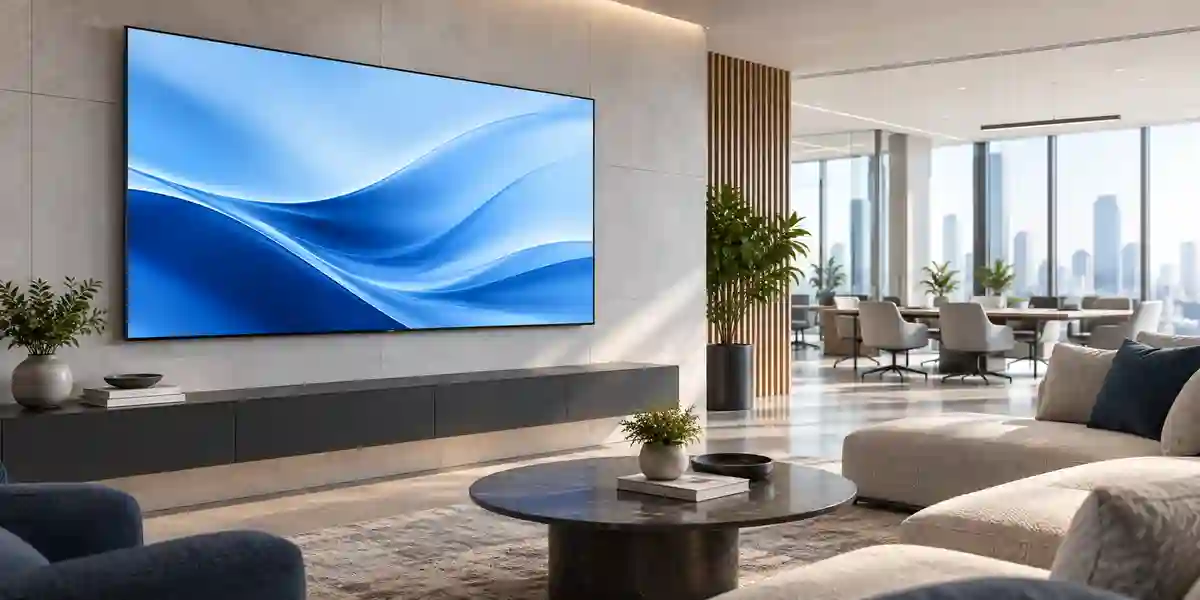
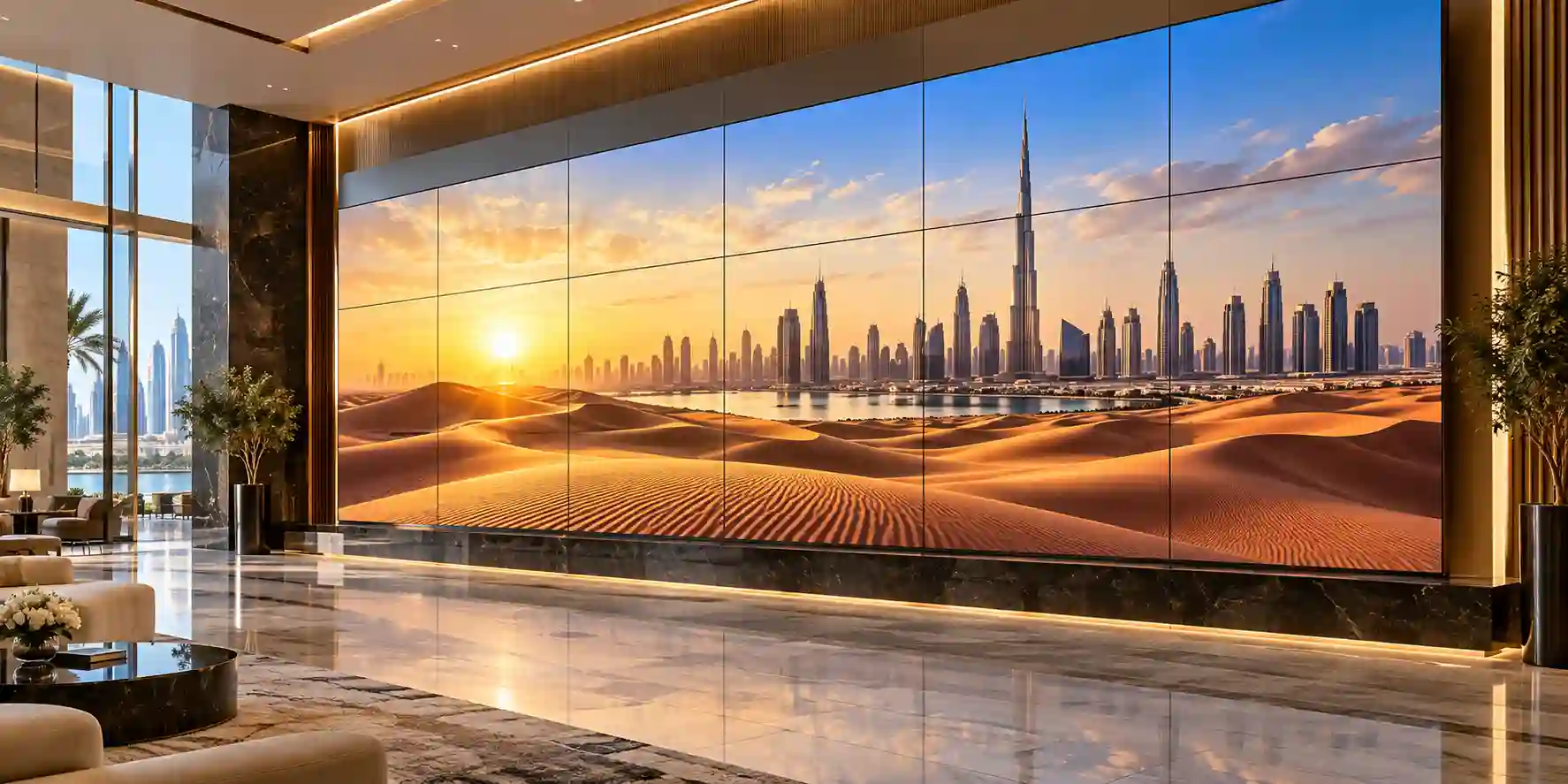
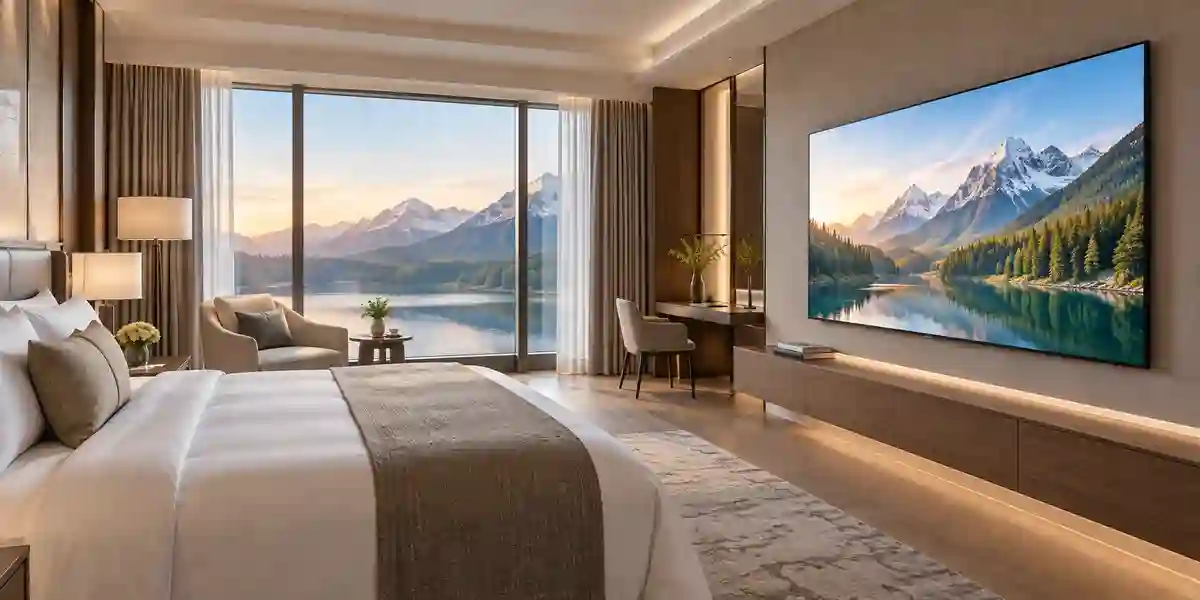
Luxury retail consultation rooms, hotel suites, restaurants and VIP lounges can use the display where premium image quality and smart entertainment matter. The supplied FourTeck image library includes Samsung examples relevant to restaurants, hotels, offices and retail settings, reinforcing how display selection changes by environment. Commercial menu-board or always-on signage deployments should be evaluated separately against dedicated Samsung signage products.
Education & Training
Small seminar rooms, faculty offices and premium training spaces may use the QN43QN90F for 4K video and laptop presentations. For interactive classrooms, a non-touch television is usually not a substitute for a Samsung interactive board. Buyer teams should determine whether touch, whiteboarding, classroom device management or multi-user annotation is required before selecting a conventional TV.
Technical Feature Deep Dives
Deep Dive 1: Processing, Throughput & Workload Performance Architecture
The most important performance characteristic of a modern premium television is not a single refresh-rate number but the complete path from input signal to emitted light. The QN43QN90F begins with a 4K native panel and Samsung’s NQ4 AI Gen3 Processor. When a source arrives, the processor must determine how to scale it, how to map its tone characteristics to the panel, how aggressively to apply sharpening or noise reduction, and how to coordinate motion behavior with the panel refresh rate. This is especially visible in mixed-use rooms. A laptop may output 4K text and spreadsheets, a streaming service may deliver compressed cinematic content, and a game console may switch into a high-frame-rate mode. The television has to handle these source transitions without requiring a different display for each workload.
4K AI Upscaling Pro is intended to improve lower-resolution sources by analyzing visual structures and mapping them to the 3840 × 2160 output grid. In business deployments, upscaling can be useful when legacy conferencing hardware or IPTV services remain at 1080p. The key purchasing principle is that upscaling improves presentation but cannot convert a poor source into a genuinely native high-resolution source. Organizations should still configure laptops, media players and conferencing endpoints to output their highest stable supported resolution and use high-quality content assets where possible.
High-frame-rate support up to 165Hz expands the device’s performance envelope. For normal video conferencing and broadcast content, the screen does not need to run at the maximum rate. For compatible PCs and gaming systems, however, a higher refresh path can reduce perceived blur and input latency. The benefit becomes most obvious in fast interactive motion. The deployment engineer must validate each link: source GPU, output port, cable, any intermediate receiver or matrix, and the selected TV HDMI input mode. A high-bandwidth television connected through a legacy 60Hz switcher will behave like a 60Hz system because the narrowest element defines the chain.
Deep Dive 2: Security, Redundancy & System Resilience
A television is increasingly a networked endpoint, which changes the security discussion. If the QN43QN90F uses smart applications, cloud services or network discovery, the organization should treat it as an internet-capable device and decide where it belongs in the network. A common enterprise pattern is to place AV and IoT endpoints on a dedicated VLAN rather than on the same unrestricted segment as user workstations or sensitive servers. Firewall policy can then allow only the services needed for the chosen operating model. If the display does not need network access because all content comes from a managed HDMI source, leaving the TV itself disconnected can be the simplest security posture.
System resilience also depends on reducing user confusion. Rooms fail operationally when people cannot determine which remote controls the volume, which input carries the conference system or why the TV wakes to a consumer app screen instead of the room PC. A resilient design therefore includes input labeling, standardized startup behavior, remote-control policy and documented reset procedures. For hospitality or shared environments, user accounts and Bluetooth pairings should be cleared according to an operational process. Where the built-in smart platform is used, firmware update ownership should be assigned rather than left to chance.
Power continuity requires realistic expectations. The television itself is not a redundant device, and integrated TVs do not provide dual hot-swappable power supplies like enterprise servers. Resilience is achieved at the room or building level through quality electrical distribution, surge protection where appropriate, controlled shutdown expectations and spare-unit strategy for critical installations. For a fleet deployment, keeping a compatible spare display or standardized mounting arrangement can be more practical than trying to create component-level redundancy. If an AV system includes network switches, control processors or conferencing codecs, those devices may merit UPS backup even when the screen is allowed to power-cycle during an outage.
Deep Dive 3: Remote Management, Telemetry & Infrastructure Integration
The QN43QN90F can integrate into a room through HDMI-CEC functions, eARC, network connectivity and source-side control, but buyers should distinguish television control from true enterprise fleet management. A dedicated commercial signage panel may expose management functions specifically designed for centralized device status, content scheduling and long-duty operation. A premium TV is typically better suited to room-level use where control is handled by a conferencing system, universal remote, smart ecosystem or local operating procedure. Before specifying dozens of units, an enterprise should prototype the intended control workflow and confirm that wake, sleep, source selection and audio behavior are predictable.
Telemetry needs also vary. In a small office, a user noticing a fault may be sufficient monitoring. In a hotel or managed meeting-room fleet, facilities teams may want to know whether a screen is online, what source is selected and whether firmware has changed. If the native television management features do not meet these requirements, external AV control platforms or managed media players can provide a monitoring layer independent of the display. This is another reason to define the operational model before purchase: two projects can use the same television but require completely different surrounding infrastructure.
Infrastructure integration should also cover EDID and source negotiation. High-resolution AV systems rely on source and display devices agreeing on supported resolutions, refresh rates, color formats and audio capabilities. Long HDMI cable runs, extenders, docking stations and switchers can complicate this negotiation. For critical meeting rooms, integrators should test the complete signal path under the actual intended modes, including wake-from-sleep and source switching. Network services should similarly be tested under corporate firewall rules rather than on an open guest connection. A pilot installation can reveal operational issues before they are repeated across a larger fleet.
What Buyers Should Check Before Purchase
The largest purchasing risks are usually not hidden inside the panel specification. They arise from ordering the wrong regional model, underestimating room size, assuming a gaming refresh mode will pass through every AV component, overlooking mounting constraints, or using a premium television for a duty cycle that would be better served by commercial signage. The following checklist turns those risks into concrete procurement questions.
01 / FIT — Configuration Fit & Model Sizing
Confirm the room dimensions, viewing distance and audience count. A 43-inch panel is ideal for closer viewing but may be undersized for a large meeting room. State whether the system is mainly for video, presentations, gaming, hospitality entertainment or dashboard use. Confirm whether the project requires high-frame-rate PC input, smart applications, external media playback or built-in broadcasting. Ask FourTeck to state the full regional model code so that the quotation is tied to an identifiable configuration rather than only a family name.
02 / MATCH — Compatibility & Environmental Requirements
List every source and sound device. Verify HDMI bandwidth, eARC behavior, mount compatibility, wall construction, cabinet clearance and power supply. Consider the lighting environment because even a Glare Free screen cannot compensate for every direct reflection. For enterprise networks, decide whether the television itself will have network access. If the display sits in a recessed wall or decorative enclosure, provide ventilation and service access. If the room requires touch interaction, clinical certification or continuous signage operation, validate whether a different product family is more appropriate.
03 / TERMS — Availability, Delivery & Warranty Terms
Ask for current stock confirmation at the quotation stage, not from an old webpage or unrelated country store. Confirm the exact delivery location, floor access, receiving hours and whether installation or wall mounting is part of the requested scope. Warranty terms must be attached to the supplied region and seller channel. For business use, ask whether any commercial-use restrictions apply and how service cases are opened. Cross-border buyers should also request export packing and customs documentation requirements where applicable.
04 / REQUEST — Quote Preparation Data Needed
A useful procurement request includes the product model, required quantity, delivery Emirate or country, desired deployment date, wall-mount requirement, source devices, audio requirement and any project-specific warranty expectation. For gaming or simulation, include target resolution and refresh rate. For hospitality, include whether the television will connect to IPTV, a set-top box or a centralized system. For enterprise offices, state whether FourTeck should quote only the TV or also cables, mounts, soundbars, media players and deployment accessories.
UAE Regional Availability & Service Ecosystem
FourTeck supports UAE technology procurement through model validation, quotation coordination, delivery planning and pre-sales guidance. For Samsung television projects, the key regional task is to match the requested model family with the correct supplied suffix, power compatibility, warranty channel and installation accessories. Availability changes by batch and distributor, so buyers should request a current project quotation tied to quantity and delivery destination rather than assuming that stock shown in another country applies locally.
K1. Dubai Supply & Logistics Support
Dubai projects can include corporate offices, hospitality properties, retail stores, restaurants, residential developments and Free Zone facilities. FourTeck can coordinate quotations around delivery location, quantity and deployment schedule, and can include relevant mounting, cabling or audio accessories where required. Free Zone and site-access requirements should be stated in the request so delivery planning accounts for gate passes, receiving windows or consolidated project shipments. For fast-moving project work, providing the complete bill of materials at inquiry stage helps reduce back-and-forth and accelerates commercial response.
K2. Abu Dhabi & Al Ain Logistics Reach
Abu Dhabi and Al Ain buyers may include government entities, energy-sector organizations, industrial companies, education facilities, healthcare groups and corporate offices. FourTeck can assist with model-code validation, quotation coordination and delivery planning for these locations. Projects with formal vendor-registration, documentation or phased-delivery requirements should identify those conditions early. Where displays are part of a wider room deployment, buyers can also request compatible mounts, network equipment, AV accessories and power-protection components for a consolidated project quote.
K3. Sharjah & Northern Emirates Logistics Infrastructure
Sharjah and the Northern Emirates contain a broad mix of education, manufacturing, logistics, retail and hospitality customers. FourTeck can coordinate sourcing and delivery for standard single-unit requirements as well as multi-site projects. For installations spread across several branches, the procurement team should provide a location schedule and per-site quantity so packing and logistics can be planned consistently. Where room conditions differ substantially, validate screen size rather than assuming one dimension is appropriate for every branch.
K4. Ajman & Surrounding Emirates Logistics Coverage
Ajman buyers can request current availability verification, delivery coordination and technical pre-sales guidance for Samsung display projects. The same principles apply: confirm exact model, intended workload, delivery address, mounting requirement and required accessories. For hospitality or retail deployments, clarify whether the display is for normal television use or prolonged signage-style operation. FourTeck can then guide the buyer toward the QN43QN90F or an alternative Samsung commercial display where the duty cycle and fleet-management requirement call for a different class of product.
GCC & Pan-African Supply Chain Reach
Beyond the UAE, FourTeck supports regional inquiries where technology products must be sourced, documented and coordinated for cross-border delivery. Export projects can involve different plug standards, model suffixes, warranty conditions, customs documents and destination-country approvals. Buyers should therefore treat cross-border supply as a project workflow rather than simply shipping a UAE retail unit. FourTeck can coordinate quotation and documentation requirements based on destination and quantity, subject to current trade and logistics conditions.
L1. Saudi Arabia (KSA) Export & Supply Support
Saudi enterprise projects can request regional inquiry support, configuration validation and project quotations for Samsung display requirements. Procurement teams should state the city, quantity, required model suffix if mandated, and whether local warranty handling is a contractual requirement. For multi-site rollouts, provide a branch schedule so the supply plan can be structured around consolidated or phased shipments.
L2. Qatar Market Supply Reach
Qatar buyers can use FourTeck for cross-border quotation coordination, hardware sourcing and project logistics planning. Hospitality, retail and corporate buyers should describe their exact usage model so television-class and commercial-signage options can be compared before shipment. Customs and delivery terms should be agreed during quotation rather than assumed from UAE domestic supply.
L3. Oman Regional Distribution Support
Organizations in Oman can request procurement guidance, model validation and quote coordination for Samsung display projects. Power compatibility, supplied accessories and warranty routes should be confirmed for the destination project. When the display is part of a broader IT or AV deployment, consolidating mounts, network hardware and source devices into the inquiry can simplify commercial planning.
L4. Kuwait Supply Chain Coverage
For Kuwait, FourTeck can coordinate project quote assistance and export supply planning based on product quantity and delivery requirements. Buyers can review regional contact and supply information through FourTeck Kuwait. Cross-border warranty handling and model-region alignment should be explicitly confirmed in the final commercial terms.
L5. Kenya & East Africa Supply Infrastructure
Kenyan system integrators, enterprises and project contractors can request technical inquiry routing and delivery coordination through FourTeck Kenya. For East African projects, destination power standards, warranty expectations, import documentation and site quantities should be provided with the request so the quotation reflects the intended deployment rather than a generic unit price.
L6. Uganda Regional Procurement Support
Uganda buyers can access localized inquiry support and technology sourcing through FourTeck Uganda. Larger projects should include the deployment timeline, destination city, number of units and any required mounting or source accessories. This helps coordinate product availability with freight and project scheduling.
L7. Pan-African Regional Logistics & Trade Reach
For broader African technology projects, FourTeck can support multi-country trade inquiries and consolidated project supply through FourTeck Africa and FourTeck International. Each destination can have different certification, tax, import and warranty considerations, so project teams should request destination-specific terms rather than extrapolating from UAE domestic availability.
Related FourTeck Products & Compatible Alternatives
The QN43QN90F is an excellent fit when buyers want premium picture processing and high refresh performance in a compact TV format. It is not automatically the best Samsung display for every project. A procurement architect should compare the operating model first, then choose the display family.
Choose a larger QN90F size where viewers sit farther away or the room needs more visual impact. Confirm that audio and motion specifications can differ by screen size.
Consider where premium Neo QLED capability is desired but the full QN90F feature set is not essential. Compare exact processor, brightness, motion and reflection specifications for the target size.
Prefer commercial signage when the workload involves extended daily operation, centralized content management, managed signage fleets or business-specific mounting and control expectations.
A useful alternative for business signage and information-display projects where commercial operation matters more than gaming-focused high refresh performance.
Choose an interactive model for classrooms and collaboration spaces that require touch, annotation and whiteboarding rather than passive TV viewing.
For hotel fleets that need hospitality management features, guest-room controls or centralized property integration, compare purpose-built hospitality television models before deploying consumer-class TVs at scale.
FourTeck can quote a mixed Samsung display estate where different spaces use different product classes. For example, a hotel may use hospitality televisions in guest rooms, QN90F televisions in premium suites and commercial signage in lobbies. A corporate project may use QN90F screens in executive offices, interactive boards in training rooms and signage displays in reception areas. This workload-based approach avoids forcing one model into roles for which another product family is better engineered.
Why Enterprises Choose FourTeck
FourTeck’s value in a display procurement project is not limited to supplying a part number. Enterprise buyers frequently need help separating a family name from an exact regional model, checking whether the proposed display suits the room and workload, identifying compatible mounts or source devices, and planning delivery around site constraints. Those steps reduce the risk of receiving equipment that is technically genuine but operationally wrong for the intended deployment.
Review model, screen size, source architecture, usage pattern and accessory requirements before quotation finalization.
Structure quotes around quantity, delivery location, accessories and project schedule rather than isolated unit pricing.
Coordinate UAE and export requirements based on receiving location, shipment size and project timing.
Clarify the warranty and service terms attached to the supplied region and commercial channel before order placement.
This approach is particularly useful for organizations buying several displays or combining the TV with networking, conferencing, sound, mounts and power protection. Consolidating the technical conversation reduces the chance that individual components are ordered independently but fail to work together as an operational room system. FourTeck does not need to claim a universal lowest price or an unrealistic service promise to create value; accurate configuration, commercial clarity and coordinated supply are the relevant procurement outcomes.
Frequently Asked Questions
1. Is the Samsung QN43QN90F a true 4K television?
Yes. Current Samsung specifications for the 43-inch QN90F identify a native 3840 × 2160 4K UHD resolution. The display also includes 4K AI Upscaling Pro to improve the presentation of lower-resolution sources. Upscaling does not turn low-quality content into genuine native 4K detail, so the best results still come from high-quality source material and correctly configured playback devices.
2. Does the 43-inch QN90F support 165Hz?
Samsung lists the 43-inch QN90F with a 120Hz refresh rate and Motion Xcelerator support up to 165Hz on current regional specifications. Achieving the highest refresh mode requires a compatible PC or source, a supported resolution, suitable HDMI cabling and a signal path that can carry the required bandwidth. If an AV receiver, matrix or extender is in the path, it must support the same mode.
3. Is this model suitable for a business meeting room?
It can be a strong choice for private offices, huddle rooms and smaller premium meeting spaces where 43 inches provides the correct viewing size. It offers multiple HDMI inputs, 4K resolution, network connectivity and strong picture processing. For larger boardrooms, a bigger display may be necessary. For centrally managed signage or continuous-duty operation, a Samsung commercial display may be more appropriate than a premium television.
4. How does Glare Free help in Dubai offices?
Dubai interiors often combine bright daylight, large windows and directional lighting, all of which can create reflections on a television screen. Samsung’s Glare Free treatment is designed to reduce distracting reflections and improve viewing consistency. It does not eliminate the need for sensible placement, and installers should still avoid positioning the screen directly opposite intense uncontrolled sunlight where possible.
5. How many HDMI ports are available?
Current 43-inch QN90F regional specifications list four HDMI inputs. This is useful for rooms that need several fixed sources such as a conferencing appliance, local PC, media player and gaming console. Published variants also list eARC for audio return. Exact behavior of high-frame-rate modes should be validated with the intended sources and any intermediary AV hardware.
6. Can the QN43QN90F replace a commercial signage screen?
Not in every case. The QN43QN90F is a premium television and is well suited to high-quality video, smart entertainment, office viewing and mixed-use AV. Commercial signage products are engineered around business operating hours, fleet management and signage workflows. If your application involves long daily operating periods, fixed content, central scheduling or multiple managed sites, FourTeck recommends comparing Samsung commercial signage before purchase.
7. Does the TV have Wi-Fi and Bluetooth?
Yes. Current Samsung regional specifications for the QN90F identify Wi-Fi 5 and Bluetooth 5.3, along with wired Ethernet. For fixed enterprise installations, Ethernet can provide more predictable network behavior than wireless connectivity. Business IT teams should also decide whether the smart television itself should connect to the corporate network or whether all applications should run through an approved external endpoint.
8. What warranty does FourTeck provide?
Warranty terms depend on the exact region, supplier channel and quoted product configuration. FourTeck should confirm the applicable warranty and service route on the commercial quotation rather than relying on a warranty published for another country. Buyers should ask for the full model suffix, warranty duration, service process and any commercial-use conditions before final purchase approval.
9. Is the QN43QN90F suitable for gaming?
Yes, it is particularly capable for a compact television because Samsung specifies high-refresh Motion Xcelerator support up to 165Hz on the 43-inch QN90F. Gaming performance still depends on the console or PC, supported refresh mode, cable bandwidth and game settings. Buyers who need a specific variable-refresh or HDR gaming feature should confirm compatibility for their source and regional TV firmware.
10. What information should I send FourTeck for a quote?
Send the requested model, quantity, delivery location, expected deployment date and whether you need a wall mount, soundbar, HDMI cables or other accessories. For corporate or hospitality projects, add the intended use case and source devices. For high-frame-rate gaming or simulation, specify target resolution and refresh rate. This allows FourTeck to prepare a quotation that reflects the actual room system instead of only the television unit.
Request a Samsung QN43QN90F Project Quote
For a practical quotation, send FourTeck the model name, required quantity, delivery location, preferred deployment timeframe and any accessory requirements. If the television will connect to a conferencing system, AV receiver, gaming PC, IPTV box or media player, include those details so connectivity can be reviewed. For UAE projects, also state whether delivery is to Dubai, Abu Dhabi, Al Ain, Sharjah, Ajman or another Emirate and whether the site has special receiving or access requirements.
Structured Product Data
Machine-readable product and FAQ data is supplied separately with this product entry so catalog systems can associate the model, brand and buyer questions with the page without adding duplicate visible content.