Samsung QN75QN85F 75-Inch Neo QLED 4K TV in Dubai, UAE
The Samsung QN75QN85F is a large-format 75-inch Neo QLED 4K television engineered for buyers who want Mini LED contrast control, powerful picture processing, high-refresh-rate motion and a modern smart platform in one premium display. In UAE deployments it can serve executive boardrooms, hospitality spaces, premium residences, retail experience zones, training rooms and multi-purpose presentation environments where image quality and connectivity matter.
Samsung Gulf lists the corresponding 75-inch QN85F family with 3840 × 2160 resolution, NQ4 AI Gen2 Processor, Neo Quantum HDR+, Quantum Mini LED Pro / Quantum Matrix class control, up to 144Hz motion capability, Dolby Atmos, 40W audio and four HDMI inputs. Regional model suffixes, service availability and tuner characteristics can differ, so FourTeck validates the exact unit offered for Dubai and UAE projects before order confirmation.
Procurement Snapshot
Product family: Samsung QN85F Neo QLED 4K
Requested model: QN75QN85F
Screen: 75-inch class, 4K UHD
Best fit: Executive AV, hospitality, premium meeting rooms, retail and education
UAE part suffix: Configuration dependent
Supply guidance: Contact FourTeck for current options, warranty and lead time.
Quick Procurement & Configuration Matrix
Brand / Model
Samsung QN85F family / QN75QN85F requested naming
Product Type
75-inch Neo QLED 4K smart television
Recommended Workloads
Presentation, collaboration, hospitality, premium content viewing, digital briefing
Scalability Limit
Single-display endpoint; multi-screen control depends on external AV management design
Power Planning
Standard indoor mains installation; confirm local power and mounting requirements before deployment
Delivery Area
Dubai, Abu Dhabi, Sharjah, Ajman and wider UAE, subject to project logistics
Warranty Guidance
Regional warranty terms vary; confirm the quoted UAE SKU and coverage
Key Integration
HDMI, eARC, USB, LAN, Wi-Fi, Bluetooth and smart ecosystem services
Executive Product Architectural Overview
For enterprise buyers, a 75-inch television is rarely just a television. It becomes a shared visual endpoint that sits at the intersection of meeting room workflows, video distribution, presentation systems, hospitality experience, executive communication and day-to-day media consumption. The Samsung QN75QN85F belongs to the QN85F Neo QLED family, a premium 4K platform built around Mini LED illumination, Samsung’s NQ4 AI Gen2 picture processor and a broad set of smart display capabilities. The value of this architecture is not simply higher picture quality. It is the ability to accept mixed source material, upscale it to a consistent 4K presentation, preserve motion clarity, manage bright and dark scene detail and connect cleanly to modern AV sources without forcing the buyer to assemble a complicated display stack.
In an executive boardroom, the practical problem is usually source diversity. A single screen may need to show a laptop presentation in the morning, a video call in the afternoon, a streamed corporate broadcast later in the day and high-resolution marketing media during an event. The QN85F platform addresses this through four HDMI inputs, eARC audio return, USB ports, Ethernet, Wi-Fi and Bluetooth. Those interfaces give integrators room to connect conferencing appliances, wireless presentation gateways, media players, sound systems and occasional local sources. For project design, the important point is to assign each source path deliberately so the display does not become the bottleneck when rooms evolve.
The 75-inch 3840 × 2160 panel provides enough pixel density for large-format presentation while remaining manageable for many corporate rooms where an 85-inch or video wall would be physically excessive. Samsung’s NQ4 AI Gen2 Processor is responsible for picture analysis, 4K upscaling and scene handling. In operational terms, this helps because enterprise content is rarely uniform: legacy 1080p video, presentation graphics, web dashboards, streaming media and camera feeds may all appear on the same screen. Upscaling cannot create detail that does not exist in the source, but an advanced processor can improve edge handling, noise control, sharpness balance and perceived consistency.
The Neo QLED approach uses much smaller backlight elements than conventional LED-lit LCD televisions, allowing more granular control of luminance zones. This matters in bright Dubai offices, hotel suites and retail spaces where ambient light can reduce perceived contrast. Neo Quantum HDR+ and Samsung’s local light control are designed to preserve highlights while maintaining shadow separation. Buyers should still evaluate glare, window placement and room illumination, because even a capable premium panel can lose impact when mounted opposite strong sunlight or uncontrolled architectural lighting.
Motion capability is another architectural advantage. The QN85F family supports Motion Xcelerator performance up to 144Hz in compatible scenarios. That is especially useful for fast video, interactive demonstrations and high-frame-rate gaming applications, although the highest refresh operation depends on source device, resolution, input mode and regional model behavior. For ordinary meeting room presentation, the value is smoother motion processing and a platform that is less likely to feel constrained as higher-frame-rate sources become common.
Audio is integrated but should be considered as one layer of an AV design rather than the final answer for every room. The 75-inch QN85F specification includes 40W, 2.2-channel sound, Dolby Atmos, Object Tracking Sound Lite and Q-Symphony compatibility. In a small executive lounge this may be adequate. In a boardroom or hospitality project, a compatible soundbar, amplifier or installed speaker system may deliver better speech intelligibility and coverage. eARC simplifies that external audio path by supporting audio return over HDMI to a compatible device.
The smart layer is based on Samsung’s Tizen platform, with network services and Samsung ecosystem integration. This can be useful when the TV operates as a premium standalone endpoint, but enterprise administrators should define a governance model for accounts, apps, network access, updates and remote-control privileges. Smart features differ by market and may require Samsung accounts or third-party subscriptions. FourTeck’s procurement role is therefore to validate the exact UAE model suffix, confirm the interfaces and warranty basis of the quoted unit, and help buyers map the TV to the room design rather than treating all QN85F variants as identical.
Enterprise Business Value & ROI Benefits
The strongest business case for a premium 75-inch Neo QLED display is not a single specification; it is the reduction of friction across multiple daily visual workflows. When a screen is easier to connect, easier to view from more positions, capable of handling mixed content quality and suitable for both formal presentations and informal media, the room becomes more useful and requires fewer workarounds. The following value areas help buyers translate technical capabilities into practical operating outcomes.
Performance Consistency
The NQ4 AI Gen2 Processor and 4K AI Upscaling help normalize the appearance of mixed-resolution sources. In business rooms where users connect different laptops, conferencing systems and media players, this reduces the visual jump between source qualities. It does not replace good source content, but it helps the display present legacy and modern material with a more consistent visual character.
Reliability Through Simpler Architecture
A well-connected large display can reduce the number of adapters, switchers and intermediary devices required for straightforward rooms. Four HDMI ports, network interfaces, wireless connectivity and eARC allow many common endpoints to connect directly. Fewer unnecessary signal-chain components can make support easier, provided the AV design remains controlled and documented.
Scalable Room Standardisation
When an organisation standardises on a known display family for executive rooms, training spaces or hospitality deployments, procurement and support teams can reuse mounting, cabling and configuration practices. Screen size and regional suffixes still need validation, but a common platform can simplify user guidance, spares planning and AV documentation across multiple sites.
Security Governance
Samsung’s Tizen smart platform includes Samsung Knox security capabilities on supported models. For enterprise use, the larger benefit comes from combining platform protections with disciplined network design: isolate display traffic where appropriate, control user accounts, restrict unnecessary apps and keep firmware current. A premium smart TV should be integrated into governance rather than treated as an unmanaged consumer device.
Energy and Space Efficiency
A single 75-inch panel can provide a substantial shared canvas without the complexity of a multi-panel wall. This can reduce mounting infrastructure, calibration effort and cable count in rooms that do not require continuous commercial signage duty cycles. Actual energy use depends on brightness, content and settings, so project teams should confirm current regional energy documentation when operating cost is a major criterion.
Business Continuity in Shared Spaces
Multiple physical and wireless connection paths give teams alternatives if one presentation method becomes unavailable. A laptop can move from wireless casting to HDMI, while network and USB options support other workflows. The value comes from resilient room design, not from assuming every connectivity feature should be active at all times.
User Experience and Brand Presentation
Premium client-facing environments benefit when presentation quality feels intentional. A large 4K screen with strong contrast, bright highlights, smooth motion and a narrow-bezel design can make boardroom briefings, product launches, hospitality content and marketing presentations look more polished. That experience has value because it reduces the need for users to compensate for a weak screen with darkened rooms, oversized fonts or repeated technical intervention.
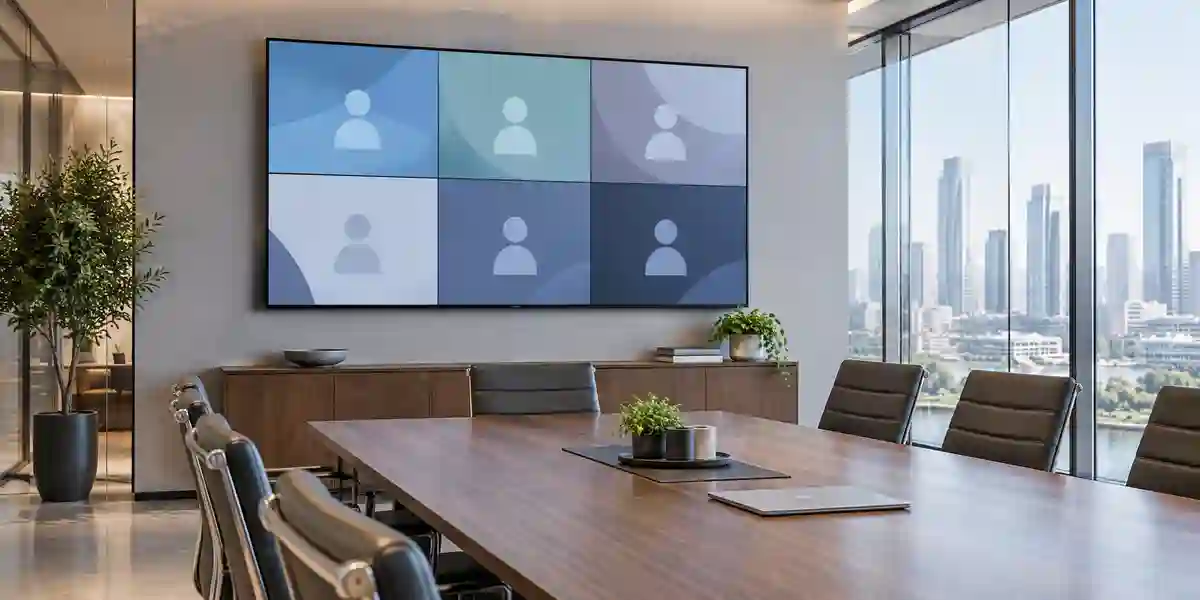
Illustrative Samsung meeting-room deployment context. Final model appearance and installation accessories may vary by configuration.
Hardware & Technical Architecture Highlights
At hardware level, the QN85F combines an LCD panel, Quantum Dot colour conversion and Mini LED backlighting with a dedicated Samsung picture-processing platform. The Mini LED layer is central to the product’s contrast architecture. Smaller light sources permit more granular dimming control than a basic edge-lit television, allowing bright highlights to coexist with darker regions more effectively. The exact number of zones is not a procurement figure Samsung generally exposes on regional retail specification pages, so buyers should avoid comparing products using unverified zone-count claims from unofficial sources.
The NQ4 AI Gen2 Processor serves as the computational layer for picture enhancement. Its responsibilities include upscaling lower-resolution content, analysing scene characteristics, balancing detail and noise, supporting HDR processing and coordinating motion behavior. In a meeting room, this processing can help make compressed web video, presentation imagery and full-resolution 4K sources look more coherent on a large 75-inch canvas. In a hospitality suite, it can maintain picture quality across broadcast, streaming and locally supplied media.
HDR handling includes Neo Quantum HDR+ and HDR10+ support on the QN85F family. HDR is relevant when content has been mastered for expanded luminance and dynamic metadata, but it should not be treated as a universal brightness enhancer for ordinary office applications. The greatest benefit appears in compatible entertainment, marketing and cinematic material. For corporate use, calibrated SDR brightness and sensible room lighting often matter more than maximum HDR intensity.
The motion subsystem is designed around high refresh capability, with Motion Xcelerator up to 144Hz in supported scenarios. Achieving the headline rate requires a compatible source, suitable HDMI configuration and content or application that can output the necessary frame rate. This is most valuable for premium gaming, simulation, fast sports viewing and highly fluid interactive demonstrations. Standard laptop presentations typically operate at lower refresh rates, but they still benefit from the screen’s broader motion-processing capability.
Connectivity is enterprise-friendly for a premium TV class: four HDMI inputs reduce the likelihood that a room will immediately need an external HDMI switch, while two USB-A ports support local media or compatible peripherals. Wired Ethernet gives installers a stable network option where Wi-Fi is undesirable. Wi-Fi and Bluetooth provide flexibility for smart features and audio accessories, although enterprise security teams may choose to limit wireless functions. eARC enables high-bandwidth audio return to compatible sound systems, while optical audio provides an additional path for legacy or simpler audio integration.
The integrated 40W 2.2-channel audio system supports Dolby Atmos, Object Tracking Sound Lite, Active Voice Amplifier Pro and Adaptive Sound Pro on the QN85F family. These technologies aim to improve spatial impression and voice clarity. For a small room this may reduce the need for extra hardware. For larger spaces with multiple seating rows or acoustic challenges, dedicated audio remains preferable because loudness and intelligibility depend heavily on room geometry and ambient noise.
The chassis uses a slim, modern design with narrow visual borders around the display. Mounting should be treated as a structural task: verify wall composition, VESA pattern, mount load rating, service clearance, power outlet position and cable bend radius. A 75-inch display is large enough that installation quality directly affects safety, usability and aesthetics. FourTeck can help buyers identify compatible mounting categories, but final installation engineering should reflect the actual site condition.
Definitive Technical Specifications & Sizing Notes
| Specification | Samsung QN85F 75-inch Family Detail | Procurement Note |
|---|---|---|
| Display class | 75-inch Neo QLED 4K | Requested naming QN75QN85F; UAE suffix can differ |
| Resolution | 3840 × 2160 | Native 4K UHD canvas |
| Processor | NQ4 AI Gen2 Processor | Handles image processing and 4K upscaling |
| HDR | Neo Quantum HDR+; HDR10+ Adaptive/Gaming | Content support varies by source |
| Contrast / backlight | Quantum Matrix / Quantum Mini LED class architecture | Regional naming can vary |
| Motion | Motion Xcelerator up to 144Hz | Requires compatible source and mode |
| Audio output | 40W, 2.2-channel | External audio recommended for larger rooms |
| Audio features | Dolby Atmos, OTS Lite, Q-Symphony | Compatibility depends on connected devices |
| HDMI | 4 inputs; 4K high-frame-rate support on compatible modes | Allocate ports during AV design |
| USB | 2 × USB-A | For supported media/peripherals |
| Network | Ethernet, Wi-Fi, Bluetooth | Wireless standard can differ by region |
| Audio return | HDMI eARC; optical output | Useful for soundbar or AVR integration |
| Smart platform | Samsung Tizen / One UI Tizen family | Services vary by market |
| Warranty / accessories | Based on selected regional model | Confirm with FourTeck quotation |
Sizing a premium TV requires more than checking diagonal screen size. A 75-inch panel is typically suited to medium-to-large rooms where viewers sit several metres from the screen, but presentation readability depends on font size, spreadsheet density, room depth and whether the display is used for detailed work or cinematic content. Buyers should also assess wall width, ceiling height, furniture position and the distance between the screen and the furthest participant. For meeting rooms, a large display can still feel too small when highly detailed documents are shown from the back of the room.
Regional model variation deserves equal attention. Samsung commonly uses different suffixes across North America, Europe, Gulf and Asia-Pacific markets. The requested QN75QN85F name identifies the intended family and size, while the actual UAE unit may carry a local QA/QE-style code. Wireless standards, tuners, stand finish, bundled remote, language options, preloaded services and warranty can vary. FourTeck therefore quotes against the exact supply configuration rather than assuming that every international specification applies without qualification.
Configuration, Sizing & Deployment Workbench
A successful deployment begins with room and workflow requirements rather than a model number alone. Use the following decision sequence before confirming a project quantity.
01 — Define Viewing Distance and Content Density
Map the nearest and furthest seats, then identify the smallest content users must read. A 75-inch 4K television is excellent for video and standard presentation layouts, but dense financial models, engineering drawings and multi-column dashboards may demand larger typography or a larger screen. For collaborative rooms, test representative content rather than relying only on diagonal-size rules.
02 — Reserve Source and Interface Headroom
List every planned source: conferencing appliance, wireless presentation gateway, room PC, digital signage player, game console, set-top box or guest HDMI input. Four HDMI ports are generous for a premium TV, but rooms often grow. If all ports are consumed on day one, design an external switching layer. Reserve eARC for the audio path when using a compatible soundbar or AVR.
03 — Plan Network and Account Governance
Decide whether the TV should use wired Ethernet, Wi-Fi or remain offline except for updates. Define who owns Samsung account credentials, who can install apps and whether screen mirroring is permitted. In managed enterprise environments, consumer-style convenience features should be reviewed against information-security policy before activation.
04 — Validate Audio Coverage
Integrated 40W audio may suit a lounge, hotel suite or compact meeting space, but it may not cover long boardrooms evenly. Consider room reverberation, HVAC noise and speech requirements. If users frequently join video calls, intelligibility should be tested at the far seats. A dedicated soundbar or installed speaker solution can provide more predictable coverage.
05 — Confirm Mounting, Power and Service Clearance
Verify the wall structure, bracket rating, VESA compatibility, outlet placement and cable path. Avoid trapping connectors behind a rigid mount with no service access. If the TV is recessed into joinery, allow ventilation and future replacement clearance. Large displays should be installed by qualified personnel using hardware matched to the substrate.
06 — Match Duty Cycle to Use Case
The QN85F is a premium television, not a dedicated 24/7 commercial signage panel. It is well suited to meeting rooms, hospitality, executive offices and controlled presentation areas. For continuous public signage, mission-critical command centres or environments requiring commercial management features, compare Samsung professional signage alternatives before standardising.
07 — Validate Regional Model, Warranty and Accessories
Provide FourTeck with quantity, project location and required delivery date so the quotation can specify the available UAE model suffix, included stand or remote, warranty basis and optional accessories. This avoids importing assumptions from overseas listings that may not apply to the locally supplied unit.
Industry Use Cases & Workload Scenarios
Banking & Finance
Executive briefing rooms can use the 75-inch 4K canvas for market dashboards, board presentations and video conferencing. Strong contrast supports detailed visual material, while multiple HDMI paths allow a room PC, conferencing system and guest device to remain connected. Sensitive organisations should govern smart accounts, casting and network access according to internal policy.
Healthcare
Training rooms, administration spaces and patient hospitality areas can benefit from a large premium display. It can support education video, operational presentations and general media. It should not be assumed to be a certified diagnostic display; clinical imaging applications require purpose-built medical monitors with appropriate regulatory characteristics.
Government & Public Sector
Meeting rooms and briefing suites can use the QN85F as a high-quality presentation endpoint. Wired connectivity is useful in controlled networks, while optional wireless services can be disabled if policy requires. Procurement teams should verify the exact UAE SKU, warranty and country-of-origin documentation required for tender compliance.
Logistics & Corporate Operations
Operations offices can present dashboards, route performance, safety content and management updates on a large 4K surface. For continuous wallboard use across long shifts, compare commercial signage models to determine whether higher duty-cycle ratings and central management are needed.
Retail & Hospitality
Premium retail consultation zones, hotel suites, lounges and restaurants can use Neo QLED contrast and HDR for visually rich content. The platform is especially attractive where the display must serve both presentation and entertainment roles. For public-facing digital signage with unattended operation, professional signage may be the better match.
Education & Training
Training rooms can display 4K media, web content and instructor presentations with sufficient scale for group viewing. Where touch interaction, annotation or classroom device management is essential, Samsung interactive displays should be compared because a premium TV does not provide the same interactive whiteboard workflow.
Technical Feature Deep Dive 1: Processing, Throughput & Workload Performance Architecture
Picture processing is the heart of a premium modern television because the panel must handle many content types that were never created for the same resolution, colour space, frame rate or compression level. The NQ4 AI Gen2 Processor gives the QN85F a processing layer that evaluates source material and applies upscaling, contrast and detail enhancement before the image reaches the panel. For buyers, the useful distinction is between native 4K content and everything else. Native 4K already contains the pixel information needed for the panel, while 1080p or lower-resolution sources must be reconstructed for the 3840 × 2160 canvas. Samsung’s 4K AI Upscaling is intended to make that reconstruction cleaner and more natural.
In enterprise environments, source inconsistency is common. A PowerPoint deck may contain high-resolution photography, compressed logos, old screenshots and embedded video. A video conference feed may vary dynamically according to network bandwidth. A hospitality feed may alternate between broadcast, streaming and locally stored media. Processing helps prevent these changes from making the display feel visually unstable. Buyers should remember, however, that no processor can restore information completely absent from the source. A badly compressed logo or low-resolution camera feed will remain limited, even if edge reconstruction and noise reduction improve its appearance.
Motion throughput adds another dimension. The QN85F supports high-refresh operation up to 144Hz for compatible sources. In simple terms, higher refresh allows the panel to show more image updates per second, reducing motion judder and improving responsiveness where the source provides matching frame rates. This is directly relevant to gaming and simulation and indirectly useful to fast-moving video or interactive demonstrations. To use the highest refresh setting, the source device, HDMI chain, cable quality, graphics output and TV input configuration must all support the target mode. An integrator should therefore validate the entire path rather than assuming the display alone guarantees 144Hz operation.
For business presentation, latency can matter even when users are not gaming. A presenter expects the cursor, annotation or wireless pointer to feel immediate. Different picture modes apply different amounts of processing, so integrators may choose a low-latency or game-oriented mode for interactive sources while using cinematic modes for premium video. The right configuration depends on room purpose. A boardroom may prioritise text clarity and low interaction delay, while a hospitality suite may prioritise HDR impact and motion smoothing.
HDR processing on the QN85F is designed to make use of the panel’s brightness range and Mini LED control. Neo Quantum HDR+ and HDR10+ can improve the separation between intense highlights and darker scene regions when compatible content is used. In a corporate demo room, that can make product videos and premium marketing material more impressive. In a standard spreadsheet meeting, HDR adds little. The practical configuration principle is to match picture mode to content rather than leaving the screen in an exaggerated showroom preset that may fatigue viewers or distort brand colours.
Technical Feature Deep Dive 2: Security, Redundancy & System Resilience
A connected television is also a network endpoint. Samsung’s Tizen platform and Samsung Knox security capabilities provide a stronger foundation than treating the display as an anonymous screen, but enterprise resilience depends on how the device is configured and operated. The first control is network scope. If cloud apps, casting and online media are unnecessary, administrators may prefer a restricted or isolated network path. If the TV uses internet services, keep software current and manage accounts centrally rather than sharing personal credentials across meeting rooms.
Redundancy comes primarily from connectivity diversity. Four HDMI ports support multiple fixed sources, while Ethernet and Wi-Fi provide alternate network methods. USB supports local playback in compatible formats, and Bluetooth can connect supported audio devices. This diversity helps when a room must continue operating despite a failed wireless gateway or temporary network issue. A presenter can move to a direct HDMI path rather than cancelling the meeting. That is practical resilience, but it only works when cables, adapters and user instructions are available in the room.
Audio resilience should also be designed deliberately. eARC can carry high-quality audio to a compatible soundbar or AVR, while optical output provides another common integration path. If the external audio device fails, the TV’s internal 40W speakers provide a fallback. For critical spaces, integrators may document a simple recovery process so support staff can revert audio to the TV speakers quickly.
Power protection is often overlooked. A large premium TV is an electronic asset that can benefit from stable mains power, surge protection and, where operational continuity matters, UPS-backed AV infrastructure. The UPS must be sized for the actual television, connected AV devices and required runtime. Buyers should not select a UPS based on screen size alone because power draw varies by brightness, content and settings.
Physical resilience includes mounting quality, ventilation and cable strain relief. A rigid wall mount should be rated above the display’s weight and fixed to a suitable structure. HDMI and power cables should not be sharply bent or compressed behind the panel. If a room uses floor boxes, conduits or in-wall cabling, spare pathways can reduce future disruption when new source standards or conferencing systems are introduced.
Finally, procurement resilience means confirming the regional model rather than buying a superficially similar import. Warranty handling, power plug, tuner standard, software service availability and local support can differ. FourTeck’s quotation process should identify the exact unit being supplied, current warranty guidance and any compatible accessories. That information gives IT and facilities teams a clearer ownership model after installation.
Technical Feature Deep Dive 3: Remote Management, Telemetry & Infrastructure Integration
The QN85F is a smart television rather than a purpose-built enterprise signage controller, so its management model is oriented toward premium connected viewing. That distinction matters. Tizen provides applications, Samsung ecosystem features, network services and device integration, while IP control is listed on various QN85F regional specifications. However, organisations that require fleet-wide scheduling, commercial device management, 24/7 health monitoring or central content publishing should compare Samsung professional signage platforms because those capabilities may be more appropriate for enterprise-scale estates.
Within a meeting room, infrastructure integration usually begins with HDMI-CEC, eARC, network control and source automation. HDMI-CEC can allow compatible devices to coordinate power and input switching. eARC can simplify audio routing. IP control can support certain automation scenarios. The exact command set and integration behavior should be validated against the supplied regional model and the room-control platform because consumer AV control can behave differently from dedicated professional displays.
Wireless integration is useful but should be intentional. Apple AirPlay is supported on many QN85F variants, and Samsung ecosystem features can simplify casting and content sharing. In an open collaboration space this can improve user convenience. In a secure boardroom, the same feature may need tighter access control. Network segmentation, guest wireless policy and device discovery settings should be planned with the security team.
Telemetry in a premium TV is less extensive than in data-centre hardware, but administrators can still use network visibility, firmware version tracking and basic device status as part of an AV asset register. A sensible enterprise process records model, serial number, location, firmware baseline, network connection type, mount type and warranty reference. That simple inventory makes future support faster when multiple displays are deployed across offices or hospitality properties.
Integration with collaboration platforms is usually achieved through external devices. Microsoft Teams Rooms, Zoom Rooms and other conferencing environments typically use dedicated room PCs, appliances or certified endpoints connected over HDMI. The TV acts as the visual and audio endpoint, while the conferencing system handles cameras, microphones, accounts and call control. This separation is beneficial because the organisation can refresh conferencing hardware independently of the display.
For multi-room standardisation, configuration documentation is critical. Record which HDMI port is assigned to the conference appliance, which is reserved for guest input, whether CEC is enabled, the selected picture mode, audio output path, network method and any enabled smart services. A display with many features becomes easier to support when the intended configuration is simple and consistent. FourTeck can help procurement teams align the bill of materials, but final management practices should be owned by the customer’s IT or AV operations team.
What Buyers Should Check Before Purchase
Most expensive display mistakes come from assuming that screen size alone defines suitability. Before purchase, confirm model suffix, room geometry, mounting, source count, duty cycle, network policy, audio expectations and warranty basis. The checklist below turns those risk areas into quote-ready information.
01 / FIT — Configuration Fit & Model Sizing
Confirm that 75 inches is appropriate for both room depth and content density. Identify whether viewers primarily watch video, read slides, inspect dashboards or interact with a room PC. A premium TV is excellent for mixed AV work, but a commercial signage panel or interactive board may be better for specialised duties. Ask FourTeck to quote the currently available UAE QN85F 75-inch regional variant corresponding to the requested QN75QN85F family.
02 / MATCH — Compatibility & Environmental Requirements
Check wall structure, mount specification, power outlet, cable path, source resolution, HDMI cable length, external audio and network availability. Bright rooms may need careful positioning to avoid reflections. Enclosed cabinetry requires ventilation. If 144Hz operation matters, confirm the source GPU, cable and input mode. If secure deployment matters, define whether Wi-Fi, Bluetooth, AirPlay or other casting services are permitted.
03 / TERMS — Availability, Delivery & Warranty Terms
Ask for the exact quoted regional suffix, country of supply, included accessories, UAE warranty guidance, delivery lead time and logistics scope. Avoid assuming that a North American QN75 code and a Gulf QA75 code have identical tuners, wireless hardware, software services or warranty. For quantity projects, confirm whether all units can be supplied from the same regional family and planned delivery batch.
04 / REQUEST — Quote Preparation Data Needed
Provide FourTeck with product family, requested size, quantity, delivery emirate, target delivery date, intended use, mounting requirement and any audio or conferencing accessories. If the project covers multiple offices, list quantities per location. For tenders, share the required documentation, warranty duration and any mandatory regional model constraints so the commercial offer can be prepared around the actual project rather than a generic retail configuration.
UAE Regional Availability & Service Ecosystem
FourTeck supports UAE buyers with product sourcing coordination, configuration validation, quotation preparation and delivery planning for enterprise and project requirements. Availability changes with distributor inventory and regional model cycles, so the correct process is to verify the current 75-inch QN85F SKU at the time of enquiry. For project orders, FourTeck can align quantity, delivery destination, accessory requirements and intended deployment schedule before final commercial confirmation.
K1. Dubai Supply & Logistics Support
Dubai projects range from corporate headquarters and DIFC offices to hospitality properties, retail spaces, schools and Free Zone operations. FourTeck can coordinate a quote for the Samsung QN85F 75-inch family, validate the UAE supply code, and plan delivery around office access, project staging and site readiness. For larger rollouts, buyers should separate delivery timing from installation timing so displays can be received safely and mounted when rooms are ready.
K2. Abu Dhabi & Al Ain Logistics Reach
For government, energy, healthcare, education and corporate customers in Abu Dhabi and Al Ain, FourTeck can support product sourcing, quotation coordination and delivery planning. Projects with formal procurement requirements should provide documentation needs early, including warranty expectations, model suffix restrictions and delivery-site procedures. Where displays are destined for executive rooms or training facilities, adding mounts, audio and conferencing accessories to the same bill of materials can simplify project control.
K3. Sharjah & Northern Emirates Logistics Infrastructure
Businesses in Sharjah and the Northern Emirates can request the same configuration validation and project quotation support. Logistics planning should account for site access, loading procedures and phased delivery where multiple rooms are involved. Educational institutions, manufacturing offices and hospitality sites should also confirm whether the television duty cycle is appropriate or whether commercial signage would provide a better long-term operating profile.
K4. Ajman & Surrounding Emirates Logistics Coverage
Ajman buyers can use FourTeck for current availability checks during the quotation stage, delivery coordination and pre-sales guidance on mounting, source connectivity and audio. A concise project brief with quantity, site location, required delivery date and intended use allows the sales team to identify the right regional model and avoid ambiguity between international QN85F variants.
GCC & Pan-African Supply Chain Reach
FourTeck can support regional buyers that source technology through the UAE for GCC and African projects. Cross-border supply requires more than product availability: buyers may need commercial invoices, packing details, country-specific import documentation, freight coordination and confirmation that the destination can support the supplied regional model. Warranty service can also be country-specific, so export customers should request written guidance before order placement.
L1. Saudi Arabia (KSA) Export & Supply Support
Saudi project teams can request configuration validation, quantity pricing and logistics coordination for corporate, hospitality and education environments. Because smart TV services, power accessories and warranty may vary by market, FourTeck can identify the available export configuration and separate confirmed features from market-dependent services.
L2. Qatar Market Supply Reach
Qatar buyers can coordinate hardware sourcing and project quotes through FourTeck when local project schedules or central procurement require UAE-based supply. For hotel, office or retail deployments, confirm quantity, intended duty cycle, mounting requirements and whether the project expects local or export warranty handling.
L3. Oman Regional Distribution Support
Oman customers can request procurement guidance, configuration confirmation and export quotation support. Large AV projects should define whether the QN85F is used as a premium television endpoint or as digital signage; that distinction influences the recommended product category and support model.
L4. Kuwait Supply Chain Coverage
For Kuwait projects, FourTeck can coordinate project enquiries, available regional variants and export logistics. Buyers can also use FourTeck Kuwait for regional inquiry routing and technology sourcing support.
L5. Kenya & East Africa Supply Infrastructure
Kenyan system integrators and enterprise buyers can request regional distribution support, technical inquiry routing and delivery planning for suitable display projects. Visit FourTeck Kenya for East Africa-focused contact and procurement pathways.
L6. Uganda Regional Procurement Support
Uganda-based customers can coordinate technology sourcing, project quantities and export logistics through FourTeck Uganda. The supplied smart TV variant should be checked for destination compatibility, particularly warranty, software services, plug type and tuner standards.
L7. Pan-African Regional Logistics & Trade Reach
For multi-country African deployments, FourTeck can help central procurement teams consolidate product requirements and route enquiries through FourTeck Africa and FourTeck Global. Cross-border projects should document destination countries, quantities and required commercial paperwork before final quotation so logistics and product suitability can be evaluated together.
Related FourTeck Products & Compatible Alternatives
The correct alternative depends on whether the buyer needs a different screen size, a commercial duty cycle, interactive capability or video-wall architecture. Staying within Samsung’s broader display ecosystem can simplify procurement while matching each room to a more suitable hardware class.
Samsung QN85F 65-inch
Choose the smaller size for executive offices, smaller meeting rooms or spaces where 75 inches dominates the wall. Confirm the regional SKU and connectivity because screen-size variants can have small design differences.
Samsung QN85F 85-inch
Choose 85 inches when the furthest viewer sits farther away or presentation content requires more readable scale. Verify wall width, lift capacity and mounting access before upgrading size.
Samsung QBC / QMC Commercial Signage
Choose professional signage for public information, scheduled content and longer operating hours where commercial management features and duty-cycle design matter more than consumer entertainment features.
Samsung Interactive Display / Smart Board
Choose an interactive panel for classrooms, workshops and collaboration rooms that require touch, annotation and whiteboarding. A premium TV offers image quality but is not a substitute for native touch interaction.
Samsung VHR / VMT Video Wall
Choose a video-wall family for control rooms, command centres and large public displays where multiple panels must operate as one coordinated canvas with commercial management.
FourTeck can compare these categories against room size, duty cycle, content type and management requirements. The goal is not to upsell screen size but to avoid deploying a television where a signage or interactive platform is operationally better.
Why Enterprises Choose FourTeck
Enterprise technology procurement benefits from specification discipline. FourTeck’s role is to translate a requested product name into a quoteable regional configuration, identify where specifications vary by market and help the buyer align the display with the wider room design. For the Samsung QN75QN85F request, that means recognising the QN85F 75-inch family while confirming which UAE suffix is actually available rather than copying an overseas part number into a local project without validation.
Pre-sales guidance can include screen-size fit, mounting category, HDMI source count, audio options, network approach and whether a commercial signage model would be more suitable. Commercial coordination covers project quantity, delivery location and requested timeframe. Post-sale warranty handling depends on the exact supplied SKU and manufacturer or distributor terms, which should be stated in the quotation rather than assumed.
This evidence-led approach is especially important for multi-site UAE and export projects because small regional differences can affect software services, tuners, wireless standards, accessories and support entitlement. Buyers get a clearer bill of materials and fewer surprises at installation when those details are addressed before purchase.
Frequently Asked Questions
1. Is the Samsung QN75QN85F the same as the UAE QA75QN85F model?
They refer to the same QN85F 75-inch product family, but Samsung uses different regional naming conventions and suffixes. The UAE market commonly lists QA-style model codes, while North American markets may use QN75 naming. Tuner standards, wireless hardware, bundled accessories, apps and warranty can vary. FourTeck should confirm the exact UAE supply code on the quotation.
2. What resolution does the Samsung QN85F 75-inch support?
The 75-inch QN85F has a native 4K UHD resolution of 3840 × 2160 pixels. Samsung’s NQ4 AI Gen2 Processor also provides 4K upscaling for lower-resolution content. Upscaling can improve perceived detail and edge quality, but final image quality remains dependent on the source resolution, compression and connection quality.
3. Does the QN85F support 144Hz?
The QN85F family supports Motion Xcelerator up to 144Hz for compatible high-frame-rate sources. Reaching 4K at 144Hz requires a source device, graphics hardware, HDMI cable and TV input mode that support the target format. Standard video and office presentations typically operate at lower refresh rates and do not require 144Hz.
4. Is this TV suitable for a corporate meeting room?
Yes, especially for executive boardrooms and premium collaboration spaces where high image quality and multiple HDMI sources are useful. It can connect to conferencing appliances, room PCs and wireless presentation devices. For rooms requiring touch interaction, central commercial signage management or 24/7 operation, an interactive or professional signage display may be a better choice.
5. How many HDMI ports are available?
Samsung lists four HDMI inputs on the 75-inch QN85F family. This allows several devices to remain connected, such as a conferencing system, room PC, media player and guest cable. One HDMI path can also be used for eARC audio return to a compatible soundbar or AV receiver, so integrators should assign ports during room design.
6. Does it include Dolby Atmos and built-in speakers?
Yes. The 75-inch QN85F family is specified with 40W 2.2-channel audio, Dolby Atmos, Object Tracking Sound Lite and Q-Symphony support. Built-in audio may be sufficient for lounges and smaller rooms. Larger boardrooms or hospitality spaces may benefit from a soundbar, AVR or installed speaker system for more even coverage and speech clarity.
7. Can the QN85F be used for digital signage?
It can display marketing and informational content in controlled environments, but it is primarily a premium television rather than a dedicated commercial signage panel. If the project requires long daily operating hours, unattended scheduling, central fleet management or 24/7 duty cycles, Samsung QBC, QMC or other professional signage families should be evaluated.
8. Does the TV support wired and wireless networking?
Yes. QN85F specifications include Ethernet, Wi-Fi and Bluetooth, although wireless standards can vary by regional model. In enterprise environments, wired Ethernet can provide a predictable network path, while Wi-Fi and Bluetooth add convenience. Security teams should decide which wireless services are permitted and keep firmware current.
9. What should I provide to get a FourTeck quote?
Send the requested product family, 75-inch screen size, quantity, delivery location, required delivery date and intended use. Also mention whether you need wall mounts, soundbars, conferencing equipment or installation accessories. For tenders, provide warranty requirements and any mandatory regional model code so FourTeck can prepare a more precise commercial offer.
10. Is UAE warranty automatically included with every QN75QN85F listing?
No. Warranty depends on the actual regional SKU, sales channel and supplier terms. Imported units may not carry the same local support as UAE-distributed models. Buyers should request written warranty information on the quotation and confirm the model suffix being supplied. FourTeck can provide current guidance for the offered configuration at the time of purchase.
Plan Your Samsung QN85F 75-Inch Procurement
For an accurate project quotation, send FourTeck the requested model family, quantity, delivery emirate, deployment timeframe and room purpose. Include any required wall mounts, soundbar or conferencing integration, and state whether the project must use a specific UAE model suffix. FourTeck can then validate the current supply configuration, compatible accessories, delivery options and warranty guidance before order placement.