
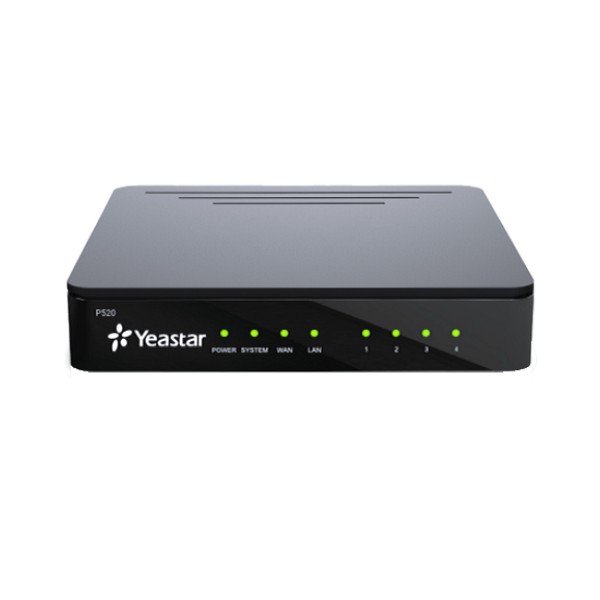
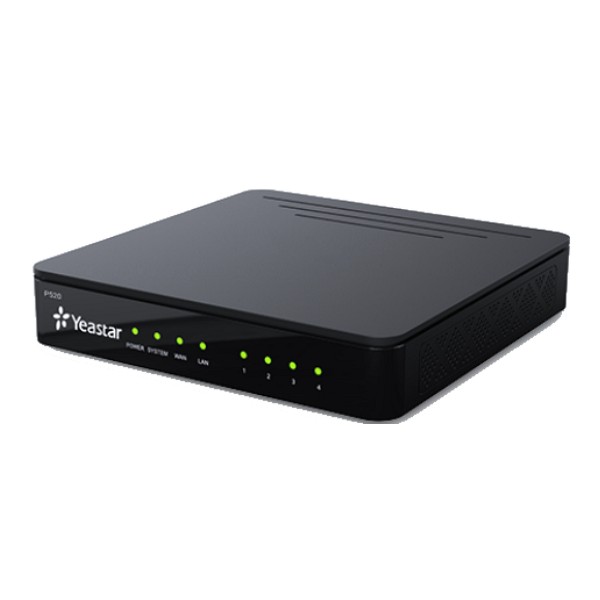
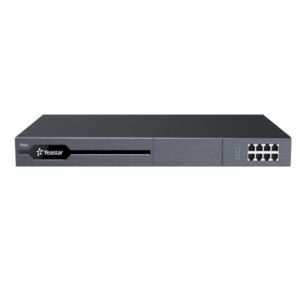
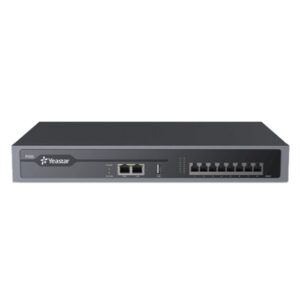
Yeastar P520 On-Premise IP PBX in Dubai, UAE
Bring office extensions, SIP trunks, selected analog or BRI connections, call routing, voicemail, collaboration tools, and day-to-day telephone administration into one compact appliance. The P520 is designed for smaller organizations that need a practical local phone system for up to 20 users without building a separate PBX server.
Quick Product Information
Yeastar
P520 Appliance Edition
On-premise IP PBX and unified communications appliance
Up to 20 users and 10 concurrent calls
Two onboard module slots; final port mix depends on selected modules
WAN and LAN interfaces, 2 × 10/100 Mbps
Desktop or wall-mount
Regional policy and supplier confirmation apply
Pre-sales review, configuration planning, delivery coordination, and warranty guidance
A Compact Business Phone System Built Around Local Control
Small organizations often need professional call handling but do not need the complexity or capacity of a large enterprise communication platform. They may have a reception desk, several departments, a sales or support queue, a few remote employees, and a mixture of SIP services with older telephone lines. The Yeastar P520 addresses that middle ground by providing a dedicated appliance that runs the phone system at the customer’s location. It gives the business a structured way to manage extensions, inbound routes, outbound rules, ring groups, IVR menus, office-hour schedules, voicemail, call transfer, call recording, paging, conference rooms, and related communications functions from a browser-based administration environment.
The appliance is sized for up to 20 users and 10 simultaneous calls. Those limits make it suitable for a compact office or branch where the user population is known and call activity is moderate. Capacity should not be judged only by employee count. A company with 18 staff may need fewer than 10 concurrent calls, while a five-person appointment desk could create heavy inbound traffic at busy times. FourTeck therefore reviews both extension count and expected call concurrency before recommending the model. The team can also help estimate whether queues, recordings, remote users, mobile clients, or external integrations will influence the design.
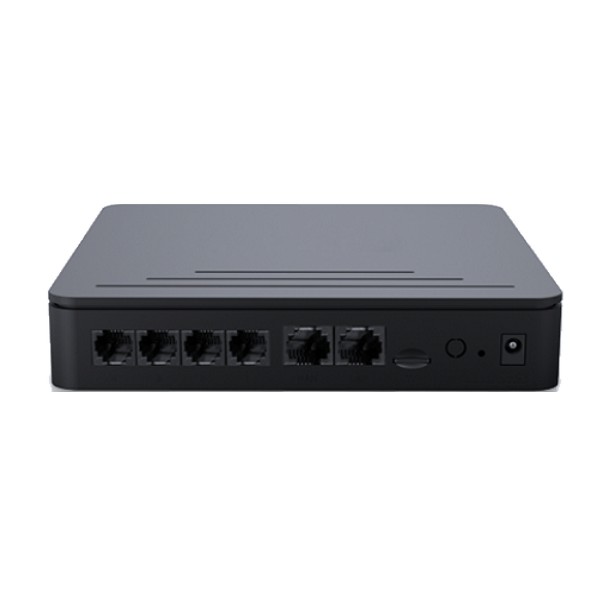
One of the most useful characteristics of the P520 is its modular telephony interface design. The chassis has two onboard module slots. Depending on the chosen modules, a project can add FXS ports for analog phones or fax devices, FXO ports for traditional PSTN lines, BRI interfaces, or selected mobile-network connectivity. This allows a business to combine modern SIP trunks with existing services rather than forcing an immediate replacement of every line and endpoint. The exact port combination must be selected before ordering because the base appliance and optional modules serve different functions.
For UAE buyers, this local appliance approach can be attractive when the business wants its core call-control platform inside the office, needs a hybrid transition from older telephony, or prefers a defined hardware system for a smaller site. It also creates a clear upgrade discussion: organizations expecting more than 20 users, more than 10 concurrent calls, higher analog density, E1/T1/J1 connectivity, or larger expansion requirements should consider a higher P-Series model or another deployment edition. FourTeck helps map the product to the real operating requirement so the purchase is based on capacity, connectivity, feature plan, and future growth rather than model name alone.
Key Business Benefits
The value of a PBX is not measured only by ports and extension limits. A useful telephone platform should make daily calling easier, reduce administrative confusion, support consistent customer handling, and fit the organization’s network and line environment. The following benefits explain how this appliance can support a small business communication plan.
Clear Capacity for Small Teams
A defined limit of 20 users and 10 concurrent calls helps buyers understand where the appliance fits. It is easier to design extension numbering, departmental routing, reception coverage, and trunk capacity when the intended scale is known from the beginning. This is especially useful for owner-managed businesses, clinics, boutiques, professional offices, and compact branch sites.
Hybrid Line Flexibility
The two module slots allow the system to be adapted for selected analog, BRI, or cellular requirements while SIP trunks remain part of the design. Businesses can preserve important existing lines, analog handsets, or fax workflows during a staged migration instead of replacing the entire voice environment at once.
Professional Inbound Call Handling
IVR menus, queues, ring groups, schedules, voicemail, transfer rules, and caller routing help a small team present a more organized experience to customers. Calls can reach the correct department or backup destination instead of relying on one receptionist or a single shared telephone.
Local Appliance Ownership
An on-premise appliance gives the company a dedicated platform at its own site. This can suit organizations that prefer local infrastructure, want direct control of network placement, or need to align voice services with internal IT policies. The business still needs secure configuration, backups, updates, and protected administrative access.
Unified Access Across Devices
Linkus UC clients can extend business communication to web, desktop, and mobile users based on the selected plan and deployment configuration. Employees can work with their business identity beyond the desk phone, which is useful for hybrid teams, managers on the move, and staff who cover calls from different locations.
Simpler Administration
A browser-based management portal centralizes extensions, trunks, routing, permissions, logs, backups, and device provisioning tasks. This can reduce the time spent making routine telephone changes and gives an administrator a clearer view of how the communication system is organized.
Better Purchase Control
Because the appliance, modules, endpoints, SIP service, and feature plan can be reviewed separately, buyers can create a solution around actual needs. This helps avoid paying for unused interfaces while reducing the risk of discovering after purchase that a required line type, remote-access feature, or endpoint connection was not included.
Product Highlights That Matter in a Real Deployment
Purpose-Built Appliance
The hardware is supplied as an Appliance Edition PBX rather than software that the buyer must install on a separate server. This keeps the infrastructure footprint compact and gives smaller businesses a defined platform for voice services.
Modular Physical Interfaces
S2, O2, SO, B2, and selected mobile-network modules provide different ways to connect analog extensions, PSTN lines, BRI services, or cellular trunks. The two available slots make planning essential because each module changes the physical interface mix.
Compact Installation
The unit measures approximately 16 × 16 × 3 cm and weighs about 0.3 kg. It can be used on a stable desktop surface or wall-mounted, subject to appropriate ventilation, cable access, and secure placement.
WAN and LAN Separation
Dedicated WAN and LAN interfaces support a structured network connection. The ports operate at 10/100 Mbps, which is adequate for the appliance’s designed voice workload but should still be integrated with a properly planned voice VLAN, firewall policy, and quality-of-service strategy.
The platform includes common business telephony capabilities such as call forwarding, transfer, parking, pickup, ring groups, paging, conferencing, caller ID routing, office hours, voicemail, call recording, reports, and security controls. Some collaboration, call-center, remote access, messaging, integration, and advanced functions depend on the selected Yeastar plan, edition rules, add-on entitlement, or external service. Buyers should therefore distinguish between hardware capacity and software entitlement. A feature may exist in the P-Series family but require a specific plan, and some functions are not supported on the P520.
Two limitations deserve particular attention. The P520 does not support the P-Series API capability described for other models, and Yeastar notes that Hotel PMS Integration is not supported on this appliance. It also does not offer E1/T1/J1 ports or D30 capacity expansion. These are not problems when the requirement is a compact office PBX, but they are important decision points for integrators, hospitality projects, or organizations planning significant user growth. FourTeck can help compare the P520 with larger appliance models, software deployment, or alternative systems when the requested project falls outside these boundaries.
Technical Specifications
| Specification Area | Yeastar P520 Details |
|---|---|
| Brand and Model | Yeastar P520, P-Series Appliance Edition |
| Product Category | On-premise IP PBX and unified communications appliance for small businesses |
| Maximum Users | 20 |
| Maximum Concurrent Calls | 10 |
| Call Center Agents | Up to 20, subject to selected plan and configured features |
| Module Slots | Two onboard telephony module slots |
| Maximum FXS Ports | 4, based on selected modules |
| Maximum FXO or BRI Ports | 4, based on selected modules and port combination |
| Maximum 3G or 4G Ports | 1, subject to compatible module and regional operator support |
| E1/T1/J1 | Not supported |
| D30 Capacity Expansion | Not supported |
| Network Interfaces | 2 × 10/100 Mbps Ethernet interfaces, identified as WAN and LAN |
| Other Hardware Interfaces | TF card slot, antenna socket for applicable modules, reset control, DC power input |
| Hard Disk and USB | No internal hard disk and no USB interface listed for this model |
| Power Supply | DC 12V, 1A |
| Dimensions | Approximately 16 × 16 × 3 cm |
| Weight | Approximately 0.3 kg |
| Form Factor | Desktop and wall-mount |
| Operating Environment | 0°C to 40°C; 10% to 90% non-condensing humidity |
| Storage Temperature | -20°C to 65°C |
| Management | Web-based portal, dashboards, provisioning, logs, notifications, backups, role controls, and troubleshooting tools; exact functions depend on plan and firmware |
| Security | Features can include TLS and SRTP call encryption, two-factor authentication, password controls, and defense policies, depending on configuration |
| Availability | Subject to regional sales policy, selected configuration, supplier status, and order quantity |
| Warranty Guidance | Vendor and supplier terms apply; confirm coverage, return conditions, and support route before purchase |
Selecting the correct configuration begins with the physical line requirement. An office using only SIP trunks may not need analog modules. A business keeping two PSTN lines could use an O2 module, while a site that needs analog extensions may require an S2 module. An SO module can provide one FXS and one FXO interface with PSTN fallback capability. BRI requirements call for the appropriate B2 design, and cellular connectivity must be checked against the supported module, operator, SIM service, antenna placement, and local policy. The maximum port figures describe the upper limit; they do not mean every port type is included in the base appliance.
Storage planning is another important point. The P520 does not include the hard-disk or USB expansion options shown on larger P-Series appliances. Businesses using extensive call recording should review retention requirements, file management, remote archiving options, and plan entitlement before deployment. The same applies to advanced collaboration, call-center, integration, and messaging functions. FourTeck can help create a bill of materials covering the appliance, modules, IP phones, PoE switching, SIP service, cabling, licensing, and installation activities so the quotation reflects the complete working system.
Configuration and Buyer Guidance
A PBX purchase should start with a communication map, not a product code. List every person, department, shared area, door phone, fax device, conference room, remote user, and external line that will depend on the system. This reveals the number of extensions, endpoint types, and physical interfaces. Include spare capacity for new staff, temporary users, and additional departments. The P520 is best considered when the final design remains within 20 users and the business does not expect to exceed 10 simultaneous calls.
How Many Calls Happen at Once?
Count peak inbound, outbound, internal, conference, and transferred calls. User count alone does not predict concurrency.
Which Line Types Must Remain?
Identify SIP trunks, PSTN lines, BRI services, cellular routes, analog phones, fax devices, and any fallback requirement.
Which Features Are Essential?
Separate must-have items such as IVR and queues from optional tools such as advanced reporting, messaging, remote services, or integrations.
What Will Change in Two Years?
Estimate hiring, new branches, higher call volumes, call recording growth, and line migration so the appliance is not outgrown too quickly.
Network readiness must also be reviewed. Voice quality depends on stable switching, correct IP addressing, suitable firewall rules, adequate internet service, and quality-of-service controls where voice shares links with data, video, cloud applications, and surveillance traffic. Remote extensions introduce additional security and NAT considerations. IP phones may need PoE switches or power adapters, while analog endpoints require the correct FXS interfaces. Cabling labels, patching, UPS protection, secure equipment placement, and configuration backups should be included in the deployment plan.
Finally, confirm the feature plan and ongoing service expectations. The appliance includes a base set of capabilities, while some advanced functions use Standard, Enterprise, Ultimate, or add-on arrangements according to Yeastar’s current licensing structure. Ask which features require renewal, which are included, and what happens if a subscription is not continued. FourTeck can help compare the requested functions with the current plan structure, but the final entitlement should be confirmed on the quotation and vendor documentation at the time of purchase.
Ideal Business Use Cases
The appliance is most effective when its capacity and interface flexibility match a clearly defined small-site requirement. The following examples show practical deployment patterns rather than guaranteed configurations. Each project still needs a review of users, trunks, endpoints, call flows, licenses, and network conditions.
Professional Office
Accounting firms, consultancies, legal practices, and service companies can create direct extensions, a reception group, departmental ring groups, office-hour routing, voicemail, and mobile access. The system can replace fragmented desk phones with one centrally managed calling environment.
Clinic or Medical Practice
Reception, appointments, billing, and practitioner extensions can be organized through IVR and queue logic. Call recording and retention policies must be reviewed against business rules and applicable privacy obligations. Fax or analog devices may be included when the selected modules and workflow support them.
Retail and Showroom
A small retail group can route calls between sales, service, accounts, warehouse, and management. After-hours messages, missed-call handling, ring groups, and mobile clients help staff remain responsive without publishing personal numbers.
Warehouse or Logistics Branch
The PBX can support office phones, dispatch desks, security points, and selected analog devices. Network and cabling design are especially important where extensions are spread across industrial areas, separate buildings, or noisy operational zones.
Small Customer Service Team
Queues, announcements, supervisor functions, recordings, and reports can support a compact help desk. Buyers should confirm which call-center tools are included in the selected plan and ensure that ten concurrent calls are sufficient during peak demand.
Branch Office
A remote branch can operate its own local call control while connecting to SIP services, remote users, or a wider corporate voice plan. The design should address numbering, inter-branch routing, security, internet redundancy, emergency calling, and centralized support responsibilities.
The P520 is less suitable when the organization needs more than 20 users, regularly exceeds 10 concurrent calls, requires E1/T1/J1 connectivity, expects large-scale analog expansion, depends on Hotel PMS Integration, or needs P-Series API support. In these cases, the correct response is not to force the smaller appliance into the project. A larger P-Series appliance, software deployment, cloud edition, or a different telephony platform may provide a better operational fit. FourTeck can help compare these paths and identify the point at which moving to a higher-capacity design becomes more economical than stretching a compact system.
Yeastar P520 Modular Trunk and Extension Design
The two onboard module slots are the product’s most important hardware planning feature. They allow the appliance to connect selected non-SIP services without turning the installation into a separate gateway project. An S2 module adds two FXS ports for analog telephones or fax devices. An O2 module adds two FXO ports for traditional PSTN lines. An SO module combines one FXS and one FXO port and includes a PSTN fallback function. A B2 module provides two NT/TE BRI ports. Supported cellular modules can create a selected GSM, 3G, or 4G route, subject to module compatibility, carrier support, SIM service, antenna placement, and regional policy.
The business benefit is a controlled migration path. Consider a small office that wants SIP trunks for normal calling but must keep two analog lines for fallback, fax, or a legacy service. Another site may have several analog handsets that are still reliable and familiar to staff. A modular design lets the buyer preserve those elements while introducing IP phones, soft clients, and modern call routing. This reduces disruption and avoids purchasing unused interfaces.
The flexibility also creates a risk: choosing modules by port count without understanding direction and function. FXS ports provide service to analog endpoints; FXO ports receive service from analog lines. They are not interchangeable. BRI modules require the correct NT or TE planning, and cellular routes require more than installing a SIM card. Dial plans, caller ID behavior, emergency calling, failover logic, and carrier rules must be considered. The module combination also determines the maximum available ports. For example, two dual-port modules can produce four interfaces, but the exact mix depends on which modules are installed.
FourTeck asks buyers to provide a simple line inventory before quotation: number of SIP trunks, PSTN lines, BRI channels, analog phones, fax devices, and cellular requirements. Include which lines are used for inbound calls, outbound calls, backup, or special services. This information allows the quotation to list the correct appliance, module combination, cables, antennas where applicable, endpoints, and configuration work. It also prevents a common procurement problem where the PBX arrives but cannot connect to the existing lines because the physical interfaces were not specified.
Yeastar P520 Call Routing and Daily User Experience
A telephone system earns its value during ordinary business activity: a customer calls, the correct team answers, the call is transferred without being lost, and staff can return messages with proper context. The P-Series feature set supports common routing tools that help create this experience. An incoming number can reach an IVR menu, ring group, queue, direct extension, receptionist, or time-based destination. Office hours and holiday rules can send calls to different announcements or voicemail when the team is unavailable. Outbound routes can separate SIP, analog, BRI, or cellular paths according to the configured trunks and dialing rules.
For employees, functions such as attended and blind transfer, call pickup, parking, forwarding, waiting, paging, intercom, voicemail, and conferencing can make communication more consistent across departments. Linkus clients can extend the business extension to supported web, desktop, or mobile environments. The exact experience depends on user permissions, plan entitlement, network configuration, and security policy. Remote access should never be enabled casually; authentication, encryption, firewall settings, device control, and update practices are part of a safe deployment.
Managers and administrators can benefit from visibility through call records, reports, logs, event notifications, queue information, and recording functions where configured. However, reporting and recording must be designed around business needs. A company should decide who can access recordings, how long files are retained, whether users are notified, where backups are stored, and what legal or contractual rules apply. The P520’s storage limitations make this planning particularly relevant for organizations expecting heavy recording volume.
The best call flow is usually simple. A long IVR with too many choices can frustrate callers, while a queue without overflow rules can leave customers waiting. FourTeck can help translate departments and working hours into a concise routing plan, prepare prompts, map extensions, configure failover destinations, and test real scenarios. Testing should include inbound and outbound calls, transfers, unanswered calls, voicemail, after-hours routing, caller ID, DTMF response, mobile client behavior, and each physical trunk. A PBX is ready for business only after the complete journey has been tested, not merely when the dashboard shows that trunks and extensions are registered.
Yeastar P520 Management, Security, and Operational Continuity
Centralized administration helps a small IT team manage communication without editing every phone separately. The platform provides a web-based portal for extension setup, trunk configuration, call routes, organization structures, roles, device provisioning, logs, event notifications, backup and restore, and troubleshooting. Auto-provisioning support can simplify compatible IP phone deployment, although model compatibility and firmware alignment should be checked before a bulk rollout. A documented configuration process is important so changes remain traceable and can be repeated during recovery.
Security begins with placement and access. The appliance should be installed in a controlled area, connected through an appropriate firewall design, and protected from unnecessary internet exposure. Administrator accounts need unique strong passwords, role-based permissions, and two-factor authentication where supported. SIP services should use secure transport options when compatible with the provider and endpoints. Defense rules, country restrictions, allowed IP ranges, failed-login protection, and logging should be tuned to the deployment rather than left as an afterthought.
Operational continuity also depends on power, internet, and provider resilience. The P520 uses a 12V DC power supply and should be connected to a suitable UPS if business calling must continue through short power interruptions. The switch, router, firewall, modem, SIP handsets, and any gateways must be protected as well; backing up only the PBX does not keep the voice path alive. Companies using a single internet connection should discuss backup connectivity or selected analog or cellular fallback routes where appropriate. Failover behavior must be tested because an available backup line is useful only when the dial plan actually sends calls to it.
Backups should be scheduled and stored securely outside the appliance. Record the firmware version, module configuration, network settings, extension list, trunks, routes, prompts, certificates, and administrator responsibilities. Before updates, review release notes, compatibility, backup status, and maintenance timing. FourTeck can help prepare a handover document that identifies the working configuration and support route. This disciplined approach reduces recovery time and protects the business from relying on undocumented settings known only to one installer or employee.
What Buyers Should Check Before Purchase
Before requesting a quotation, buyers should confirm the complete communication requirement rather than sending only the model name. The correct solution depends on capacity, line types, endpoints, plan entitlement, network readiness, installation scope, and future growth. FourTeck uses these details to help reduce wrong module selection, missing accessories, incompatible phones, or an undersized system.
Capacity Fit
Provide the current user count, expected growth, and peak simultaneous calls. Include remote workers, shared-area phones, conference rooms, door phones, and temporary users. A higher model may be more economical if the company is already close to the 20-user or 10-call ceiling.
Trunk and Port Mix
List SIP trunks, PSTN lines, BRI services, analog endpoints, fax machines, and cellular routes. Specify which lines must support incoming calls, outgoing calls, failover, or emergency use. This determines the required modules and routing design.
Feature and Plan Review
Identify mandatory functions such as IVR, queues, recording, mobile clients, advanced reports, messaging, CRM integration, remote service, or supervisor tools. Confirm which are included, which need a paid plan, and which are unavailable on this model.
Endpoint Compatibility
Share the make and model of existing IP phones, analog phones, fax devices, headsets, door phones, and paging systems. Auto-provisioning and feature-key behavior vary between endpoints, firmware versions, and PBX releases.
Network and Power
Confirm firewall model, internet links, voice VLAN, PoE switch capacity, cabling, IP plan, UPS coverage, and equipment location. Remote users and SIP trunks need secure network policies and dependable connectivity.
Recording and Data Retention
Estimate recording hours, retention period, access permissions, backup destination, and compliance responsibilities. The P520 lacks the internal disk and USB expansion available on larger appliances, so storage planning requires special attention.
Warranty and Support Expectations
Ask about supplier warranty terms, return conditions, remote or onsite support, configuration ownership, firmware maintenance, and escalation routes. Do not assume that hardware warranty includes installation or ongoing administration.
Quote Preparation
Send the delivery location, quantity, user count, line inventory, phone models, required features, preferred installation date, and whether configuration, cabling, SIP service, or training is needed. A complete brief produces a more useful quotation.
Buyers should also consider long-term cost. The appliance price is only one part of the system. Modules, handsets, PoE switching, power backup, SIP subscriptions, feature plans, installation, prompts, support, and future renewals can influence the total. A low hardware quote may not include the items required for a working deployment. FourTeck can prepare an itemized proposal that separates hardware, licenses, services, and optional components, making it easier to compare solutions on equal terms.
UAE Availability and Service Support
FourTeck supports Yeastar P520 inquiries across Dubai and the UAE with pre-sales review, configuration guidance, quotation assistance, and delivery coordination. Availability can change according to Yeastar’s regional sales policy, distributor status, selected modules, feature plan, quantity, and procurement timing. For that reason, the page does not present an unverified stock promise. The sales team confirms the current position after receiving the required configuration.
A useful inquiry should state whether the buyer needs the base appliance only or a complete telephone solution. Complete projects may include telephony modules, IP phones, analog endpoints, PoE switches, SIP trunk planning, rack or wall accessories, UPS protection, structured cabling, installation, extension programming, IVR prompts, user training, and support. FourTeck can help review these elements and identify which are essential, optional, or already available in the customer’s environment.
Warranty handling follows the applicable vendor and supplier terms. Buyers should confirm the covered period, proof-of-purchase requirements, exclusions, return process, and whether advance replacement or onsite support is included. FourTeck can provide guidance before purchase and help coordinate the support route for products supplied through its channels. Service scope should be written into the quotation so hardware coverage is not confused with configuration or maintenance services.
Coverage Across Dubai, Abu Dhabi, Sharjah, and Ajman
Businesses in Dubai, Abu Dhabi, Sharjah, and Ajman can contact FourTeck for product availability, system sizing, module selection, and quotation support. The same model can be used very differently from one site to another. A Dubai consultancy may need SIP trunks and mobile clients, an Abu Dhabi clinic may need reception queues and call recording, a Sharjah warehouse may retain analog lines, and an Ajman retail business may need a simple IVR with after-hours routing. The proposed configuration should reflect the operating environment rather than the city name.
Delivery coordination depends on confirmed availability, quantity, destination, and project scope. For installation work, site access, working hours, existing cabling, firewall administration, SIP-provider details, and endpoint locations should be reviewed before scheduling. Businesses with multiple UAE branches should also decide whether each location needs a local appliance or whether a centralized, software, or cloud design would be easier to manage.
FourTeck can help compare these approaches and prepare a consistent extension, numbering, and support plan. A multi-site design should cover inter-branch dialing, failover, internet dependency, emergency numbers, security boundaries, and who owns daily administration. This avoids creating separate systems that work individually but are difficult to operate as one business communication environment.
GCC and Africa Business Inquiry Support
FourTeck also supports business technology inquiries for selected GCC and Africa markets through regional channels. Organizations in Saudi Arabia, Qatar, Oman, Kuwait, Bahrain, Kenya, Uganda, and other locations may request product guidance, configuration review, and procurement coordination. Availability, permitted cellular modules, power accessories, warranty handling, tax treatment, shipping, and delivery lead time can vary by country and supplier route.
Regional buyers should provide the destination country, quantity, required line types, local SIP provider, endpoint list, and whether installation will be handled by an internal team or local integrator. BRI, analog, cellular, emergency-calling, and caller-ID behavior can differ between operators and markets. A configuration tested for one country should not be assumed to work identically elsewhere without validation.
For regional information, buyers can use FourTeck Africa or FourTeck Kuwait alongside the UAE contact channel. FourTeck can help identify suitable alternatives when the P520 is not available under local sales policy or when a project needs higher capacity, different interfaces, or a deployment model better suited to cross-border management.
Other Options Buyers May Consider
A good communication proposal considers the surrounding system, not only the PBX appliance. The following FourTeck resources and related products can help buyers evaluate higher capacity, analog expansion, endpoints, and complete project services.
Yeastar TA800 FXS Gateway
Consider this 8-port FXS gateway when the project must connect more analog phones or fax devices than the P520’s internal module arrangement can support.
Yeastar P550 Enterprise Renewal
Useful for existing P550 users reviewing Enterprise Plan continuity, renewals, remote features, reporting, and call-center requirements on a larger appliance platform.
Business IP PBX Selection Guide
Compare appliance, software, cloud, and hybrid phone systems when user capacity, remote work, integrations, or multi-site requirements exceed a simple branch installation.
Yealink Business IP Phones
Review desk phones and endpoint families for reception, standard users, managers, shared spaces, and remote-working requirements. Final interoperability should be checked by model and firmware.
IPBX and Telecom Services
Suitable when the requirement includes cabling, SIP trunk planning, firewall readiness, installation, prompts, endpoint configuration, testing, and ongoing support.
Buyers expecting fast growth should also ask FourTeck to compare the P550, P560, or P570 appliance families. Higher models increase users, concurrent calls, physical interface capacity, network speed, and expansion options, but the best selection depends on the complete design. A larger appliance is not automatically the right choice for every company, just as a smaller appliance should not be chosen only because its initial hardware price is lower.
Why Business Buyers Choose FourTeck
FourTeck approaches telephony procurement as a system-design task. A working PBX depends on capacity, trunks, endpoints, network quality, security, licenses, configuration, and user adoption. The team helps buyers review these parts before ordering so the proposal is connected to a real business requirement.
Requirement Discovery
User count, call peaks, departments, line types, remote work, recording, growth, and support expectations are reviewed before the bill of materials is prepared.
Configuration Guidance
FourTeck helps match modules, endpoints, feature plans, network requirements, and accessories to the intended deployment.
Itemized Quote Support
Hardware, licenses, services, and optional components can be separated so buyers understand what is included and can compare proposals more fairly.
Deployment Coordination
Delivery location, installation scope, cabling readiness, provider access, maintenance windows, testing, and user handover can be coordinated as part of the project.
Warranty Guidance
The team can explain the applicable supplier route and help buyers distinguish hardware warranty from configuration, support, and maintenance services.
Alternative Matching
When the model is unavailable or does not meet capacity, interface, integration, or regional requirements, FourTeck can suggest a more suitable path.
This buyer-focused process is valuable for both small companies and project teams. Small businesses may need help translating everyday calling problems into technical requirements. Integrators and enterprise buyers may need a clear product list, compatibility review, delivery plan, and documentation. In both cases, the objective is the same: supply a communication platform that can be installed, tested, managed, and supported without avoidable surprises.
Frequently Asked Questions
What is the Yeastar P520 used for?
It is an on-premise IP PBX appliance for small businesses that need centralized extensions, trunks, call routing, IVR, queues, voicemail, recording, and unified communication functions. It is designed for up to 20 users and 10 concurrent calls. The final capability depends on the selected telephony modules, feature plan, endpoints, SIP service, and network configuration.
Does the P520 include analog or BRI ports?
The appliance has two onboard module slots, but the required port types depend on the modules ordered. Available module choices can provide FXS, FXO, mixed FXS/FXO, BRI, or selected cellular connectivity. Buyers should specify their existing lines and analog devices before quotation so the correct module combination is included.
Is it suitable for more than 20 employees?
The published user capacity is 20. A company with more employees, expected growth, or many shared endpoints should consider a higher-capacity model or another P-Series deployment edition. Even with fewer than 20 employees, the system may be undersized if peak call concurrency exceeds 10 or if the project needs interfaces and features not supported by this model.
Can FourTeck help choose the correct modules?
Yes. Share the number of SIP trunks, PSTN lines, BRI connections, cellular routes, analog phones, fax machines, and fallback requirements. FourTeck can use this information to recommend a module mix and identify whether an external gateway or larger PBX would be more suitable.
Does the P520 support remote employees?
Linkus unified communication clients and remote access functions can support mobile, desktop, and web users according to the selected plan and deployment settings. Remote use requires secure authentication, appropriate firewall and network design, supported endpoints, and reliable internet connectivity. The exact entitlement and configuration should be confirmed before purchase.
Can the appliance be used for call recording?
Call recording is part of the P-Series business feature set, but storage and retention must be planned carefully. The P520 does not have the internal hard-disk or USB expansion options of larger appliances. Buyers should estimate recording volume, retention period, backup destination, access permissions, and applicable privacy or compliance obligations.
Is the Yeastar P520 available in Dubai and the UAE?
FourTeck accepts product and project inquiries across the UAE. Current availability depends on Yeastar regional sales policy, supplier status, module selection, quantity, and procurement timing. Contact the sales team with the required configuration and delivery location so availability and quotation details can be confirmed.
What information is needed for a quotation?
Provide the number of users, peak simultaneous calls, line types, analog devices, required features, endpoint models, delivery location, quantity, and whether installation, SIP trunk planning, cabling, prompts, training, or support is required. This helps FourTeck prepare a complete proposal instead of quoting only the base appliance.
What warranty and support are provided?
Warranty coverage follows the applicable vendor and supplier terms and should be confirmed on the quotation. Configuration, onsite installation, remote administration, maintenance, and user training may be separate services. FourTeck can provide warranty guidance and define the proposed support scope before the order is approved.
Can businesses request multiple units or a regional project supply?
Yes. Businesses can request bulk or multi-site quotations, subject to availability and country requirements. Share the number of sites, unit quantities, destination countries, local line types, endpoint standards, installation responsibility, and desired delivery schedule. FourTeck can help coordinate product matching and identify where a different model or deployment approach is more practical.
Need Help Building the Right Phone System?
Send FourTeck your user count, concurrent-call estimate, line inventory, endpoint requirement, delivery location, and support scope. The team can review the appliance, modules, licenses, phones, network items, and services needed for a complete business-ready proposal.
Reviews
There are no reviews yet.