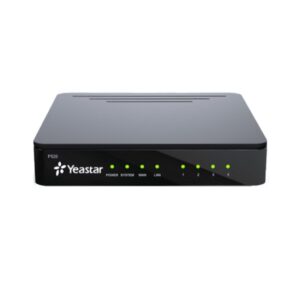
Sangoma Vega 60G v2 VEGA-60GV2-0404 VoIP Gateway in Dubai, UAE
The Sangoma VEGA-60GV2-0404 is a compact eight-channel gateway that bridges four FXS station connections and four FXO trunk connections into a SIP-based voice environment. It is designed for enterprises that need to preserve useful analog telephony assets while modernising call control, SIP trunking, branch connectivity and operational management.
For UAE deployments, the platform is especially relevant where a phased migration is preferable to disruptive rip-and-replace projects: existing phones, fax machines, analogue PSTN lines, alarms or other supported devices can remain in service while the core communications architecture moves toward IP.
Procurement Snapshot
Manufacturer: Sangoma Technologies
Model: Vega 60G v2
Part number: VEGA-60GV2-0404
Gateway mix: 4 FXS + 4 FXO
Network: 10/100/1000Base-T RJ-45
Deployment: Enterprise, branch and service-provider edge
UAE supply: Contact FourTeck for current availability and regional power/support options.
Quick Procurement & Configuration Matrix
Brand / Model: Sangoma Vega 60G v2, VEGA-60GV2-0404.
Product Type: Mixed FXS/FXO analog VoIP media gateway.
Recommended Workload: Analog endpoint and PSTN integration with SIP platforms.
Scalability Limit: Eight VoIP channels for the analog FXS/FXO configuration; larger estates can use multiple gateways or higher-density models.
Power: External 12V, 24W AC/DC adapter. Regional plug and accessory details should be confirmed.
Environment: 0°C to 40°C; 0% to 90% non-condensing humidity.
Delivery Area: Dubai, Abu Dhabi, Sharjah, Ajman and wider UAE; export coordination by project.
Warranty Guidance: Warranty and support entitlement are configuration and channel dependent; confirm on quotation.
Executive Product Architectural Overview
The Sangoma Vega 60G v2 family is built for one of the most persistent challenges in enterprise communications: the transition between established analogue telephony and modern IP-based call control. Many organisations have already adopted SIP trunks, hosted voice, IP-PBX platforms or unified communications systems, but still operate analogue phones, fax machines, legacy PBX connections, door phones, paging interfaces, elevator phones, alarm diallers or public-switched telephone network circuits. Replacing every analogue dependency at the same moment can create unnecessary capital cost, operational risk and project complexity. The VEGA-60GV2-0404 addresses that transition point by placing four FXS interfaces and four FXO interfaces behind a SIP-capable gateway, allowing an architect to retain selected analogue assets while centralising routing and management in an IP environment.
The two analogue interface types have different roles. FXS ports behave as station-facing interfaces: they can provide the analogue line presentation expected by supported telephones, fax devices or other endpoints. FXO ports, by contrast, interface with analogue lines or PBX ports that provide the line service. Combining both in one compact appliance is valuable at branches where a business may simultaneously need to keep several analogue endpoints and several PSTN circuits. Instead of purchasing separate gateways for each direction, a mixed-port unit can consolidate the requirement into one managed device, subject to channel planning and compatibility validation.
On the IP side, the Vega 60G v2 uses a Gigabit Ethernet interface and supports SIP V1 and V2. The underlying purpose is not to make analogue traffic faster; rather, it provides a standard network attachment for control, media transport, remote management and integration with SIP-based infrastructure. Supported voice codecs include G.711 a-law and μ-law, G.729a, G.723.1 and G.726, providing choices that balance interoperability and bandwidth according to the surrounding system. Fax and modem scenarios receive additional treatment through T.38 and G.711-based transport, which is important because analogue fax and modem applications can be more sensitive to packet loss, jitter and transcoding than conversational voice.
In practical architecture, the gateway normally sits at the boundary between an analogue service domain and an IP voice domain. A branch could connect legacy handsets to FXS ports, connect analogue PSTN lines to FXO ports, register the gateway to one or more SIP proxies, and use dial-plan rules to route calls according to destination, availability or policy. The platform also supports NAT traversal, direct dialling, registration to multiple proxies and sophisticated call routing. These capabilities can be used to design controlled fallback paths: for example, calls can use a preferred SIP route during normal operation and retain an alternate local path where permitted by the surrounding configuration and carrier service.
Local survivability functions strengthen the branch-edge role. Sangoma lists standalone proxy operation, IP-device survivability, IP-device call routing and emergency call routing. These functions should be planned as part of an overall continuity architecture rather than treated as a substitute for redundant call-control systems, diverse WAN links or tested emergency calling procedures. Nevertheless, they give communications engineers additional tools to maintain useful call behaviour when a central service is unreachable. This can be especially important for retail sites, clinics, warehouses, schools, hospitality properties and remote offices where basic voice reachability must be considered alongside WAN availability.
For Dubai and wider UAE projects, the architectural relevance is often found in mixed-generation estates. A head office may already use a modern unified communications platform, while secondary facilities retain analogue trunks, fax equipment or building systems. The VEGA-60GV2-0404 allows the migration strategy to be sequenced around business priorities rather than around a forced hardware replacement deadline. It can also reduce the number of separate interface appliances required at a small site because it combines both station and trunk connectivity in a single 1U-height, compact chassis measuring approximately 200 × 127 × 43 mm and weighing around 0.8 kg.
Procurement should remain configuration-aware. Sangoma documents options across the wider Vega 60G line that may not apply identically to every individual SKU, including optional PoE on some models. Buyers should therefore use VEGA-60GV2-0404 as the controlling part number, validate the exact regional power accessory, confirm support entitlement, check interoperability with the intended PBX or SIP service, and verify analogue electrical requirements before deployment. FourTeck can coordinate this pre-sales validation so that the quoted unit matches the planned UAE environment rather than relying on family-level assumptions.
Enterprise Business Value & ROI Benefits
The commercial case for an analogue-to-SIP gateway is rarely about adding a new communications feature in isolation. Its value comes from extending the useful life of existing devices, controlling migration risk and consolidating voice routing at the IP layer. The VEGA-60GV2-0404 can support a staged modernisation programme in which endpoints are replaced when business requirements justify the change, rather than because a legacy PBX or carrier interface has been removed.
Migration Efficiency
A phased migration can be financially preferable to immediate replacement of every analogue device. Four FXS ports allow selected station devices to remain connected while the voice core moves to SIP. This can reduce project disruption, simplify user change management and help procurement teams spread replacement decisions across planned refresh cycles.
Trunk Continuity
Four FXO ports provide a path for integrating analogue PSTN services or compatible PBX interfaces. Where local analogue lines remain operationally useful, the gateway can connect them to SIP-based call control and routing. This may support continuity during trunk migration, branch cutovers or carrier transition programmes.
Routing Control
Flexible dial planning lets administrators make call-routing decisions at the gateway boundary. Multiple SIP proxy registration, direct dialling and local routing capabilities can reduce dependence on rigid analogue call paths. The business benefit is greater control over how existing telephony assets participate in a modern communications design.
Operational Resilience
Standalone proxy and survivability capabilities provide options for keeping selected calling functions available if upstream services are disrupted. The measurable value depends on the design and test regime, but the feature set enables architects to build more graceful failure behaviour than a simple single-path gateway.
Secure Transport
SIP over TLS and SRTP can protect signaling and media when supported end to end by the surrounding platform. HTTPS and SSH provide secure management choices. These features help the gateway fit into enterprise security baselines where unencrypted control channels are being reduced or removed.
Manageability
SNMP, Syslog, remote firmware upgrade, TR-069, TFTP, FTP and web-based administration give operations teams multiple methods for provisioning and observation. Better visibility can reduce the cost of diagnosing branch voice issues because administrators can collect data and make controlled changes without immediate physical attendance.
ROI should be calculated against the actual migration programme. Relevant inputs include the replacement cost of analogue devices, technician visits, PBX or carrier cutover windows, SIP trunk costs, support contracts, outage exposure and the expected life of retained equipment. The gateway does not make every legacy device worth keeping; instead, it gives procurement and architecture teams a controlled interface through which replacement can be prioritised. In a hotel, for example, maintaining selected room or service phones for another refresh cycle may be reasonable. In a regulated or life-safety environment, a specialist review may conclude that a particular analogue device should instead be replaced with a certified IP alternative. The value of the VEGA-60GV2-0404 is therefore strongest when it is part of a documented transition strategy.
Hardware & Technical Architecture Highlights
The VEGA-60GV2-0404 is a purpose-built media gateway rather than a general-purpose server. Its architecture is centered on real-time conversion between analogue telephony signaling/media and packetised SIP communications. On the analogue side, four FXS and four FXO interfaces are presented on RJ-11 connectors. The FXS side supports configurable analogue line impedance profiles including 600R, 900R and CTR-21, while Sangoma specifies FXS line reach up to 2000 ohms and as much as 8 km depending on the environment. These figures are design limits rather than guarantees for every cable plant; conductor size, loop condition, attached equipment and local electrical characteristics must be evaluated.
The IP interface is a single RJ-45 Gigabit Ethernet connection supporting 1000Base-T, 100Base-TX and 10Base-T operation with full- or half-duplex modes. For a voice gateway carrying a maximum of eight analogue VoIP channels, Gigabit Ethernet provides ample raw transport capacity. The engineering issue is therefore quality, not bandwidth volume. Voice packets require predictable delay, jitter control and low loss. The gateway supports Type of Service, DiffServ, 802.1p/Q VLAN tagging, comfort noise, silence suppression, adaptive jitter removal, quality statistics and G.168 echo cancellation with a tail of up to 128 ms. These capabilities allow network engineers to integrate voice into a converged LAN with explicit prioritisation policies.
Codec choice can also influence bandwidth and interoperability. G.711 provides 64 kbps audio payload and is often selected when bandwidth is readily available and compatibility is prioritised. G.729a, G.723.1 and G.726 offer lower-bitrate options that may be useful across constrained WAN links, although end-to-end licensing, transcoding behaviour and platform support should be checked. For fax, the gateway supports T.38 as well as G.711-based transport; for modem scenarios, support extends to V.90 with G.711. Successful fax and modem operation can depend strongly on the service provider, SIP platform, codec path and network quality, so proof testing is recommended before a large rollout.
A separate USB port is provided for storage, and an RJ-45 serial console interface supports local administrative access. Management capabilities also include HTTPS, SSH, SNMP versions 1, 2 and 3, Syslog, RADIUS accounting/login, remote firmware upgrades, automated configuration updates, TR-069 and file-transfer methods. This breadth is useful in heterogeneous enterprise estates where network operations teams may already have SNMP monitoring, central Syslog collection or device-provisioning processes.
Security architecture should be applied deliberately. Sangoma lists SRTP for media and TLS for SIP signaling, together with configurable user passwords and secure management protocols. Telnet is also listed as an available management method, but organisations with modern security policies should prefer secure alternatives such as SSH and HTTPS, disable unnecessary services where supported, restrict the management plane with firewall rules or VLAN separation, and maintain a controlled firmware lifecycle. Encryption availability does not by itself guarantee a secure deployment; certificate handling, credential policy, network segmentation and log review remain important.
Physically, the gateway is compact: approximately 200 mm wide, 127 mm deep and 43 mm high, with a weight around 0.8 kg. Sangoma describes it as 1U form factor, making it straightforward to incorporate into a communications rack or structured equipment area when appropriate mounting hardware is available. Power is delivered through an external 12V, 24W AC/DC adapter. In UAE projects, buyers should confirm the supplied regional plug and consider protected power from an appropriate UPS where voice continuity matters. Operating specifications of 0°C to 40°C and 0% to 90% non-condensing humidity mean installation should be in a controlled indoor environment with adequate ventilation.
Definitive Technical Specifications Table & Sizing Notes
| Area | VEGA-60GV2-0404 Specification | Buyer Note |
|---|---|---|
| Analog ports | 4 × FXS + 4 × FXO, RJ-11 | Confirm exact endpoint and line mapping before purchase. |
| VoIP channels | 8 for FXO / FXS | Plan concurrency and growth; use additional/higher-density gateways if required. |
| VoIP protocol | SIP V1, SIP V2 | Validate interoperability with PBX, SBC and carrier. |
| Codecs | G.711 a-law/μ-law, G.723.1, G.729a, G.726 | Codec support on every hop should be checked. |
| Fax / modem | T.38; G3 fax; G.711 fax path; modem up to V.90 over G.711 | Pilot-test mission-critical fax/modem applications. |
| LAN | 1 × RJ-45 10/100/1000Base-T | Use voice VLAN/QoS policy where appropriate. |
| Quality controls | Adaptive jitter removal, DiffServ, ToS, 802.1p/Q, G.168 echo cancellation up to 128 ms | End-to-end LAN/WAN policy still determines results. |
| Security | SRTP media, SIP TLS, HTTPS, SSH, configurable user passwords | Enable secure methods and restrict management access. |
| Management | Web, RADIUS, SNMP v1/v2/v3, Syslog, TR-069, TFTP/FTP, serial, Telnet/SSH | Align with operational and security policy. |
| Local survivability | Standalone proxy, IP-device survivability, IP call routing, emergency call routing | Validate failover scenarios during acceptance testing. |
| Power | External 12V, 24W AC/DC adapter | Confirm UAE plug/accessory and UPS strategy. |
| Dimensions / weight | 200 × 127 × 43 mm; approximately 0.8 kg | Check rack/shelf mounting plan and cable bend radius. |
| Environment | 0°C to 40°C; 0% to 90% humidity non-condensing | Deploy indoors in controlled communications space. |
| PoE | Option available on some Vega 60G models | Configuration dependent; do not assume inclusion on VEGA-60GV2-0404 without quote confirmation. |
Sizing begins with ports and call paths, not merely with the total number of users in the organisation. Four FXS ports can serve up to four analogue station interfaces, while four FXO ports can connect up to four compatible analogue line interfaces. The gateway supports eight VoIP channels in the FXS/FXO configuration, so an architect should identify the maximum expected concurrent analog calls and determine whether the port mix matches the site. A branch with six analogue phones and two PSTN lines, for example, is not a direct fit for a four-FXS/four-FXO device even if the total requirement is eight connections. A different Vega model or multiple units may be more appropriate.
Network sizing should include WAN quality, VLAN design, firewall policy, SIP traversal and codec selection. Power planning should consider the external 12V adapter and the continuity requirement for the site. Optional family features such as PoE must be confirmed against the exact quoted configuration. Support coverage, firmware eligibility and warranty should likewise appear explicitly on the commercial offer. FourTeck can help convert these technical variables into a bill of materials that reflects the actual UAE deployment.
Configuration, Sizing & Deployment Workbench
01 / Map the analogue estate
Begin by inventorying every connection that must terminate on the gateway. Separate station-side requirements from trunk-side requirements. FXS is commonly used for supported analogue endpoint devices, while FXO is used toward analogue lines or compatible PBX interfaces. Record whether each device is a phone, fax, modem, paging interface or other analogue device, and document its electrical and signaling expectations. This prevents a frequent procurement error: choosing a gateway by total port count while overlooking the required direction of each port.
02 / Calculate concurrency and headroom
The model provides eight analogue VoIP channels across its four FXS and four FXO connections. Estimate busy-hour concurrent calls rather than average daily call volume. A location with low average use can still experience concentrated call peaks. Add reasonable headroom for seasonal traffic, expansion, emergency calls and operational exceptions. If the site is likely to exceed the available port mix or concurrency, consider a higher-density architecture or multiple gateways rather than designing to the edge of capacity.
03 / Validate the SIP environment
Document the target IP-PBX, hosted platform, SIP proxy, SBC and service provider. Confirm signaling protocol, authentication method, registration model, codec list, DTMF handling, caller-ID format and inbound/outbound numbering behaviour. Where TLS and SRTP are required, validate certificate and cipher expectations on the surrounding systems. The goal is not simply to prove that all components support SIP, but to confirm that they support compatible operational profiles.
04 / Plan voice quality on the network
Voice quality depends on end-to-end network behaviour. Reserve appropriate VLANs, QoS markings and switch policies; review WAN latency, jitter and packet loss; and confirm that firewall or NAT devices preserve the required SIP and media flows. Sangoma provides DiffServ, ToS, VLAN tagging, jitter management and echo cancellation, but these features work best when the rest of the network is engineered consistently. For remote branches, test under realistic WAN load rather than only on an uncongested commissioning link.
05 / Treat fax and modem as specialist workloads
Fax and modem services should be explicitly tested. T.38 can improve fax transport through IP networks, while G.711 pass-through is also supported. However, carrier support, transcoding, jitter buffers and network impairment can affect results. If a business process depends on fax transmission, payment terminals or modem traffic, perform a pilot with the same service provider and PBX configuration planned for production. Record success criteria and fallback procedures before purchasing for multiple branches.
06 / Design power, rack and environmental placement
The gateway uses an external 12V, 24W adapter and should be installed within the documented 0°C to 40°C operating range and non-condensing humidity limits. Select a rack shelf or approved mounting method that protects connectors and maintains cable organisation. Where voice service is business-critical, connect the gateway and adjacent network switch to appropriately sized UPS protection. Include the router, firewall and SIP access path in the continuity calculation; powering only the gateway will not sustain calls if upstream infrastructure is unavailable.
07 / Define management and security policy
Choose HTTPS and SSH for administration where possible, restrict management to trusted networks, use strong credentials and integrate monitoring through SNMP or Syslog according to policy. Disable services that are unnecessary for the operational model when the platform configuration permits. Establish a firmware change process, back up the running configuration and document the gateway’s role in the voice topology. The handover package should include management IP details, port mapping, SIP peers, dial-plan logic and rollback steps.
08 / Confirm commercial and support terms
Before ordering, ensure the quotation states the exact VEGA-60GV2-0404 part number, quantity, included power accessories, support/warranty entitlement, delivery destination and any required services. Family-level datasheets can list options that differ by region or model, so the commercial bill of materials should be the final reference. For Dubai projects, FourTeck can coordinate this validation before the purchase order is released.
Industry Use Cases & Workload Scenarios
Banking & Finance
Branches and operations centres may retain selected analogue lines or devices during a controlled migration to IP voice. The mixed FXS/FXO design can provide an interface between those endpoints and a SIP-controlled environment. Because financial organisations commonly enforce stringent segmentation and audit policies, secure management, centralized logging, restricted administration and documented failover testing should be incorporated into the deployment standard.
Healthcare
Clinics, laboratories and administrative facilities can use a gateway to maintain supported analogue phones, fax workflows or legacy service interfaces while the main communications platform moves to SIP. Healthcare teams should carefully distinguish routine business communications from life-safety systems. Critical clinical or emergency devices require device-specific compatibility and regulatory review rather than an assumption that any analogue port is an acceptable interface.
Government & Public Sector
Government estates often include buildings of different ages and telecommunications generations. The Vega 60G v2 can act as a migration bridge for small sites where analogue endpoints and lines must coexist with central SIP infrastructure. Its remote-management capabilities can help infrastructure teams operate geographically distributed gateways, while project governance can standardise firmware, logging, access controls and emergency routing procedures.
Logistics & Warehousing
Warehouses may have desk phones, gatehouse lines, fax endpoints or legacy devices that are inconvenient to replace during an IP-PBX refresh. A mixed gateway can preserve these interfaces while enabling central SIP routing. The compact chassis suits communications rooms where rack space is limited, while remote monitoring reduces the need to dispatch a technician for every configuration change or diagnostic check.
Retail & Hospitality
Retail branches and hospitality properties often have distributed analog requirements that outlive the core PBX. The 4 FXS + 4 FXO arrangement can support a small site’s mixed migration, particularly where several analog endpoints and several local lines remain in use. Procurement teams should map each port to a business function and confirm whether future refurbishment will reduce or increase the analogue footprint.
Education
Schools and training campuses can use the gateway during phased communications upgrades where reception phones, fax machines or other supported analog devices remain active. Local call routing and survivability features can be considered as part of a wider continuity plan. Cabling distances, voice VLANs, access controls and emergency calling behaviour should be tested across the real campus network before final acceptance.
Technical Feature Deep Dive 1: Processing, Throughput & Workload Performance Architecture
A media gateway’s performance cannot be assessed in the same way as a general-purpose computer. CPU clock rate and memory capacity are less useful buying metrics than channel density, media handling, codec support, signaling behaviour and latency. The VEGA-60GV2-0404 is designed around eight analogue VoIP channels and must process telephony events in real time. Each active call involves signaling state, analogue conversion, packetisation, jitter management, echo control and potentially codec processing. The appliance abstracts this complexity behind a purpose-built gateway interface, but architecture teams should still understand the variables that affect call quality.
The first variable is codec selection. G.711 offers high interoperability and avoids low-bitrate compression, but it uses more bandwidth than G.729a or G.723.1 once IP overhead is included. In a Dubai office connected over a modern LAN and high-capacity WAN, G.711 may be the simplest operational choice when supported by the provider. In a remote branch with constrained WAN bandwidth, a lower-bitrate codec may reduce link consumption. The surrounding PBX, SBC and carrier must support the same codec, and any transcoding step can add resource consumption or quality considerations. Capacity planning should therefore be done end to end, not from the gateway datasheet alone.
The second variable is packet delivery quality. Human speech is highly sensitive to delay variation and loss. The Vega platform includes adaptive jitter removal, Type of Service, DiffServ, VLAN tagging and QoS statistics, which enable an architect to align the gateway with enterprise network policy. These mechanisms cannot recover a severely congested or unreliable WAN, but they can help prioritise voice and provide visibility into conditions. An acceptance test should include sustained data traffic, not just a quiet network, to confirm that calls remain intelligible under expected utilisation.
Echo cancellation is another important part of analogue interworking. Sangoma specifies G.168 cancellation with a tail of up to 128 ms. Analogue circuits and hybrid interfaces can introduce echo paths that would be objectionable on voice calls if unmanaged. Correct impedance settings and line conditions still matter, so a deployment engineer should select appropriate country/line profiles and verify call quality on each analogue path. The aim is to combine gateway processing with correct physical-layer configuration.
Fax and modem workloads expose different performance constraints. Unlike speech, their tones and modulation are less tolerant of packet impairment and some voice-processing techniques. T.38 can relay fax information in a form designed for IP networks, while G.711 pass-through maintains the audio path when supported. Modem support up to V.90 over G.711 broadens compatibility, but the actual success rate can vary by carrier path. For organisations that still depend on these applications, performance validation should use representative documents, call durations, line conditions and destinations.
Technical Feature Deep Dive 2: Security, Redundancy & System Resilience
Voice gateways sit at a sensitive boundary. They can connect internal IP networks to analogue carrier services and devices, and they may be capable of placing chargeable calls. Security therefore requires attention to both cyber controls and telephony routing policy. The Vega 60G v2 supports SIP signaling over TLS and media encryption through SRTP, allowing encrypted communications where the connected systems support compatible profiles. Administrators should verify certificate management, trust chains, negotiated protocols and operational monitoring rather than enabling encryption without validation.
Management protection is equally important. HTTPS and SSH provide secure access choices, while SNMPv3 can offer authenticated and encrypted monitoring compared with older SNMP versions when properly configured. RADIUS can assist centralised login/accounting designs, and Syslog can forward events to a central collector. Because the feature set also includes legacy administration methods such as Telnet and file-transfer protocols, security teams should minimise exposed services and restrict access using network segmentation, ACLs and firewalls. A dedicated management VLAN is often preferable to permitting administration from general user networks.
Resilience is expressed through more than hardware duplication. Sangoma lists standalone proxy operation, IP-device survivability, IP-device call routing and emergency call routing. In a branch architecture, these functions can be used to preserve selected call capabilities if a central SIP proxy or WAN path is unavailable. Exactly what remains possible depends on how the dial plan, local trunks and endpoints are configured. A design review should identify normal call paths, each failure scenario, the intended degraded mode and the recovery sequence.
For example, a branch might normally route outbound calls through a central SIP service. If the WAN fails, local routing could potentially use connected analogue lines for defined destinations, subject to carrier and configuration constraints. This should not be assumed automatically; it should be engineered, documented and tested. Emergency calling deserves special attention because location information, local regulations, line availability and numbering behaviour can differ between centralized and local routes. Businesses should engage their telecom provider and internal governance teams to ensure the chosen design satisfies operational and regulatory requirements.
Power resilience also matters. The gateway’s low 24W adapter requirement makes it relatively easy to place on UPS-backed power, but the calling service depends on the entire path. Switches, routers, firewalls, optical network terminals, SBCs and carrier access equipment may all need protection. In a UAE branch, the continuity assessment should therefore map every dependency between the analogue endpoint and its destination. The Vega gateway can contribute local survivability capabilities, but a resilient service emerges only when power, network, call control and carrier dependencies are considered together.
Technical Feature Deep Dive 3: Remote Management, Telemetry & Infrastructure Integration
Distributed voice gateways create an operational challenge: the hardware may be located in branches where no telephony specialist is present. The Vega 60G v2 addresses this with several management methods. An HTTP(S) web server provides browser-based administration; SSH and serial console access provide command-oriented paths; SNMP enables monitoring; Syslog supports central event collection; and remote firmware/configuration mechanisms can support lifecycle management. The architectural benefit is that a voice team can manage a fleet using established network-operations practices rather than treating every gateway as an isolated appliance.
SNMP monitoring can be integrated into enterprise infrastructure-management platforms to provide device health and event visibility. Where security policy permits, SNMPv3 should be considered because it supports stronger security than earlier versions. Syslog can feed a central SIEM or log platform, allowing gateway events to be correlated with firewall, switch, SBC and PBX records. This can significantly improve troubleshooting. A call-quality complaint that appears to originate at the gateway may actually coincide with WAN loss, switch congestion or a provider event; centralized telemetry helps operations teams reconstruct the sequence.
TR-069 and automated configuration mechanisms can be useful when deploying multiple gateways, particularly for service-provider or multi-branch environments. The operational model should include version control, configuration backups, staged rollouts and rollback procedures. A seemingly minor dial-plan change can affect inbound and outbound call behaviour, so production modifications deserve the same change-management discipline as firewall or routing updates. Where templates are used, branch-specific values such as IP addressing, SIP credentials, PSTN routing and emergency destinations should be separated from common configuration.
Remote firmware upgrade capability reduces the need for site visits, but it introduces lifecycle responsibilities. Before upgrading, administrators should review release notes, confirm compatibility, back up configuration, schedule an appropriate maintenance window and define rollback options. For large deployments, test the new version on a representative pilot gateway before broad deployment. This approach reduces the chance that an interoperability change will affect every branch simultaneously.
Infrastructure integration also includes physical and documentation standards. The gateway should have a reserved switch port, clearly identified voice VLAN, static or managed IP assignment, labelled analogue ports and documented power source. Port mappings should describe which FXS connection serves which endpoint and which FXO connection terminates which line. At handover, the operations team should receive topology diagrams, administrative ownership, monitoring details, warranty/support references and escalation contacts. FourTeck can use this information during procurement to help confirm that the ordered model aligns with the planned operational design.
What Buyers Should Check Before Purchase
Most gateway procurement mistakes are not caused by a missing headline feature. They arise from a mismatch between port type, regional accessories, SIP behaviour, analogue line conditions, support terms or deployment assumptions. Use the four checks below to turn a generic hardware request into a deployable bill of materials.
01 / FIT: Configuration Fit & Model Sizing
Confirm that four FXS and four FXO ports match the actual line direction requirements. Count current devices, planned additions and spare capacity. Document peak simultaneous calls and decide whether one gateway is sufficient. If the port mix is wrong, choose another model rather than adapting the network around an unsuitable hardware configuration. Confirm fax or modem use separately because these workloads warrant dedicated testing.
02 / MATCH: Compatibility & Environmental Requirements
Identify the PBX, SBC, SIP provider, carrier lines and analogue devices that will connect to the unit. Validate codecs, authentication, TLS/SRTP expectations, caller ID, DTMF, line impedance and numbering plans. Check rack space, operating temperature, UPS capacity and cable routing. Do not assume that a family-level option such as PoE is included on the exact SKU without explicit confirmation.
03 / TERMS: Availability, Delivery & Warranty Terms
Ask the quotation to state current UAE availability, lead time, warranty coverage, support entitlement, power adapter/plug, included accessories and any regional variation. If the project involves multiple locations, define whether units should ship centrally or directly to branches. For export projects, include destination country and required documentation so logistics can be planned before order release.
04 / REQUEST: Quote Preparation Data Needed
Provide the exact model VEGA-60GV2-0404, quantity, UAE delivery location, required date, PBX/SIP platform, number of FXS and FXO connections, fax/modem requirements and desired support coverage. For a migration project, include the current telephony environment and cutover schedule. This information lets FourTeck focus the quotation on technical fit rather than only unit price.
A strong procurement package also records acceptance criteria. These can include successful registration to the SIP platform, inbound and outbound calling, caller ID, DTMF, fax transmission, failover behaviour, encryption, monitoring visibility and restore procedures. Defining these tests before the equipment arrives makes commissioning more predictable and helps distinguish hardware issues from carrier, network or configuration problems.
UAE Regional Availability & Service Ecosystem
FourTeck supports UAE businesses that need coordinated sourcing, model validation and delivery planning for enterprise communications hardware. For the Sangoma VEGA-60GV2-0404, the quotation process can include part-number verification, port-mix confirmation, accessory checks, quantity planning and support/warranty clarification. Current stock, lead time and commercial terms vary with the sourcing cycle, so project buyers should request a live quotation rather than relying on static availability assumptions.
K1. Dubai Supply & Logistics Support
Dubai deployments can include corporate offices, hotels, retail branches, logistics operations, data-centre-adjacent communications rooms and Free Zone facilities. FourTeck can coordinate quotations for single-unit requirements or multi-site projects, validate the requested VEGA-60GV2-0404 configuration, and plan delivery around the project schedule. Where several gateways are part of a migration, buyers can provide site quantities and cutover dates so procurement is aligned with installation phases. Staging and pre-deployment requirements should be defined at quotation stage.
K2. Abu Dhabi & Al Ain Logistics Reach
Organisations in Abu Dhabi and Al Ain can request sourcing support for government, industrial, education, healthcare and corporate communications projects. FourTeck can coordinate part-number verification, commercial quotation and delivery planning to the designated site or project receiving point. For regulated or high-availability environments, the buyer should include security, support, maintenance-window and acceptance-test requirements so the selected gateway is evaluated within the larger communications design.
K3. Sharjah & Northern Emirates Logistics Infrastructure
Businesses in Sharjah and the Northern Emirates may operate mixed estates with older analogue cabling and newer IP platforms. The Vega 60G v2 can be evaluated as a controlled interworking layer where four FXS and four FXO interfaces match the requirement. FourTeck can assist with quotation handling, model confirmation, delivery coordination and pre-sales clarification, while implementation teams define SIP routing, voice VLANs, carrier interfaces and power resilience.
K4. Ajman & Surrounding Emirates Logistics Coverage
Ajman-based companies can request current availability verification, commercial quotation and delivery coordination for VEGA-60GV2-0404 requirements. Small and medium branches often benefit from careful port mapping because the mixed configuration must match both endpoint and trunk counts. Providing an existing PBX model, SIP provider, number of analogue devices and project date helps FourTeck identify configuration questions before dispatch.
GCC & Pan-African Supply Chain Reach
Cross-border communications projects require more than product selection. Import documentation, lead times, regional power requirements, support coverage and final-mile delivery can all affect deployment. FourTeck can coordinate project inquiries for GCC and African destinations, with commercial terms confirmed per shipment. Buyers should provide the destination country, city, quantity, required date and any documentation requirements at the start of the inquiry.
L1. Saudi Arabia (KSA) Export & Supply Support
Saudi Arabian enterprise projects can request configuration validation and project quotation support for the Sangoma Vega gateway. Multi-branch deployments should identify quantity by location, expected cutover stages and whether equipment is being integrated by a local partner. Export, customs and delivery terms should be confirmed in the commercial proposal for the specific order.
L2. Qatar Market Supply Reach
Qatar-based buyers can coordinate sourcing and cross-border logistics for enterprise voice gateway projects. The technical request should state the PBX or SIP service, port requirements and any analogue PSTN dependencies. FourTeck can then align the commercial offer with the required VEGA-60GV2-0404 model and project delivery plan.
L3. Oman Regional Distribution Support
For Oman, FourTeck can support hardware procurement guidance, model verification and quote coordination. Because analogue line characteristics and carrier services can vary, deployment teams should validate the gateway against the local telephony environment. Delivery and export conditions should be agreed before order placement.
L4. Kuwait Supply Chain Coverage
Kuwait project teams can request quote assistance and export coordination through FourTeck Kuwait. Include quantity, destination, project date and support expectations so the response can address both technical configuration and logistics.
L5. Kenya & East Africa Supply Infrastructure
System integrators and enterprise buyers in Kenya can use FourTeck Kenya for regional inquiry routing, sourcing coordination and project delivery discussions. For branch voice migrations, sharing the existing PBX and analogue port schedule helps validate whether the mixed 4 FXS + 4 FXO model is the correct fit.
L6. Uganda Regional Procurement Support
Uganda-based organisations can coordinate technology sourcing through FourTeck Uganda. Project requests should identify site quantity, telephony platform, deployment date and delivery destination so procurement and technical clarification can proceed together.
L7. Pan-African Regional Logistics & Trade Reach
For multi-country African projects, FourTeck Africa and FourTeck global can be used for wider trade and project inquiries. A consolidated bill of materials, destination matrix and deployment schedule can help streamline quotation and logistics planning across multiple countries.
Related FourTeck Products & Compatible Alternatives
Sangoma offers several Vega 60G configurations for different analogue port mixes. The closest alternative should be chosen from the actual station-versus-trunk requirement rather than from price alone. Buyers can ask FourTeck to confirm current sourcing and the exact replacement or equivalent where a particular regional configuration is unavailable.
| Model | Port Emphasis | When to Consider |
|---|---|---|
| VEGA-60GV2-0404 | 4 FXS + 4 FXO | Balanced requirement for four analogue endpoints and four analogue trunks. |
| VEGA-60GV2-0800 | 8 FXS | Sites focused on analogue station devices with no FXO trunk requirement. |
| VEGA-60GV2-0008 | 8 FXO | Sites primarily integrating multiple analogue PSTN/trunk interfaces. |
| VEGA-60GV2-0400 | 4 FXS | Smaller endpoint migration where four FXS interfaces are sufficient. |
| VEGA-60GV2-0004 | 4 FXO | Smaller analogue trunk interworking requirement. |
A larger project may also be better served by a higher-density gateway architecture rather than several small units. Conversely, multiple small gateways can provide site-level independence and simplify phased branch deployment. The correct design depends on failure domains, call density, geography, carrier interfaces and management standards. FourTeck can quote the requested SKU while also helping buyers compare nearby configurations when the port distribution does not match the site.
Why Enterprises Choose FourTeck
Enterprise communications procurement works best when technical validation and commercial sourcing are connected. FourTeck can help buyers confirm that VEGA-60GV2-0404 is the intended Sangoma model, that the 4 FXS + 4 FXO layout suits the deployment, and that the quotation identifies current regional accessories, support and delivery terms. This reduces the chance that an installation team receives a gateway that is technically from the correct product family but wrong for the actual port or service requirement.
For project quotations, FourTeck can coordinate quantities across sites, delivery locations, required dates and related infrastructure requirements. Pre-sales discussions can focus on the buyer’s PBX or hosted SIP platform, analogue lines, fax/modem use, voice VLAN design and continuity expectations. Commercial responses can then distinguish confirmed specifications from configuration-dependent options. After purchase, warranty or support requests can be routed according to the entitlement attached to the order.
FourTeck does not need to rely on exaggerated supplier claims to create value. The practical advantages are disciplined part-number handling, a procurement workflow aligned to enterprise projects, regional logistics coordination and the ability to discuss hardware within a wider systems architecture. For UAE organisations modernising voice services across branches, this approach helps the gateway purchase become part of a controlled migration rather than an isolated equipment transaction.
Frequently Asked Questions
1. What is the Sangoma VEGA-60GV2-0404?
The VEGA-60GV2-0404 is a Sangoma Vega 60G v2 analogue VoIP gateway with four FXS station ports and four FXO trunk ports. It converts between analogue telephony interfaces and SIP-based IP communications. It is commonly evaluated for branches and enterprises that are migrating to IP voice while retaining selected analogue phones, fax equipment, PBX connections or PSTN lines.
2. How many calls can the VEGA-60GV2-0404 support?
Sangoma specifies eight VoIP channels for the FXS/FXO configuration. The practical design must also match the physical port mix: four FXS and four FXO. Buyers should calculate peak concurrent analogue calls and allow reasonable headroom. If the site needs more than four station or four trunk interfaces, another Vega configuration or multiple gateways may be more suitable.
3. Does it support fax machines?
Yes. The Vega 60G supports fax transport including T.38 and G.711-based methods, with G3 fax capability documented. Fax over IP can be sensitive to packet loss, codec changes and carrier behaviour, so organisations that depend on reliable fax should test representative transmissions through the intended PBX, SIP service and WAN before a large deployment.
4. Which voice codecs are supported?
The documented codec set includes G.711 a-law and μ-law, G.729a, G.723.1 and G.726. Codec selection should be agreed across the gateway, PBX or SBC and service provider. G.711 is often chosen for broad compatibility when bandwidth is available, while lower-bitrate codecs may be useful on constrained links. Actual call quality depends on the complete network path.
5. Can the gateway be securely managed?
The platform provides HTTPS and SSH management choices, as well as SNMP including version 3, Syslog and configurable credentials. SIP signaling can use TLS and media can use SRTP where the surrounding systems support compatible configurations. Enterprises should still restrict management networks, disable unnecessary services where possible, maintain firmware and enforce strong credential and certificate practices.
6. Does the Vega 60G v2 provide failover or survivability functions?
Sangoma lists standalone proxy operation, IP-device survivability, IP call routing and emergency call routing. These features can support branch continuity strategies, but they need to be configured and tested for the actual PBX, SIP service and PSTN connections. They should be treated as part of a wider resilience design that also addresses WAN, power, network equipment and carrier dependencies.
7. What power supply does it use?
The gateway is specified with an external 12V, 24W AC/DC adapter. UAE buyers should confirm the regional plug and included power accessory on the quotation. Where voice availability matters, the gateway should be connected to suitable UPS-backed power together with the network switch, router and other components required to maintain the intended call path.
8. Is PoE included?
Sangoma’s Vega 60G family documentation states that a PoE option is available on some models. This should not be interpreted as confirmation that PoE is included on every VEGA-60GV2-0404 unit. PoE capability is configuration dependent. Ask FourTeck to state the power method and included accessories on the project quotation before purchase.
9. Can I buy VEGA-60GV2-0404 in Dubai?
FourTeck can handle Dubai and UAE project inquiries for the Sangoma VEGA-60GV2-0404. Current availability, lead time, warranty, support and regional accessories should be confirmed through a live quotation. Provide the required quantity, delivery location, PBX or SIP platform, planned FXS/FXO use and required date so the procurement response can address both commercial and technical fit.
10. What information should I provide before requesting a quote?
Send the exact part number VEGA-60GV2-0404, quantity, UAE delivery location, required date, current PBX or hosted voice platform, SIP carrier details if known, number and type of analogue devices, PSTN line requirements, fax/modem usage and support expectations. This information helps confirm that the 4 FXS + 4 FXO configuration is suitable before the order is placed.
Request a Project Quote for VEGA-60GV2-0404
For an accurate quotation, send FourTeck the model VEGA-60GV2-0404, required quantity, delivery location, deployment timeframe, PBX or SIP platform, and a brief description of the four FXS and four FXO connections you plan to use. Include any fax, modem, encryption, survivability, support or staging requirements. FourTeck can then validate the requested configuration and coordinate current UAE sourcing and logistics terms.