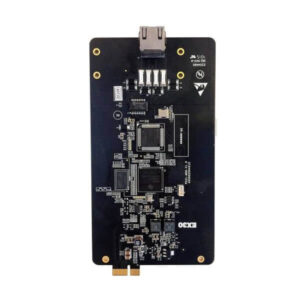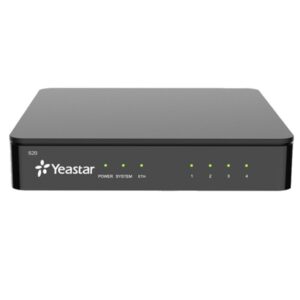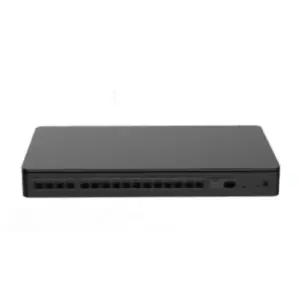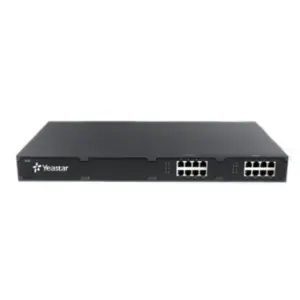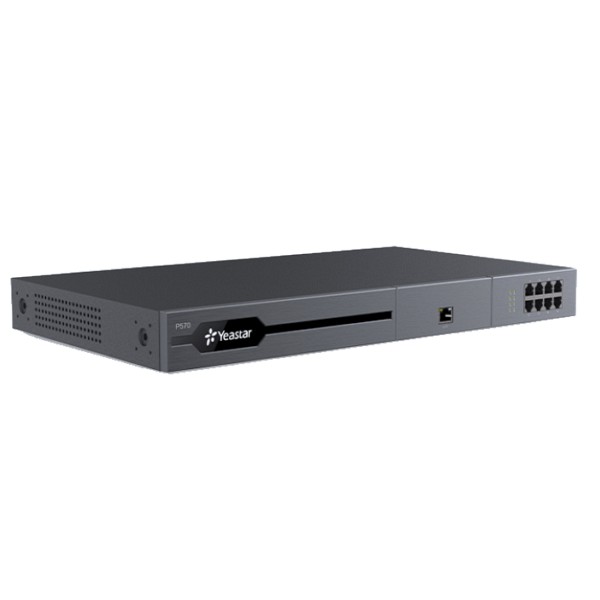
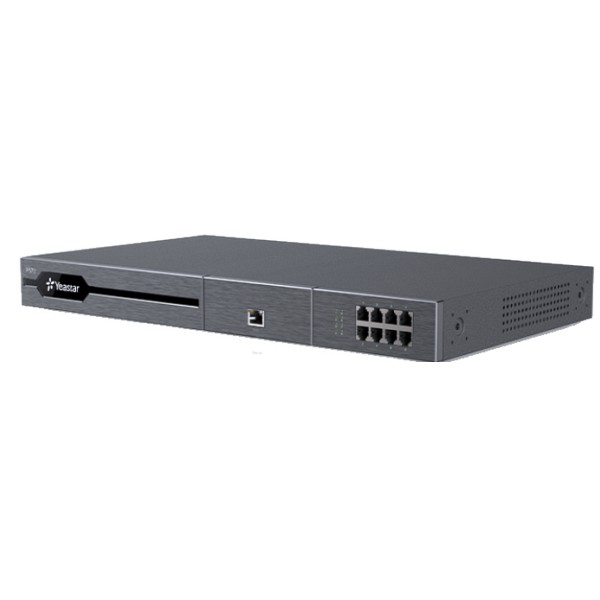
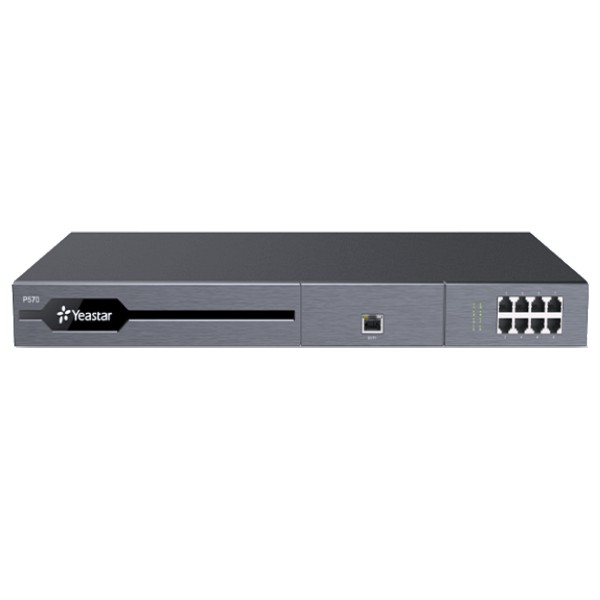
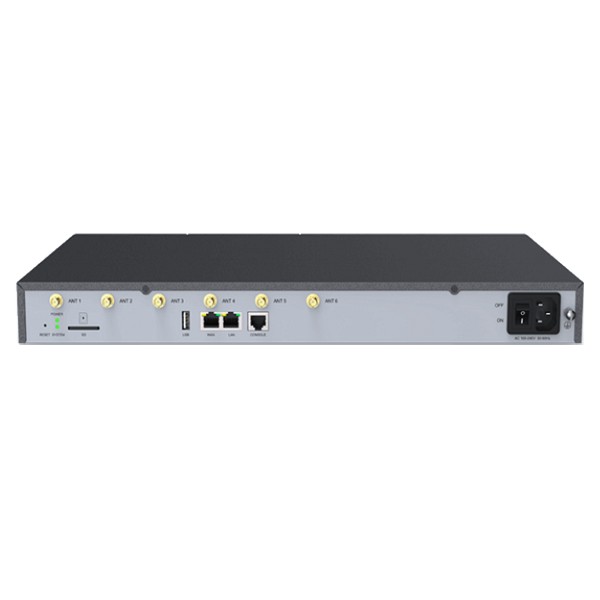
Yeastar P570 IP PBX in Dubai, UAE
Build a structured voice and collaboration environment for a larger office, contact team or multi-department organization. The P570 combines scalable extension capacity, modular telephony interfaces, call-management tools and Linkus unified communication clients in a 1U on-premise appliance. FourTeck helps buyers size the platform around real user numbers, simultaneous-call demand, trunk types, branch requirements and future growth rather than selecting hardware only by headline capacity.
60 / 90 / 120 Calls
Modular Trunk Options
1U Rack Deployment
Configuration Guidance
Quick Product Information
A Business Communication Core Built for Structured Growth
A growing organization eventually reaches the point where a basic office phone system becomes difficult to manage. More departments create more extension groups. Customer-facing teams need queues, recordings and supervisor visibility. Remote users need a secure way to remain connected. Branches need consistent dial plans. Management wants useful call records, while the IT team needs predictable administration and backup procedures. The P570 is designed for this stage of business growth: it provides a dedicated on-premise platform that can centralize calling and collaboration without forcing the company to build a PBX server from separate components.
The appliance starts at a capacity suitable for approximately 300 users and 60 simultaneous calls, with supported expansion paths to 400 or 500 users and 90 or 120 simultaneous calls. That distinction matters because extension count and concurrent-call count are not the same measurement. A company may have 350 registered users but only 45 people speaking externally or internally at the busiest moment. Another organization with fewer extensions may operate a contact desk where simultaneous usage is much higher. Correct sizing therefore begins with real call behavior, not a simple staff headcount.
The hardware also supports a modular approach to traditional and mobile telephony connections. Depending on the selected boards and modules, the system can accommodate analog extensions, analog lines, BRI interfaces, cellular channels and E1/T1/J1 connectivity. This helps businesses modernize at a practical pace. A hotel, clinic or industrial facility may still rely on analog handsets or fax devices, while the office team moves to SIP phones and Linkus clients. A company with an existing PRI service may need to retain that trunk during a migration. The modular design allows the communication plan to reflect the actual site rather than forcing every connection into one method.
For UAE buyers, the platform is most valuable when it is planned as part of the complete voice environment. The PBX must work with the network, firewall, SIP provider, IP phones, headsets, power protection, cabling and user policies. FourTeck supports this wider discussion. The goal is to determine whether the P570 has the right capacity, which interfaces are necessary, what subscription level is appropriate, how recordings should be stored, and what preparation will make deployment smoother. Buyers can also review FourTeck’s business PBX selection guide when comparing appliance, software and cloud approaches.
Key Business Benefits
The strongest reason to choose a higher-capacity PBX is not the number on a datasheet. It is the operational control the business gains when communication workflows, users and trunk resources are planned on one expandable platform.
Capacity That Can Follow Growth
A business can begin with the base user and call capacity, then expand within the supported P570 tiers when headcount or call demand increases. This protects the communication design from becoming undersized too early and gives procurement teams a clearer roadmap for phased growth.
Flexible Trunk Migration
SIP, analog, BRI, cellular and E1/T1/J1 requirements can be evaluated within one modular appliance. This is useful for sites that cannot replace all lines and endpoints in one project. The business can preserve necessary legacy connections while moving suitable users to IP communication.
Connected Teams Beyond the Desk
Linkus web, desktop and mobile clients allow eligible users to work with extensions and collaboration tools beyond a fixed desk phone. Remote-access design, security controls and plan requirements should be reviewed, but the result can be a more consistent experience for travelling staff and hybrid teams.
Better Customer Call Handling
IVR menus, queues, business hours, call routing, recording and supervisor functions can turn an unstructured phone setup into a controlled customer-contact workflow. Calls reach the correct teams more consistently, and managers gain better visibility into service activity.
Central Administration
A web-managed PBX gives the IT team one place to control extensions, routes, permissions, schedules, prompts and event information. Central administration reduces dependence on manual changes at individual phones and supports more consistent policies across departments.
Layered Communication Security
Supported controls include encrypted signaling and media options, two-factor authentication, password policies, allowed-country controls and defensive mechanisms. Effective protection still depends on correct firewall rules, administrator access, updates and user practice.
Integration Potential
The P-Series ecosystem can connect with selected CRM, helpdesk, directory and collaboration platforms according to plan and integration support. Proper integration can reduce repeated data entry, improve call context and help customer-facing staff work from familiar business tools.
Product Highlights That Matter During Procurement
The P570 sits at the higher end of Yeastar’s P-Series Appliance Edition range. Its value comes from the combination of capacity, modular interfaces and unified communication services. Buyers should view these strengths as parts of one design rather than isolated features.
Three Supported Capacity Levels
Choose 300, 400 or 500 users and the corresponding 60, 90 or 120 simultaneous-call tier. Expansion requires the appropriate DSP capacity and should be included in the project plan.
Two Expansion-Board Positions
Two board positions support a flexible mix of EX08 telephony-module expansion or EX30 digital trunk connectivity according to the required interface design.
Up to Six Cellular Ports
Selected module combinations can provide up to six 3G/4G ports. Carrier compatibility, SIM services, antenna placement and regional requirements must be checked before ordering.
Local Recording Storage Choices
A SATA drive bay supports storage up to 2TB, while the USB interface can support compatible portable storage. Recording volume, retention policy and backup location need to be planned separately.
Broad Endpoint Provisioning
Yeastar lists auto-provisioning support across hundreds of IP phone models. The exact handset model and firmware should still be validated before a large rollout.
NFC-Assisted Initial Network Setup
The appliance includes NFC read/write support that can assist with initial network setup through a compatible mobile workflow. Administrators should still apply documented production settings and security controls.
Some capabilities vary by Standard, Enterprise or Ultimate plan, and certain services or add-ons may have separate subscription conditions. FourTeck can help prepare a bill of materials that distinguishes base appliance capacity, expansion hardware, telephony modules, storage, endpoints, licenses and deployment services.
Configuration and Buyer Guidance
A successful PBX order begins with a communication map. Buyers should document how many people need extensions, how many external numbers are used, where calls enter the organization, which departments require queues, whether recordings are mandatory, and how staff work outside the office. This information turns a model request into an implementable design.
1. Count Users Correctly
Include desk-phone users, softphone users, common-area phones, reception positions, meeting rooms, security points, warehouse extensions, fax endpoints and future hires. Shared devices may not represent individual staff, but they still affect extension planning.
2. Estimate Peak Calls
Review busy-hour call records when available. Count internal and external simultaneous sessions, conference usage, queue traffic and remote extensions. A reasonable peak estimate prevents call capacity from being confused with total staff count.
3. Identify Every Trunk
List SIP trunks, analog lines, BRI services, PRI circuits and cellular channels. Note which services must remain during migration. This determines whether the appliance needs only network connectivity or a specific set of expansion boards and telephony modules.
4. Define User Features
Separate essential calling from advanced requirements such as supervisor tools, custom reports, CRM integration, omnichannel messaging, remote archiving or video collaboration. The appropriate feature plan should be selected from the required workflow.
5. Plan Storage and Retention
Recordings may be useful for training, quality control or dispute review, but they create storage and access responsibilities. Define retention time, authorized users, backup location and privacy policy before deciding on disk capacity.
6. Check Network Readiness
Voice quality depends on switches, cabling, VLAN design, QoS, firewall behavior, internet stability and endpoint power. A PBX upgrade should include a network review, especially when many phones or remote users will be added.
FourTeck can help convert these findings into a bill of materials covering the appliance, D30 modules, EX08 or EX30 boards, telephony modules, storage, IP phones, headsets, PoE switching, UPS protection and implementation services. Buyers looking at the wider infrastructure can review FourTeck IPBX and telecommunication solutions.
Ideal Business Use Cases
The P570 is most appropriate where communication is important enough to justify centralized control, higher capacity and room for modular integration. The following examples show how different organizations can use the platform without assuming that every feature or module belongs in every deployment.
Corporate Offices
A headquarters with finance, sales, service, operations and management teams can use a central dial plan, department ring groups, IVR menus, direct numbers, call permissions and reporting. Linkus clients can extend selected functions to laptops and mobile devices for employees who move between offices or work remotely.
Customer Support and Contact Desks
Queues, announcements, callbacks, recording and supervisor tools can support structured customer handling. The correct plan and agent count should be confirmed. Organizations should also design escalation rules, overflow destinations, working hours and recording access before go-live.
Hospitality Properties
Hotels and serviced residences may combine SIP office phones with analog room handsets, reception consoles, service extensions and emergency call flows. Optional hotel functions and PMS integration depend on edition and plan. Extension numbering, room status workflows and analog-port density must be designed carefully.
Healthcare Groups
Clinics and medical centers can route calls to reception, appointments, billing and clinical departments while maintaining after-hours messages and internal extensions. Privacy policies, recording access, emergency procedures and uptime expectations should be documented as part of the deployment.
Education Campuses
Schools, colleges and training groups can connect administration, admissions, faculty offices, security points and common areas. Paging, intercom, emergency numbers and permission policies should be matched to the campus layout and existing network.
Logistics and Warehousing
A logistics company may need office phones, dispatch desks, warehouse extensions, guard rooms and branch dialing. Reliable network links, cordless coverage, paging, mobile-user access and fallback arrangements are often as important as the core PBX hardware.
Multi-Branch Businesses
Retail, trading and service companies can use consistent extension numbering and inter-branch communication when connectivity and security are properly planned. The design should consider internet redundancy, branch firewalls, local emergency calling and what happens if the main site becomes unavailable.
Government and Large Administration Teams
Structured permissions, department routing, directory integration and administrative control can support larger teams. Procurement should include security review, backup procedures, role separation, change documentation and support ownership.
Yeastar P570 Capacity and Concurrent-Call Planning
Capacity planning is the first feature area that deserves close attention. The appliance can operate at 300 users and 60 concurrent calls, then scale through supported tiers to 400 users with 90 calls or 500 users with 120 calls. These pairings are meaningful because a PBX must have enough registered-user capacity and enough real-time media-processing capacity. An extension consumes a user position, while an active conversation consumes call capacity. Conferencing, call recording and other workflows can add resource considerations, so peak demand should be estimated conservatively.
A head office with 320 employees may not automatically need the 500-user configuration. It may fit the 400-user level if the extension plan, service accounts and growth allowance are understood. Conversely, a 250-seat customer-service operation can generate enough simultaneous sessions to make call capacity the deciding factor. Historical call detail records are the best starting point. Where no records exist, FourTeck can help the buyer estimate busy-hour traffic based on department behavior, outbound campaigns, incoming queue volume, conference use and remote staff.
Each supported D30 DSP expansion module adds capacity for 100 users and 30 concurrent calls, and the P570 can accept up to two. Buyers should decide whether expansion is required at launch or can be scheduled later. Installing only the base capacity may reduce initial cost, but a project expecting rapid growth should reserve budget, rack access and a maintenance window for future expansion. It is also wise to keep a margin rather than operating continuously at the theoretical maximum.
Capacity also influences licensing and user experience. Plan features, remote services, contact-center functions and integrations can have separate entitlement conditions. FourTeck’s proposal can clearly separate hardware capacity from service-plan requirements so the customer understands what is included now, what can be enabled later, and what may renew on a subscription basis.
Yeastar P570 Modular Telephony Connectivity
Many business sites are not purely SIP. They may have analog reception lines, fax machines, lift phones, door communication, BRI service, a PRI circuit or cellular calling requirements. The modular front section of the P570 allows the communication system to be assembled around these connections. The appliance supports two expansion boards. An EX08 board provides four module slots and eight panel interfaces, while an EX30 board provides an E1/T1/J1 connection. The chosen combination determines the physical ports available on the finished system.
Supported telephony modules include S2 for two FXS ports, O2 for two FXO ports, SO for one FXS and one FXO, B2 for two BRI interfaces, and cellular module options. This design lets a buyer create a practical mix. A hotel could require multiple FXS ports for analog room phones and one digital trunk. A company migrating from PSTN might retain several FXO lines while moving most traffic to SIP. A remote site may use cellular connectivity as part of its call strategy, subject to carrier and module compatibility.
The most common purchasing mistake is assuming that the maximum port count is included in the base appliance. It is not. Maximum values describe what the model can support with the appropriate expansion hardware. The quote must list every required board and module. It should also include antennas, cables, patching, rack accessories and any external gateways required by the site.
For projects with many analog endpoints, an external gateway can sometimes be cleaner than filling internal module slots. Buyers can review the Yeastar TA800 eight-port FXS gateway as one related option. FourTeck can compare internal modules and external gateways based on cable layout, rack position, endpoint count, maintenance access and future expansion.
Yeastar P570 Unified Communications and Administration
A modern PBX should support more than dial tone. Yeastar’s P-Series platform combines telephony with Linkus clients, operator tools, contact-center functions, messaging options, conferencing and integrations. The exact feature set depends on the selected plan, but the platform gives businesses a route to bring desk-phone calling, browser access, desktop applications and mobile communication into a more consistent environment.
For users, Linkus can provide access from web, desktop and mobile devices. This is useful for managers moving between locations, sales staff working remotely and teams that need extension-based communication without remaining beside a desk phone. Deployment still requires security decisions: administrators should define who may use remote access, how devices are protected, whether multi-factor controls are required, and how lost devices or departing staff are handled.
For reception and service teams, the Operator Panel and queue tools can improve visibility. Calls can be routed according to business hours, department rules, caller identity or other configured logic. Supervisors may use monitoring, reports, wallboards and post-call workflows where their selected plan supports them. A thoughtful design begins with the desired customer journey: greeting, language choice, department selection, queue treatment, overflow, voicemail, callback and after-hours behavior.
For administrators, browser-based control, permissions, event logs, backup and restore, phone provisioning and security settings reduce manual work. Integrations with supported CRM, helpdesk, directory and collaboration services can make call context more useful, but compatibility should be confirmed against the exact platform edition, subscription, API availability and customer workflow.
The best outcome is not enabling every available function. It is choosing the functions employees will actually use, assigning clear owners, documenting changes and training key users. FourTeck can help translate operational requirements into a manageable launch plan rather than presenting the system as a long list of unused features.
What Buyers Should Check Before Purchase
Before requesting a quote, buyers should confirm the required capacity, usage environment, compatibility needs, support expectations and delivery location. The P570 model name alone does not define the finished system. Expansion modules, trunk interfaces, storage, service plan, IP phones, network equipment and installation scope can change both the cost and the deployment result.
Configuration Fit
Confirm the required user tier, simultaneous-call tier and whether D30 expansion is needed immediately. Provide extension growth estimates for at least the next few years so the system is not selected too close to its limit.
Trunk and Port Mix
List every SIP, analog, BRI, PRI and cellular requirement. Specify how many channels are active, which numbers must be retained and whether old services will be removed after migration.
Phone Compatibility
Share the make, model and firmware of existing IP phones. Auto-provisioning support is broad, but large deployments should validate the exact endpoint and required functions such as BLF, directory, headset control and secure provisioning.
Plan and Renewal Scope
Identify essential advanced functions before choosing Standard, Enterprise or Ultimate. Ask which services renew, which add-ons are optional and what happens to functionality if a subscription is not renewed.
Recording and Storage
Estimate recording minutes, retention period and access policy. Decide whether local storage, USB storage or remote archiving is appropriate, and include backup procedures in the operational plan.
Rack, Power and Network
Reserve 1U rack space, provide suitable cooling, protective earth, UPS-backed power and structured Ethernet. Review PoE-switch capacity for phones and confirm firewall, VLAN and QoS readiness.
Deployment Responsibility
Define who will configure trunks, create extensions, record prompts, build IVR menus, provision phones, train users and support the system after launch. A clear responsibility matrix reduces delays and missed tasks.
Quote Preparation
Provide company location, quantity, target date, user count, call estimate, trunk details, phone requirements, desired features and installation scope. This information helps FourTeck prepare a relevant proposal instead of a generic appliance-only price.
Buyers replacing a smaller P-Series appliance should also review license, subscription and migration requirements rather than assuming settings can be moved without preparation. FourTeck’s Yeastar P550 Enterprise renewal page is a useful reference for understanding why plan status and renewal details need to be checked separately from hardware.
UAE Availability and Service Support
FourTeck supports product inquiries across Dubai and the wider UAE with assistance for capacity planning, module selection, licensing review, quotation, delivery coordination and warranty guidance. Availability can vary according to the appliance version, expansion boards, telephony modules, DSP capacity, storage, requested quantity and supplier status. For that reason, the most useful inquiry includes the complete communication requirement rather than the model name alone.
Pre-sales guidance can cover extension count, busy-hour call estimates, SIP or legacy trunk requirements, existing IP phones, analog endpoints, call recording, contact-center needs, remote users, integration expectations and rack environment. FourTeck can help identify missing accessories and clarify which items belong in the initial order. This is particularly important when the deployment includes EX08 or EX30 boards, telephony modules, D30 expansion, internal storage, headsets, PoE switching or UPS protection.
Warranty handling and support terms should be reviewed with the current quotation. Buyers should ask what is covered by the product warranty, what implementation services are included, how software updates are handled, and whether ongoing remote or onsite support is required. A well-defined support scope reduces confusion after installation and helps the customer assign internal responsibility for administration, backups and change control.
Dubai, Abu Dhabi, Sharjah and Ajman Coverage
Businesses in Dubai, Abu Dhabi, Sharjah, Ajman and other UAE locations can contact FourTeck for availability checks, configuration guidance and quote assistance. The communication requirement may be a headquarters upgrade, a new branch rollout, a contact-center project, a hotel migration or a replacement for an older PBX. Each project benefits from the same preparation: user count, call volume, trunk inventory, endpoint list, feature requirements and target deployment date.
Delivery and implementation planning depend on the destination, site access, rack readiness, cabling, number-porting or trunk arrangements, and the availability of chosen modules. Multi-site businesses should also explain whether all branches will register to one central appliance, use local gateways, or require a different resilience approach. Network links and firewalls between locations must be reviewed before assuming that inter-branch calling will work reliably.
FourTeck can coordinate product supply and related solution discussions across the UAE, but final availability and schedule are confirmed only after the configuration and quantity are known. This avoids unverified stock claims and gives the buyer a clearer understanding of what will be supplied, configured and supported.
GCC and Africa Availability
FourTeck also supports business technology inquiries across selected GCC and Africa markets through regional platforms and inquiry channels. Organizations in Saudi Arabia, Qatar, Oman, Kuwait and Bahrain may contact the team for product matching, capacity discussion and supply coordination. Companies in Kenya, Uganda and other African markets can use the relevant FourTeck regional channels to discuss project requirements.
Cross-border orders require additional checks. Telephony regulations, carrier services, module compatibility, power standards, warranty handling, customs, delivery terms and local installation resources can vary. A cellular module suitable in one country may not be the right choice in another. SIP-trunk certification and number requirements also differ by provider. Buyers should share the installation country, carrier, trunk type and expected support model before a proposal is finalized.
Regional projects often include multiple branches with different endpoint counts and network conditions. FourTeck can help structure the inquiry so each site has a clear user count, call estimate, trunk plan and accessory list. Availability, delivery, warranty and service arrangements remain subject to product type, country and supplier confirmation.
Other Options Buyers May Consider
A complete communication project usually includes more than one product. Related choices depend on whether the customer needs a smaller PBX, analog extension growth, a wider IPBX service, endpoint replacement or network preparation. These references help buyers explore the surrounding solution without making an unfair one-model comparison.
Yeastar TA800 FXS Gateway
Suitable when the project needs eight external analog-extension ports without consuming the PBX’s internal module positions. Useful for analog phones, fax devices and phased migrations.
Yeastar P550 Enterprise Renewal
Helpful for buyers reviewing how P-Series plans, renewal terms and feature entitlements are managed separately from the physical PBX appliance.
Business PBX Selection Guide
Compare on-premise appliances, software platforms and cloud phone systems by business size, control preference, remote access, licensing and deployment approach.
IPBX and Telecom Solutions
Useful when the requirement includes SIP trunks, cabling, IP phones, network switching, firewalls, IVR setup, migration and ongoing support.
Business IP Phones
A PBX rollout may need executive phones, reception consoles, general office handsets, cordless devices and headsets selected around user roles.
Project Consultation
Choose this path when the buyer has mixed trunks, several branches, legacy phones, compliance concerns or an unclear migration sequence.
Why Buyers Choose FourTeck
Business communication purchases often fail because the discussion stops at model and price. FourTeck approaches the inquiry as a working system. The team can help buyers understand what the appliance must connect to, how many users and calls it must support, which modules are necessary, and what services are required before staff can use it confidently.
Business IT Supply Support
The proposal can include related infrastructure such as IP phones, PoE switches, firewalls, UPS protection, racks and storage rather than treating the PBX as an isolated box.
Configuration Guidance
User capacity, call capacity, boards, modules, storage and plans can be reviewed against the actual workload so the buyer receives a more relevant bill of materials.
Pre-Sales Consultation
The team can discuss call flow, trunk migration, endpoint compatibility, recording requirements and branch connectivity before the order is finalized.
Quote Assistance
Buyers receive a clearer path to a current quotation after sharing the quantity, location, required capacity, module mix and service scope.
UAE Delivery Coordination
Delivery planning can account for product configuration, supplier confirmation, order quantity and site requirements without using unverified availability claims.
Warranty Guidance
Current vendor and supplier terms can be explained with the quotation so buyers understand product coverage, service scope and escalation paths.
FourTeck supports SMB, mid-market and enterprise buyers that need a practical procurement conversation. The objective is not to claim that one appliance suits every organization. It is to help the customer determine whether the P570 matches the site, and to identify a more suitable option when capacity, deployment style or budget points elsewhere.
Frequently Asked Questions
What is the Yeastar P570 used for?
It is an on-premise IP PBX and unified communication appliance for organizations that need centralized extension management, call routing, IVR, queues, recordings, remote-user tools and integration options. It is suited to larger offices, contact teams, hospitality, healthcare, education and multi-branch environments where the required capacity falls within the supported P570 tiers.
How many users and simultaneous calls can it support?
The supported appliance tiers are 300 users with 60 concurrent calls, 400 users with 90 concurrent calls, and 500 users with 120 concurrent calls. Expansion depends on the correct D30 DSP capacity. Buyers should estimate busy-hour traffic separately from total staff count because not every registered user will be on a call at the same time.
Does the base appliance include all analog and digital ports?
No. The maximum FXS, FXO, BRI, cellular and E1/T1/J1 values describe supported limits when suitable expansion boards and telephony modules are installed. The base appliance should be quoted with the exact EX08 or EX30 boards and the modules required for the customer’s trunk and endpoint design.
Can FourTeck help choose the correct configuration?
Yes. FourTeck can review extension count, peak calls, SIP and legacy trunks, analog endpoints, IP phones, recording needs, remote users, feature plans, rack environment and deployment scope. This information helps create a bill of materials that covers the appliance and the required modules, storage, endpoints and related infrastructure.
Is the P570 available in Dubai and the UAE?
FourTeck accepts inquiries for Dubai and other UAE locations. Current availability depends on the appliance version, expansion modules, plan, quantity and supplier status. Contact the sales team with the required configuration and delivery location so availability and quotation details can be checked for the complete order rather than only the base unit.
Does it support remote and mobile users?
The P-Series platform supports Linkus clients for web, desktop and mobile use, with available remote-access services depending on the selected plan and deployment. A secure rollout should include user permissions, strong authentication, firewall review, device policy and a process for lost devices or departing employees.
Can the system record calls?
Call recording is supported on the appliance platform, subject to configuration and applicable policies. Buyers should plan storage capacity, retention time, backup, user access and legal requirements. The appliance supports a SATA drive bay and compatible external storage options, but the correct capacity depends on actual recording volume.
Which IP phones can be used?
Yeastar states broad auto-provisioning support across many IP phone models, but buyers should verify the exact phone and firmware. Important checks include SIP compatibility, BLF behavior, directory support, headset integration, secure provisioning, PoE requirements and whether existing devices need manual configuration.
How do Standard, Enterprise and Ultimate plans differ?
All plans provide core calling features, while advanced communication, contact-center, reporting, integration, messaging and archiving functions vary. Some services or add-ons may renew separately. Buyers should list required workflows first, then confirm the plan and renewal terms instead of choosing only by plan name.
Can businesses request bulk or project supply?
Yes. Businesses can request project quotations covering one or more PBX appliances, expansion hardware, IP phones, gateways, headsets, PoE switches, UPS systems and deployment services. Share the site count, quantities, rollout schedule, delivery locations and support expectations so FourTeck can prepare a structured proposal.
Need Help Choosing the Right P570 Configuration?
Send FourTeck your user count, peak call estimate, trunk types, phone quantity, required features and delivery location. The team can help review capacity, modules, storage, plan options, warranty guidance and project requirements before preparing a current quotation.