

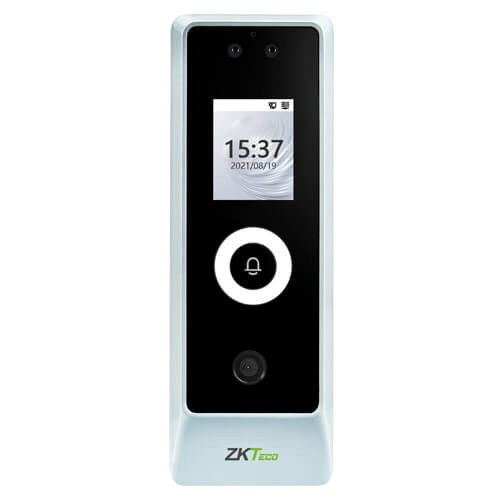
Contactless access control for staff, visitors and secured doors
The direct answer: this terminal is designed for organizations that want one outdoor-capable access point to recognize faces, accept QR credentials and read compatible RFID cards without relying on a separate reader for every credential type. It can manage the door interface locally while communicating with ZKTeco management software and related access-control infrastructure.
The ZKTeco ProMA-QR sits between a simple credential reader and a larger multi-component access system. Its role is to authenticate a person or credential at the door, apply access rules, and communicate an entry decision to the connected lock and door hardware. That makes it relevant to office lobbies, employee entrances, warehouse staff doors, shared commercial buildings, campuses, reception-controlled environments, residential communities and locations where temporary visitor credentials are useful.
QR support is particularly useful when the organization wants a digital credential that can be issued without handing every visitor a physical card. ZKTeco lists dynamic and static QR authentication for this model, with dynamic QR use linked to the ZKBio CVSecurity environment. Facial recognition adds a second contactless method for regular users, while RFID remains useful for existing card populations, staff groups or fallback workflows. Optional palm authentication may also be available in selected configurations, so buyers should specify whether palm is part of the requirement rather than assume it is included by default.
From a deployment perspective, the unit includes interfaces for an electric lock, door sensor, exit button, alarm and auxiliary functions, plus TCP/IP, Wiegand and RS485 connectivity. This matters because a door project is rarely just the terminal. A complete design may also need a suitable lock type, power supply, exit hardware, emergency release path, door contact, network connection, mounting position and software configuration. The right combination changes by door construction, life-safety requirements and the organization’s security policy.
For UAE buyers, FourTeck can help turn those requirements into a clearer bill of materials before a quotation is finalized. Share how many doors need control, approximate enrolled user count, whether visitors require QR codes, which card technology is already in use, the management platform, installation environment and any integration requirement. That information is more useful than selecting the model only by headline capacity.
Why the credential mix matters in a real access-control project
The strongest business value is flexibility: regular staff, contractors and visitors do not all need to use the same credential. A well-planned deployment can assign an authentication method that fits each population while keeping door events under one access-control workflow.
Use different entry methods for different people
Employees may prefer face or card authentication for everyday entry, while visitors can be issued QR credentials for a limited workflow. This can reduce pressure to issue physical cards for every short-term guest and gives security teams a more flexible approach to enrollment. The important buyer decision is not simply whether the terminal supports several methods, but how each method will be assigned, managed and revoked.
Fast touchless authentication
Current ZKTeco specifications list facial authentication below 0.35 seconds. In busy reception or staff-entry environments, fast recognition can help keep the access point moving, provided enrollment quality, camera position, lighting and access rules are configured correctly.
Room for large user populations
The published specification includes 50,000 users, 30,000 face templates as standard, 50,000 cards and 500,000 transaction records. This can suit sites that need more than a small-office reader, while still requiring sensible planning for enrollment, retention and system administration.
A metal terminal designed for exposed access points
ZKTeco lists an aluminium-alloy housing and IK07 vandal resistance. The current global parameter table lists IP67 ingress protection, while older regional literature may still show IP66. If weather sealing is a contractual requirement, buyers should ask for the exact hardware revision and datasheet that will be supplied. That verification is more reliable than assuming every regional listing represents the same production revision.
Works beyond a single isolated door
TCP/IP, Wiegand and RS485 support give system designers several ways to connect the terminal within an access-control environment. ZKBio CVSecurity support adds centralized administration where that platform is selected for the project.
Core door interfaces are built in
Electric lock, door sensor, exit button and alarm connections reduce the need to treat the device only as a front-end reader. The installation still needs appropriate power, lock selection, emergency egress design and local regulatory review.
Important strengths to confirm before you buy
The ProMA-QR is built around three practical themes: contactless credentials, rugged physical construction and integration into a managed access-control environment. Buyers should evaluate all three together because a strong terminal can still be the wrong choice if the credential policy or existing infrastructure does not match.
The current global specification identifies a 2MP WDR binocular camera, 2-inch colour LCD, Quad Core A55 1.2GHz processor, 1GB RAM and 8GB ROM. Facial authentication distance is listed from 30cm to 170cm. Those characteristics support the terminal’s role as a compact face-authentication endpoint rather than a large interactive kiosk.
- Face, RFID and dynamic/static QR authentication on ProMA-QR.
- Optional palm authentication where the selected configuration supports it.
- 30,000 face templates standard; 50,000 listed as an optional expansion.
- 50,000 card capacity, 50,000 user capacity and 500,000 transaction capacity.
- TCP/IP, Wiegand input/output and ZKTeco RS485 connectivity.
- Webserver, anti-passback, access levels, groups, holidays and record query functions.
- SIP video intercom and ONVIF support listed on the current ZAM230-platform global specification.
- Wall mounting with compatibility for Asian gang-box and single gang-box formats.
Some older ProMA literature contains earlier platform details, capacity options and protection ratings. For a new project, FourTeck recommends confirming the exact part supplied, firmware/platform generation and applicable datasheet before treating a feature as contractually included. This is especially important for ingress protection, optional RFID modules, palm capability, video-intercom functions and any third-party interoperability requirement.
ProMA-QR specification reference for procurement
The table below follows ZKTeco’s current global ProMA Series parameter set for the ProMA-QR model. Regional literature may differ by hardware revision or option, so final quoted configuration should be checked before order approval.
| Specification | ProMA-QR detail | Buyer note |
|---|---|---|
| Product type | Standalone multi-credential access control terminal | For controlled doors and managed entry points |
| Operating system | Linux | Confirm software and firmware requirements |
| Processor / memory | Quad Core A55 1.2GHz, 1GB RAM, 8GB ROM | Current global ZAM230 platform listing |
| Display | 2.0-inch colour LCD, 240 × 320 | Compact status and interaction display |
| Camera | 2MP WDR binocular camera | Placement and lighting still affect recognition quality |
| Authentication | Face, card, QR code; palm optional | Confirm optional palm requirement in quote |
| QR code | Dynamic and static QR authentication | Dynamic QR use is linked to ZKBio CVSecurity workflow |
| Face capacity | 30,000 standard; 50,000 optional | Select capacity for expected enrollment growth |
| Card / user capacity | 50,000 cards / 50,000 users | Card technology options should be checked separately |
| Transactions | 500,000 | Plan event sync and retention in the management system |
| Face authentication speed | Less than 0.35 seconds | Actual user flow depends on environment and access rules |
| Face distance | 30cm to 170cm | Mounting height and approach path matter |
| Communication | TCP/IP, Wiegand input/output, RS485 | Match to controller, reader and network design |
| Door interfaces | Electric lock, door sensor, exit button, alarm, auxiliary I/O | Lock and life-safety hardware are project dependent |
| Software | ZKBio CVSecurity; ZKBio Time listed for TA Push on current platform | Licensing and deployment scope should be quoted separately |
| Video / intercom | SIP video intercom and ONVIF support on current ZAM230 listing | Confirm compatible monitor/NVR topology before project sign-off |
| Power | DC 12V 3A | Power design must also account for lock and accessories |
| Operating environment | -26°C to 55°C; 10% to 90% RH non-condensing | Check site exposure and enclosure requirements |
| Protection | Current global table: IP67 and IK07 | Older literature may state IP66; verify exact supplied revision |
| Dimensions / net weight | 194.7 × 68.7 × 28.3mm / 0.45kg | Check wall space, back box and cable route |
How to read this specification table
Capacity figures describe what the terminal platform can store, but they do not determine whether the deployment is well designed. A 30,000-face capacity does not mean every site should enroll 30,000 people. Consider expected active users, turnover, visitor frequency, database administration and how quickly events are synchronized to the management server.
Likewise, communication interfaces are not a guarantee that every third-party controller or reader will interoperate without testing. Wiegand, RS485, SIP and ONVIF describe available standards or protocols, but compatibility still depends on mode, firmware, profile, system architecture and the exact device on the other end. For critical integrations, confirm compatibility before purchase and include commissioning time in the project scope.
Questions that determine the correct door configuration
Start with the door and user workflow, not the terminal alone. The same model can be a good fit for one entrance and a poor fit for another depending on credential policy, lock hardware, network availability, visitor process and system integration.
Who needs to enter?
Separate permanent staff, temporary contractors, recurring visitors and one-time guests. That tells you whether face, card, QR or a combination should be the normal credential.
What card technology exists today?
Do not assume an existing staff card will work because both systems are described as RFID. Confirm frequency, card technology and required module before ordering.
How will visitors receive QR codes?
Define who creates the credential, how long it remains valid, whether it can be reused, and what happens when a visit changes. This process determines the software and administration requirements.
Which lock and door hardware will be controlled?
Maglocks, electric strikes, door sensors, emergency release devices and exit buttons have different wiring and life-safety considerations. Include the full door hardware in planning.
Where will management run?
If ZKBio CVSecurity is part of the project, confirm server, licensing, network access, administrator responsibility and backup expectations. Software should be treated as part of the solution, not an afterthought.
Is the site exposed to weather or impact?
For outdoor or semi-exposed locations, confirm the exact supplied ingress rating, cable entry, sun/rain exposure, mounting surface and any protective installation details required by the site.
For a useful FourTeck quotation, send the required quantity, number of doors, user count, existing card type if any, visitor QR requirement, preferred management software, door lock type, project location, target installation date and whether installation or configuration assistance is needed. If the project includes existing controllers or third-party NVR/intercom equipment, include the model numbers so compatibility can be reviewed instead of assumed.
Where this terminal fits best
The ProMA-QR is most useful where identity, temporary credentials and physical door control need to meet at the same access point. It is not merely an attendance clock; it is an access-control endpoint with door interfaces and management functions.
Corporate entrances with mixed employee and visitor access
A corporate lobby often has two very different populations. Employees need quick repeatable entry, while guests need controlled temporary access. Face or RFID can serve regular staff, and QR can be used for visitors when the software workflow is designed to issue and expire credentials appropriately. This reduces the need to maintain a single credential policy for everyone and can make reception processes easier to standardize.
Warehouses and logistics sites
Staff doors, contractor entrances and controlled operational zones can benefit from rugged access terminals. Buyers should pay extra attention to dust exposure, outdoor mounting, gloves or PPE, lighting, network routes and whether user flow peaks at shift changes.
Education and campus environments
Campuses may have staff, students, contractors and visitors using different entry policies. High user capacity and centralized management can be useful, but privacy policy, enrollment governance and door-group design should be agreed before large-scale biometric deployment.
Residential communities and managed buildings
Resident credentials can be combined with QR-based visitor workflows where the selected management platform supports the intended process. Deployment planning should include gate/door type, visitor authorization responsibility, intercom requirements and after-hours support procedures.
Data rooms and restricted internal spaces
For sensitive rooms, access levels, anti-passback and multiple verification methods may be relevant. The final policy should be based on the organization’s security risk and compliance requirements, with the lock hardware and door monitoring designed accordingly.
Multi-site businesses standardizing access control
Organizations with several branches often want common credential rules, centralized user administration and consistent door-event visibility. The terminal can be part of that standardization when each site has suitable network connectivity and the management platform is designed for the number of locations. Before a bulk order, test the proposed workflow at one representative site, document enrollment and visitor procedures, confirm card compatibility, and define how firmware, user data and device health will be administered across branches.
ZKTeco ProMA-QR Multi-Credential Access
Face, QR and RFID do not simply add more ways to unlock a door. They let an organization design different credential experiences for different groups. That is valuable when permanent employees, temporary contractors and guests all pass through the same entrance but should not be enrolled in the same way.
Facial recognition is convenient for regular users because the credential is contactless and cannot be forgotten in the same way as a card. RFID remains practical where organizations already issue cards or need a familiar physical credential. QR becomes important when the business wants to send a digital token to a visitor’s phone or print it for temporary use. The management process behind the credential remains critical: issue, validity period, revocation and event logging should be defined before deployment.
Buyer outcomes
- Less dependence on one credential format for every user.
- Potentially simpler visitor access when QR issuance is configured correctly.
- Faster routine entry for enrolled staff using face recognition.
- Ability to retain compatible card workflows where RFID remains important.
- More policy flexibility for different doors, access levels and user groups.
Decision point: confirm the exact card technology and QR management workflow before ordering. “RFID” and “QR support” are broad labels; the project needs to match actual credential formats and software behavior.
ZKTeco ProMA-QR Outdoor Deployment Design
An access terminal installed outside a building entrance has a harder job than a reader mounted in a protected interior corridor. It must cope with temperature, dust, moisture exposure, physical contact, glare, mounting conditions and cable entry while still recognizing users quickly. The ProMA family addresses that requirement with an aluminium-alloy body and published vandal and ingress protection ratings.
The rating does not remove the need for good installation practice. The installer still needs to protect cable terminations, choose a stable mounting height, avoid direct water paths into wall penetrations, manage sun and backlight where possible, and ensure the connected power and lock hardware are suitable for the location. For a UAE outdoor project, provide FourTeck with photos or a description of the entrance so exposure can be considered before final product selection.
ZKTeco ProMA-QR Integration and Management
The terminal can fit into a wider system, but integration must be designed deliberately. ZKTeco lists TCP/IP, Wiegand input/output and RS485, along with ZKBio CVSecurity support. The current ZAM230 global specification also lists SIP video intercom and ONVIF compatibility, giving project teams additional integration possibilities when the required devices and profiles match.
Management checklist
- Where will ZKBio CVSecurity run?
- Who owns user enrollment and deletion?
- How often are event logs synchronized or backed up?
- Which administrators can change door rules?
- How will multiple sites be segmented and supported?
Integration checklist
- Controller or reader model and interface mode.
- Lock, sensor, alarm and exit-device wiring.
- NVR or indoor monitor model if video functions are required.
- Required ONVIF profile or SIP behavior.
- Network VLAN, addressing and firewall requirements.
A common project mistake is to see a familiar protocol name and assume plug-and-play compatibility. Standards improve interoperability, but firmware versions, protocol profiles and feature implementation can still differ. For high-risk integrations, the safer approach is to confirm the exact devices, test the required workflow and include commissioning responsibility in the scope rather than relying on a generic compatibility label.
What Buyers Should Check Before Purchase
The biggest risk is buying the correct model name with the wrong surrounding configuration. Credential type, software, lock hardware, outdoor rating, network design and optional modules can change whether the terminal actually fits the requirement.
Configuration Fit
Confirm active user count, expected face enrollment, card population, QR visitor volume and whether optional palm authentication is required. Ask for the exact regional part and current datasheet when an optional capacity or feature is part of the project specification.
Compatibility Check
Identify existing card technology, controller or reader model, lock type, management software, network design and any NVR/intercom component. A protocol name is not enough; the feature used in the project should be verified end to end.
Availability and Warranty
Availability, supplied revision and warranty terms can vary by source and order. Request current written confirmation for the exact unit, accessories and support scope. If a project needs a specific ingress rating or certification, include it explicitly in the requirement.
Quote Preparation
Send quantity, number of doors, deployment location, user count, credential method, existing card type, software requirement, lock details, target date and installation scope. This lets FourTeck prepare a more relevant quotation instead of pricing an incomplete hardware-only request.
Should I choose ProMA-QR or another ProMA model?
Choose the QR variant when QR credentials are a genuine part of the access workflow. If the project only needs face and RFID, the ProMA-RF family option may be sufficient depending on the current regional offering. If fingerprint is required, the standard ProMA model is the family member designed to include fingerprint authentication. The right choice follows the required credential mix, not the most feature-rich name.
Buying support for UAE access-control projects
FourTeck supports product inquiries across Dubai and the UAE with assistance for model selection, configuration review, quotation requests, delivery coordination and warranty guidance. Availability can vary based on the exact hardware revision, optional credential module, supplier status, required quantity and project schedule, so current supply should be confirmed before procurement approval.
For project-level assistance, buyers can also review FourTeck’s CCTV and access control systems guidance or discuss wider deployment needs through the FourTeck IT services overview.
Dubai, Abu Dhabi, Sharjah and Ajman coverage
Businesses in Dubai, Abu Dhabi, Sharjah, Ajman and other UAE locations can contact FourTeck for product availability checks, configuration guidance and quotation assistance. The most useful first conversation covers the door count, credential method, user population and deployment environment so the terminal, accessories and software can be reviewed as one access-control requirement.
For multi-site rollouts, share whether all locations will use the same card technology and access rules. Standardizing these decisions early can make enrollment, administration, spare planning and troubleshooting more consistent across branches. If sites differ significantly in door construction or exposure, the hardware and installation scope may still need site-specific adjustment.
GCC and Africa availability planning
FourTeck also supports business technology inquiries across selected GCC and Africa markets through regional channels. Organizations in Saudi Arabia, Qatar, Oman, Kuwait and Bahrain, as well as Kenya, Uganda and other Africa-region markets, can discuss product requirements, but availability, delivery options, warranty handling and configuration support may differ by country and supplier route.
Regional projects benefit from a standardized technical schedule that lists the exact model, credential type, capacity, software requirement, door interfaces, expected quantity and required delivery location. This makes it easier to compare like-for-like supply across several destinations and reduces the risk of mixing hardware revisions or optional modules unintentionally.
Other options buyers may consider
The best alternative depends on the credential mix and whether the project needs a standalone terminal, a broader access-control installation or supporting network hardware. These options help buyers frame the surrounding requirement without assuming every project should use the same device.
ZKTeco ProMA-RF family option
Consider the ProMA-RF family variant when the requirement is face and card access without a QR-code workflow. It can reduce feature complexity if visitors will not use QR credentials.
ZKTeco ProMA family option with fingerprint
Consider the standard ProMA family model when fingerprint authentication is a stated requirement. Fingerprint is not listed as an authentication method for ProMA-QR, so the credential requirement should drive model selection.
Access control system design
Useful when the requirement includes multiple doors, locks, readers, cabling, centralized software and commissioning rather than a terminal-only purchase.
PoE and network switching
Access-control endpoints still depend on a stable network. Review switch capacity, VLAN design and power requirements if the door system shares business infrastructure.
CCTV integration planning
Where access events and surveillance are part of one security design, network capacity, NVR compatibility, camera coverage and event procedures should be reviewed together.
Project consultation
Choose this path when the buyer needs help defining the requirement before selecting hardware, licenses and installation scope.
Practical support around the hardware purchase
Access control is one of the product categories where a quotation can look complete while still missing a critical item. The terminal, lock, power, door sensor, exit hardware, software, network and installation details must work together. FourTeck’s role is to help business buyers make those dependencies visible before purchase.
FourTeck does not need to treat every inquiry as a one-model purchase. If the requirement indicates a different credential mix, higher project complexity or integration risk, the recommendation can shift toward another model or a full access-control design. Buyers can start from the FourTeck UAE website or go directly to the FourTeck contact page with project details.
Questions business buyers ask before ordering
What is the ProMA-QR used for?
It is a standalone access-control terminal for managing entry through controlled doors using facial recognition, RFID cards and QR codes. It can connect to electric lock, door sensor, exit button and alarm interfaces, while also communicating with management software such as ZKBio CVSecurity. It is suited to business entrances, campuses, logistics sites, residential communities and other managed-access locations.
Does it support both static and dynamic QR codes?
Yes. ZKTeco’s current product specification lists dynamic and static QR code authentication for the ProMA-QR. Dynamic QR use is associated with the ZKBio CVSecurity mobile workflow. Before deployment, define who creates the QR credential, its validity period and how it is revoked so the visitor process is secure and manageable.
How many faces and cards can it store?
The current global specification lists 30,000 facial templates as standard, with 50,000 available as an optional capacity, plus 50,000 card credentials, 50,000 users and 500,000 transaction records. Buyers should select capacity based on active enrollment and expected growth rather than simply choosing the highest possible number.
Is it suitable for outdoor installation?
ZKTeco lists an aluminium-alloy housing, IK07 vandal resistance and a current global ingress-protection rating of IP67. Some older regional literature lists IP66, so buyers with a contractual outdoor rating should confirm the exact supplied hardware revision and datasheet. Correct mounting, cable sealing and site exposure remain important even when the terminal carries an outdoor rating.
Can it work with existing RFID cards?
Possibly, but card compatibility should be checked rather than assumed. The ProMA family is offered with different RFID technology options and modules. Provide FourTeck with the existing card type, frequency or a sample/card model where possible so the proposed terminal configuration can be matched to the credential already used by employees.
Does ProMA-QR include fingerprint recognition?
No. ZKTeco lists fingerprint authentication on the standard ProMA family model, not on ProMA-QR. The QR variant is designed around face, card and QR authentication, with optional palm support depending on configuration. If fingerprint is required, buyers should compare the standard ProMA model rather than assume a sensor is present on the QR version.
Can FourTeck help with configuration and installation planning?
FourTeck can help review door count, credential method, user capacity, existing card technology, software requirement, network connectivity, lock type, deployment environment and delivery location. Installation scope depends on the project, so provide details about the existing door and cabling if you want the quotation discussion to include deployment rather than hardware only.
Is it available in Dubai and the UAE?
FourTeck can assist with availability and quotation requests for Dubai and UAE projects. Current supply can vary by hardware revision, optional module, required quantity and supplier status. Contact FourTeck with the intended configuration and project schedule so availability can be checked against the exact model requirement rather than a generic family name.
What information should I send for a quote?
Send the product model, required quantity, number of doors, estimated user count, face/card/QR requirements, existing card type, software preference, lock or door hardware details, project location, target date and whether you need installation or configuration support. For system integration, also provide controller, NVR or intercom model numbers where applicable.
Can businesses request bulk supply for multiple sites?
Yes, businesses can request project or bulk supply support. For multi-site deployments, provide the total quantity, site list, preferred standard credential policy, management-platform plan and delivery schedule. FourTeck can review the requirement for consistent model selection and identify where site-specific door hardware or environmental conditions may require a different installation approach.
Need Help Building the Right Access-Control Quote?
FourTeck can review your credential policy, user count, door hardware, software requirement, integration needs, deployment location and quantity before preparing a quotation. This is especially useful when QR visitors, existing RFID cards or outdoor installation conditions are part of the project.
Share the model, quantity, number of doors, credential methods, existing card type, software requirement, delivery location and target project date.
Reviews
There are no reviews yet.