

ZKTeco SpeedFace-V3L-RFID Facial Recognition RFID Terminal in Dubai, UAE
A compact Linux-based stand-alone access terminal that combines visible-light facial recognition with RFID card and virtual-password verification for controlled doors and attendance workflows.
It is a practical fit for organizations that want a narrow wall-mounted terminal, fast face verification, flexible reader and door interfaces, and a path into ZKTeco software without buying a larger kiosk-style device. The RFID variant is distinct from the base SpeedFace-V3L: the manufacturer model table lists face, card and password authentication for this version rather than fingerprint enrollment.
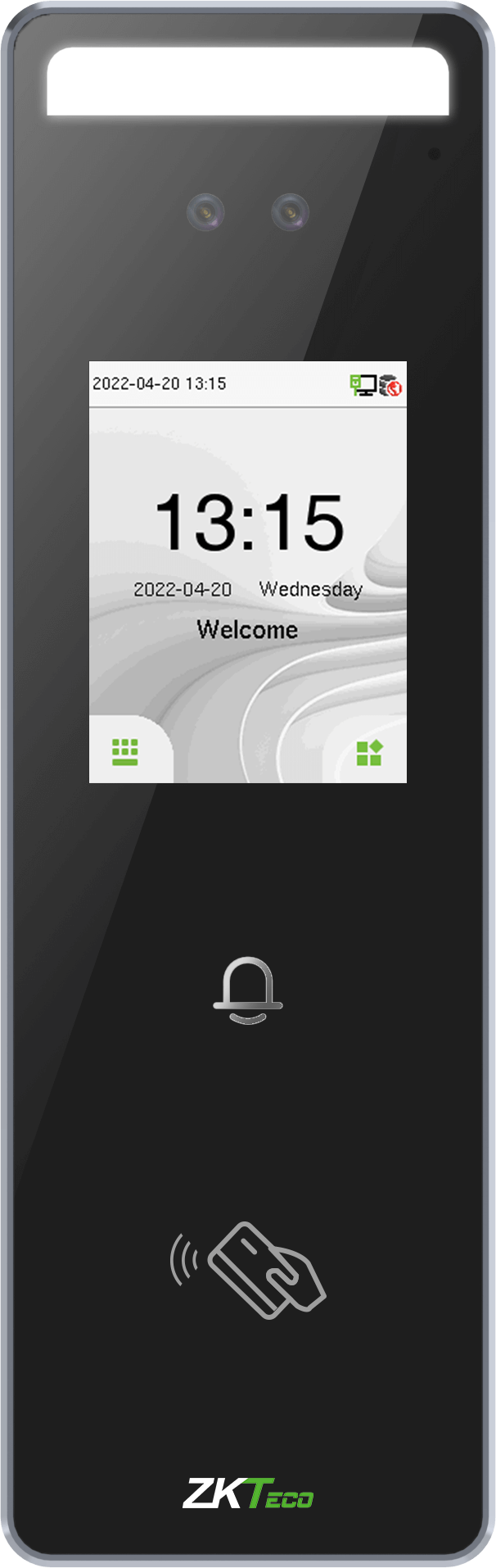
A Compact Identity Checkpoint for Controlled Business Entrances
The ZKTeco SpeedFace-V3L-RFID is designed for a straightforward job: identify an enrolled person at the door, apply the configured access rules and provide the interfaces needed to control common door hardware. It uses visible-light facial recognition as the touchless biometric method and adds RFID card plus virtual-password verification. That combination is useful where a company wants face recognition for convenience but still needs cards for contractors, visitors, users who prefer a credential, or existing badge-based workflows.
For a business buyer, the important distinction is the exact V3L variant. The base SpeedFace-V3L includes fingerprint capability, while the model-specific manufacturer table lists the RFID version with face, card and password verification and no fingerprint template capacity. That matters during procurement because two devices with nearly identical names can lead to different enrollment plans. If fingerprint authentication is mandatory, FourTeck should review the requirement before the RFID variant is selected.
The terminal is compact enough for door-frame and wall deployments, with manufacturer dimensions of 185 × 58.5 × 20 mm and wall-mount support compatible with a single gang box. Its IP65 ingress-protection rating makes it more suitable than an indoor-only terminal for entrances exposed to dust or occasional water, although installation details, cable entry, power supply placement and environmental exposure still need proper site planning. ZKTeco lists an operating range from -5°C to 45°C and 10% to 90% non-condensing relative humidity, so a UAE installation should consider direct sun, enclosed vestibules and actual local heat at the mounting point rather than relying only on the headline IP rating.
Connectivity is another reason the model can fit both stand-alone and managed deployments. TCP/IP is provided for network communication, Wi-Fi is an optional choice, and the device includes Wiegand input/output plus ZKTeco RS485 reader connectivity. Door-side interfaces cover an electric lock, door sensor, exit button, alarm, auxiliary input and doorbell. This means the terminal can sit at the center of a practical single-door design or participate in a wider access arrangement, subject to the selected software and controller architecture.
For buyers in Dubai and the wider UAE, FourTeck can help turn the model number into a complete requirement. That review can include card frequency, user count, face capacity, door lock type, exit method, optional Wi-Fi, software preference, cabling and deployment support. The result is a more useful quote and a lower risk of receiving a terminal that is technically correct but incomplete for the intended door.
Why This Model Works Well in Practical Access Projects
The value is not only biometric recognition. Buyers gain a compact endpoint that supports multiple verification choices, common door interfaces and manageable user records without moving immediately to a larger enterprise terminal.
Fast face verification reduces credential handling
ZKTeco specifies facial verification in under one second with a recognition distance of roughly 0.5 to 2 metres. In a normal employee entrance, that can reduce the need for every user to present a card at every passage. It is particularly useful at reception-controlled offices, staff-only corridors and entry lanes where the business wants a quick identity check without a touch surface. The practical benefit is smoother movement while keeping identity tied to an enrolled profile.
RFID and password provide alternative verification paths
Not every user or workflow should depend on face recognition alone. RFID cards can support existing staff badges, visitor credentials and controlled exceptions, while virtual-password verification provides another configured method. Multiple verification methods also let an administrator design stricter access rules where policy requires more than one factor, subject to the device configuration and software workflow.
Room for everyday access records
The manufacturer lists 200,000 transaction records, with 500 face templates and an optional 1,500-face level, plus 3,000 cards with an optional 10,000-card level. Those figures make capacity planning more predictable for small and mid-sized facilities. Buyers should still size the terminal around active users, staff turnover, visitor policies and how often records are synchronized or archived.
Built-in interfaces simplify a single-door design
Connections for an electric lock, door sensor, exit button, alarm, auxiliary input and doorbell reduce the number of separate components needed around a straightforward controlled entrance. Wiegand and RS485 options also help when the design includes external readers or controllers. The exact wiring and power arrangement should be reviewed with the chosen lock and safety requirements before installation.
IP65 supports more demanding entrance locations
An IP65-rated enclosure gives deployment teams more flexibility around dusty corridors, semi-exposed entrances and building thresholds than an indoor-only reader. It does not remove the need for correct cable sealing, suitable power supplies or protection from extreme direct heat. In the UAE, mounting position and exposure should be considered as part of the device selection, especially for outdoor-facing gates.
Software options support centralized administration
ZKTeco lists ZKBio CVAccess for software management, ZSmart as a mobile application and ZKBio Zlink as a cloud service. The exact platform used in a project should be confirmed before purchase because integration expectations, protocol settings, licensing and deployment architecture can influence the final configuration. FourTeck can help buyers describe whether they need local access administration, mobile interaction, cloud-connected management or integration with an existing ZKTeco estate.
What Stands Out in the RFID Variant
This version is best understood as a face-and-card access terminal rather than a fingerprint model. That sounds simple, but it is an important purchasing detail because the SpeedFace-V3L family contains several closely named variants. Selecting by series name alone can lead to the wrong authentication method.
The 2.4-inch touch display provides a compact local interface, while the camera and adjustable fill light support visible-light facial recognition. ZKTeco lists a 1 MP camera system; buyers who require a specific sensor arrangement should confirm the current production specification because manufacturer materials use different wording in separate camera and hardware lines.
For a procurement team, the strongest reason to shortlist this model is the balance between a compact form factor and a useful set of door interfaces. It can serve a modest office entrance without requiring a large terminal, yet it still offers network communication, external reader options and software integration. The correct choice depends on whether 500 face templates are enough, whether the organization already uses a compatible RFID technology, and whether the chosen access platform aligns with the wider site design.
SpeedFace-V3L-RFID Technical Specifications
The table below summarizes manufacturer-listed data for the SpeedFace-V3L family with RFID-model distinctions applied where they are explicitly stated. Optional capacities, card technology and Wi-Fi should be confirmed for the exact supplied unit.
| Specification | Manufacturer-listed detail | Buyer note |
|---|---|---|
| Model | SpeedFace-V3L-RFID | RFID family variant |
| Operating system | Linux | Embedded terminal platform |
| Display | 2.4-inch ISP LCD touch screen, 240 × 320 | Compact local interface |
| Authentication | Face / card / password (virtual keypad) | Fingerprint is not listed for the RFID model |
| Face capacity | 500 (1:N / 1:1), optional 1,500 | Confirm capacity option for project size |
| Card capacity | 3,000, optional 10,000 | Useful for mixed credential estates |
| Transaction capacity | 200,000 | Plan synchronization and archive policy |
| Face verification speed | <1 second | Designed for quick doorway verification |
| Recognition distance | 0.5 m to 2 m | Mounting position affects user approach |
| Face algorithm | ZKFace 3.5 | Visible-light facial recognition |
| Card type | 125 kHz ID card or 13.56 MHz IC card options | Confirm card frequency before ordering |
| Communication | TCP/IP; optional Wi-Fi; Wiegand input/output; ZKTeco RS485 | Match to network and reader architecture |
| Door interfaces | Electric lock, door sensor, exit button, alarm, auxiliary input, doorbell | Check lock current and safety design separately |
| Power | 12 V DC, 3 A | Power plan must include door hardware needs |
| Operating environment | -5°C to 45°C; 10% to 90% RH non-condensing | Review actual UAE mounting exposure |
| Ingress protection | IP65 | Suitable mounting practice still required |
| Dimensions / weight | 185 × 58.5 × 20 mm; net 0.3 kg | Slim wall-mount format |
| Supported software | ZKBio CVAccess; ZSmart; ZKBio Zlink | Confirm protocol, licensing and deployment method |
| Manufacturer-listed certifications | ISO14001, ISO9001, CE, FCC | Request current documentation if project compliance requires it |
Choosing the correct configuration starts with user count and credential type. A 500-face deployment can be adequate for a single office with a stable staff population, but a project approaching that limit should consider the optional higher face capacity or a different model. The same logic applies to cards: 3,000 credentials is generous for many small and mid-sized sites, yet multi-tenant buildings, education campuses and facilities with large visitor or contractor populations may need the optional 10,000-card level. Capacity should include expected growth, disabled credentials that may remain in the database and administrative accounts rather than only today’s headcount.
Card frequency is equally important. A site already using 125 kHz ID cards should not order a 13.56 MHz IC configuration by assumption, and the reverse is also true. Buyers should send FourTeck a sample credential specification or the exact card technology used by the existing system. Network method, software platform and lock interface should be confirmed at the same time. This turns the specification table into a deployment plan instead of treating each line as an isolated feature.
Configuration and Buyer Guidance
The right purchase is determined by the door, user population and management workflow rather than the model name alone. Confirm these questions before requesting a final quotation.
Which authentication methods are mandatory?
This RFID variant supports face, card and virtual password. If the requirement includes fingerprint enrollment, choose a different V3L variant or another model. This is the highest-risk naming issue in the family and should be resolved before any commercial comparison.
What card technology is already in use?
Confirm whether the site uses 125 kHz ID credentials or 13.56 MHz IC credentials. Existing card numbers, encoding practices and security expectations can affect whether current badges can be retained or must be re-issued.
How many users will be enrolled over the device life?
Use future headcount, contractors, visitors and administrative records when comparing 500 versus optional 1,500 face capacity. For cards, compare the standard 3,000 level against the optional 10,000 level with realistic growth in mind.
What controls the door?
Define the lock type, exit button, door contact, alarm expectation and whether an external reader or access controller is involved. The terminal offers common interfaces, but the complete power and fail-safe design is a separate engineering decision.
Which software workflow is required?
State whether the project needs local management, ZKBio CVAccess, mobile interaction, ZKBio Zlink or integration with an established ZKTeco platform. Licensing and protocol choices should be reviewed before rollout, especially for multiple doors or sites.
Is the mounting environment suitable?
Check installation height, recognition approach, cable path, direct sunlight, temperature exposure and network access. IP65 helps with dust and water exposure, but it does not make every outdoor position equally suitable.
For a useful quote, send FourTeck the required quantity, location, active user count, face and card preference, existing card frequency, door lock type, network method, software platform and whether installation or configuration support is required. Those details are more valuable than asking only for a unit price because they reveal whether the exact RFID variant is a good fit.
Ideal Business Use Cases
This terminal fits best where the access point needs fast identity verification, moderate user capacity and common door-control interfaces rather than a large kiosk or high-capacity enterprise appliance.
Corporate staff entrances
A corporate office can use facial recognition for regular employees and retain RFID cards for selected staff, contractors or temporary access workflows. Access levels, groups and holiday rules help administrators separate departments or schedules. The compact format is useful where a full-size terminal would look intrusive on a meeting-floor corridor or reception-side door. Capacity planning should consider all active badges and employees across the expected service life.
Warehouses and logistics areas
Staff doors at warehouses can benefit from IP65 protection, card fallback and a touchless face option. The terminal can be used near controlled office-to-floor transitions or staff entrances where door contacts and electric locks are part of the design. Direct outdoor heat, dust, cabling and power should still be reviewed at the exact mounting point.
Schools and training facilities
Education sites may use the device for staff-only rooms, administrative areas or controlled entrances where registered users need repeatable access. Face and card options give administrators flexibility when different user groups follow different credential policies. Larger campuses should verify capacity and central software design before standardizing on a single terminal model.
Clinics and restricted office zones
Back-office rooms, medicine storage areas, records rooms and staff-only corridors can use controlled access without requiring users to touch a fingerprint sensor. The exact security policy, audit requirement and privacy procedure should be defined by the organization; the terminal provides an identification endpoint rather than a complete policy by itself.
Residential and managed properties
Property teams can consider the model for staff access, service zones or controlled resident areas where face and RFID credentials are appropriate. The card-capacity option can be relevant when many residents or service credentials are involved. Multi-door projects should also review centralized software, visitor workflows and whether another ZKTeco architecture is more suitable.
Small multi-door or branch projects
A branch network may deploy similar terminals across several entrances for a consistent user experience, but management architecture becomes more important as the count grows. Before buying multiple units, confirm whether records will be managed locally or centrally, how credentials are synchronized, whether sites share the same card technology and how network connectivity is secured. FourTeck can help compare a stand-alone design against a controller-led approach when the project expands beyond a few doors.
SpeedFace-V3L-RFID Facial Recognition and Anti-Spoofing
The main biometric method is visible-light facial recognition. ZKTeco states a facial verification speed below one second, a recognition distance of 0.5 to 2 metres and an anti-spoofing algorithm intended to defend against fake photo and video attempts. For a buyer, those specifications translate into a quicker doorway experience and a stronger identity check than relying on an unverified card alone.
Performance in a real entrance still depends on enrollment quality, mounting height, lighting, user approach and environmental conditions. A camera mounted too high, exposed to direct glare or positioned where users approach at awkward angles can reduce the practical benefit of a fast algorithm. Site design should therefore be considered part of biometric performance rather than an afterthought.
SpeedFace-V3L-RFID Door Connectivity and Access Interfaces
A terminal becomes useful only when it can participate correctly in the door system. This model includes interfaces for an electric lock, door sensor, exit button, alarm, auxiliary input and doorbell, plus Wiegand input/output and a ZKTeco RS485 reader connection. TCP/IP provides the core network path and Wi-Fi is optional. That combination gives integrators several ways to build around a controlled entrance, but it also creates choices that should be settled before cabling begins.
The purchase decision should include the door hardware list, not only the terminal. Ask whether the lock is fail-safe or fail-secure, whether an emergency release is required, how power is backed up, whether the exit side needs a reader, and whether the building already has an access controller. Those questions determine whether the SpeedFace-V3L-RFID acts as the main stand-alone controller or as one component of a broader system.
SpeedFace-V3L-RFID Capacity and Management Planning
Capacity is more than a headline number. The standard 500-face and 3,000-card levels can serve many offices comfortably, while optional 1,500-face and 10,000-card levels provide room for larger populations. The 200,000-transaction record capacity supports routine activity, but organizations still need a management process for syncing records, removing former users and maintaining clean credential data.
Decision checklist
- Count active employees, contractors, residents or students who may need face enrollment.
- Include growth and temporary users when choosing the face-capacity option.
- Estimate the total credential database, not only cards issued on day one.
- Decide whether one administrator or several branches will manage enrollment.
- Confirm how lost cards, former staff and duplicate records are removed.
- Plan how transaction logs are collected and retained according to business policy.
A small site can sometimes operate with simple local administration, while a multi-door environment benefits from centralized management and consistent enrollment rules. ZKTeco lists ZKBio CVAccess, ZSmart and ZKBio Zlink among supported software options, but buyers should confirm current compatibility and licensing for the intended deployment. FourTeck can review the number of doors, sites and administrators to help determine whether this terminal remains the right endpoint as the project grows.
What Buyers Should Check Before Purchase
The biggest purchase risk is selecting the correct family name but the wrong authentication variant. Confirm face, RFID card, fingerprint and QR requirements first, then validate card frequency, capacity, software and door hardware before comparing commercial offers.
Configuration Fit
Confirm that face, card and password are the intended methods. If fingerprint is a must-have, the RFID model is not the correct family variant. Next, choose between the listed standard and optional face/card capacities based on future enrollment rather than current headcount alone. Wi-Fi is also optional, so do not assume every unit includes wireless connectivity.
Compatibility Check
Match the RFID module to existing credentials: 125 kHz ID and 13.56 MHz IC options are not interchangeable simply because both are called access cards. Review the lock, exit button, door sensor and any external reader or controller. If an existing ZKTeco software environment is already deployed, send FourTeck the platform name and version for compatibility review.
Availability and Warranty
Ask for the exact supplied variant, card module, optional features, included accessories and current warranty terms on the quotation. Availability can change with supplier status, quantity and configuration, so FourTeck should confirm current commercial options for the requested project rather than relying on a generic series listing.
Quote Preparation
Provide quantity, delivery location, user count, door count, card frequency, preferred software, network method, installation environment and target date. Mention whether the request is device-only supply or includes locks, power supplies, exit buttons, cabling, configuration or installation. A complete requirement makes it easier to compare the right configuration instead of unrelated prices.
Also consider long-term administration. Who enrolls a new employee? How are leavers removed? Does a branch need local control, or should head office manage every terminal? Are access records required for audits or attendance processes? These operational questions often determine whether a stand-alone device remains convenient after installation. If the project is likely to expand to many doors, ask FourTeck to compare this terminal with controller-based or higher-capacity ZKTeco options before standardizing the hardware.
UAE Availability and Service Support
FourTeck supports inquiries for ZKTeco access control solutions across Dubai and the UAE with practical pre-sales review. Availability is not assumed to be fixed because the exact RFID module, optional capacity, Wi-Fi requirement, order quantity and supplier status can affect what is commercially available at a given time. Buyers can request a current quotation after the technical requirement is confirmed.
If the request includes installation, provide photographs or a brief description of the door, nearby power, network cabling, wall surface, existing lock and exit method. That lets the team discuss whether the terminal alone is sufficient or whether additional door hardware, power supplies, card credentials or integration work should be included. For current options, use the FourTeck contact page.
Dubai, Abu Dhabi, Sharjah and Ajman Coverage
Businesses in Dubai, Abu Dhabi, Sharjah and Ajman can contact FourTeck for product availability, configuration review and quotation support for access-control projects. A request can be as simple as one controlled office door or as detailed as a multi-site rollout with common credential and management requirements.
For supply-only orders, share the exact model, quantity and credential requirement. For projects that include implementation, add the number of doors, location type, lock hardware, network availability and software expectation. FourTeck can then help match the requested terminal with related access-control components and advise when a different ZKTeco model or architecture may be more suitable. You can also review FourTeck’s CCTV and access control solutions in the UAE for broader project planning.
GCC and Africa Availability
FourTeck also supports business technology inquiries through regional channels serving selected GCC and Africa markets. Organizations in Saudi Arabia, Qatar, Oman, Kuwait and Bahrain, as well as buyers in Kenya, Uganda and other African markets, can discuss product requirements, quantities and delivery expectations through the relevant inquiry route. Availability, delivery methods, warranty handling and support scope may vary by country, product configuration and supplier status.
For a cross-border project, it is useful to standardize the technical requirement before requesting regional pricing. Specify the same RFID card technology, user capacity, software platform and door interfaces for each site, then identify any locations with different network or environmental conditions. This helps procurement teams compare equivalent configurations rather than mixing different variants under one model family name.
Regional buyers can start with FourTeck UAE, FourTeck Kenya, FourTeck Uganda, FourTeck Africa or FourTeck Kuwait depending on the project location and inquiry path.
Other ZKTeco Options Buyers May Consider
If a requirement changes from face-plus-RFID to fingerprint, QR or a larger-capacity environment, another model in the ZKTeco range may fit better. The options below are decision prompts rather than direct one-to-one replacements; final specifications should be reviewed for the exact model.
SpeedFace-V3L base model
Consider the base V3L when fingerprint verification is part of the requirement alongside face and card workflows. This is the most important family-level comparison because the physical design and naming are close to the RFID version while the supported biometric methods differ.
SpeedFace-V3L [QR]
Consider the QR variant when barcode or QR credential workflows are needed instead of RFID-focused verification. It is relevant for visitor, ticket or mobile-code scenarios, but the exact supported code formats and licensing should be checked against the current manufacturer specification.
SpeedFace-V5L Series
A useful family to review when a project needs a different terminal class or expanded feature set. Ask for an exact model comparison rather than assuming all V5L variants share the same authentication methods.
SenseFace Series
For larger or more feature-rich facial access deployments, the SenseFace family may be worth comparing. Capacity, interfaces, display size and software support vary by model, so the intended door and user population should guide selection.
Why Buyers Choose FourTeck for Access Control Projects
Access control hardware is easy to misquote when the request contains only a model name. FourTeck focuses on the surrounding decisions that make the product usable: credential type, door hardware, software, network method, capacity, installation environment and support expectations. That approach is useful for procurement teams that need a technically comparable offer rather than an isolated device line item.
FourTeck’s broader IT products and service support can also be relevant when access control depends on structured cabling, network readiness, switching, server or cloud management, or coordination with other business systems. The goal is to help buyers identify the full requirement before procurement so fewer project details are discovered after hardware arrives.
ZKTeco SpeedFace-V3L-RFID FAQ
What is the SpeedFace-V3L-RFID used for?
It is a stand-alone access control and time-attendance terminal for verifying enrolled users at controlled entrances. The RFID version supports visible-light facial recognition, RFID card and virtual-password verification. It can connect to common door hardware and management platforms, making it suitable for offices, warehouses, schools, clinics, managed properties and other business environments with controlled doors.
Does the RFID version include fingerprint recognition?
The manufacturer model table lists face, card and virtual-password authentication for SpeedFace-V3L-RFID and shows no fingerprint template capacity for that variant. Fingerprint support belongs to the base SpeedFace-V3L model. If fingerprint is required, tell FourTeck before quotation so the correct V3L variant or another suitable ZKTeco terminal can be reviewed.
How many faces and RFID cards can it store?
ZKTeco lists 500 face templates with an optional 1,500-face level, and 3,000 card records with an optional 10,000-card level. It also lists 200,000 transaction records. Buyers should choose capacity based on future user numbers, staff turnover, visitor or contractor credentials and the expected lifetime of the deployment, not only today’s active headcount.
Which RFID card type should I order?
The manufacturer lists 125 kHz ID card and 13.56 MHz IC card options. The correct choice depends on the credentials already used by your organization and the required card technology. Do not order based only on the word RFID. Share the existing card specification, reader model or card frequency with FourTeck so the supplied terminal can be matched correctly.
Can it connect directly to a door lock?
The terminal includes manufacturer-listed interfaces for an electric lock, door sensor, exit button, alarm, auxiliary input and doorbell. Wiegand and RS485 interfaces are also available for reader or controller scenarios. The complete door design should still be checked for lock type, power, emergency release, fail-safe behavior and local safety requirements before installation.
Is Wi-Fi included?
ZKTeco lists Wi-Fi as an optional communication method, while TCP/IP is part of the standard communication set. Buyers who need wireless networking should request that option specifically and confirm current availability. Even with Wi-Fi, the terminal still needs suitable 12 V DC power and the appropriate door-control wiring for the intended installation.
Is the terminal suitable for outdoor-facing entrances?
The device carries an IP65 ingress-protection rating and a manufacturer operating range of -5°C to 45°C. That helps with dusty or semi-exposed locations, but buyers should still review direct sunlight, local heat, cable sealing, power-supply placement and mounting exposure. An IP rating does not replace good installation practice or environmental planning for a UAE site.
Which ZKTeco software can manage it?
The current manufacturer page lists ZKBio CVAccess, the ZSmart mobile application and ZKBio Zlink cloud service. The right choice depends on whether the project needs local, mobile or cloud-connected management and whether other ZKTeco devices are already installed. Confirm software version, protocol and licensing requirements before a multi-door or multi-site rollout.
How do I request a quotation in Dubai or the UAE?
Send FourTeck the model, quantity, delivery location, user count, required RFID card type, software preference, network method and whether the request includes locks, power supplies, exit buttons, cabling or installation. FourTeck can then check current availability, clarify configuration choices and provide a quotation aligned with the actual project rather than a generic series price.
Need Help Choosing the Correct V3L Variant?
FourTeck can review your intended authentication method, card technology, user count, door hardware, software preference, quantity and delivery location before preparing a quote. This is especially useful when comparing the visually similar base, QR and RFID versions of the SpeedFace-V3L family.
Share: model/variant, quantity, number of users, RFID card frequency, door count, lock type, network method, software platform, delivery location and required installation scope.

Reviews
There are no reviews yet.