

ZKTeco SpeedFace-V5L-QR Facial Recognition QR Terminal in Dubai, UAE
A wall-mounted biometric terminal for controlled entry and attendance workflows using facial authentication, a dedicated dynamic QR module, card or password credentials, with optional palm authentication on the current series.
It is designed for organizations that need a flexible checkpoint rather than a single-purpose reader. FourTeck can help review software, credential method, lock interface, network connection, installation accessories and the exact hardware revision before quotation.
Touchless Face Verification
Access & Attendance Workflows
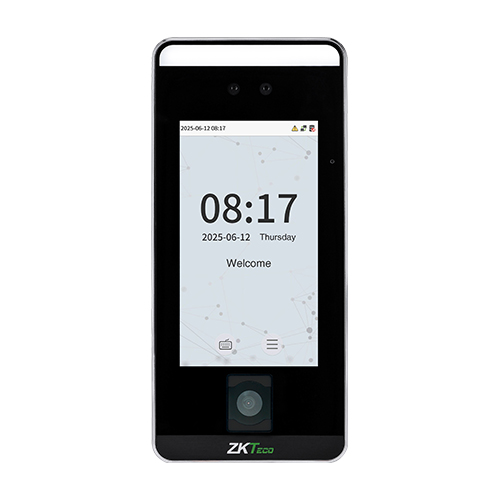
A Flexible Identity Checkpoint for Doors and Attendance
The ZKTeco SpeedFace-V5L-QR is built for organizations that want one entrance device to support several identity methods without forcing every employee, contractor or visitor into the same credential process. The dedicated QR module is the defining difference in this version. It is intended to work with dynamic QR credentials through the ZKBio CVAccess mobile application, giving a business a practical path for mobile-based access alongside facial authentication, card credentials and passwords. Palm authentication is an option on the current product family and should be confirmed when the requirement depends on it.
For a buyer, the important point is not only that the terminal recognizes a face. A complete access-control deployment also involves the door lock, exit button, door sensor, network connection, user database, management software and the rules that determine who can enter, when they can enter and how events are recorded. The SpeedFace platform is designed to sit at that operational edge. It communicates with management software and access-control hardware so the terminal becomes part of a wider security workflow rather than a stand-alone screen on a wall.
This makes the model relevant to corporate offices, clinics, education facilities, warehouses, staff entrances, service centers and commercial premises where different populations may need different authentication methods. Employees may use face or card credentials. Approved visitors can be handled through a QR workflow when the software design supports it. Sensitive areas can use stronger multi-method policies where the selected implementation requires more than one factor. The terminal also includes anti-spoofing and mask-detection functions within the series, helping administrators improve the quality of facial authentication in real-world environments.
For UAE buyers, the best purchasing process starts with the environment rather than the model name alone. FourTeck can review the number of users, number of doors, credential strategy, software preference, network layout, card technology, required accessories and installation expectations. This avoids a common mistake: ordering the correct terminal model but missing the exact reader option, power planning, door hardware, mounting requirement or software component needed for the project to operate as intended.
Why the QR Variant Can Simplify Mixed-User Access
The strongest business value is flexibility: different users can be authenticated in ways that match their role, access duration and operational context, while one terminal remains the physical checkpoint.
One checkpoint, several identity methods
Face, QR, card and password methods let an administrator design different entry experiences for employees, temporary users and controlled visitors. This is useful when a business wants convenient daily entry for staff but does not want to issue a permanent card to every short-term user. Optional palm authentication adds another biometric direction when the selected hardware configuration and policy call for it.
Better fit for temporary or app-based credentials
The QR variant includes the dedicated module for dynamic QR workflows with ZKBio CVAccess. That can reduce dependence on shared PINs or physical card issuance in deployments where mobile credentials are appropriate and properly managed.
Fewer routine touch points
Facial and QR authentication can reduce repetitive contact with shared keypads or fingerprint sensors. For busy reception areas, staff entrances and public-facing facilities, this can support a cleaner and faster flow while keeping the access decision tied to an assigned identity.
Access rules stay more structured
The terminal is intended for managed access environments, so administrators can work with user identities, schedules, groups, access levels, anti-passback and event records rather than treating the door as a simple open/close device.
A practical building block for multi-door projects
Standard network and access-control interfaces make the terminal suitable for structured projects where multiple doors, readers and management points must be coordinated. Buyers can plan a consistent credential strategy across sites, then decide where the QR version is needed and where another model in the family may be sufficient. This helps avoid paying for a specialized credential method at every door if only selected entrances require it.
Clearer handover for IT and facilities teams
A network-managed terminal gives technical teams a more maintainable path than disconnected stand-alone credentials. Proper planning still matters: user enrollment, backup, network security, firmware and software ownership should be assigned before handover.
The Important Strengths Are in the Combination
The SpeedFace-V5L[QR] is not simply a face reader with a barcode add-on. Its practical advantage is the ability to combine a dedicated QR credential path with biometric authentication and conventional access-control interfaces. That gives a business more choices when building policy for permanent staff, contractors, guests and areas that need different levels of control.
Current ZKTeco documentation also places the model in a modernized V5L family with updated processing hardware, software support and optional communication features. Because older regional data sheets can show different capacities or algorithms, procurement teams should match the quotation to the current production revision and not assume every historical specification applies to every unit in the channel.
Technical Specifications
The values below follow the current 2026 ZKTeco SpeedFace-V5L Series documentation for the QR model. Exact supplied options can vary by regional SKU, production revision and selected module, so the quotation should identify the final configuration.
| Specification | Current SpeedFace-V5L[QR] Reference | Buyer Note |
|---|---|---|
| Order ID | AC01-SP15H-P47 | Use this to distinguish the QR variant in procurement. |
| Display | 5-inch IPS color LCD, 720 × 1280 | Suitable for guided enrollment and local interaction. |
| Camera | 2MP WDR binocular camera | Used for visible-light facial authentication. |
| Operating system | Linux | Appliance platform; management is through supported ZKTeco software. |
| Processor / memory | Quad Core A55 at 1.2GHz; 1GB RAM; 8GB ROM | Current series hardware reference. |
| Face template capacity | 10,000 (1:N) | Confirm current unit revision when replacing an older V5L deployment. |
| Palm template capacity | 3,000 (1:N), optional | Palm requirement must be stated in the quote request. |
| Card capacity | 10,000 (1:N) | Card technology selection still needs confirmation. |
| Transaction capacity | 200,000 | Plan regular synchronization and retention in managed deployments. |
| Authentication methods | Face / palm optional / card / password; QR module for dynamic QR credentials | Build policy around user type and risk. |
| Facial authentication speed | Less than 0.35 second | Actual flow also depends on enrollment quality and site conditions. |
| Recognition distance | Face: 30–170cm; palm: 15–40cm | Mounting height and user approach should be planned accordingly. |
| Card technology | 125kHz ID card standard; 13.56MHz IC card optional; multi-tech modules optional | Match the terminal to existing credentials before purchase. |
| QR function | Dynamic QR through ZKBio CVAccess mobile app, standard via QR module | This is the key distinction from non-QR family variants. |
| Communication | TCP/IP; optional dual-band Wi-Fi; Wiegand input/output; ZKTeco RS485 | Choose wired networking where reliability and policy require it. |
| Door interfaces | Aux input/output, electric lock, door sensor, exit button, alarm | Door hardware and power design remain project-specific. |
| Power | DC 12V, 3A | Plan a suitable regulated power source and backup strategy if required. |
| Operating environment | -10°C to 45°C; 10% to 90% RH non-condensing | Use a protected installation location within stated limits. |
| Dimensions / weight | 202.93 × 91.93 × 21.5mm; 0.6kg net | Wall-mount format compatible with supported gang-box arrangements. |
| Supported software | ZKBio CVAccess, ZKBio Time, ZKBio Zlink | Choose software according to access, attendance and cloud/on-premise needs. |
Choosing the correct configuration means looking beyond capacity. A site that already uses 13.56MHz credentials should not assume the standard card reader matches the installed badge population. A project that requires palm verification must request that option explicitly. Wi-Fi is also optional, so a buyer planning a wireless-only installation should confirm it in writing. For QR workflows, the management software and mobile process matter just as much as the scanner itself. FourTeck recommends sharing the current door hardware, credential type, software preference, number of users, required doors and any attendance reporting requirement so the quote reflects the working system rather than only the terminal.
Configuration and Buyer Guidance
The safest way to buy this terminal is to define the door, users and software first. The model can support several authentication methods, but a correct system depends on how those methods are assigned and connected.
What credential must every user have?
Separate permanent staff, contractors and visitors. Decide whether each group will use face, QR, card, password or an approved combination. This is the highest-risk choice because it affects hardware options, enrollment, software and daily administration.
Which card technology is already deployed?
If the business already has employee badges, identify their frequency and technology before ordering. A visually identical card may use a different chip or protocol, and an incorrect reader option creates unnecessary reissuance work.
How will the terminal reach management software?
Wired TCP/IP is usually straightforward for permanent installations. Optional Wi-Fi can be useful where cabling is difficult, but wireless design, security policy and signal quality should be checked rather than assumed.
What is already installed at the door?
Confirm lock type, power supply, exit button, door sensor, fire-release requirements and cabling. The terminal is one part of the access-control chain, and the door hardware must be selected and powered correctly.
Is attendance reporting also required?
Access control and attendance may share identities but serve different workflows. Clarify reporting, shift handling, synchronization and software ownership so the chosen platform supports the operational goal.
Will this become a multi-door or multi-site system?
Plan naming, user enrollment, network addressing, administrator roles and backup from the start. A terminal that works well at one door should still fit the management model when more locations are added.
For a useful quotation, send FourTeck the number of doors, approximate user count, authentication method, existing card type, software preference, network method, door hardware status, quantity, delivery location and whether installation or configuration assistance is expected.
Ideal Business Use Cases
The QR variant is most useful where the organization needs controlled identity at the door but not every user should receive the same long-term credential.
Corporate offices with staff and visitor flows
A corporate site often has stable employees, recurring contractors and visitors who only need temporary entry. Permanent users can be enrolled for facial or card access, while a managed QR workflow can support approved short-duration credentials. This allows security teams to avoid treating every person as a permanent badge holder. Reception and facilities teams still need a process for approval, expiry, escort rules and exception handling, but the terminal provides a flexible physical endpoint for those policies.
Clinics and healthcare administration areas
Touchless face or QR methods can be useful in busy environments where shared-touch credentials are less desirable. The terminal can control staff-only rooms, office entrances or administrative zones when the installation is designed within the building’s safety and emergency-egress requirements.
Education and training facilities
Schools, colleges and training centers can use multi-method authentication for staff entrances, labs, administration rooms or selected campus checkpoints. The right policy depends on age group, privacy requirements, visitor handling and whether attendance is part of the project.
Warehouses and logistics offices
Warehouses often combine office staff, shift workers, drivers and temporary contractors. A flexible terminal can help separate credentials by role while event records support review of controlled doors. Installation should consider dust exposure, mounting protection, power backup and the physical approach to the reader.
Multi-tenant commercial buildings
A building operator may need different credential lifecycles for property staff, tenants, contractors and scheduled visitors. The QR model can be considered when the chosen ZKTeco software workflow is part of a broader visitor or mobile-access strategy.
Multi-site organizations standardizing access
For businesses with several branches, consistency matters more than a single advanced feature. A common terminal family can simplify administrator training, enrollment procedures and support documentation. The QR version can be deployed at entrances that need mobile or visitor credentials, while other family variants may suit doors that only need biometric or RFID authentication. This tiered approach can keep system design practical and avoid unnecessary complexity.
ZKTeco SpeedFace-V5L-QR Dynamic QR Access
The key reason to choose the QR model is the dedicated module for dynamic QR credentials through ZKBio CVAccess. This matters because a QR credential can be distributed and managed differently from a permanent physical card. In a properly designed workflow, a temporary user can receive an approved digital credential without being enrolled as a long-term badge holder.
The scanner alone does not create a visitor-management process. The business still needs rules for who issues a credential, when it becomes valid, when it expires, whether identity is checked before issue, and how revoked or unused credentials are handled. Buyers should therefore evaluate the QR function together with the management platform and the organization’s access policy.
ZKTeco SpeedFace-V5L-QR Facial Authentication and Anti-Spoofing
Facial authentication is designed to make regular entry quick without requiring a user to present a contact credential. The current series combines a binocular camera, visible-light facial algorithms, mask detection and anti-spoofing controls. For a buyer, the value is not a marketing claim about speed; it is the ability to create a predictable doorway experience where enrolled users can be checked with minimal physical interaction.
Organizations with higher-risk rooms should decide whether face-only access is sufficient or whether a second factor is required. That choice should be based on the sensitivity of the area and business policy, not on convenience alone. FourTeck can help buyers map the available methods to user groups before the terminal is ordered.
ZKTeco SpeedFace-V5L-QR Door and Software Integration
A biometric terminal becomes useful only when it fits the rest of the access-control system. The V5L family supports network communication and common door-control interfaces, which allows the terminal to participate in a managed design with locks, sensors, exit controls and software. The exact architecture should be agreed before installation so the project does not depend on improvised wiring or unsupported assumptions.
Integration decision checklist
- Confirm whether the door uses fail-safe or fail-secure locking and how emergency release is handled.
- Check whether an existing controller, reader, exit button or door sensor must remain in place.
- Decide whether the terminal will use wired TCP/IP or an optional wireless interface.
- Choose the ZKTeco management platform that matches access control, attendance and cloud requirements.
- Plan administrator roles, user enrollment, data backup, event retention and firmware responsibility.
- Document the final card technology and any optional palm or multi-tech module so replacement units can be matched later.
For new projects, these questions can be solved during design. For replacement projects, they are even more important because the new terminal must work with existing credentials and door hardware without disrupting daily operations. Sending photographs of the existing reader, controller model, lock type and a simple network diagram can make the quotation and migration plan more accurate.
What Buyers Should Check Before Purchase
The biggest purchase risk is ordering by model name without confirming the credential technology, software workflow and door environment. The same terminal family can be supplied with options that materially change compatibility, so a buyer should validate the working requirement before approving the order.
Configuration Fit
Confirm whether QR is needed at every door or only selected entrances. State whether palm authentication is required, whether existing cards must be reused, and whether the project needs access control, attendance or both. These decisions define the useful configuration much more clearly than a generic request for a face-recognition device.
Compatibility Check
Check existing badge technology, lock voltage, controller design, network availability, gang-box mounting, software version and administrator permissions. If the terminal is replacing an older unit, confirm whether user data can be migrated or whether fresh enrollment is required.
Availability and Warranty
Ask which production revision and option set is being quoted. Availability can vary by supplier and quantity, while warranty handling depends on the supplied channel and commercial terms. Request clear information on included hardware, accessories, software licensing where applicable and the process for warranty support.
Quote Preparation
Provide user count, door count, credential methods, quantity, delivery location, target date, existing card type, network method, software requirement and whether installation is included. For bulk or phased projects, also identify which doors need QR so the design can use the most suitable family variant at each point.
Replacement guidance is especially important when an older SpeedFace model is already installed. Current 2026 documentation differs from some older regional sheets, so the production revision should be matched before assuming identical capacity, algorithm version or optional features. FourTeck can help compare the quoted unit against the existing environment and recommend a suitable alternative if the requested variant is not the best fit.
UAE Availability and Service Support
FourTeck supports product inquiries in Dubai and across the UAE with model selection, configuration review, quote assistance, delivery coordination and warranty guidance. Availability can change according to the current production revision, selected card or palm options, supplier status and order quantity, so the most useful request identifies the exact deployment requirement instead of asking only whether the model is available.
Dubai, Abu Dhabi, Sharjah and Ajman Coverage
Businesses in Dubai, Abu Dhabi, Sharjah and Ajman can contact FourTeck for access-control terminal inquiries, configuration guidance and quotation support. The same model can be used in very different environments, so the support discussion should include whether the site is a corporate office, warehouse, clinic, school, commercial building or another controlled facility.
For multi-location projects, buyers should also identify which branches need QR credentials, whether a central software platform will manage all doors, and whether the same card technology is used at every location. This helps create a consistent deployment plan and avoids ordering identical hardware for sites that actually have different access requirements.
GCC and Africa Availability
FourTeck also supports business technology inquiries for selected projects across the GCC and Africa through its regional inquiry channels. Customers in Saudi Arabia, Qatar, Oman, Kuwait and Bahrain may have different delivery, warranty and sourcing conditions, while organizations in Kenya, Uganda and other African markets may need coordinated procurement for branch or project locations. Product availability should therefore be confirmed for the destination country rather than assumed from UAE supply.
Regional access-control projects often benefit from standardizing the software platform and credential policy while allowing hardware options to vary by site. A headquarters may use QR visitor workflows, while a smaller branch may only need face and card authentication. FourTeck can help buyers describe the requirement by user type, site count, quantity and delivery country before preparing a regional quotation path.
Other ZKTeco Options Buyers May Consider
The QR model is not automatically the right choice for every door. The best alternative depends on whether the project prioritizes fingerprint, RFID, palm, QR credentials, environmental protection or a different physical form factor.
ZKTeco SpeedFace-V5L
Consider the standard V5L when fingerprint support is important and a dedicated QR module is not the primary requirement. This can be a better fit for staff-only doors with established biometric enrollment.
ZKTeco SpeedFace-V5L-RFID
A suitable direction when card-based access is central to the project and the dedicated QR workflow is not required. It remains within the same product family, which can simplify a mixed deployment.
ZKTeco SenseFace Series
Worth reviewing when the project needs a newer alternative family or different model options. The exact SenseFace model should be selected by capacity, credential type and deployment environment.
ZKTeco SpeedPalm Series
Consider a palm-focused family when touchless palm authentication is a primary requirement rather than an optional credential method.
ZKTeco RevFace Series
A useful comparison direction for buyers who want a different facial-recognition terminal format. FourTeck can check current model availability and suitability against the required door workflow.
Why Business Buyers Contact FourTeck
Access-control hardware is easy to under-specify because the terminal is only one part of the working system. FourTeck helps buyers connect the model choice to door hardware, software, credentials, network design and commercial requirements so the quotation is easier to evaluate and deploy.
FourTeck also provides broader CCTV and access-control system support and business IT product services. This is useful when the terminal is part of a larger office, surveillance, networking or physical-security project rather than an isolated hardware purchase.
Frequently Asked Questions
These answers focus on the practical decisions buyers usually need to make before they request a quotation or plan installation.
What is the SpeedFace-V5L[QR] mainly used for?
It is used as a biometric access-control and time-attendance terminal at controlled entry points. The QR version is especially relevant when a business wants dynamic mobile QR credentials in addition to facial authentication, card or password access. Optional palm authentication can be included on the current family. The final use should be planned with the door hardware and management software.
Is the QR scanner standard on this model?
Yes. In ZKTeco’s current product-family documentation, the SpeedFace-V5L[QR] uses a dedicated QR module for dynamic QR codes through the ZKBio CVAccess mobile application. This is the key distinction from family variants where QR may be optional or handled differently. Buyers should still confirm the exact quoted production revision and software workflow.
Can it work with our existing employee cards?
Possibly, but the card technology must be checked first. The current QR model lists 125kHz ID card support as standard, with 13.56MHz IC and multi-tech options available. If your organization already uses badges, provide the card type or existing reader model before ordering so the quoted terminal can be matched to the installed credential population.
Does it include palm recognition?
Palm authentication is listed as optional on the current 2026 SpeedFace-V5L family. If palm is a required method, state it clearly in the quotation request instead of assuming every QR unit includes the same capability. Older regional data sheets may show different wording, which is another reason to confirm the current production option before purchase.
Which software can manage the terminal?
Current ZKTeco documentation lists ZKBio CVAccess for on-premise access control, ZKBio Time for time-attendance workflows and ZKBio Zlink as a cloud-based platform. The correct choice depends on whether the project prioritizes door access, attendance, mobile credentials or centralized cloud management. FourTeck can help review the intended workflow before quoting the system.
What is required for installation?
A working door deployment may need a suitable power supply, electric lock, door sensor, exit button, network connection and structured cabling, depending on the existing setup. The terminal is wall mounted, but the site still needs appropriate positioning and a safe cable route. Share the current door hardware and installation environment so missing accessories can be identified early.
Is Wi-Fi included?
Wi-Fi is optional in the current series, while TCP/IP wired networking is listed as standard. If the installation cannot use Ethernet, request the wireless option specifically. For permanent access-control points, the network design should also consider security policy, signal quality, maintenance access and how the terminal will continue operating during network interruptions.
Is it available for business orders in the UAE?
FourTeck can support UAE inquiries, but current availability depends on the exact model revision, selected options, supplier status and required quantity. The best approach is to request a quote with the quantity, credential methods, software requirement and delivery location. This allows the response to identify the correct unit and any accessories needed for a complete deployment.
Can FourTeck support bulk or multi-site projects?
Yes, FourTeck can review multi-door and multi-site requirements for quotation and product planning. Share the number of locations, doors, user groups, existing credential technology, software preference, quantity and project timeline. A mixed-model design may sometimes be more sensible than using the QR variant everywhere, especially when only selected entrances need mobile QR credentials.
Need Help Matching the Terminal to Your Door?
FourTeck can review the intended use, user count, credential method, software platform, existing card type, door hardware, quantity, delivery location and warranty expectations before preparing a quote. This helps ensure the requested terminal matches the actual access-control workflow.
Share the model, required quantity, authentication methods, software preference, delivery location and whether installation support is needed.
Reviews
There are no reviews yet.