

ZKTeco FaceDepot-7B Facial Recognition Terminal in Dubai, UAE
A 7-inch indoor facial recognition station for controlled business entry, door access and barrier integration, with capacity for up to 10,000 face templates.
The model combines visible-light facial recognition, dual cameras and access-control interfaces with optional fingerprint and RFID credential modules. ZKTeco currently marks the model as EOL, so lifecycle confirmation and alternative-model review are important parts of procurement.
0.3–3 m Recognition Distance
EOL Lifecycle Review
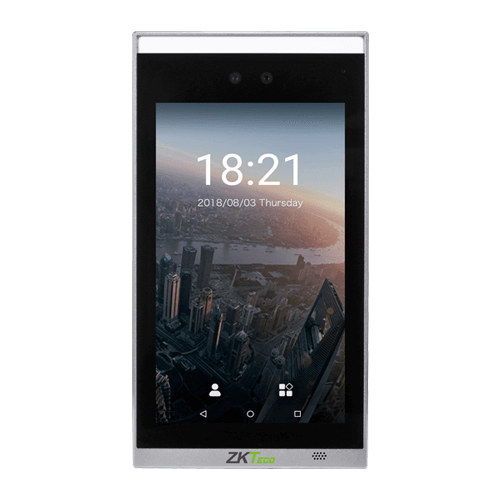
ZKTeco FaceDepot-7B Overview for Business Access Control
FaceDepot-7B is an indoor facial recognition station built to sit at the point where a person requests access to a controlled door, gate or compatible barrier. Its practical role is straightforward: present a user-facing 7-inch touch display, detect and compare faces through a dual-camera system, and communicate with the surrounding access-control components that ultimately decide whether an entry point should unlock. For businesses replacing card-only access or adding touchless identification to an existing door environment, that combination can reduce reliance on a single physical credential while keeping the terminal connected to familiar access-control interfaces.
The official specification lists capacity for 10,000 users and 10,000 face templates, with 100,000 log records. Hardware includes a 7-inch 1280 × 720 touch screen, a quad-core A17 1.8 GHz processor, 2 GB RAM, 16 GB ROM and a 2MP dual-lens camera. The terminal supports TCP/IP and USB Host as standard communication methods, while Wi-Fi is optional. Integration paths include RS485 for an external reader and Wiegand input/output, along with interfaces for a door lock, door sensor, alarm, exit button and auxiliary input. That gives system integrators useful flexibility when the terminal is part of a wider entrance-control design rather than a stand-alone device mounted without planning.
A key procurement point is the product lifecycle. ZKTeco currently marks FaceDepot-7B as EOL on the FaceDepot Series listing. End of life does not automatically mean that no units can be sourced, but it does mean buyers should avoid treating the model as a current long-term platform without checking supplier status, replacement paths, software expectations and support continuity. This is especially important for multi-door projects where the organization wants consistent hardware across several years.
For Dubai and wider UAE deployments, FourTeck can help review the access point, required user count, preferred authentication method, network path, optional credential modules and intended software environment before a quote is prepared. That review is useful whether a business specifically needs this model for an existing estate or is open to a newer equivalent. The goal is to match the hardware to the operational requirement, not simply to source a familiar model number.
Key Business Benefits
The value of this terminal comes from how its verified features affect access workflows, integration choices and day-to-day administration. Buyers should focus on those operational outcomes rather than on biometric technology in isolation.
Reduce dependence on a carried credential
Facial recognition lets enrolled users authenticate without presenting a card to the terminal. In offices, controlled staff areas or entrance lanes, that can create a smoother arrival process while preserving identity-based control. Optional RFID and fingerprint modules can add alternative methods when policy, user preference or fallback requirements call for more than face verification alone.
Support sizeable enrolled populations
Up to 10,000 user records and 10,000 face templates make the terminal relevant for offices, schools, shared facilities and other sites that need more than a small local user list. Capacity should still be planned against the wider software and access-control design.
Connect to established door-control components
RS485, Wiegand input/output and dedicated access-control interfaces help the terminal fit into a door ecosystem that may include locks, sensors, exit buttons, alarms and external readers. This is valuable when a buyer is upgrading one layer of a system instead of replacing every component.
Present a clear interaction point
The 7-inch touch display provides a large visible interface compared with compact readers. That can make enrollment prompts, feedback and on-door interaction easier to understand for staff and visitors who use the entrance every day.
Choose wired connectivity first, wireless where required
TCP/IP supports standard network integration, while optional Wi-Fi can help in locations where a suitable wireless design is preferred. Buyers should confirm whether the exact unit includes Wi-Fi rather than assuming it is standard on every configuration.
Make lifecycle status part of the buying decision
Because ZKTeco lists the model as EOL, procurement should include a practical discussion about remaining supply, replacement planning, compatible software and the expected operating horizon. For a one-for-one replacement in an existing estate, the model may still be specifically required. For a new multi-year project, a current-generation alternative may be the safer basis for standardization.
What Stands Out in the FaceDepot-7B Design
The design centres on a larger display, visible-light facial recognition and a flexible set of access-control interfaces. A 2MP dual-lens camera supports real-time face detection, while the vendor specifies a facial recognition distance of 0.3 to 3 metres. That range is useful when planning the terminal at a doorway, reception point or lane where users approach naturally rather than needing to press a reader directly.
The hardware platform combines a quad-core A17 processor running at 1.8 GHz with 2 GB RAM and 16 GB ROM. These figures matter mainly as confirmation of the device platform rather than as a reason to compare it with a PC. In procurement terms, the more relevant decision is whether the software, firmware and current support path remain appropriate for the customer’s access-control environment.
The optional fingerprint and RFID capacities are also important. The vendor lists up to 10,000 fingerprints and 10,000 RFID credentials when the corresponding modules are selected. Buyers should therefore specify whether face-only operation is acceptable or whether a second method is required. The standard model is intended for indoor deployment. ZKTeco’s current international listing assigns IP65 protection specifically to the FaceDepot-7BL(WP) variant, so an outdoor-facing project should not assume the base unit has the same environmental rating.
Technical Specifications
The table below reflects the current ZKTeco international product page. Optional items should be confirmed on the exact unit being quoted, and lifecycle status should be discussed before the model is used as the basis of a new standard deployment.
| Specification | FaceDepot-7B | Buyer note |
|---|---|---|
| Product type | Indoor facial recognition station | Plan for controlled indoor entry unless a rated variant is selected. |
| LCD | 7-inch touch screen, 1280 × 720 | Large interface for door-side interaction. |
| CPU | Quad-core A17 1.8 GHz | Vendor-specified device platform. |
| Memory | 2 GB RAM / 16 GB ROM | Fixed platform specification. |
| Camera | 2MP dual lens | Used for real-time face detection. |
| Recognition distance | 0.3 to 3 m | Useful for planning user approach and mounting position. |
| Communication | TCP/IP, USB Host; Wi-Fi optional; RS232 for external printer; RS485 for external reader; Wiegand input/output | Confirm optional Wi-Fi and actual integration path. |
| Access-control interfaces | Door lock, door sensor, alarm, exit button, auxiliary input | Review compatibility with the specific door hardware. |
| User capacity | 10,000 | Suitable for larger enrolment lists than small standalone readers. |
| Face templates | 10,000 | Core biometric capacity. |
| Fingerprint | 10,000 optional | Requires the appropriate optional module. |
| RFID | 10,000 optional | Credential technology should be confirmed before order. |
| Log capacity | 100,000 | Plan retention and central management in the software layer. |
| Power | 12V 3A | Power supply and cabling should be included in installation planning. |
| Operating temperature | -10°C to 45°C | Keep deployment within vendor environmental limits. |
| Operating humidity | 10% to 90% | Installation environment remains important. |
| Ingress protection | IP65 for FaceDepot-7BL(WP) | Do not apply this rating to the standard FaceDepot-7B. |
| Supported software | ZKBio CVSecurity | Confirm software version and lifecycle compatibility for the project. |
| Lifecycle | EOL on current FaceDepot Series listing | Check current supplier status and suitable replacement options. |
Choosing the correct configuration starts with the authentication policy. A face-only requirement may use the core terminal, while a project that expects card or fingerprint fallback must confirm the optional module and credential type before the order is placed. The network path should then be checked: wired TCP/IP is the most predictable method for many fixed access points, while optional Wi-Fi should be specified only when the site design supports it. Door hardware is the third decision area. Lock type, sensor, exit button, alarm behaviour and any external reader need to be mapped to the terminal and the access-control design. Finally, lifecycle matters. A buyer replacing an existing device may have a strong reason to remain with the same model, while a new project should compare a current ZKTeco platform before standardising across many doors. FourTeck can use these details to structure a more useful quotation and reduce the risk of omitted modules or an unsuitable deployment choice.
Configuration and Buyer Guidance
The highest-risk mistake is ordering by model name alone. Access-control terminals depend on the door environment, credential policy, network, software and lifecycle plan, so each of those points should be confirmed before a purchase request becomes final.
Is this for a new project or a replacement?
A replacement device may need to match an existing estate exactly. A new project has more freedom and should weigh the EOL status against newer platforms before committing to the model.
Which authentication methods are required?
Face is central to the platform. Fingerprint and RFID are optional, so specify whether the project needs a second credential, what card technology is expected and whether alternative authentication is part of the access policy.
How will the terminal connect?
Confirm Ethernet availability, VLAN or security requirements, the need for optional Wi-Fi, and whether RS485 or Wiegand integration will be used with external readers or controllers.
What door hardware is already installed?
Share the lock type, door sensor, exit button, alarm requirement and any external reader. An integrator should verify electrical and functional compatibility instead of assuming every existing component can be reused unchanged.
Is the installation environment suitable?
The standard model is positioned for indoor use. If the terminal will be exposed to weather, dust or direct outdoor conditions, review a suitably rated model rather than borrowing the IP65 claim from the FaceDepot-7BL(WP) variant.
What should be included in the quote request?
Provide quantity, number of doors, user count, authentication method, existing software, network method, delivery location, required date and whether installation or configuration support is expected.
Ideal Business Use Cases
The strongest use cases are controlled entrances where enrolled users should be identified quickly and the terminal can integrate with a door or barrier system. Suitability still depends on environmental conditions, lifecycle expectations and the wider access-control architecture.
Corporate office staff entrances
For a controlled office doorway, the terminal can provide a visible facial authentication point for employees while working with door locks, sensors and exit controls. The 10,000-user capacity supports much larger staff lists than small-office readers. Buyers should confirm whether face-only access is acceptable or whether optional card or fingerprint credentials are required for fallback, higher-assurance areas or mixed user groups.
Turnstile and barrier entry
ZKTeco states compatibility with its own and third-party barriers. This makes the model relevant to reception lanes and controlled entry points where successful identity verification needs to trigger a physical barrier. Integrators should verify the exact control interface and timing behaviour for the selected lane equipment.
Education and training facilities
The product has been used by ZKTeco in an educational entrance-control case. A school, training centre or academy may consider it when a large enrolled population needs controlled entry. Project teams should still review privacy policy, enrollment administration and the current product lifecycle before replicating an older deployment design.
Existing FaceDepot estates
Organizations already operating FaceDepot devices may need a matching model for replacement or consistency. This is one of the clearest reasons to request the same EOL model, but the quote should include a discussion of available units, software compatibility and how future replacements will be handled.
Restricted rooms with multiple credential needs
Where policy requires more than one authentication option, the optional fingerprint and RFID modules can broaden the credential mix. The buyer should specify the exact authentication workflow in advance rather than assuming that optional hardware is included with every unit.
ZKTeco FaceDepot-7B Visible-Light Facial Recognition
The terminal’s defining capability is visible-light facial recognition supported by a dual-camera design. For the buyer, the practical benefit is not the algorithm name itself; it is the ability to identify an enrolled user as they approach the access point from a stated recognition distance of 0.3 to 3 metres. That can reduce the need for a person to touch a sensor or remove a card from a wallet during routine entry.
Mounting position, ambient lighting, user flow and the physical access lane still matter. A facial terminal should be placed so users approach in a predictable direction and the device is not exposed to unsuitable environmental conditions. The model is described as an indoor station, so projects that face an exterior entrance should review how protected the unit will be and whether a rated alternative is more appropriate.
ZKTeco FaceDepot-7B Access-Control Connectivity
A biometric terminal becomes useful only when it can participate in the access-control system around it. FaceDepot-7B provides TCP/IP and USB Host, optional Wi-Fi, RS485 for an external reader, Wiegand input/output and connections for common door-control components. That creates several integration paths for a project designer, but it also creates a requirement to document exactly how the terminal will communicate before hardware is ordered.
ZKTeco FaceDepot-7B Credential Flexibility and Lifecycle Planning
The model can extend beyond face authentication through optional fingerprint and RFID capability. That flexibility matters where one user group needs contactless facial entry while another group still depends on a card, or where a project wants a fallback method. The specification lists optional capacities of 10,000 fingerprints and 10,000 RFID credentials, matching the scale of the core user database.
The more important issue today is lifecycle. Since the manufacturer’s FaceDepot Series page marks the model EOL, optional modules, matching accessories and replacement devices may not follow the same supply pattern as a current platform. A buyer should therefore connect the credential decision to a longer-term support plan rather than treating the terminal as an isolated purchase.
What Buyers Should Check Before Purchase
The central purchase risk is not facial-recognition capacity; it is buying an EOL terminal without confirming whether it fits the existing system and the planned operating horizon. A good quote request should therefore explain why this exact model is required and what it must connect to.
Configuration Fit
Confirm the user count, number of face templates, need for fingerprint or RFID, and whether optional Wi-Fi is required. If the project needs capabilities outside the verified specification, ask for a newer model rather than assuming an upgrade option exists.
Compatibility Check
Share the existing controller, external readers, lock, sensor, exit button, network design and management software. Wiegand or RS485 support does not remove the need to confirm device-level compatibility and wiring.
Availability and Warranty
Because the model is EOL, availability can depend on distributor or supplier status, quantity and region. Warranty terms should be confirmed on the commercial offer rather than assumed from older product listings.
Quote Preparation
Send the required quantity, door count, business location, user volume, credential method, software environment, target date and whether installation support is needed. This helps FourTeck distinguish a direct replacement request from a new-project requirement that may benefit from an alternative.
Is this model suitable for a new UAE office project?
It can meet the functional needs of an indoor facial access-control point, but a new project should not ignore its EOL status. If the organization intends to deploy several terminals or standardise on the platform for years, comparing a current ZKTeco alternative is a sensible procurement step. If the need is to replace an installed FaceDepot device and preserve compatibility, the same model may still be the preferred request when available.
UAE Availability and Service Support
FourTeck supports product inquiries across Dubai and the UAE with assistance for model confirmation, configuration review, quote requests, delivery coordination and warranty guidance. For this terminal, availability should be treated as conditional because the manufacturer currently lists the model as EOL. Supplier status, quantity, optional modules and the requested delivery date can all affect whether the exact configuration can be offered.
For a useful enquiry, provide the exact model, quantity, optional biometric or card requirements, current access-control software, number of doors, installation location and target date. FourTeck can then check the available path and, where necessary, suggest a technically relevant alternative rather than quoting an unsuitable substitute.
Dubai, Abu Dhabi, Sharjah and Ajman Coverage
Businesses in Dubai, Abu Dhabi, Sharjah, Ajman and other UAE locations can contact FourTeck for availability guidance, configuration review and quotation support. The same buying questions apply across the Emirates: whether the device is replacing an existing terminal, how many users and doors are involved, which authentication methods are required, what access-control software is already in place, and whether the terminal will be installed in a protected indoor location. For project quantities, it is also useful to share the planned rollout schedule so availability can be evaluated against supplier status and the model’s EOL lifecycle. FourTeck can help structure the request around the actual site requirement and coordinate related access-control needs where appropriate.
GCC and Africa Availability
FourTeck also supports business technology inquiries through its regional platforms for selected GCC and Africa markets. Requests may come from Saudi Arabia, Qatar, Oman, Kuwait, Bahrain, Kenya, Uganda and other Africa-region locations, but product availability, commercial terms, delivery options, warranty handling and configuration support can differ by country and supplier route. An EOL access-control terminal should therefore be checked on a country-by-country basis rather than assumed to have the same channel status everywhere.
Regional buyers should provide the destination country, quantity, whether the request is for a replacement or a new installation, the required authentication modules and any software compatibility requirement. If the exact model cannot be sourced or is not the best long-term fit, a current alternative can be discussed before the project is committed to an ageing platform.
Other Options Buyers May Consider
When the exact model is requested for compatibility, the first step is to confirm whether it can be sourced. When the project is new, it is useful to compare newer platforms and related access-control infrastructure so the final design is not limited by an EOL product choice.
ZKTeco SenseFace 7 Series
A current ZKTeco 7-inch facial access-control family with face, card and password capability, larger standard user/card capacity and newer platform features. It is worth reviewing when a buyer wants a current-generation basis for a new deployment rather than a like-for-like replacement.
ZKTeco FaceDepot-7BL
A related 7-inch Linux-based hybrid biometric terminal. It differs in platform and verification options, so it should be compared on exact project requirements rather than treated as a direct drop-in replacement.
CCTV and Access Control Systems
For projects that need more than a terminal, FourTeck can review the surrounding access-control design, including readers, door hardware, software, cabling and related security infrastructure.
Managed or PoE Switching for Security Networks
The terminal itself requires 12V 3A power, but larger security projects may also include IP cameras, intercoms or other network devices that need structured switching. Plan switching separately from terminal power.
Why Buyers Choose FourTeck
Access-control procurement is rarely only a box purchase. The terminal has to match the site, door hardware, network, credential policy and management software, and this particular model adds a lifecycle question because it is listed EOL. FourTeck’s role is to help business buyers frame those requirements clearly before the order is placed.
If the project includes wider security infrastructure, buyers can also review FourTeck CCTV and access-control services or start with the FourTeck UAE technology portfolio before sending the final requirement.
Frequently Asked Questions
What is FaceDepot-7B used for?
It is an indoor facial recognition station used at controlled entrances. The terminal can identify enrolled users and interface with door locks, sensors, exit buttons, alarms, external readers and compatible barriers. It is suitable where a business wants facial authentication at the point of entry rather than relying only on a physical card.
How many users and faces can the terminal store?
ZKTeco lists a user capacity of 10,000 and a face-template capacity of 10,000. The vendor also lists 100,000 log records. If optional fingerprint or RFID modules are selected, the published capacity is 10,000 for each of those credential types. Optional hardware should be confirmed in the quotation.
Is the standard FaceDepot-7B weatherproof?
The current ZKTeco international page describes the FaceDepot-7B as an indoor station. Its IP65 note is specifically attached to the FaceDepot-7BL(WP) variant. Buyers should therefore not apply that protection rating to the base model and should review a suitable rated option for exposed or outdoor installations.
Is FaceDepot-7B still a current model?
ZKTeco’s current FaceDepot Series listing marks the model EOL. That means buyers should confirm current supply, support expectations and replacement options before committing to it. A like-for-like replacement may still justify the model, while a new project should compare a current-generation alternative.
Does it support card or fingerprint authentication?
Yes, fingerprint and RFID are listed as optional modules, each with a published capacity of 10,000. They are not described as standard on every unit. A buyer who needs card or fingerprint operation should specify the credential method and confirm that the relevant module is included in the quoted configuration.
Can it connect to an existing access-control system?
The terminal provides TCP/IP, RS485 and Wiegand input/output, plus interfaces for common door-control components. That gives integrators several options, but actual compatibility depends on the controller, reader, lock, wiring and software already in use. FourTeck can review the known system details before a quotation is finalised.
What software does the current vendor page list?
The current ZKTeco international product page lists ZKBio CVSecurity as the supported software. Organizations with an existing ZKTeco software environment should confirm version compatibility, licensing and migration requirements before purchase, particularly because older regional documents may reference earlier software naming.
Is the terminal available in Dubai and the UAE?
FourTeck can check current UAE sourcing based on supplier status, required quantity and configuration. Because the model is EOL, availability should not be assumed. Send the model, quantity, optional module requirements, delivery location and target date so the request can be checked against current channel conditions.
What should I provide before asking for a quote?
Provide the required quantity, number of doors or barriers, user count, authentication methods, existing software, network method, delivery location, required date and whether installation or configuration support is needed. If the model is replacing an existing unit, include that information because compatibility may be the main reason to source the same device.
Can FourTeck suggest a replacement if this model is unavailable?
Yes. FourTeck can review the required face capacity, credential methods, display size, connectivity, software environment, door interfaces and deployment conditions to identify a more current option. A replacement should be chosen by functional fit and compatibility, not by appearance or model naming alone.
Need Help Confirming the Right Access-Control Terminal?
FourTeck can review whether you need the exact FaceDepot model for an existing system or whether a current alternative is more suitable. Share the intended use, number of doors, user count, authentication method, existing software, quantity, delivery location and target date.
For an EOL model, the most useful request includes both the technical requirement and the reason the exact unit is needed. That helps the team check supply and discuss a replacement path if required.
Reviews
There are no reviews yet.